Stuff I’ve Built: The Nakashima-Inspired Bench

  • July, 2009

I have been a George Nakashima fan since my neighbor lent me his autographed copy of Soul of a Tree. Nakashima was a master at blending crisply-cut details with wild look of wood slabs cut from the log.  Live edges, bark inclusions and all make his tables something much more grand than just a plain old table.
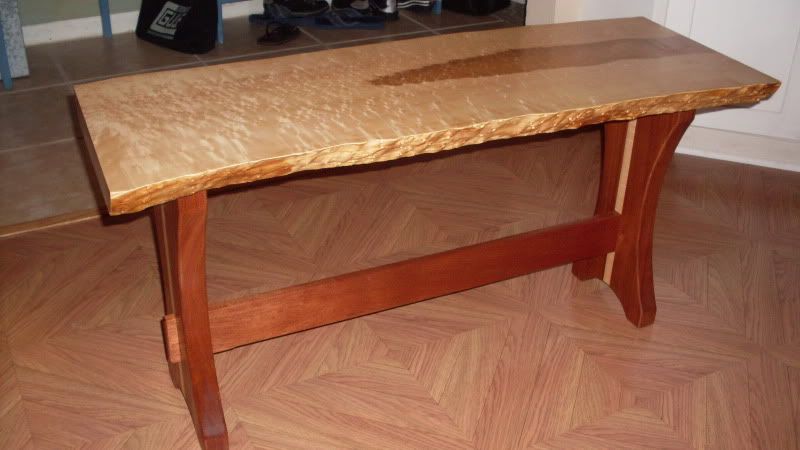
For the past few years, I had wanted to find a suitable piece of wood to use to build my own slab bench, but my hardwood suppliers here in Florida weren’t able to easily lay their hands on such a board.  When I had mentioned what I was looking for to Eric Poirier of Bell Forest Products, he located the sweet board for me.  Hard maple with both bird’s-eye and tiger effect in it.  The wood makes the bench for me… And, the live edge of the board… WOW.
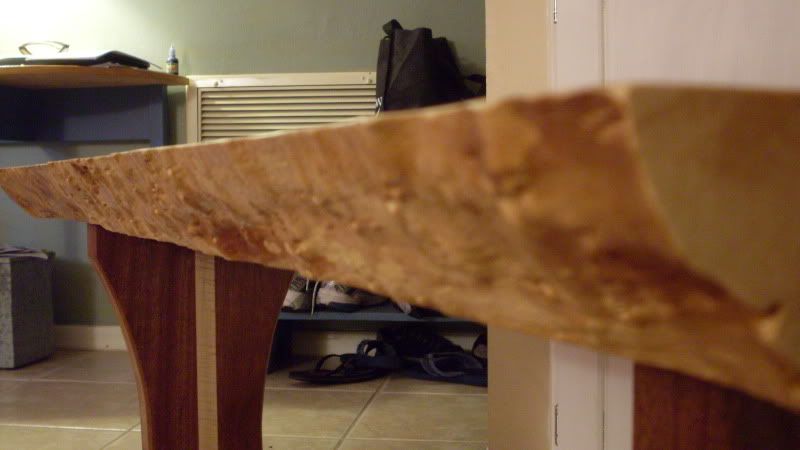
For the base, I used some mahogany and a strip of tiger maple.  My friend Craig Andrews drew out the base for me on Sketchup, and it looked very cool.  I used a jigsaw and my oscillating spindle sander to bring it to final shape.

The stretcher passes through two open mortises in the legs, giving some visual interest to the piece.  There is a top stretcher that is mortised into the two legs.  This provides a more than adequate surface to screw the top to the base.  Yes, I used screws.  The thought of cutting and chiseling through that board’s surface for through tenons didn’t do anything for me.  Maybe for a more ordinary looking piece of wood on a later project…
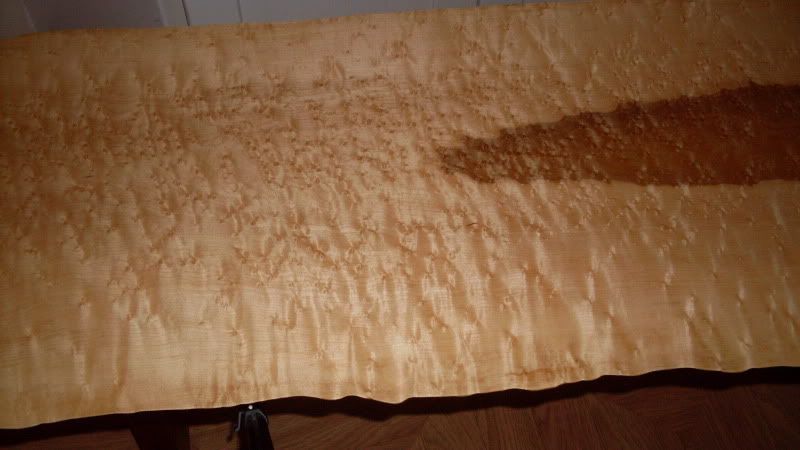
I had to start the finish at my hardwood supplier, Weiss Hardwoods in Largo. They had the big Powermatic wide format belt sander that took the wood from rough to baby’s bottom smooth in about three minutes. I gladly paid the very reasonable fee to have this done for me instead of trying to scrape and sand it smooth myself.

Once I got it home, I used card scrapers and my cabinet scraper to fine the surface up even more.  A coat of 1# cut shellac sealed all of the wood on the project, and I sanded that down with 400 grit wet/dry paper to make the wood velvety smooth.   I followed that with three top coats of my finishing mix on the entire project, sanding with 600 grit paper between.  Then, two coats of wipe on poly were added to the top to provide additional protection.  This was finally followed by some paste furniture wax.

This was a very rewarding project.  I love to watch people run their hands over the polished top and the live edges when they see it for the first time.  That tells me that I think I may have done Nakashima proud.
One tough sucker

I have this friend on the Woodworker’s Website Association named Jim.  He’s a now-retired grizzled veteran of the competitive northeast construction and cabinet trades.  He’s seen it all, heard it all, tried it all and shoots straight from the hip. Ask a question, you get an honest answer with Jim. He’s that kinda guy.

But, that’s not who this article is about.  It’s actually about something he dropped off for me this past March when he was down for a visit.

Now that Jim is retired, he has time on his hands to travel and to tinker.  Before his trip this spring, he called me and asked if I was interested in looking at something he had built.  One Saturday morning, I drove to the travel trailer park Jim was staying at, and after our greetings and some shop talk, he showed me something that looked like Rube Goldberg himself had created. Old plumbing fittings, waferboard, 2 x 4’s and weatherstripping had been cobbled together.  It looked as if it had been picked over in a rubble heap.  MacGyver would be proud of this…

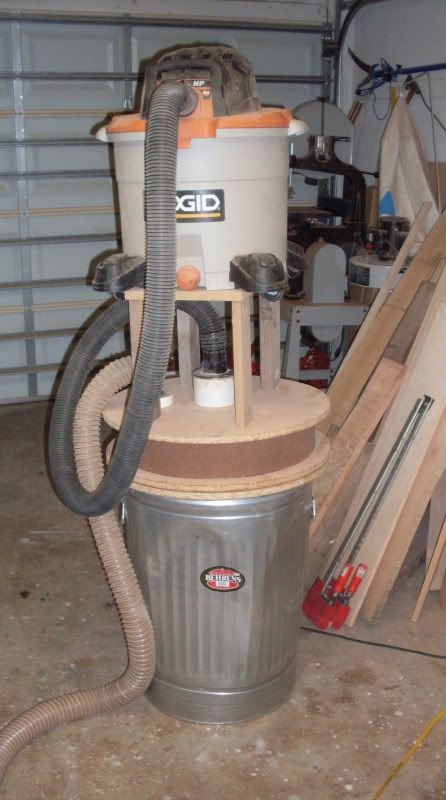
The total stackWhile it did look nasty at first, it may prove to be something that will change how I work in my shop.
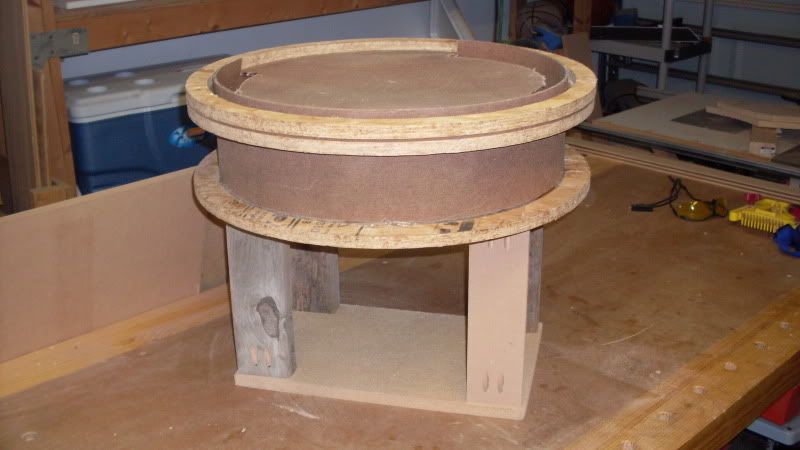
Jim had created a modified cyclonic dust collector. He started with the plans drafted by Phil Thien.  Phil’s plans show how to create an inexpensive dust collector which fits onto the top of a metal garbage can.  A shop vac and an intake hose to suck up the dust is everything needed to create your own dust collection system.

Jim’s improvements include extending the cyclone separator in a compartment above the trash can, which Jim says improves the airflow by removing any potential debris interference.

Since it was nearing the start of hurricane season, I had left the collector in the corner of my shop to – err – collect dust.  Finally, this past weekend, I was able to run to Home Depot and pick up an old-fashioned metal trash can to affix the collector to.

Jim had routed a groove to fit over the rim of the can and had sealed the bottom of it to get an airtight fit.  I hooked it up as described, and I was initially thoroughly unimpressed.  The collector didn’t seem to generate enough suction to lift even the finest of dust.  I fiddled with the collector for a while, and then I discovered my problem.  I hadn’t fit the lid deep enough into the groove.

A quick shove down on the offending side,  I got that sealed up and WOW…

The suction generated by my standard issue shop vac was impressive. Planer shavings, sawdust, small animals – what couldn’t this thing pick up?  Jim had also warned me that if I drew a vacuum by sealing off the intake hose, the trash can could collapse due to the air pressure.  Well… sure enough, the silly thing’s sides did buckle when I put my hand over the intake hose!  I’ll also have to follow his advice and cut a brace for the inside of the can to give it extra support.

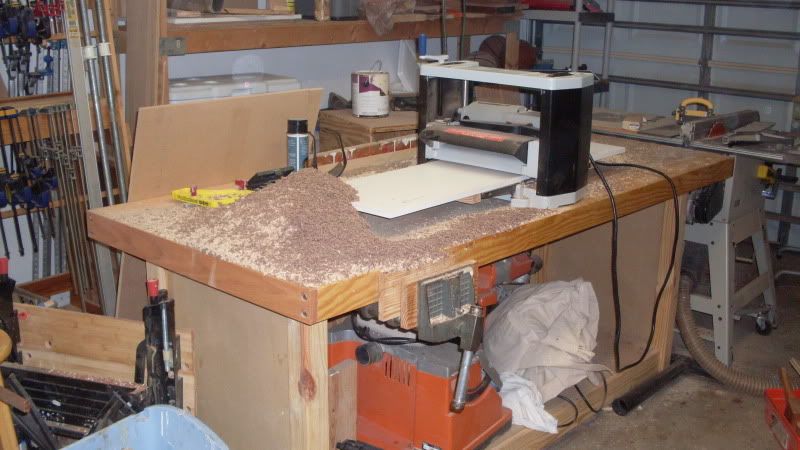
To put this unit to the test, I set up a field experiment.  I had been planing strips of ash and walnut for a project, and I had a good pile of shavings there ready to be cleaned up.  The shop was a mess.

I took my shop vac outside and emptied it.  I banged out the filter – the works.  It was as squeaky clean as I dared make it.  I stacked the empty shop vac on top of the unit and hooked up the hoses.  That’s when I went to work, sucking up everything.

The suction worked as I had expected it to for a dust collector.  There was a large rush of air headed into the hose, and everything was sucked through into the can.  I love clear hoses on my collector…

After working the hose for a while, cleaning up the mess of a long day in the shop, I stopped the shop vac and took a peek inside.  There was some fine dust in the vacuum’s tank, but that was it.  None of the larger shavings made it to the vacuum.

A peek into the trash can showed me why… there’s where I found all of the planer shavings, silently resting in the can.  A quick trip outside, and the can was clean once again.

The collector was extremely effective.  I have a 1 hp 500 cfm Delta model in my shop, and I rarely use it.  The system gets clogged up frequently and it doesn’t have the ‘oomph’ to get the planer shavings.  Then, there are the bag changings… something I never look forward to.  That metal ‘belt’ I have to snap in place rarely goes on the first – or second – try.

This system exceeded all my expectations. In fact, I will be looking into getting a dedicated shop vac to mount on top of the collector on a semi-permanent basis.

Hey, Jim, I gotta hand it to you.  You are one tough sucker after all!

P.S. – If you are interested in seeing Jim’s plans, I can forward the messages to him

Quick Poll

Woodworking is many things to many people.

For some, it’s a fun and easy way to spend a Saturday afternoon.  For others, it’s the continuation of a family legacy, carrying on the work of a parent or grandparent.  Some may even consider it a form of therapy, getting them out of their daily routine.

While it may seem clear cut to some, for others, it’s a debate.  Is woodworking an art, or is it a craft?

Sure, this is typically discussed among the high-minded folks at some fancy gallery opening, but it’s an interesting question. Since most woodworking projects have a function, they are considered craft.  But, come on.  A George Nakashima table, with its use of live edges of boards and tastefully placed butterfly keys certainly isn’t the same as a plain old coffee table.

So, this week’s poll is trying to get to the heart of the matter – do you believe woodworking is art, craft or something else.

[poll id=”83″]

Link of the week

Extreme How To’s Mortise and Tenon Page

So, you’ve never cut a mortise and tenon joint?  Or, maybe you have only done it with power tools, and you want to try it with hand tools only?  Maybe it’s the other way around, and you are looking to find a faster, machine based method?

Well, if any of these fit your situation, or you just want to learn a little bit more about this venerable and strong joint, Extreme How-To’s page on mortise and tenon joints is worth a visit.

The page starts off with descriptions of common mortise and tenon arrangements (blind mortise, haunched mortise, through tusk tenons…  the works) complete with illustrations.

The site then goes on to describe how to cut these joints with hand tools (chisels and hand saws) and power tools.

A great E-Bay find

There’s nothing quite like stumbling upon a great old hand plane at a flea market, a garage sale or online.  What’s even better is if that plane can fill a void in your collection.

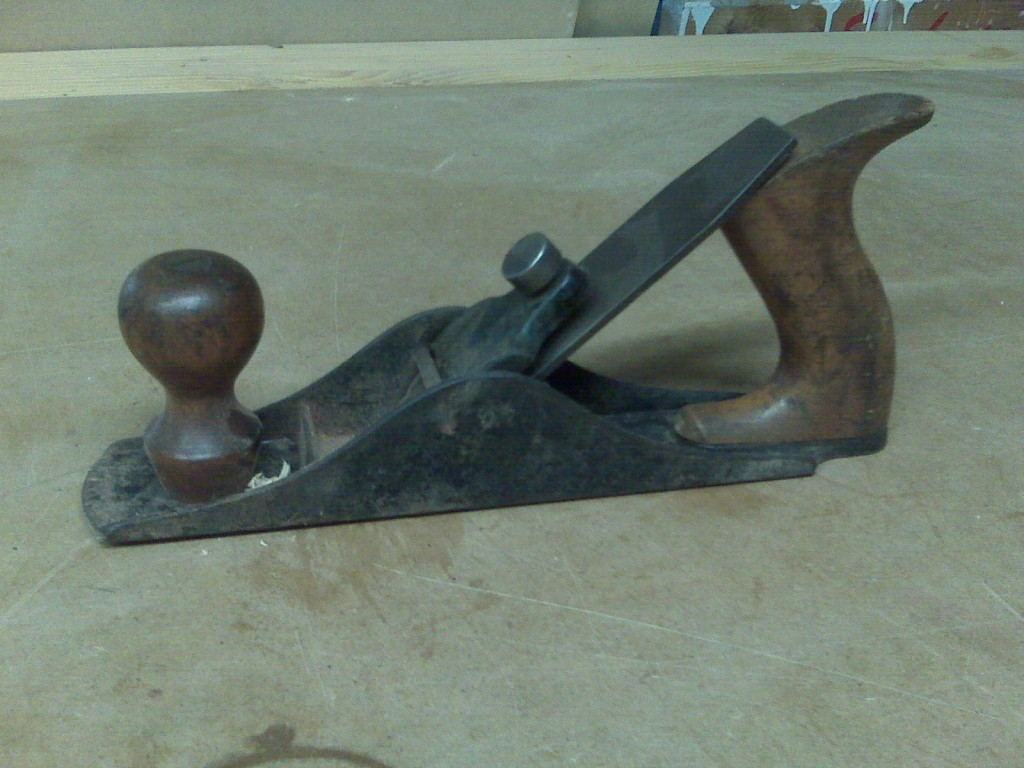
And, that’s just what I recently found.  While cruising the collectible woodworker’s tools category on eBay, I came across this great little scrub plane.IMG00087

The description was exactly what I had been seeking to add to my collection:

Fresh from a recent barn sale here on Cape Cod a Stanley scrub #40 plane complete with an about full Sweetheart blade. Good wood no cracks or repairs just minor wear from use. Being sold as pictured & found uncleaned, please note there are a few minor rubs in iron bottom sole that could be buffed out if desired by new owner, not bad & clearly shown but needed to mention.

I put in a bid, and the seller accepted it.  As I always do after buying something on eBay, I restlessly waited for the plane to arrive in my shop, counting the minutes until the UPS delivery guy showed up.

I really do need a hobby…

Wow.  It was in great shape – exactly as described.  What surprised me most once I had removed it from the box was the outstanding condition it was in.  There was some minor rust down on the cap iron, but nothing a little buffing with steel wool couldn’t remove.  The handles were in superb condition, and besides a wipe with some paint thinner to remove the dust, the plane was ready to roll.

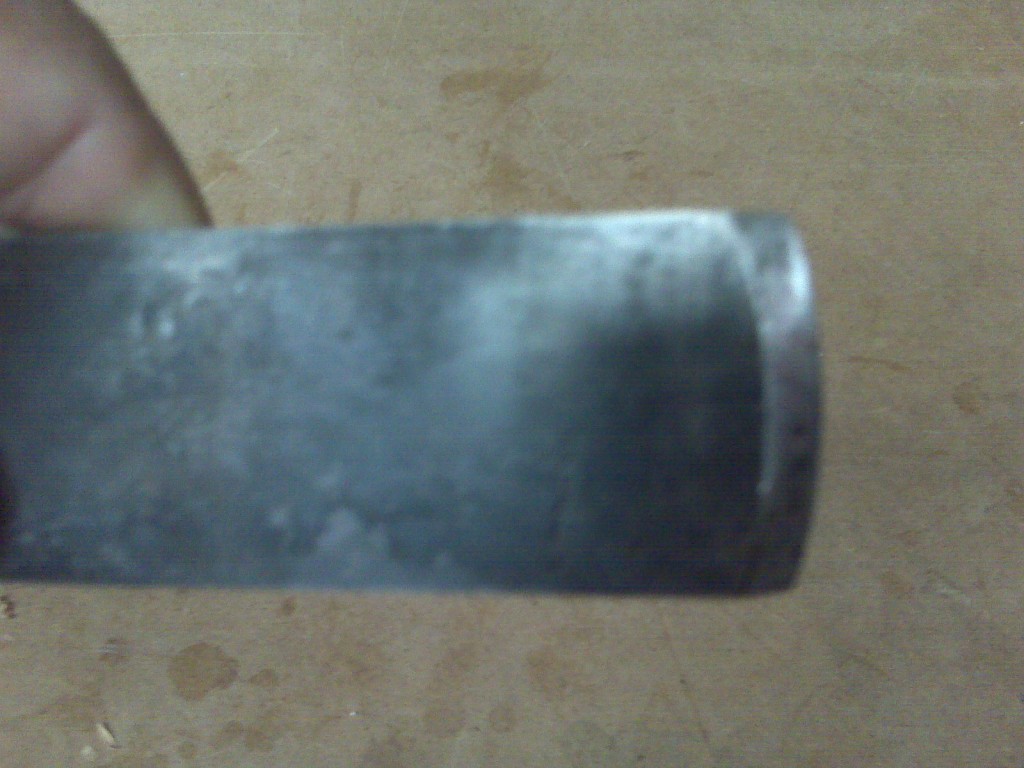
IMG00089

It took the iron out and inspected it closely.  Indeed, this was a 1930’s era Stanley Sweetheart plane with its distinctive mark. I was stunned to see the shape of the working end – it was definitely rounded.  This is, of course, to help hogging off the wood in the roughing phase a whole lot easier.

The Japanning on the plane body is in outstanding shape, and the sole was very flat.  Again, for a hard working plane such as a scrub, this one is in outstanding shape.

Once I had touched up the blade a bit (it still needs a more advanced sharpening) I was very surprised by how light and small the plane was.  I had been hogging off waste from boards with a No. 5 jack plane, and this thing was nothing like the jack.  Small, easy to grip, manuverable.

Then it dawned on me – what a clever idea to make it lighter… I was wearing out my shoulders and back hogging off the waste with a much heavier plane.  The scrub  would make quick work of the high spots without wearing me out.  And, in a day when EVERYTHING was hand planed, well, lighter was better!

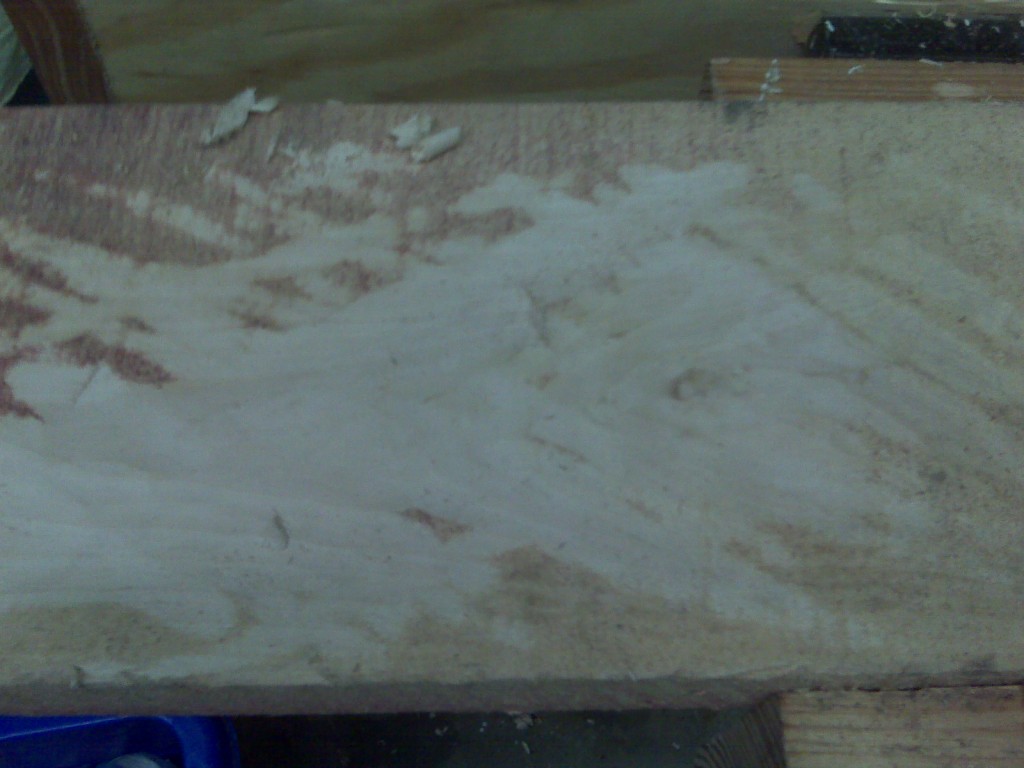
The cut on the scrub plane is definintely something you have to get used to.  You are certainly not making whisper thin shavings.  This is a rough tool for roughly surfacing a board, and does it ever leave a rough surface.  I ran the scrub over this piece of birch to give you an idea of what the cut looks like.

IMG00088

Of course, you will need to use the heavier follow on planes to perfect the surface.  But, with all of the grunt work done with the scrub plane, that smoothing process will be a lot faster – and a lot more pleasant.

A woodworking vacation

Wow.  What a weekend.  My family and I just got back from a quick vacation to the oldest continuously occupied European settlement in North America – St. Augustine.

Now, it was so impressive standing in the Castillo de San Marcos, walking down Caroline Street (the oldest street in the United States) and being tempted to sip from the Fountain of Youth.  It was fun taking one of the ghost tours, seeing where the first Catholic mass was celebrated in North America and sampling the beers at the A1A Ale Works (if you ever find yourself in St. Augustine, you owe it to yourself to try the beer cheese soup at A1A).

But, by far, one of the most breathtaking stops is the old Ponce de Leon hotel, now part of Flagler CollegeHenry Flagler, a railroad tycoon who opened up the east coast of Florida to tourists, had built the buildings to be one of the most lavish and impressive structures in the city.  He built the structure in the 1880’s complete with running water, electricity (brought to the hotel by Flagler’s good friend Thomas Alva Edison) and one of the most valuable collections of Tiffany glass in the country.

While the buildings today are all part of the working college, the impressive plaster work, art pieces and unbelievable woodwork are all there for visitors to see. And, wow, what woodwork was there! From your first step into the grand rotunda, your head will be spinning as you look at the impressive oak woodwork and plaster frescoes.

While the entry rotunda is impressive all by itself, when you are led into the student’s dining hall, your jaw will hit the floor.  Of course it’s first life wasn’t for slinging hash for hungry college kids – some of the most well heeled and rich folks took meals with Mr. Flagler.  Having been a student at the University of Maryland and eating in their dining halls, I was stunned.  Besides the stunning Tiffany windows that frame the views onto the grounds, the amazing woodwork and plaster paintings make it difficult to believe that students take their regular meals there.

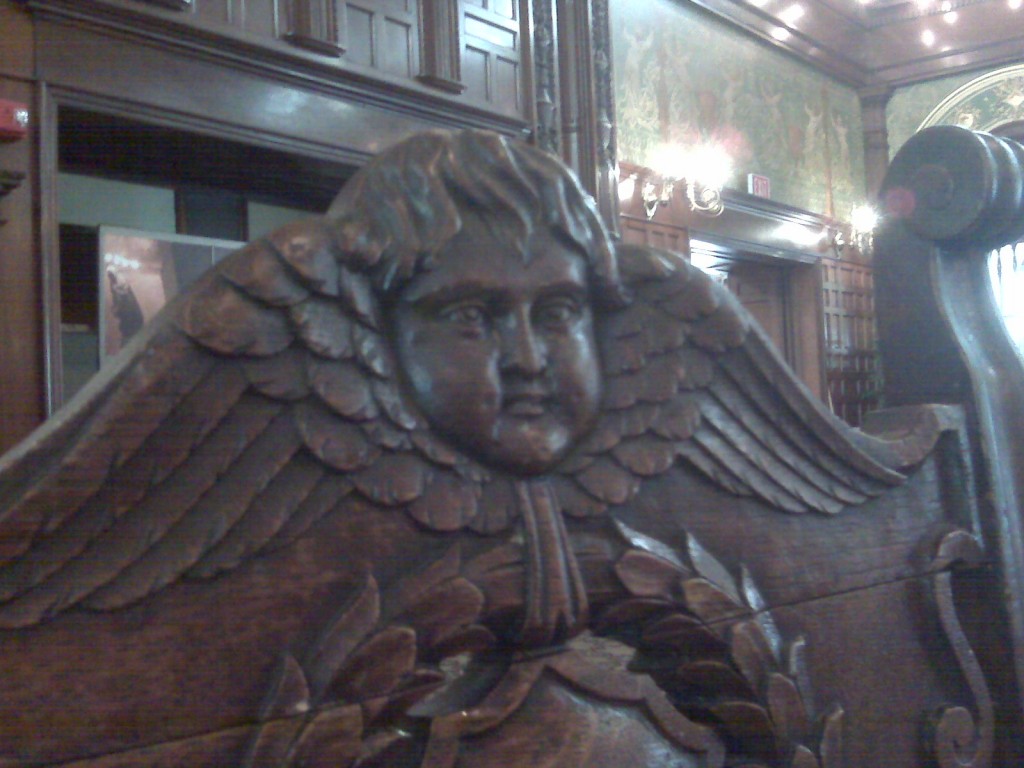
Now, even MORE interesting are the chairs the students sit on.  When Mr. Flagler commissioned the furniture for his hotel, he – of course – went to only the finest artisans he could hire. Again, he turned to  Tiffany and Sons to carve some elegant dining chairs to match the original mahogany tables.  The chairs were stoutly made, with full mortise and tenon construction, with intricate brass tacks securing the horsehair stuffed leather tops.  The original chairs also have casters on the front two legs of the chairs, so they can easily be swung out from the table to allow the ladies wearing the heavy dresses and gowns of the day easier access.

A close up of the tiffany carving

Over the years, many of the original chairs were sold at auction, and many reproductions were commissioned, which roughly mimic the appearance of the originals.  While many have been sold off, there are still a few of the original Tiffany pieces on the dining room floor… where students today can sit in and take in a bite to eat.

I could go on for a while longer, but I still have to unpack dirty laundry and get ready for work tomorrow. But, if you are a woodworker and find yourself in St. Augustine, Florida… well… bring your camera and get ready to drool.

Quick Poll

Let’s face it – our woodworking projects are something we can be very proud of.  Whether a perfectly executed set of kitchen cabinets or an expertly turned piece, we want that work to be identified with us.

For some people, they will name the project they are working on, much as an artist will name a painting or a sculpture.

Some names are basic – “A dining room table”

Some are more descriptive – “Aunt Marge’s Dining Room Table.”

And, some names are very creative and further identify the piece – “The Thanksgiving Tableau.”

This week, I want to know if you have ever named one of your work pieces, and which naming scheme you have used.

[poll id=”82″]

part of the Wood Talk Online community