Category Archives: Experiences

A woodworking vacation

Wow.  What a weekend.  My family and I just got back from a quick vacation to the oldest continuously occupied European settlement in North America – St. Augustine.

Now, it was so impressive standing in the Castillo de San Marcos, walking down Caroline Street (the oldest street in the United States) and being tempted to sip from the Fountain of Youth.  It was fun taking one of the ghost tours, seeing where the first Catholic mass was celebrated in North America and sampling the beers at the A1A Ale Works (if you ever find yourself in St. Augustine, you owe it to yourself to try the beer cheese soup at A1A).

But, by far, one of the most breathtaking stops is the old Ponce de Leon hotel, now part of Flagler CollegeHenry Flagler, a railroad tycoon who opened up the east coast of Florida to tourists, had built the buildings to be one of the most lavish and impressive structures in the city.  He built the structure in the 1880’s complete with running water, electricity (brought to the hotel by Flagler’s good friend Thomas Alva Edison) and one of the most valuable collections of Tiffany glass in the country.

While the buildings today are all part of the working college, the impressive plaster work, art pieces and unbelievable woodwork are all there for visitors to see. And, wow, what woodwork was there! From your first step into the grand rotunda, your head will be spinning as you look at the impressive oak woodwork and plaster frescoes.

While the entry rotunda is impressive all by itself, when you are led into the student’s dining hall, your jaw will hit the floor.  Of course it’s first life wasn’t for slinging hash for hungry college kids – some of the most well heeled and rich folks took meals with Mr. Flagler.  Having been a student at the University of Maryland and eating in their dining halls, I was stunned.  Besides the stunning Tiffany windows that frame the views onto the grounds, the amazing woodwork and plaster paintings make it difficult to believe that students take their regular meals there.

Now, even MORE interesting are the chairs the students sit on.  When Mr. Flagler commissioned the furniture for his hotel, he – of course – went to only the finest artisans he could hire. Again, he turned to  Tiffany and Sons to carve some elegant dining chairs to match the original mahogany tables.  The chairs were stoutly made, with full mortise and tenon construction, with intricate brass tacks securing the horsehair stuffed leather tops.  The original chairs also have casters on the front two legs of the chairs, so they can easily be swung out from the table to allow the ladies wearing the heavy dresses and gowns of the day easier access.

A close up of the tiffany carving

Over the years, many of the original chairs were sold at auction, and many reproductions were commissioned, which roughly mimic the appearance of the originals.  While many have been sold off, there are still a few of the original Tiffany pieces on the dining room floor… where students today can sit in and take in a bite to eat.

I could go on for a while longer, but I still have to unpack dirty laundry and get ready for work tomorrow. But, if you are a woodworker and find yourself in St. Augustine, Florida… well… bring your camera and get ready to drool.
A long e-mail chain…

In case you haven’t yet guessed, I love to write.  And, when readers of Tom’s Workbench send me an e-mail, I enjoy the back and forth that takes place.

Some people have called me a know-nothing hack, while others have said I’m pretty decent with a saw.  While those are intersting to read, the ones I really enjoy are those that come in from readers asking for my opinion or assistance because – for some strange reason – they want to use a technique I had described.

This past April, reader named Big Bill McDonald wrote in, asking what appeared to be a simple question about the finishing recipe I had described in my post I’m So Finished.

Little did I realize that for the next four months, Bill and I would be exchanging a series of e-mails back and forth about finishing methods and philosophies.

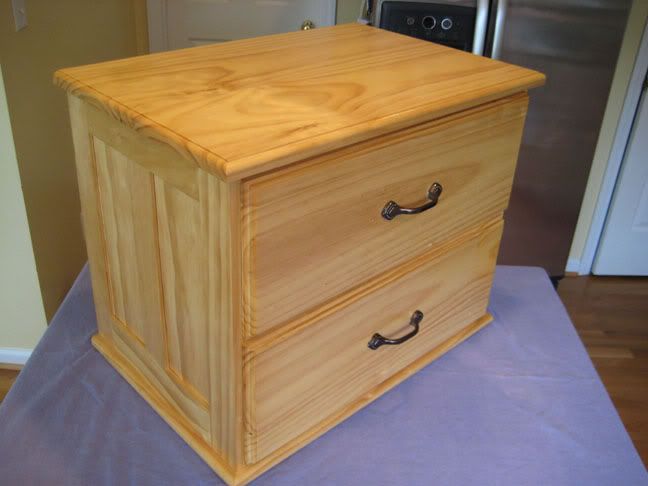
Bill stared out asking about using the Rude and Crude finishing method on a pine toy box he had built.  Concerned about splotching on the piece, we communicated about the shellac seal coat and its purpose and the rest of the finishing regimen.  Judging from the results he got, I’d say this piece came out beautifully, and his son Ben should be one very happy camper to have such a nice piece in his room.

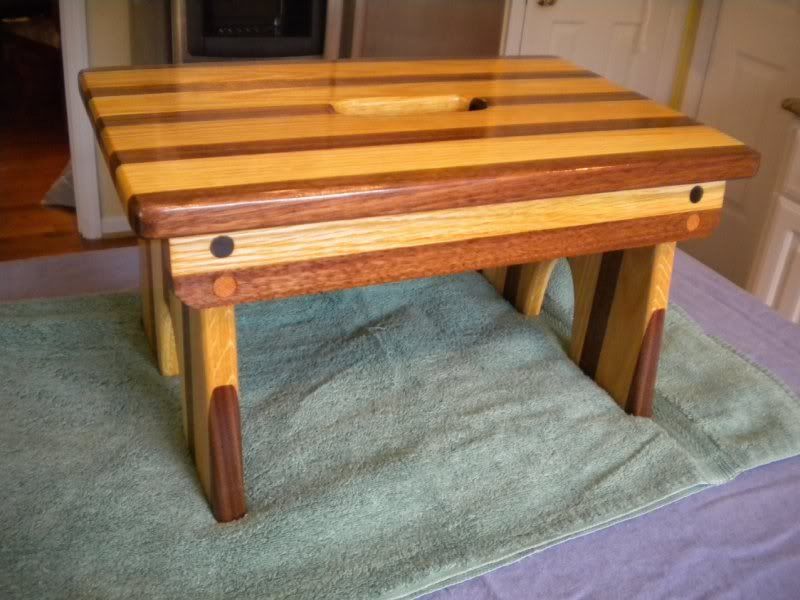
Being that we are both dads, we quickly understood that one project was going to lead to many more. The next one he tackled was a very sweet looking walnut and oak step stool, so his kids would be able to do those important tasks we always hope they will learn to do WITHOUT us having to hound them… (OK, go back into the bathroom, flush AND wash your hands with soap…)

Ben had based his design on a piece he saw on the Internet.  Using strips of walnut and oak to laminate the panels, Bill did a very good job, building a sturdy step stool that will see many years of good use.

Of course, the stool presents its own challenges – it will stepped on by clean and not-so-clean shoes and will undoubtedly see a lot of water.  Bill was concerned that the finish recipe may not be durable enough to survive those rigors.  Once I assured  him that the step stool I built for my sons managed to survive with very few marks, he seemed relieved.

Now, to be fair, Bill did start this last series of e-mails with the line:

Ok – this is my LAST finish question, I promise ! (I say that to myself every time – sigh.  Finishing, I have learned, is it’s own whole world).

However, that’s OK if you keep e-mailing, Bill.  It has been fun discovering this world of finishing with you, and you are teaching me a great deal about your methods along the way.

E-mails like yours are some of the best I get in my inbox and prove, once again, that the online woodworking community is an active and vibrant one.

A link to our roots

Part of what I love most about blogging are my Links of the Week.  I spend a good bit of time surfing the web for the most useful or interesting links I can, and feature one of them each Friday.  Who knows, maybe you will find a fun weekend project you could knock out or read more about a particular woodworkers to see if their style interests you.

But, this past Friday’s Link of the Week brought a reply from the moderator of the Tool Crib power tool blog.  Tool Crib had posted a quick question on several woodworking forums asking who or what were the greatest influences in getting the readers involved in  the craft. The responses were very enlightening, and made for some very interesting reading.

He also told me that it had been two years since the conducted the survey, and that I was more than welcome to conduct it again to get a wider sample.

So, this weekend, I started posting on a few forums asking the readers to name the top three influences in their woodworking adventures.  So far, the response has been very brisk, and there have been some funny, thoughtful and touching responses.

I will leave this survey ‘open’ through August 15 (but, I also reserve the right to end it August 1 if there’s no more input coming in) and then analyzing the responses for a later post.

If you would like to participate in the survey, or you would like to read some of the comments which have already been posted, you can see the question at:

If you are not a forum member and would still like to get involved, you can always use my contact form to send me your input.

This could be a very interesting survey…

Wood and Food are Good

When I was growing up, I must have driven my mom and dad crazy.

While my brothers were involved in things such as auto repair, music and sports, I spent quite a bit of time relaxing, watching TV and just hanging around.  In other words, I had very few hobbies I wanted to pursue.  Since both of my parents kept exceptionally busy with yard work and other necessary home jobs, I was often encouraged to get off my duff and take up some activity to build my interest and keep me active.

Boy, have the times changed.

Today, my wife has to caution me to take things a little easier and find some time to relax.  I can’t help myself, because the hobbies I found an interest in are just so darned interesting.  I’m writing, reading and studying the weather.  I’m watching old movies. I’m even home-brewing beer.

And, my three favorite hobbies are woodworking, food and wine.

Talk about three fields of interest where you can study for years and never discover all of the nuances.  New and exciting wines from nearly all corners of the world are popping up on specialty store shelves.  Some wines can even vary tremendously from the same stretch of sunny river valley depending on how much sunlight they get or the composition of the soil.

Foods from around the world illustrate different cultures’ views of taste and the evolution of their ingredients.  Even something as simple as pasta has hundreds of different iterations – from udon noodles in Japan to the familiar spaghetti with meatballs my mom makes.

And, woodworking… well… the selection of furniture styles (Shaker, modern, Chippendale), building materials (plywood, hardwoods, exotics) and tool choices (table saw, band saw, lathe) alone can keep your average woodworker busy for decades.

However, the more I learn about these three hobbies, the more amazed I am about how tied together they really are.  In fact, many aspects of what we eat and drink owe their existence and unique characteristics directly to their contact with wood.

Of course, there are the completely obvious examples.  Tree fruits (apples, cherries, peaches, olives) and spices (nutmeg, cinnamon, allspice) simply wouldn’t be if they didn’t have the trees they grew on.  And, once those trees have finished their long, productive lives, many of them find their way into workshops around the world to start their next life as a beautiful piece of furniture.

In the days before cardboard,  airtight cryopacks and other modern packaging methods, wood built the containers of choice for carrying foodstuffs. Crates, casks and barrels were all made of wood, and these durable containers served well for many years.

In fact, one of the ‘goofs’ listed for the movie The Godfather was that during the scene where Don Vito was shot during an assassination attempt, the oranges he spilled out onto the ground came out of a cardboard box… not the standard wooden crate that would have been used during that era.

The skill of the cooper – or barrel maker – was exceptionally important in days past, and still is now.  Any food item that primarily a liquid or a fine powder that could leak out had to be contained in a relatively water-tight container.  Flour, corn meal, salt pork and beef were stored in barrels, and some of my earliest memories of going to lunch with my dad involved fishing pickles out of a brine-filled barrel at a New Jersey deli.

The relationship between beverages and wood is legendary.  Modern steel beer kegs may have replaced wooden barrels, but the romance of tapping the wooden keg is still strong.  Even though the beer may come from modern tanks to ensure the product’s freshness, many microbreweries will decorate their establishments to at least make it appear the beer is still tapped straight from the barrel.

One large American beer company even goes so far as to advertise their brew Beechwood Aged.  It is what it sounds like – the young beer is pumped into a large lagering tanks with beech chips which affects the flavor of the final product.

Wine and spirits, on the other hand, are frequently aged in wooden barrels which impart unique taste and color components to the beverage.  Bourbons, Scotches and other Whiskeys come from the still as clear as vodka, but gain their characteristic brown shade from interaction with the wood in the barrels.

Many red wines and a few white varieties (particularly wines made from the Chardonnay grape) add layers of complexity when allowed to age in oak barrels.  The vintner can fine-tune the flavor of the wine by carefully controlling how much time it spends in the barrel. Italian and Spanish wine makers are even required by law to age any wines labeled Reserva in oak casks for a minimum of an additional year to concentrate the flavors and further mellow the wine.  Gran Reservas require a minimum of at least three years in the casks to earn that designation.

Then, there is food preparation.  The first chopping boards ever used may have been the stumps of downed trees.  Those later evolved to sawn tree rounds and then to large butcher blocks made of end or edge grained hardwoods.  Apprentice butchers would often buy a butcher’s block and use it throughout their entire careers, planing the surfaces smooth after they became heavily worn.

And, just think, I haven’t gotten to wooden bowls, serving utensils, rolling pins or any of the dozens of other kitchen implements that can be made out of wood.

The next time you are in the kitchen preparing a meal and sipping one of your favorite beverages, stop and think for a minute about the inseperable ties between food and wood.  They are very, very good.

A Manic Mother’s Day

No, this didn’t happen yesterday… but, every Mother’s Day, I’m reminded of a unique project I had to undertake for a neighbor.  It all started with a new kitchen range back in 2004…

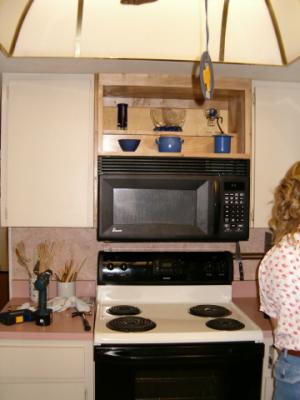
The kitchen display cabinetMy neighbor Chris is a handy guy.  He’s been a sushi chef, has rebuilt carburetors and today cleans rugs for the local school system.  He’s a hustler, never allowing grass to grow under his feet.  So, it came as  no surprise that he was installing a new range in his home for his wife as a Mother’s Day gift.

I just happened to show up at the house as Chris ran into a huge problem.  He had taken out the old range and remembered that he had tiled under it a few years earlier when doing some other kitchen improvements.  Unfortunately, the new range had a higher control panel on the back, and it wouldn’t fit under the cabinet above.  What a bummer…

As he was contemplating major surgery on the range to make it fit, I had already consumed two of the beers he had offered me.  I could sit for hours and watch him work. Seriously.  My wife and Chris’ wife joined us at the dining room table, watching Chris try desparately to fit the too-tall range into the too-short space.  That’s when I opened my big mouth.  “I can build something for there.”

The room went silent.  Chris’ wife turned to me and asked, “Can you?”

“Sure,” I said.  “I’ll just need Chris’ help.”

“Great!” She said.  “We need it done before we all go back to work on Monday, though.  I can’t live without a kitchen…”

Boy, did I ever stick my foot in it.  I had never really built a cabinet before, nor had I selectively removed existing cabinetry to make a new unit.  This was going to be a real test.

And, early on Mother’s Day morning, Chris was knocking on my door asking if we could get ready to build.  We went to the local home improvement center and bought our supplies, then came back home.

At this point, we had already showered the ladies in gifts.  The next one was the offer that we would stay at home to work on the cabinet and the moms would be able to go to the beach together – without the kids.  Besides, Chris’ daugther was just about old enough to watch the three other little ones with some minor help…

The box was easy to build – just 3/4″ birch plywood and some maple edging.  In order to hide the electric hook up and display some of her Swedish glassware, we decided to build a ‘step’ into the piece.  Once it was built, we used a spray can of lacquer to finish the piece – it dried in a flash.

I had failed to realize how precise I needed to be when building the piece.  A horrible thought hit me as we took it over… What if it didn’t fit….

After removing the existing cabinet, we hoisted the new unit into place and it slid in beautifully.  Whew.  Chris drove screws into the studs and neighboring cabinets while I ran home to mill some molding for the sides of the piece.  Total time for the project was about five hours, and the results weren’t all that terrible to look at.

After we finished, I looked outside the window and noticed that the moms were out in Chris’ pool with the kids.  I took off my shoes and put my wallet, keys and cell phone on the cabinet.  I walked outside onto the pool deck shaking my head.  “What’s wrong?” asked Chris’ wife.

“There’s nothing left to do on the project!” I yelled as I cannonballed into the pool, to the surprise of the kids and the moms.  Chris pushed the new range into place, and had already started dinner for both families.

The display case didn’t last too long, though.  Their home was destroyed in a fire seven months later and the display case was broken out and heaved into a dumpster.  I still look back fondly at that project and the manic Mother’s Day we spent with our good friends.

Expo-sing myself to new stuff

The Woodworking Show logoThis past weekend, I went to the Tampa edition of the Woodworking Show, and I’m glad I did.
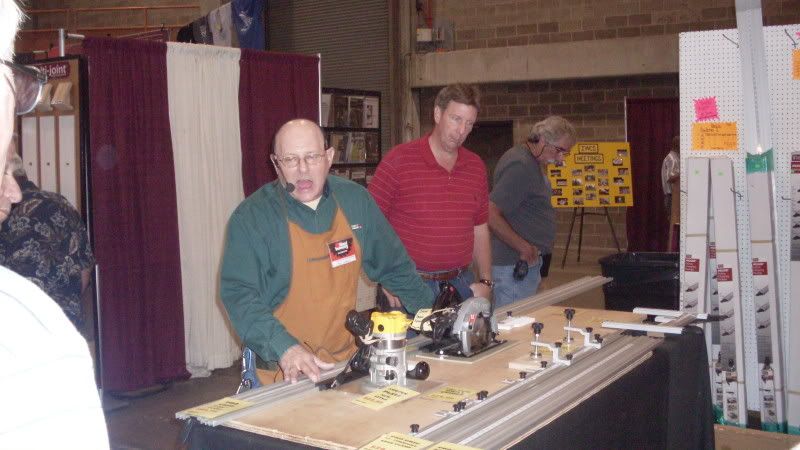
For those of you not familiar, the Woodworking Show is a traveling woodworking expo where woodworkers can come to see new tools, buy scads of new products and get a great deal of advice.  This is now my fourth year of attending the Tampa show, and every year I look forward to it.

This year, I noticed something very interesting and quite unexpected – the place was crowded.  Even in these uncertain economic times, woodworkers were packed shoulder to shoulder at demonstration booths taking in the presentations about Carter band saw guides, Grip Tite magnetic feather boards and the Prazi Chestmate dovetail jig.  I spoke with several of the exhibitors who all sang the same refrain – there has been a significant increase in attendance over  the past few years, and people were buying – the smaller items.

Oh, sure, the ‘big iron’ was there.  I got to see both Saw Stop table saw models at the same time, and the newly redesigned Delta Unisaw attracted a crowd.  However, those units were not moving as they had in years gone by.  To me, it appeared that the folks who were lovingly caressing the handles and cast iron tops were taking mental notes to consider a later purchase.

Surprisingly, there were very few ‘brand new’ designs being offered.  The folks at the Kreg Tools booth (one of the larger ones at the show) were even lamenting openly that the only really ‘new’ item they were offering was their brand new corner clamp to help with cabinet assembly.

Hawking the waresWhile most of the tools weren’t bleeding edge new to the industry, they were certainly new to me.  I finally had an opportunity to see the DeWalt and Festool track saws almost side-by-side (they were a two minute walk apart, but that was manageable).  I’m not sure which model is ‘better’, but both systems are very slick and quite an improvement over your basic circular saw.
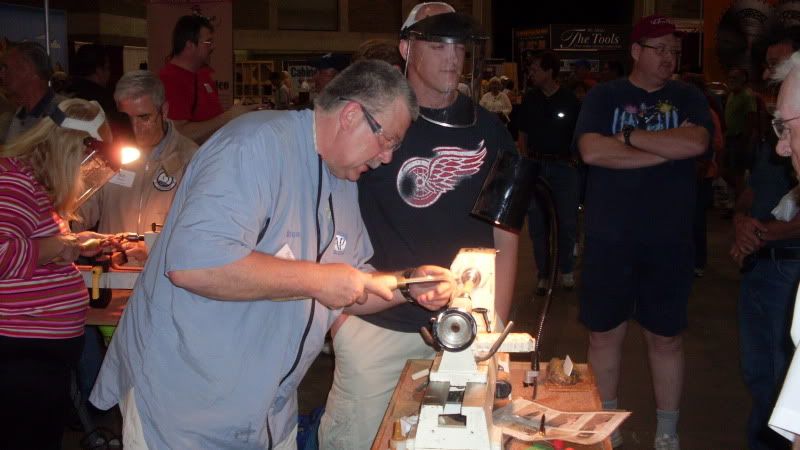
I also rediscovered something about the craft – namely that there must be a thousand different ways to get from point A to point B.  No fewer than four ‘dovetailing’ systems were being demonstrated – systems that made through dovetails, half-blind dovetails, decorative dovetails… the works.

My favorite vendor booth was from Lee Valley tools. They had a great selection of chisels, planes, saws and other tools from their catalog, and had benches set up where customers could use them.  I had my eye on about a dozen tools, but the woodworking budget was far from enough to cover everything I wanted.  I settled on one of the new design Veritas dovetail saws, which should be coming in the next few days.

There was a new emphasis on hand tools at the show, with an exhibit area called the hand tool rodeo.  The presentation primarily covered the hand plane and was valuable in showing what the working parts were and how the functioned.  At this booth, a local woodworker had brought a selection of his own tools for expo goers to use.  It was a treat to use his massive beech jointer on a piece of cherry.  More to come on this…

Learn to turn Tucked away on one side of the expo was one of the most valuable areas – it was the table set up for several of the local woodworking guilds.  There, local woodworkers and turners were showing off their projects and touting the advantages of joining the clubs.  I know this would run counter to the purpose of the expo, but I would have loved to have seen those tables in a more prominent place where they could have seen some additional traffic.

Finally, the best part were the education booths.  Wow, from cabinet building to finishing, those booths offered a great deal of advice for novice to advanced woodworkers.  Turning, finishing and cabinetmaking lessons were all taught, but the highlight of the show was the booth sponsored by Wood Magazine.  There, Jim Heavey was offering some common-sense woodworking tips to help stretch your woodworking dollar, get more accuracy in your cutting and improve the safety of your shop.

After six hours of wandering the Florida State Fairgrounds entertainment hall, I was beat.  But, I also left the expo feeling recharged, wanting to get out into the shop to try some of the new techniques I learned and tools I purchased.

All in all, an excellent way to spend a Saturday.

Inspiration in obvious places

A nice set of kitchen cabinetsMaybe I’m a different kind of woodworker, but I really do enjoy the challenge of making doors and drawers.  Those are typically the pieces of a project that cause woodworkers the most angst.

Sure, building a large cabinet or series of cabinets is the fun part.  You get to do the giant case work and, once it’s moved into place and installed, you get an idea of how the project will look.  Heck, you can even begin moving stuff into the cabinets once you are done installing and get to the doors and drawers whenever… maybe years from now.

I guess I got my love of doors from seeing just how they can change the overall look of a piece.  Any set of cabinets without its doors and drawers looks just about the same as any other set of cabinets.  But, add some flat slab doors, raised arched panels, flat panel Shaker models or glass panel doors and the entire look of the piece changes from utilitarian to works of art.

Unfortunately for me, I got myself into a rut.  You see, I fell into the trap a lot of other woodworkers fall into – once I bought a nice set of matched cope and stick joints to build doors with, everything started to look the same.  Every door had the same profiles, and it was getting redundant.  What I needed was a readily available source of inspiration to shake me from the ho-hum everyday doors I  was building.

Then it hit me like a sack of bricks.  I got into my car and drove over to my local Lowes and Home Depot.  There, in the kitchen cabinet section was all the inspiration I needed.

Kitchen remodeling is a very lucrative business.  Sure, right now very few people have the available cash to do that kind of work, but the real estate market is even worse than the remodeling market.  Until the real estate market rebounds and people feel confident in going out to purchase a new home, they are far more likely to redo that ugly 1970’s vintage kitchen to make it more functional and easier on the eyes.  It doesn’t hurt that it makes sound economic sense to remodel the kitchen, since the return on the investment can usually be recouped at the sale of the property.

Just some kitchen cabinet door stylesIn that kitchen remodeling section, big time manufacturers such as Kraft Maid and Thomasville have catalogs of their kitchen offerings.  Since these companies spend a tremendous amount of money to market their products, their sales literature is loaded with full-color, glossy images of their installed kitchens in show homes.  Talk about a treasure trove of ideas for the average woodworker!

Their door and drawer options are shown in different species and finish options, which can really help you envision what the final piece looks like.  And the varieties of styles – WOW!  Sure, some would require a large tooling investment, but others (such as doors with mitered rails and stiles, Mission style doors, etc.) can be built with an average collection of router bits and a decent table saw available in most shops.

As a bonus, most of the catalogs offers useful suggestions on how to properly set up a kitchen to ensure it is efficient, ideas on how to address problem storage areas and recommendations on how to incorporate cabinets in other areas such as bathrooms and walk in closets.  Not a bad resource for the beginning cabinetmaker to get their hands on.

Do these catalogs offer step-by-step guides on how to cut these profiles and joints?  No.  The companies don’t want to give away all of their secrets – after all, they want you to buy!  But, it’s not a bad idea to poke your head in at your local home center to pick up a few catalogs and put them to good use.