All posts by Tom

I'm the guy who writes the blog...

My shop’s split personality

What a summer. A major family vacation swing through the northeast, including some awesome woodworking destination stops. Followed by a quick trip off to the Kennedy Space Center and Cocoa Beach. Followed by a quick weekend getaway with my good friend Bob and his family to enjoy a little sand, surf and boating.

This has been a total blast.

Of course, this has also meant that there hasn’t been a lot of progress on things in the shop. Which means, my shop is now broken into two distinct zones of activity, and I have to make some quick progress on both of them…

In one half of the shop, it’s strictly tile. Remember that bathroom project? Yeah… I thought you might. After I ripped out the old tile, moldy drywall and rusty old tub, we changed out the drain and supply plumbing, replaced the tub and surrounded the area with cement board. I used thinset mortar to seal up the joints, and then painted the area with a red waterproofing membrane.

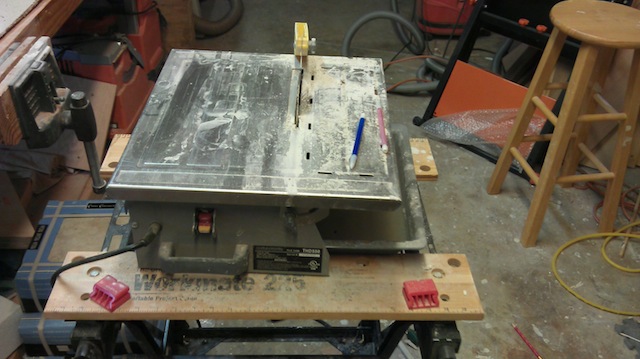
But, I’m quickly discovering that tile is not wood … not in the least. It’s not that cutting isn’t something unfamiliar. Heck the tool I am using is a table saw… yes, a table saw for tile. It’s just that when I get close to finishing my cuts, the tile usually breaks. Plus, I’m working with super-hard porcelain tile – which means I need to take some extra care during the cutting.
Why the hurry? Well, school starts again in a few weeks here in Florida… wouldn’t it be nice to have two working bathrooms in the house again?

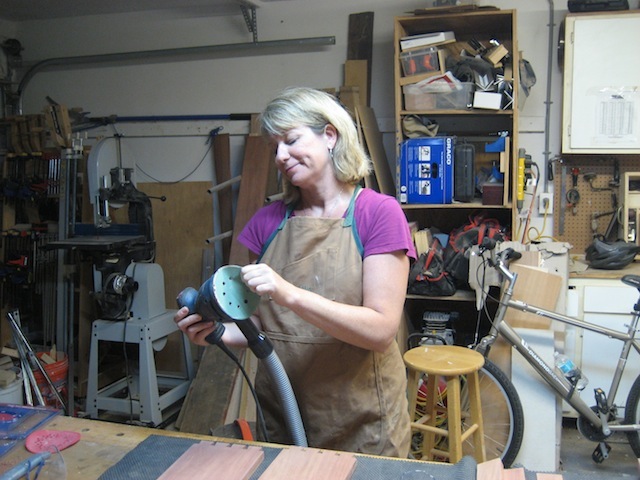
Meanwhile, on the other side of the garage, I have a few woodworking projects taking up some space. The santos mahogany step stool is approaching its finale as Rhonda flexes her sanding muscles. She’s got another post in the works, and from there – I think she’s ready to become an expert finisher.

While this would be exciting on its own, I have created a challenge for myself. You see, in about a week, I’m headed to some emergency management training near where my next niece lives who is about to turn 16. Granted, her birthday isn’t until November, but I will be flying and landing at an airport close to her house. So, I thought, why not bring her hope chest to her now as part of my checked on luggage? You remember that I built a hope chest for my oldest niece a few years ago, right?
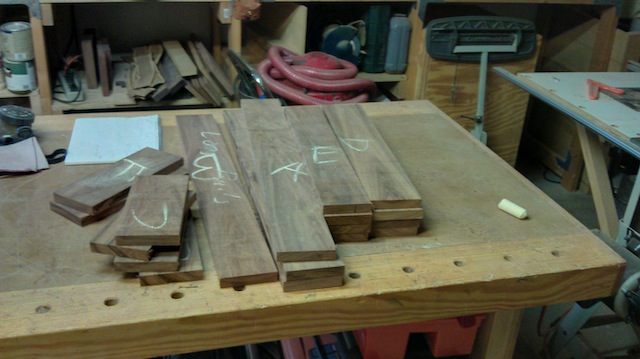
So, I have been milling like a madman the past few nights after work.  Spent a little time yesterday afternoon getting all of the pieces planed, cut to size and ready to roll for the plan. The plan, by the way, is the simple blanket chest built by Norm, but with some Mayan walnut I got from Bell Forest Products… and the panels from another piece of I wood I’ll have to write about…
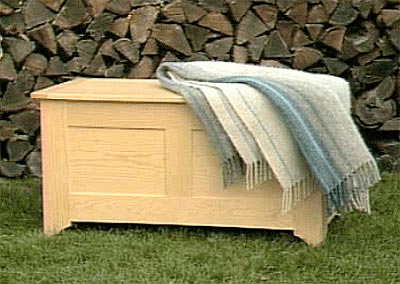
Meanwhile, it was great to get some time at the table saw I was a lot more familiar with. It was also great using my miter bench to cut things to the right size – nice and square. I’m just hoping I can get the piece ready to go before the big trip…
 

Link of the Week

San Francisco Fire Department

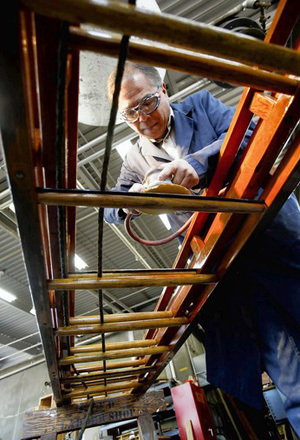
Now, why would I feature the city of San Francisco’s Fire Department on a woodworking blog? Beside the fact that these brave men and women work to help keep the city safe and rescue those in peril, they also hold on to a great old tradition – their ladders are made out of wood.

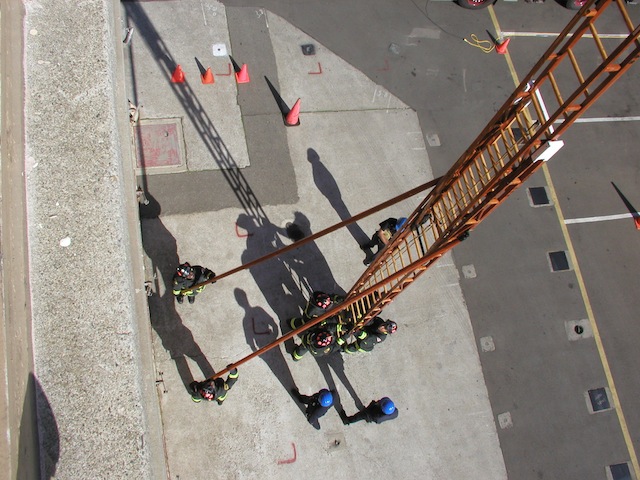
And, not only wooden ladders – the SFFD is the only department in the country that uses custom-made, hand crafted ladders. Yes, folks, in 2012, city employees custom build and repair more than 350 of these beauties. Built of ash, Douglas fir and hickory, wooden ladders are preferred due to the large number of overhead power lines in the city. Their weight also helps keep them stable as crews climb in the frequently-windy weather of the city by the bay.

That weight – 350 pounds for a 50 foot long model – requires a great deal of coordination.. and brute strength.  In fact, it takes a crew of six firefighters to raise the ladder into place, with a fire lieutenant helping to orchestrate the lift.

A link to a fascinating video can be found from the SFFD’s wooden ladder page. Take some time to check this out – it’s amazing.

Many thanks to the San Francisco Fire Department for the images and the background info!


Important People: Matt Vanderlist

There have been a bunch of folks who have had a major influence on Tom’s Workbench over the past five years. I wanted to take the time to recognize a few of the folks with which the blog would have never happened.

Today, I send a shout-out to Matt Vanderlist.

Shortly after getting involved with Marc, he strongly recommended that I check out Matt’s site. These two guys were just about to launch a new venture – Wood Talk Online – and he wanted me to be up to date on what Matt was doing.

I was amazed to see just how much of a pioneer that Matt was.  With his own motivation, he was the first woodworker to put up a woodworking podcast.  It wasn’t an easy process – critics told hi m that the idea would never work, and he wavered for about six months before that fateful day in January of 2006, when episode one made its debut.

Matt has always been an encouraging voice in my development as a blogger. He’s the kind of guy you can shoot an idea past, and he can offer some sound advice. With his loyal and devoted audience and years of expertise, he has been able to suggest things  help my site flourish.

When Matt launched The Spoken Wood Podcast – seeking audio readings from other names in the woodworking community – I was honored that he selected me to be one of his first authors.  Today, I am proud to have been a part of this initiative that has opened the doors to an incredible amount of portable woodworking content, and exposed my blog to new audiences I would have never been able to reach.


Species Spotlight: English Brown Oak

What a big year it has already been for Her Majesty Queen Elizabeth II. First, the entire world celebrated the 60th anniversary of her ascension to the throne. All I can say is that when I hit 60 years of doing something, I hope Sir Paul McCartney will be able to play at my party!

Later this week, she’ll open the 2012 Summer Olympics in London. This will be the third time that the capitol of the United Kingdom will be hosting the games, and the last time, Her Majesty had a chance to take them in as Princess Elizabeth while her father King George VI reigned.

And now, THIS!  A species spotlight on English Brown Oak.  On Tom’s Workbench? Why, it’s a trifecta of royal proportions!

Now, the English Brown Oak is the wood fit for a monarch. These regal trees grow all across the British isles, as much as 120 feet tall and 10 feet in circumference. If you visit the United Kingdom, you will still find forests of ancient oaks, including the old stomping grounds of Robin Hood, Sherwood Forest.  These stately trees were the ones that inspired J.R.R. Tolkien to dream up the Tree Ents in his Lord of the Rings trilogy.

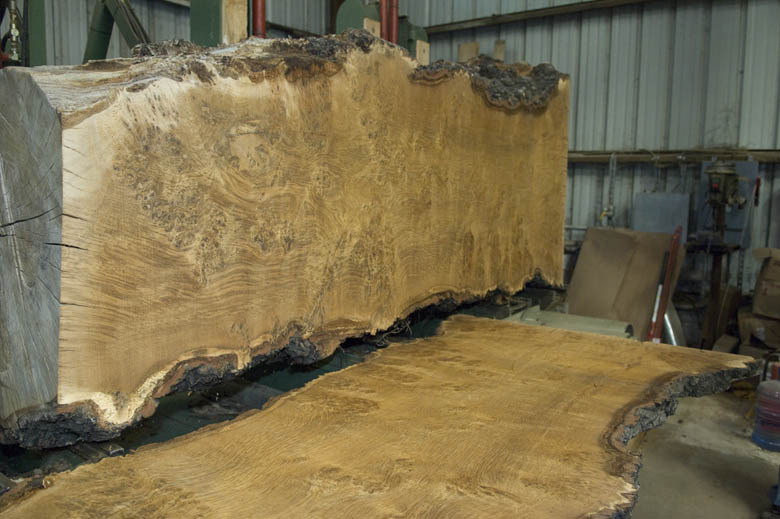
The wood itself is equally as handsome as the tree. While the tree is in the white oak family, it is a darker shade than you might be used to. It is a hard, heavy, dense wood that resists crushing, and, as with other white oaks, displays tremendous ray flake when quartersawn. The wood typically has a very straight grain, making it a great choice for steam bending.

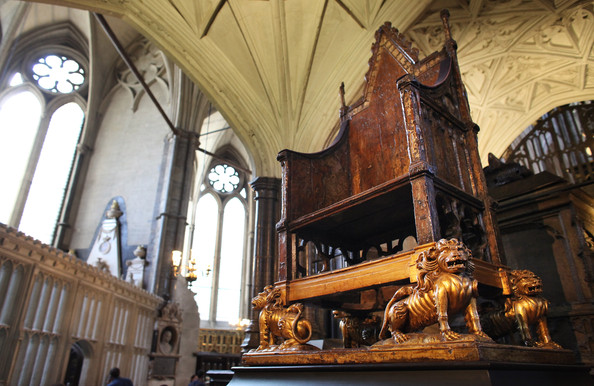
These trees were grown for buildings, ships and furniture. Shakespeare’s Globe Theater was made of timbers cut from oak forests. King Edward’s Chair, the throne on which monarchs are coronated, is made out of this very wood.

Be warned, though, if you try to use metal fasteners in English brown oak, you might run in to trouble. In fact, you will be learning one of the other uses the wood is famous for – tanning leather. The tannins in the wood are very tough on metal fasteners, and can cause significant corrosion. This tannin also gives English brown oak a moderate amount of decay resistance when used on outdoor projects.

OK, I admit that maybe the whole Tom’s Workbench feature may be a little overblown, I do think Her Majesty will be pleased to see just how much pleasure the stately oaks from her sceptered isle have given woodworkers throughout the ages and throughout the world.


Important People: Rhonda Iovino

There have been a bunch of folks who have had a major influence on Tom’s Workbench over the past five years. I wanted to take the time to recognize a few of the folks with which the blog would have never happened.

Today, I send a shout-out to my wife, Rhonda Iovino. It’s only appropriate, since today is our 19th anniversary.  (How does she find the patience to deal with me?)

A million years ago, when I first started woodworking as a hobby, I wanted to surprise my wife with a blanket chest. Something I wanted to build for her so she could stash some items which held important memories (items such as the snorkels we used on our honeymoon in Puerto Rico) as well as some useful, but out-of-season things (winter blankets during the long, hot Florida summers).

While that first project was an abomination (come on, Tom, construction plywood?), she never once wavered in support of my new hobby. Over the years, she has encouraged me to go to woodworking events – both locally and long-trips away from home – to help develop my skills. We have worked together in selecting projects to give as gifts for friends and neighbors. She has recently stepped to the plate and learned how to do some sanding and finishing on projects, and has expressed interest in looking forward to possibly building a few of her own. (How on Earth will we decide who gets time on the band saw?)

The best thing about her being part of the Tom’s Workbench team, though, is that she’s always there for me. No matter how many challenges I face, she lends encouragement – and a wise word or two – to get me back on track. And, when I’m sky-high with excitement after building a project, she brings me back to Earth, encouraging me to look critically at the piece I have built to see how I could improve my technique.

It has been one heck of an adventure, Rhonda. Thanks for being there.


About face!

With football season coming up, I always think back to my days when I attended the University of Maryland. I worked on campus all summer, and every afternoon, my co-workers and I would talk about the upcoming season, which games we were looking forward to, and how cool it was going to be to sneak some ‘adult libations’ into the stadium for the games. Ahhh, to be young and dumb again…

After work, though, I would always look forward to the walk back to my apartment. As I crossed Route 1, I had to pass in front of the campus’ chapel and the large field that rolled up the hill toward it. It was at the bottom of this hill where the school’s marching band was practicing, getting ready for performances. And, boy, did they ever suffer in the heat as the band director took more than one hundred individual performers and made a cohesive unit. The staff would teach the band members how to play together. How to create formations. And, most importantly, how to march together. It was always impressive to hear just one command – for example, ABOUT FACE – and see the entire formation of students turn on their heels and change direction in an instant. Such power used with such finesse.

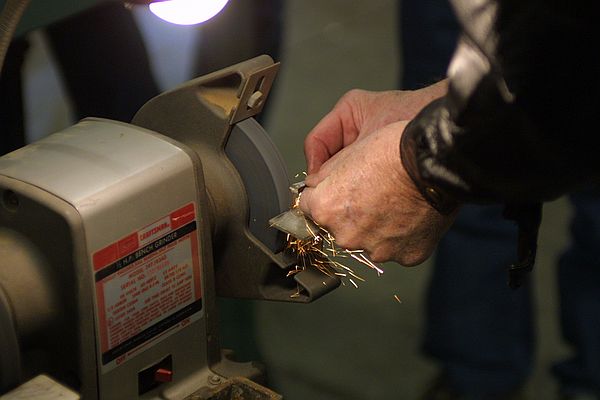
Sharpening is a task where you also need to use more than a little bit of finesse. For instance, if you want to sharpen a hatchet blade, you need to be aggressive to remove enough material to get that edge into fighting shape. But, when my barber hones his straight razor for my post haircut neck shave, he’s very careful with the leather strop.

In much the same way in the shop, there are some sharpening applications where you want to be extremely aggressive with the tool, and times when you need that feather soft touch to ensure the finest edge. Many woodworkers go for a high-speed grinder to get that rough stuff out of the way, then turn to stones to get the fine honing. But, can that be done on a single machine?

Surprisingly, my Tormek can handle both tasks. The wheel on the sharpener can be graded to a coarse cut for edge shaping, then later regraded to a finer grit for the polishing process. Just as important as stone grading on this system is the direction in which the stone rotates.

If you sharpen a blade with the stone turning toward you, the cut is far more aggressive. The wheel can remove a tremendous amount of material in short order (something you do need to pay attention to, otherwise you could totally reshape your tool!) with the turning direction turned toward you. So, if you are trying to get a nick out of your blade, this is a great feature. When you want to put the final polish on the blade, simply turn the machine around, and with the wheel turning away, you lay the blade edge on the wheel and the cut is much less aggressive.

The only problem with this arrangement? The machine is solidly built and kind of heavy. Plus, with a tub full of water keeping the wheel wet, you can get quite a bit of sloshing going on, soaking the stuff on your bench. That’s why I sort of parked it in one configuration – wheel rotating away – and kept it there. It was OK, but it would have been better to have that other option.

That’s why I was so pleased to see a new accessory for my Tormek sharpener. The folks over at Tormek sent me one of these turntables to mount the tool on, making this twist a piece of cake to pull off. The base is solidly built, with gripping feet on its bottom and a smooth ball-bearing guided turntable. The top of the base is relieved to have the Tormek’s feet rest in place, preventing it from slipping.

With this new base in place, I can easily move from the coarser grinding to the finer honing. This has encouraged me to do more sharpening of tools as they dull, instead of waiting for them to all be dull and setting aside a block of time to sharpen them all at once. My tools stay sharper, the quality of my cuts remains high and it can help me make some beautiful music at my bench in the shop.


Quick Poll

It’s happened to all of us.  You are working from commercial plans or a cut list of your own devising.  You follow the plans closely and make all of the cuts.

But, when you move on to the assembly process, you accidentally glue a piece in the wrong place.  For me, I usually discover this accident when I get farther down the road on the assembly process and have to break the pieces apart or cut new ones.  Drats!

Fortunately, most woodworkers make this mistake once, then turn to a method of carefully marking the pieces to ensure it never happens again.

This week, let us know how you keep track of the pieces in a complex project.  Do you use the tried and true cabinetmaker’s triangle or something else?