All posts by Tom

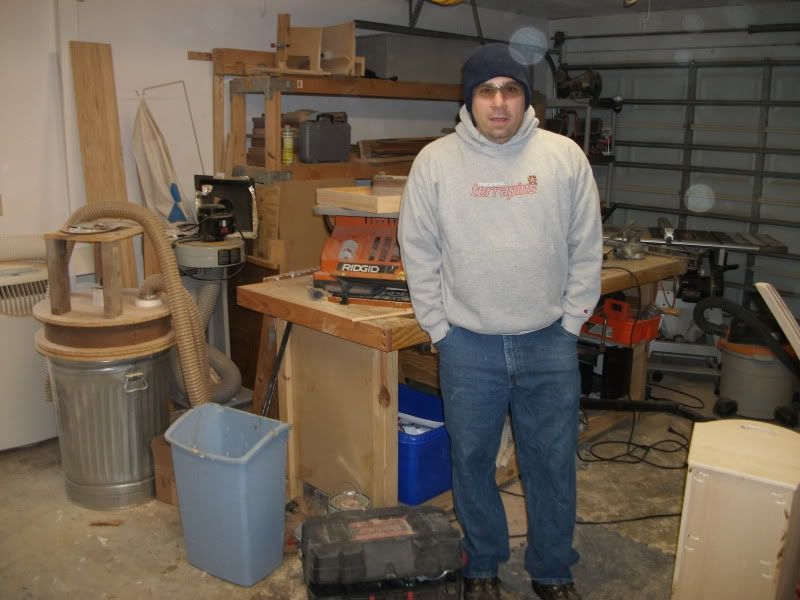
I'm the guy who writes the blog...

Stuff I’ve Built: The Cradle

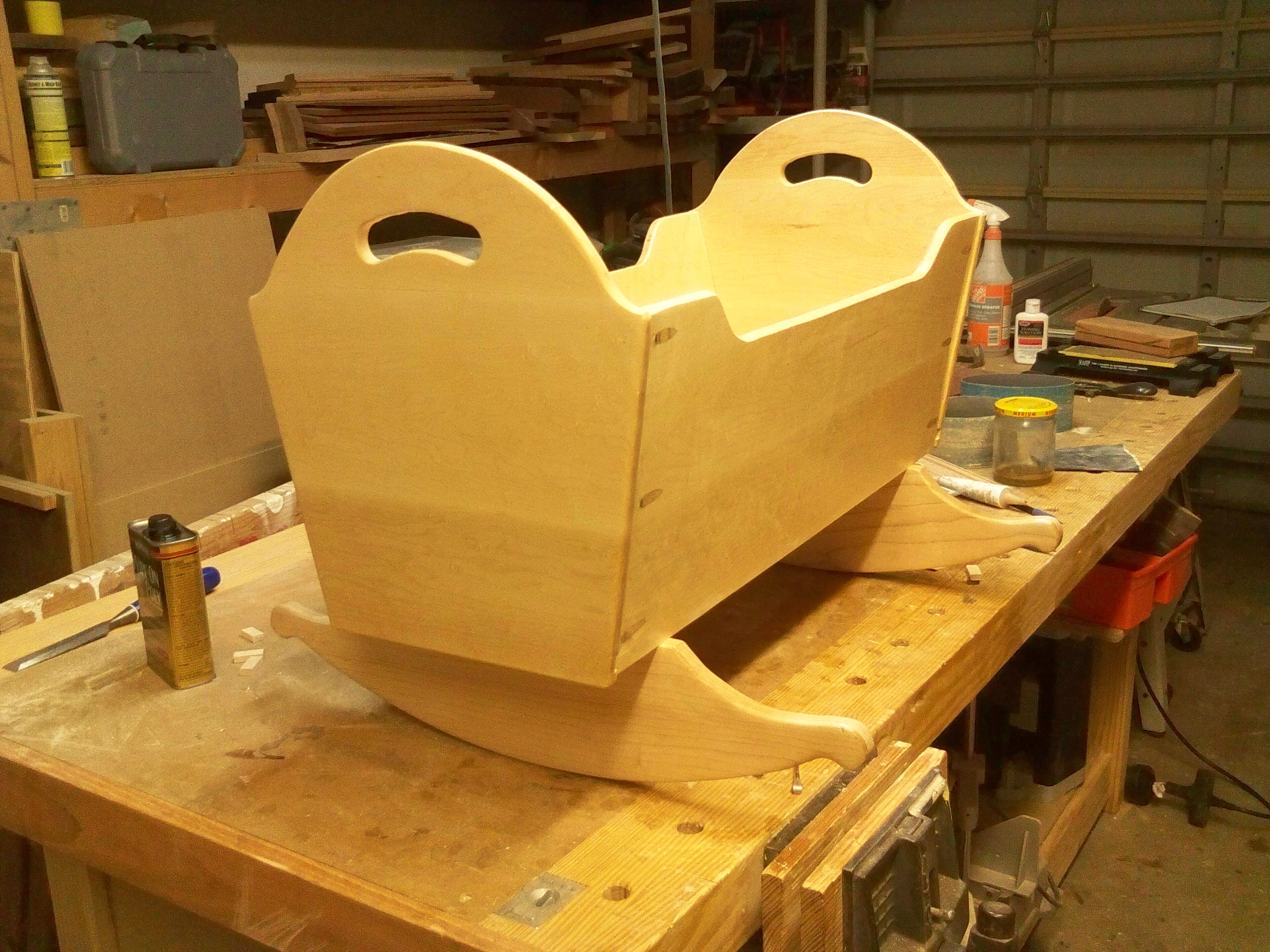
This is one of those projects that was supposed to be done a few weeks ago.  When I first posted my entry about building a cradle to donate to a local pregnancy crisis center, it was supposed to be ready in time for Christmas.

However, I don’t think that the need for it has gone away.  It’s done now and ready to be dropped off anonymously to be given to a new mom.

The original patterns for the cradle came printed on standard letter-sized paper and had to be joined together to create the full sized working plans.  That took a little time to understand, but was very easy and allowed me to create the flowing curves on the piece.

The original plan for the cradle was to be a knock-down design which could be stored safely after a child outgrew it, waiting for the next new family member should a new one arrive. After discussing this plan with my wife, she brought up a very important point.  If I was donating the cradle anonymously and someone had a question about how to set it up, how would they know what to do?

At that point, I decided I should modify the plan to permanently attach the sides to the head and foot board.  Fort this application, I chose plugged pocket screws, but I could have easily chosen dovetails or some other joinery method.

The handles were easy to cut. Working from the patterns, I located two center point for 1″ forstner bit holes and connected them with a flowing curve.

As I cut each piece to size, I finish sanded them and rounded over all the edges, paying special attention to the areas that were going to get handled.  This was much easier before everything was assembled.

The finish was a thinned down coat of Zinnser Seal Coat (mixed half and half with denatured alcohol).  Then, A thorough sanding with 400 grit paper to get the surface super smooth, then three coats of wipe-on poly to offer more protection.

Again, I would like to thank the folks at Wood Magazine who donated their cradle plan and the guys at Bell Forest Product for donating the beautiful maple.  Thanks, guys.  I appreciate your generosity!

Now, to get the cradle into the car and get it down to the pregnancy crisis center before they open at 8:30…. I hope they like it!

Species Spotlight: Bubinga

Some species of wood we use to build projects are very understated. Subdued. Reserved.

And then there is Bubinga.

This exceptionally beautiful, hard and dense wood from central Africa is a true standout when it comes to furniture making. Known occasionally as African Rosewood, bubinga is one of 16 different species of the genus Guibourtia. The evergreen trees can reach heights of 40 – 50 meters tall with a trunk diameter of 1 – 2 meters.

Bubinga is a very tough wood. “It’s right up there on the Janka scale of hardness – taking nearly 2000 pounds of force to drive a steel ball halfway into a piece,” said Eric Poirier of Bell Forest Products. “That makes it a very good choice for all sorts of applications – especially for making tool handles and hand planes.”

Eric had helped me select an outstanding piece of bubinga when I had built my Krenov-style plane. The wood cut, planed and worked beautifully while still being impervious to the fingernail test.

Bubinga’s color is very unique and runs from a striking deep rose color toward a shade of red mixed with purple. While working with it, I kept remembering the distinctive label color found on a Dr. Pepper bottle. “This dramatic color really makes bubinga pop when paired as an accent with lighter wood. A maple project with bubinga accents… wow… now you are talking!”

“It’s not just the color, but the figure of the bubinga that can really be dramatic,” said Eric. “You can see burl, quilted or even something that closely resembled tiger striping within the highly figured boards.”

The wood is very durable, and is often used in boatbuilding. Turners absolutely love the stuff because it takes very crisp detailing. “A bubinga bowl really makes a statement, and bubinga pens will attract a lot of attention from admirers.”

Bell Forest Products keeps a supply of milled bubinga lumber on hand for projects. They also get some very choice boards that can be custom picked from pictures on their website. “Right now, we have an unbelievable kiln-dried slab of bubinga in stock. It’s 1 5/8” thick, 48” wide and a whopping 182” long. It’s got sweet live edges on both sides, and would allow a talented woodworker to make an outstanding project. Heck,” Eric continued, “we’re even throwing in the shipping for free!”

Quick Poll

There have been many advances in woodworking .  Today, the craft is more of a hobby than a back breaking avocation, with table saws, routers and other power tools making life in the shop easier.

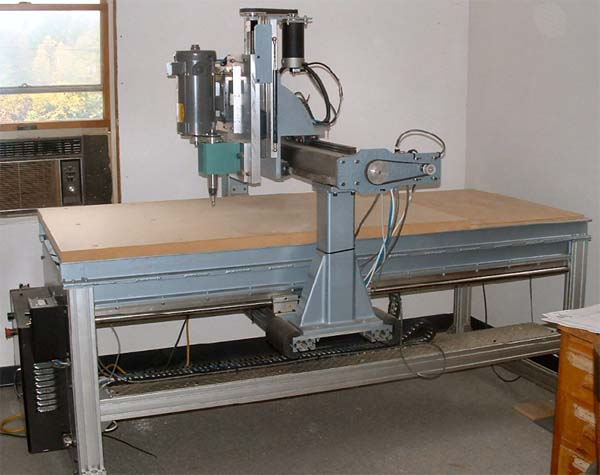
One of the biggest advances in production woodworking shops has been the computer numerically controlled (CNC) router.  Information about the project pieces is entered into a computer, material is fed into the machine and the final pieces are ready in short order. The patterns are repeatable, so many duplicate projects can be produced.  For larger furniture and cabinet shops, CNC machines have been a great addition.

And as technology continues to advance, it won’t be long before manufacturers make smaller, more affordable CNC machines for the average home woodworker.

That begs the question: When CNC machines become more affordable, will you add one to your shop?

[poll id=”108″]

Link of the week

The Haitian Art Company’s wood carving page

Based out of Key West, Florida, the Haitian Art Company was opened in 1977 and showcases the works from artists in Haiti. The owner Bruce Kravitz, deals directly with the artists in the island nation, buying their paintings, paper mache, metal work and wood carvings.

The Haitian Art Company has maintained close ties with many of Haiti’s best-known artists, and has been instrumental in supporting emerging talent.

Tragically, those ties are totally in question after this week’s catastrophic earthquake struck this impoverished island nation.

After viewing the gorgeous works and thinking about the terrible plight of those suffering through one of the worst tragedies seen in the western hemisphere, if you feel moved to make a donation, here are a few links to agencies you might want to consider:


Heaters… in… Space!

Wasn’t the original Star Trek show just too darned cool?

I mean, they had the tricorders that could tell them what was in the air on the planets they visited.  They had transporters to go from place to place quickly.  Dr. McCoy had that little salt-shaker looking thingamabob that he waved over patients and told him everything he needed to know about their condition.

And, the uniforms on the female crew members were something to look at.  Of course, that was 1960’s TV for you.

The one thing I thought was really interesting was how they stayed warm in cold locations.  Basically, someone would unholster their phaser, point it at a rock, squeeze the trigger and then huddle around the warm goodness until the Klingons were vanquished, Captain James T. Kirk came to grips with his split personality or some other plot issue was resolved.

Oranges during the recent freeze, Altoona, Florida

Given the recent cold snap in Florida, I wish I could have just used a phaser on a rock to raise the temperature in my shop.  But, I’m afraid that technology is a few centuries away.  So, I’m stuck with what’s out there on the market to heat things up on those chilly winter days.

Yes, this is heater advice from a guy who lives in Florida.  Pay attention…

A quick word about heat.  If you remember high school science, heat is basically just a form of energy.  The transfer of heat always goes from high temperature (energy) to low temperature (the lack of energy).  That’s why you have to power a heating device to keep your shop toasty and why your air conditioner has to work so hard to move heat out of your shop during the summer. In effect it’s actually trying to warm up the outdoors by using the heat in your home or shop.
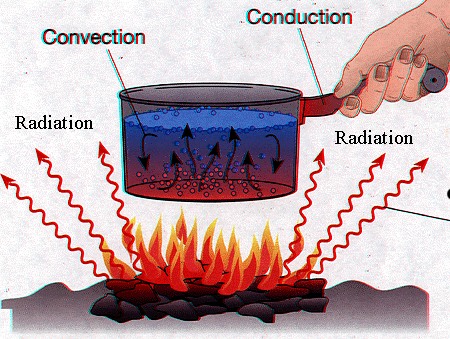
Three methds of heat transfer

There are also three methods of heat transmission that we commonly see.  The first is conduction, which really won’t come into the discussion here unless you wear some kind of heated shop apron on chilly days.  Conduction actually moves heat through physical contact between items.  That’s why my hands were going numb when I held a cold hand plane last weekend… the heat was being conducted along its merry way.

Next, there’s convection.  Warm air is lighter in density than cold air.  That’s why hot air balloons fly.  A heater relying on convection will heat up the air, send it upward and draw in cold air from the room to fill the void.  This is a great way to evenly heat an entire room.

The final way is through radiation.  No, not the ionizing radiation you expect to see Engineer Montgomery Scott handling in the engine pods, but a little something like it.  The heat is actually directly transferred through waves through space from the heat source to your body.  This makes it great for spot heating, something like you do in a workshop you don’t want to heat entirely.

Many methods of heating employ both convection and radiation.  For example, if you light a fireplace, the fire (if you use glass doors or a fireplace insert and don’t let all the warm air rush up the chimney) will heat the air in the room through convection.  If you walk over to the fireplace and point your hands at the fire to warm them up, the heat you feel is arriving via radiation.

Now, when it comes to shop heaters, I’ve learned that there are many choices, and each does its own thing exceptionally well.

First, there are whole-shop heaters.  If you live where there’s plenty of ice and snow and you want to work during the winter, you’ll have to spring for one of these.  They are usually permanently mounted into place and have larger BTU heat outputs and a correspondingly larger fuel consumption.

Since my shop just gets chilly from time to time, I’m going to be selecting from column two – the space heaters.  These are smaller, portable units that can warm up a specific area.  The beauty about them is I can stash one up in the attic all summer long and just drag it down when I need it for the brief cool season in my shop.  They could also provide some supplemental heat for a fully heated shop to lessen the effects of a cold spot.

Next, I have to choose the method that powers the space heater.  There are ones that burn some type of fuel like kerosene, propane or natural gas.  These offer a good deal of heat for their weight and don’t rely on the power to be on to do their thing.  That makes them ideal in the event of a blackout.  The down side is that they produce a deadly gas called carbon monoxide (CO).  Let’s just say that this stuff is lethal, and it’s a great idea to buy a CO detector when you pick up your heater.  Sure, it may add to your cost, but it probably will cost significantly less than hospital bills or a funeral. Seriously.

The other option is an electric heater.  They take power off the grid to do their work, eliminating the threat of CO in the shop.  They come in several different sizes, and in three main designs.

The first ones are primarily convection heaters. They have a fan which draws cold air over a heating element, blowing the warm stuff back into the room. These give a nice, even heating to the room, but, in a larger shop without insulation – like my shop here in Florida – it may take a while feel any warmth.  Like the arrival of spring kind of while. For smaller, insulated shops, though, not a bad idea.

The next ones are primarily radiation heaters. No, they don’t need dilithium crystals, but they do use quartz or metallic heating elements and a reflector.  Just like a spotlight, if you are in the path of the beam from this heater, you’ll warm up.  These might be a great solution if you spend a lot of time in one area (your workbench) and want to direct your heat that way.
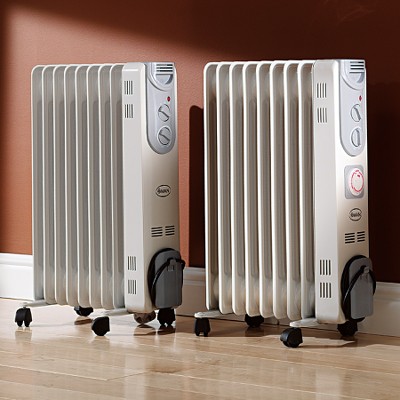
Oiled Filled electric space heaters

The one I am leaning toward purchasing is sort of a combination radiator/convection heater.  These models look like the good old steam radiators found in older buildings.  Instead of channeling scalding hot steam, these models are filled with an oil that is warmed by the electric heater.  The best thing about these heaters is there are no exposed heating elements. The element is immersed in the oil in the unit and the heat is conducted (Actually convected through the fluid medium) to the outer fins by the oil.  This way, there’s nothing directly exposed to sawdust in the air. I have used these way back when I lived in Maryland, and found them to give off a nice, even heat to the room while still allowing you to warm your hands – or posterior – by holding them near the unit.

Whatever method or fuel you choose to heat your home, just keep this in mind – The National Fire Protection Administration reports that heating equipment is the leading cause of home fires during the months of December, January and February, and trails only cooking as a cause for home fires year-round.  Some other sobering facts include:

  • In 2006, heating equipment was involved in an estimated 64,100 reported U.S. home structure fires, with associated losses of 540 civilian deaths, 1,400 civilian injuries, and $943 million in direct property damage.
  • In 2006 heating equipment fires accounted for 16% of all reported home fires (second behind cooking) and 21% of home fire deaths.
  • Space heaters, whether portable or stationary, accounted for one-third (30%) of the home heating fires and three-fourths (73%) of home heating fire deaths in 2006.
  • In 2003-2006, the leading factor contributing to home heating fires (28%) and deaths (46%) was heating equipment too close to things that can burn, such as upholstered furniture, clothing, mattresses or bedding. These statistics exclude fires that were confined to a chimney, flue, fuel burner or boiler.

Some safety tips from the NFPA are:

  • Maintain a 3 feet (or 1 meter) separation between things that can burn and heating equipment.
  • When buying a new space heater, make sure it carries the mark of an independent testing laboratory.
  • Plug your electric-powered space heater into an outlet with sufficient capacity and never into an extension cord.
  • Use the proper grade of the proper fuel for your liquid-fueled space heater, and never use gasoline in any heater not approved for gasoline use. Refuel only in a well-ventilated area and when the equipment is cool.

Oh, and if you do want to heat that rock with your phaser, be sure no one is standing in the line of fire.

I’ll have to set my new heater to ‘stun’ once I turn it on…

How cold is it?

I moved to Florida from Maryland 18 years ago.  In fact, by the end of this year, I will have lived in Florida longer than I lived in my home state of New Jersey.

Does that make me a native Floridian yet?

I’m not sure about the time requirement to be considered a Florida native, but there’s another sure-fire test you can use to determine that I have become one – how I tolerate cold.

Now, in most Florida winters, we get a few days of blustery weather that brings some cool temperatures calling.  Those days may struggle to get to the 60’s Fahrenheit and can dip into the low 40’s and maybe the upper 30’s.

However, this year has not been typical.  Since New Year’s Day, our temperatures have been well below average.  In fact, we have recently broken the all time low maximum temperature record this past weekend.  The last time our area saw temperatures this cold for this long was back in the late 1980s.  We are currently running an average of 17 degrees lower than average for the month of January. (Just a note:  This cold stretch has already broken records — with nine consecutive days colder than 60 degrees. The last recorded stretch under 60 degrees for the Tampa Bay area was seven days in 1956)

No, these temperatures are not New York, Chicago or Detroit cold.  They are not Minneapolis, Toronto or Stockholm cold.  And, they are certainly not Calgary, Moscow or Duluth cold.

But, it’s safe to say that in my home, built to withstand long periods of high temperatures, it’s colder than a well digger’s posterior.  It’s colder than part of the thoracic anatomy of a witch. And, yes, it’s cold enough to freeze the spherical objects off a brass monkey.

I had this great weekend of work in the shop planned.  I was going to plow through a few projects that have been sitting on the bench for a while and bring them to completion.  So, I started my shop day by dressing in clothes that don’t normally get pulled out of the closet.  I put on a pair of work jeans, two pairs  of socks and my boots.  I layered a T-shirt, a thermal woven shirt and hooded sweatshirt over that.  I even put on a warm hat I had to buy on a trip to Maryland one February a few years back.

Come heck or high-water, I was going to do some work in the shop.

That’s when I took my first step out.  It was bracing.

My shop is normally so hot and humid, I easily move from tool to tool with little or no trouble.  Sure, I end up squishing in my boots from time to time, but no big deal.  I know how to handle the heat.

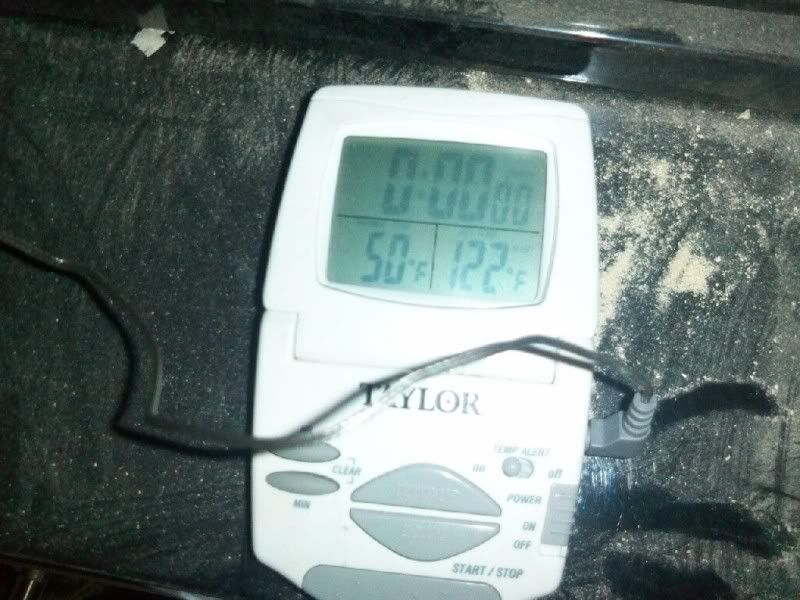
But, the cold was so different.  Parts of me started to ache shortly after I started working.  My hands and shoulders were not used to these kinds of temperatures.  I wanted to get a reading on how cold my shop was, so I went inside to get the oven probe thermometer.  This sucker has a tremendous temperature range. It  can read the internal temperature of a roasting leg of lamb and can also tell the temperature inside your freezer.

I plugged  in the probe and turned it on.  The reading fell fast, eventually settling at 50 degrees.  That’s funny, since the outside temperature never rose above 44 on Saturday.  Brrr…

I discovered some interesting things about the shop in the cold.  For instance, neither the Titebond III or especially the bottled hide glue flowed freely.  In fact, I got to the point where I had to put the bottled hide glue inside the house and let it heat up so I could apply it to a project.  And, once I was able to coax out a bead onto the wood, it gelled so quickly that I had to hustle to get the mating piece pressed into place before it thickened to a taffy-life consistency.

As I puttered around the shop, rubbing my hands together to try to get them warm, three thoughts crossed my mind.

  1. I developed a new-found appreciation for everyone who works in cold climates.  While the air conditioner in my shop makes it more comfortable in the summer, y’all must agonize over heating choices in order to just get into your shop.
  2. As cold as it is in Florida, I’m still looking forward to a warming trend later this week, pretty much ending this record-breaking cold snap for the Sunshine State and bringing us back to more seasonable temps.
  3. When your shop is that cold, there’s nothing wrong with calling it a day early and coming inside.  Working in that kind of cold is one heck of a distraction, and it’s probably better to just get out of the shop.

Once I was out of the shop, I got back inside and warmed up. But, did I stop working for the day?  Heck no!  I went to my other favorite work room in the house and got busy. There was a refrigerator full of food to cook, and I spent the rest of that day making chicken stock, a pot of soup and a pot roast.

Hey, it helped to keep the house warm!

Quick Poll

Chip carving.  Relief carving. Carving in the round.

Wood carving is an interesting way to add style and design to even the most basic projects.  There’s a wide variety of techniques available to the woodworker, and the tools can be either hand or power.  There’s even a large choice of entry price points – from the single chip carving knife to the most expensive carving set.

This week, we want to know if you have ever carved in wood and how involved you were with it.

[poll id=”107″]