All posts by Tom

I'm the guy who writes the blog...

Link of the week

Materials Technology Wood

One of the saddest things to see is the reduction of the number of wood shop programs that have been closed in middle and high schools. It’s as if school planners believe that every student can’t be ‘successful’ without going to to a university.

Wouldn’t it be great to see a wood shop curriculum online?  That’s exactly what you’ll find at the Materials Technology Wood site.

Created by Tony Sheridan at the University of Limerick in Ireland, the site  is a resource for teachers of the Irish junior certificate with particular emphasis on practical skills development through the design and manufacture of woodworking projects.

Logically designed, the site offers excellent primers on safety, basic joinery and projects based on skill level.  It’s an interesting site to brush up on some basics, get an idea for projects and to develop a plan to develop the skills of a budding woodworker in your life.

There’s gold in them there ratios…

I have always hesitated to write articles about how to design projects.  Maybe it’s because I’ve built more than a few stinkers and want to forget about them. Or, is it that sometimes I design my projects as I go along… pencil in one hand and crying towel in the other?  I can’t keep the reasons straight anymore.

There is one convention that I have stumbled across while designing a few projects that has helped me out of more than a few jams along the way.  That is the Golden Ratio.

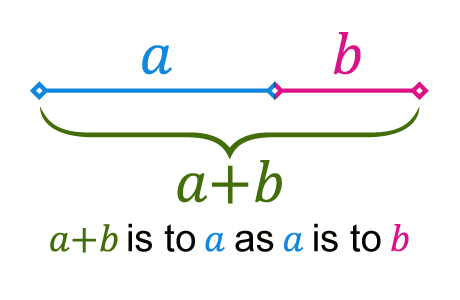
Just what the heck is it?  Well, it’s a classical design concept that has been in play for more than two millennia… Back in the days of ancient Greece, mathematicians such as Pythagoras and Euclid were noticing that in balanced shapes in construction, nature and geometry that there was this relationship between sizes of items that kept recurring. It was described as the extreme and mean ratio.  What does that mean?  Heck, I was an English major back in college… you do the math. However, it can be expressed quite eloquently in the following diagram:

The idea must have taken off, because many classical structures such as the Parthenon were built with this pleasing ratio in mind.

The golden ratio is also expressed as the Greek letter phi (φ) or as a number expressed as 1.618033…. This is known as an irrational number – kinda like my family’s checking balance after we pay all of our bills. “Honey, how did the account get so low? That’s just totally irrational!”

How does this help with woodworking? In many cases, it can be used to create a more balanced looking piece.  You can create the Golden Ratio by doing some complicated math, buy a special phi graded ruler or do what I do – look for a free online golden ratio calculator like this one.

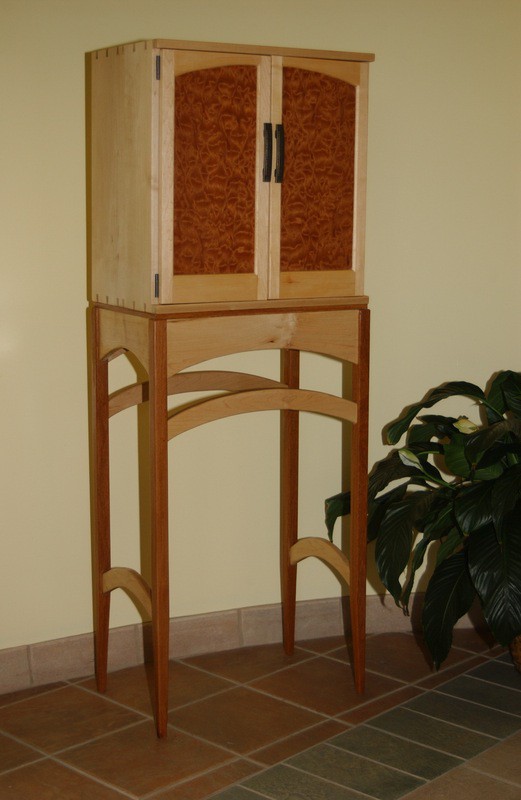
The best example of one of my projects using the golden ratio was the Fujiwhara Chest. I knew I wanted to build a cabinet about five feet (or 60 inches) tall, but how large should the cabinet section be versus the leg height?  I wanted the proportions to be nice to look at and convenient to access. So, I went online and plugged my numbers in.  I saw that the golden ratio of 60 inches is 23 and 37.  That’s when I drew up the plans for a 23 inch tall cabinet and a 37 inch tall base.

I also had to determine how deep to build the piece.  Should I just guess, or try to get it balanced? I plugged in 23 inches (the height of the cabinet) and figured the golden ratio for that – 14 inches deep. So, that’s how deep I built the piece.  The proportions came out pretty spot on, and one of the comments I got from the judges the year the Fujiwhara Chest showed was that it used proportions very well.

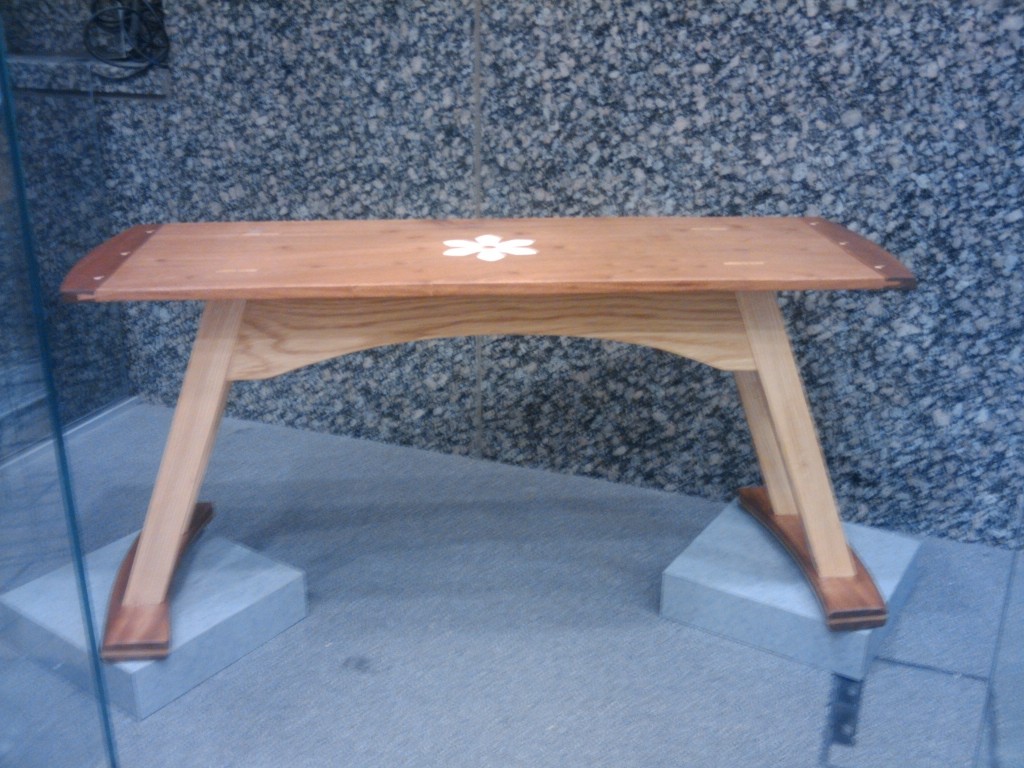
Another project I used the golden ratio on was Centered.  My plan was to come up with a unique looking table featuring a wide sapele board and angled legs. And, that’s exactly what I built.  And, when I showed the piece to some other folks, they all gave the same reaction.  “It looks nice, but something’s not right with it.” The project had no visual weight on the top, making it look too much like an ironing board.

OK, back to the shop it went for me to add some aprons to the piece.  How large should they be?  I plugged the total height of the table from floor to top – 17 inches into the calculator and saw that the numbers were going to be 7 inches and 12 inches.  This presented a few problems… I didn’t have a 7 inch wide ash board to use on the piece, and my band saw didn’t have that kind of resaw depth. Hmmm…

One other thing about the golden ratio is that you can continue to drill down, using the ratio numbers to make smaller dimensions.

So, since there is this relationship between numbers, I entered the  12 inch measurement into the calculator and came out with 5 and 7…   I figured why not try for 5?

Perfect. The apron looked balanced when I cut it to 5 inches tall. To help make it more graceful, I plugged the number 5 into the calculator and came up with 2 and 3.  I marked the center of the board two inches up from the bottom edge, connected a few points by a curve and cut it out to get a nice, graceful look.

Did I explain the golden ratio properly? Probably not. I’m pretty sure someone will weigh in to point out my complete lack of mathematical abilities or why the golden ratio should be avoided… but for a dunderhead like me, using this concept seems to help me in the design phase.

http://en.wikipedia.org/wiki/Parthenon

Stuff I’ve built: The Valentine’s Day box

Oh, do I love my band saw now. All of the stuff I had planned on doing with it… well, I can now!

For instance… I wanted to build a little something special for my wife for Valentine’s Day today. The project I wanted to build had to be small so it didn’t stand out like a sore thumb on my bench. It had to use up some of the pretty scraps of wood I had around the shop. And, it had to be something special.

I dug around in my wood stash and found a scrap of 8/4 cherry and some 3/8″ birds eye maple.  Why not a bandsawn box? Not only would it be small, it would be fun.

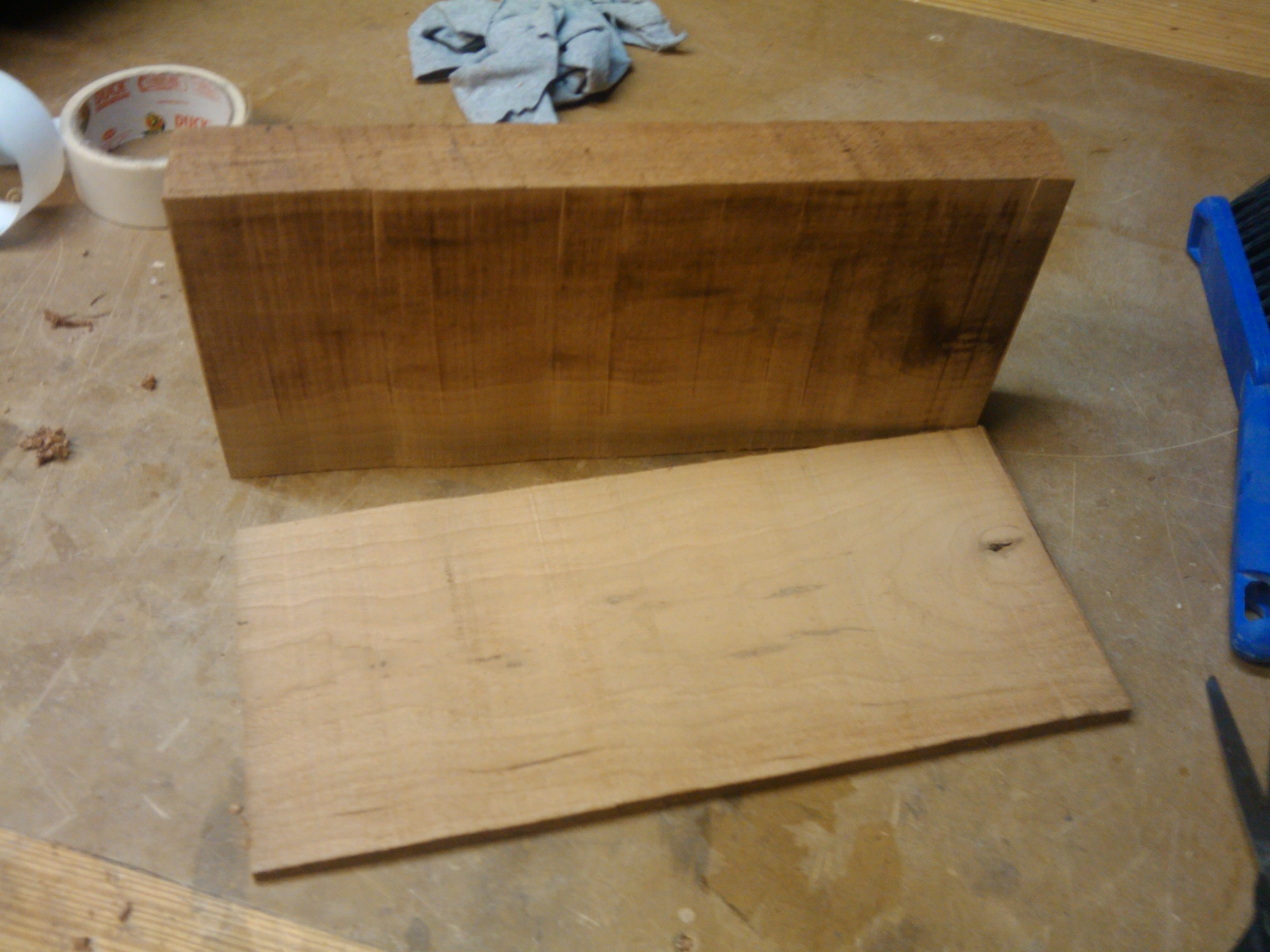
First things first, I had to resaw off the bottom of the piece of cherry.  Just about 1/2″ thick, thick enough to serve as a solid base for the box. I left it with the bandsawn marks on it… I was going to come back to sand it after I had everything marked and cut out.

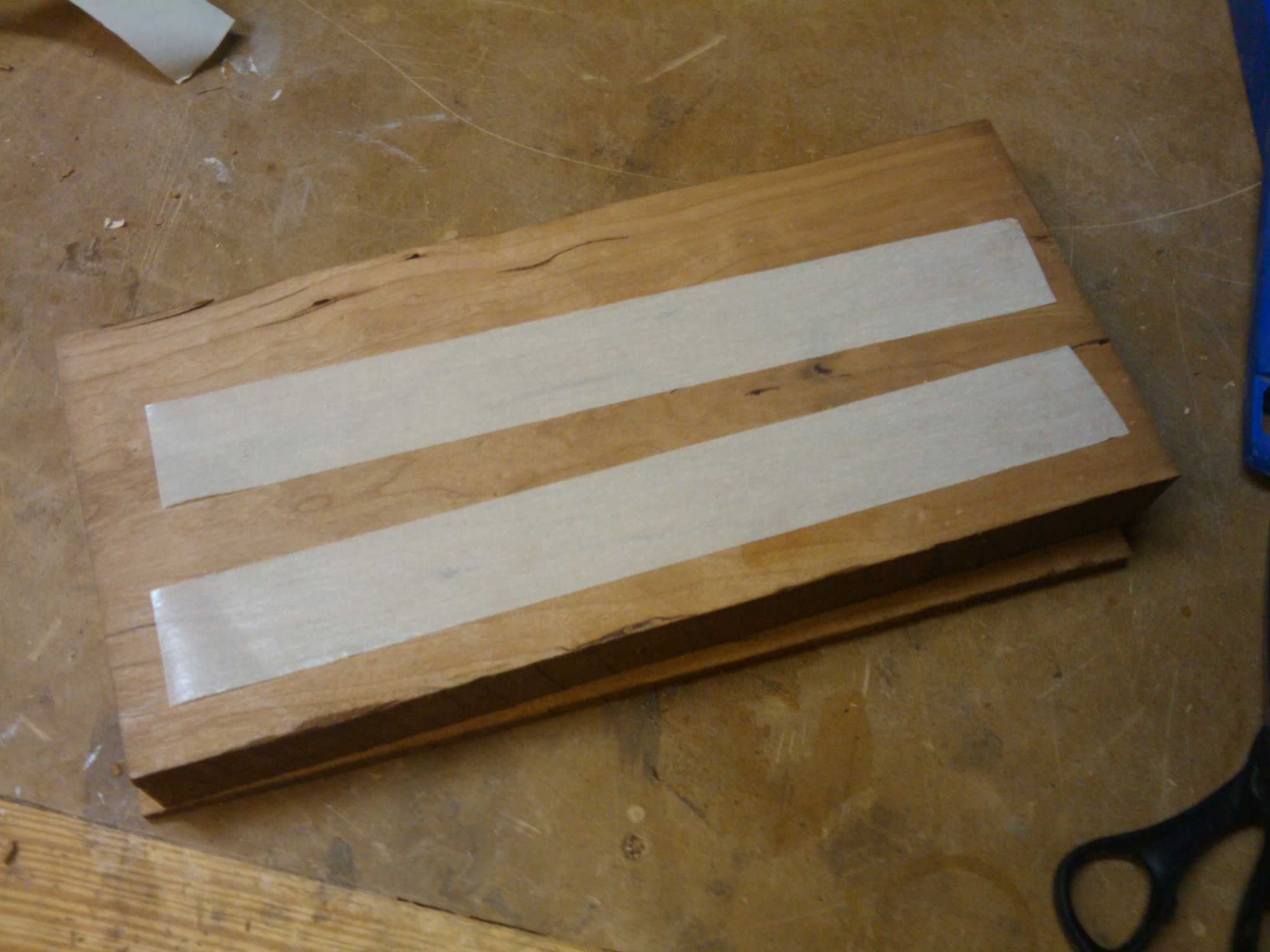
I then used some cloth double stick carpet tape to stack the pieces together before I cut them out on the band saw.This way, they would all come out with the same shape. I was careful to match the grain and stick them together tightly.

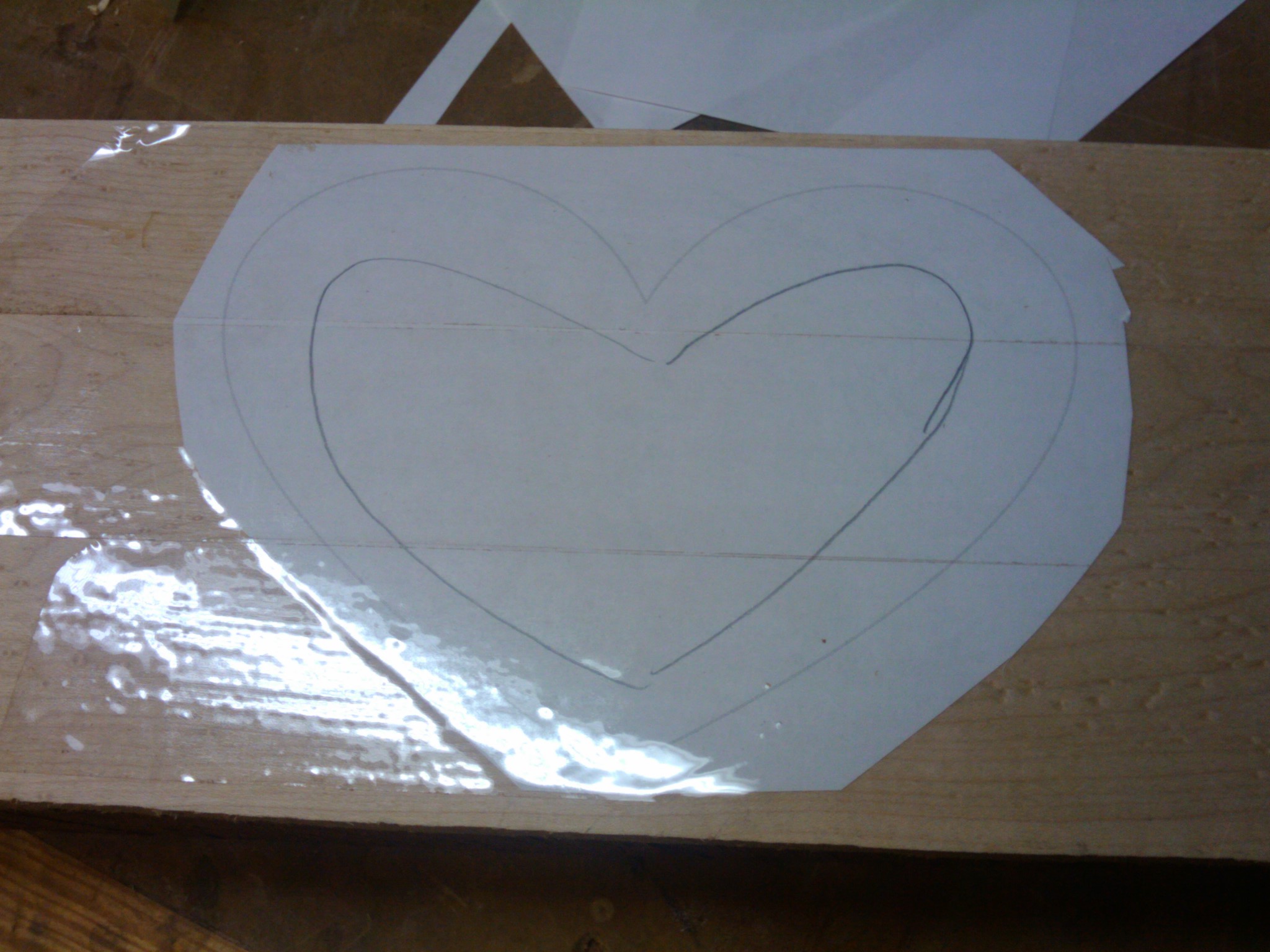
I found a line art drawing of a valentine on line and printed it off on my inkjet printer.  While messing around with the image, I traced what I believed the inside cutout would look like, and I taped the image down to the wood. Now, after I cut the first one, From here,I took it to the saw and with a 1/4″ blade, followed the line.  Not only had I cut the shape in the wood for the box, I had also cut the pattern free from the board… suddenly, I had a perfect pattern if I ever wanted to make another one.

I separated the layers and traced a line about 1/2″ in from the outside of the  edge of the middle piece. I sawed this out from the middle, making the cavity for the box. I had to cut through the outside wall of the box, but I was going to be able to glue that shut when I glued the bottom to the box.

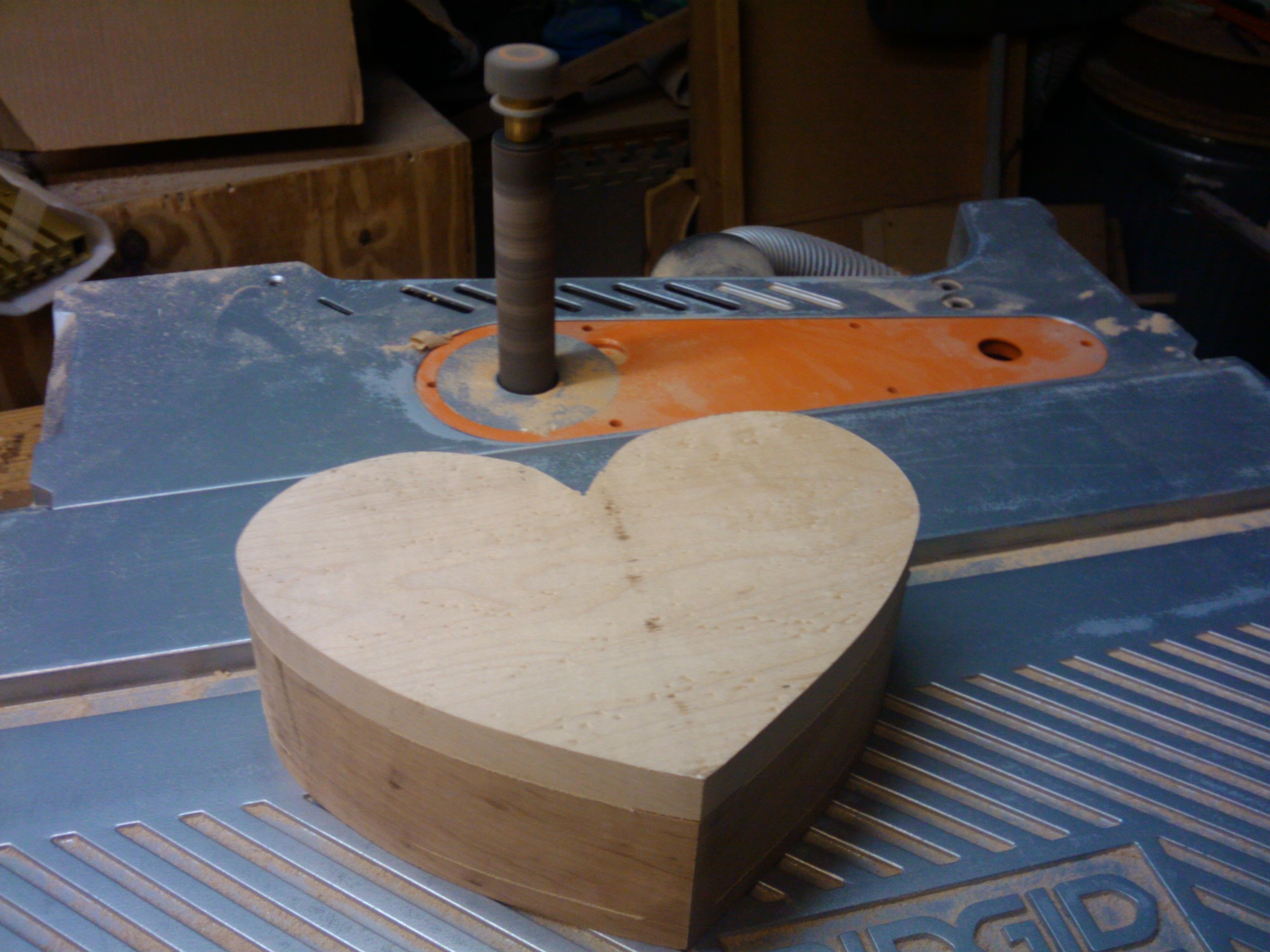
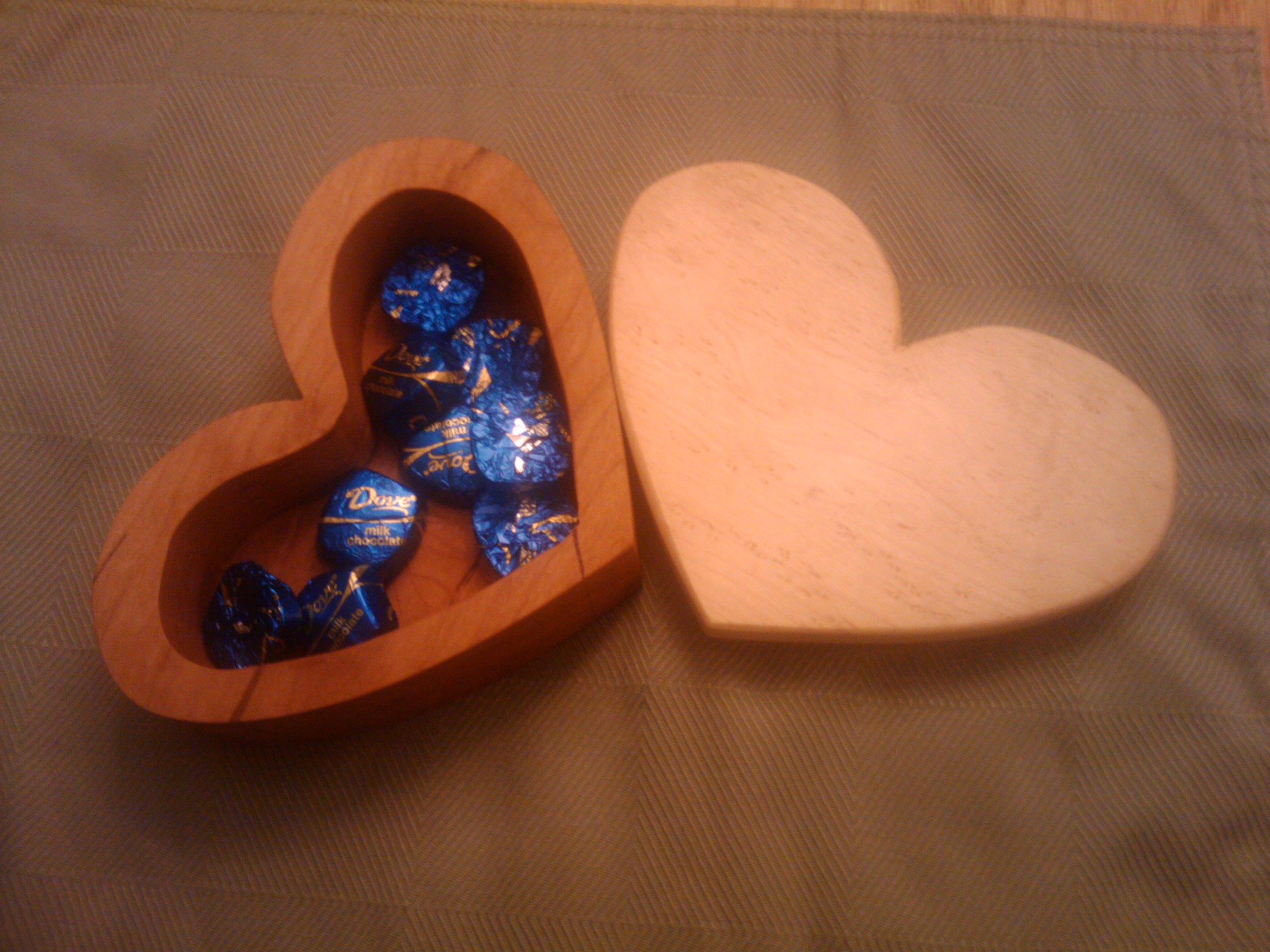
The next -and probably most important – tool I turned to was my Rigid combo spindle and belt sander. This gem of a tool with the spindle allowed me to sand the bandsaw marks out of the inside of the box before I glued everything together. I also sanded the box bottom so when I glued it together, I would be nice and smooth. I then glued the box middle to the box bottom. I then used the belt sander attachment to perfect the sides and lid of the box to make it nice and smooth. I hand sanded the top of the cleft of the heart, because I couldn’t get the spindle or belt sander into there.   Finally, I used the random orbit sander to hit the top and bottom and chamfered the lid and body.  I applied the finish a few weeks ago – I wanted to make sure that the smell was gone when I put some chocolates in it for my wife…

Overall, this was a great project… it checked all of the boxes on my list… and my wife loved it.

Quick Poll

Let’s say theoretically that you have a good friend who – because of age or illness – is nearing the end of his or her life.

One day, he or she asks if you – a woodworker they respect – would use your talent and skill to build them an urn to house their remains for their eternal rest.

Would you do it?

[poll id=”159″]

Link of the week

The Shrinkulator

No, this has nothing to do with  Seinfeld character George Costanza and a famous scene involving swimming in a cold pool.

Instead, wood shrinks and expands as humidity levels change – as was demonstrated in an article I posted a few years ago.

If you have lots of time, you could put a sample of wood out in your shop and measure its dimensions every day for a year to get an idea of seasonal humidity swings and how the affect the wood for your projects. Or, you could plug your numbers into the Shrinkulator and see how much different species of wood will move based on your local humidity conditions.  A very useful utility to help anticipate the impact of seasonal changes and your construction methods.

Stuff I’ve Built: The Bible Box

February 2011

Our church’s youth ministry is planning on sending some of the kids on a trip to see the Pope at World Youth Day in Barcelona, Spain. The organizers are looking to host a dinner dance to help raise funds to make that happen. As part of the program they are looking for donations of food, decorations,  DJ services – the whole shebang.

And, donations of items to enter into a silent auction, with the proceeds going to help the fund grow.

I’m sure they’ll end up with the basics – items to put into themed baskets (A night at the movies, a day at the spa…), golf outings at local courses, services from parishioner’s businesses… the works.  You knew I couldn’t let this opportunity pass…

So, I set to work on building a Bible box for the auction – someplace for the family to put the good book, a set of rosary beads, palms from Palm Sunday and other items. I built the sides from a set of sapele boards I had first laid out and mitered for a project that went terribly wrong. Yes, these boards were supposed to be the twin box to the one that went south.

I cut and planed the box top and bottom from wider sapele pieces and fit them into dadoes to form the lid and the bottom, and then glued the mitered box together.  I then cut the lid of the box free at the table saw. This was a delicate operation – you don’t want to cut all the way through on the passes.  The key is to leave a little ‘web’ of wood at the top of the cut, and once all of  the cuts are made, slice the box lid free with a utility knife. This way, the lid won’t get free and ruin the cut.

As I laid out the cuts with my Kehoe Jig to reinforce the corners, doubts started to enter my mind. How would this box look different than all the others I was building as of late?  They all seemed to have three our four splines in them down the side, no feet, lift off lids … No, I had to do a couple of things to make this box stand out.

I started with  some pieces of bird’s eye maple that had been sitting around for a few months. I planed them down to about 3/8″ thick when I built the last project with them months ago, but I can’t remember why…

I then cut some pieces of the maple into quarters and glued them onto the lid to create the shape of a cross. Once it was glued into place, I brought out the random orbit sander and brought it even with the ‘rim’ of the top. The cross shows up as a ‘negative’ relief … I think it looks cool.

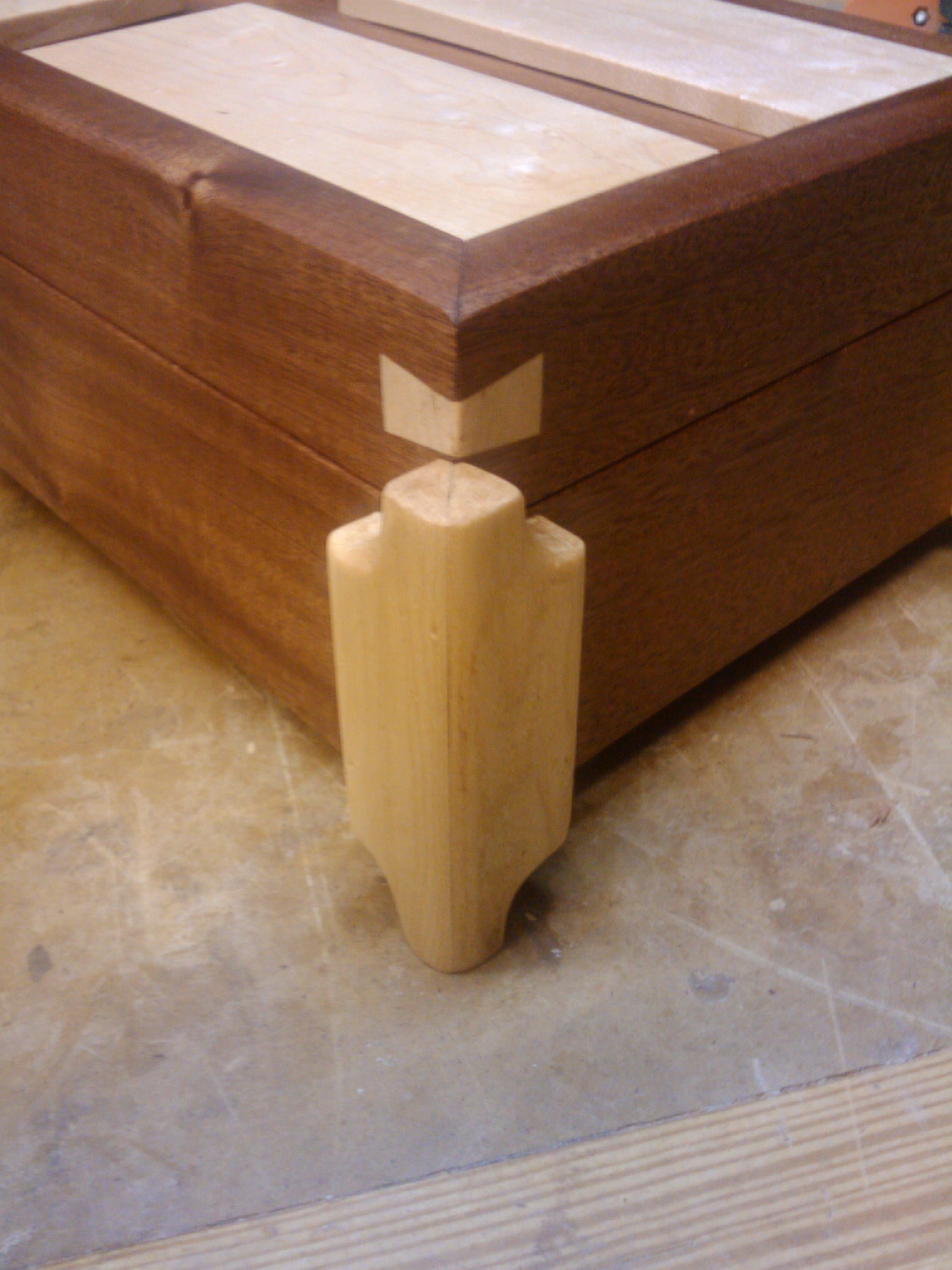
Then, I ripped a section of maple to about three inches wide.  I then bevel ripped the board down the middle at 45 degrees and cut the pieces so they would come together as a mitered assembly.  A quick cut at the band saw left me with ‘outside’ edges that curved up and down to form smaller feet, and I left the tops a little longer than the height of the box body to reference the top. A little bit of liquid hide glue allowed me to rub the joint together and have it hold while drying.  I love that trick.

Once the glue dried, I then glued them to the outside of the box and held them in place with a band clamp wrapped around the outside.

Since the lid’s corners weren’t secured, I figured what the heck, and I threw some Kehoe splines into it.  I kept them maple to continue with the contrasting wood theme.

The finish is my typical formula – a 1# cut of dewaxed shellac, followed by a thorough sanding with 320 grit paper and two coats of Watco Danish Oil. Once it was all done, I dropped it off at the church. I went to one of the ladies who was helping with my sons’ religious ed classes and told her it was for the auction. I have this feeling it may not make it to the auction – someone on the staff may buy it!

The most difficult thing about this project happened during construction. A good friend of mine looked at it on the bench and said, “Funny, it looks like the Holy Humidor.”  From that moment on, all I could do was think about lining the box with cedar and putting a few stogies in it!

The sharpness quotient

A sharp looking paint job. A sharp-dressed man. A sharp wit.

We throw out the word “sharp” a lot during our daily routine. And, most of the time that we do so, we aren’t referring back to something that can cut anything but the mustard.

As woodworkers, though, isn’t “sharp” one of our primary concerns? Sharp tools cut wood better than dull ones, are safer to use and lead to much better results. But, what exactly is sharp, and how do you know when you’ve gotten there?
To get to the bottom of this, we return to Ron Hock of Hock Tools. “Sharp is simply a quality you get when two planes intersect at zero radius. The closer to zero radius the intersection is, the sharper the edge will be.”

Seems simple enough, but of course, that’s not the end of the story. Ron began by explaining to me that for something to have sharpness, those edges have got to meet at a 90 degree or more acute angle. “You can get sharp edges on a board you cut to 90 degrees. Take it off the jointer and feel the edge and you’ll learn quickly what a sharp corner feels like. But, if you cut the board at greater than 90 degrees, the edge may be clean and crisp, but it’s less likely to cut you.”

That makes the angle of the edge a critical component. “The rule is that the more acute the angle where the two planes meet, the finer the edge, but the more fragile it will be.” That’s why razor blades shave hair smoothly with their very acute angle edges, but they would stink as wood-cutting chisels.
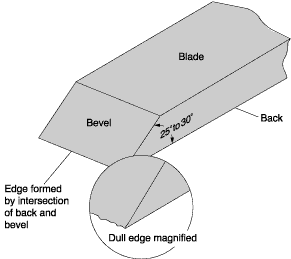
Interestingly, chisels are a very easy way to get a handle on this matter of sharpness. Paring chisels, used to carefully slice away wood for a joint, are usually ground with a 20 degree bevel. Mortising chisels, on the other hand, need to have their bevels ground at a wider angle – usually about 30 – 35 degrees – to withstand the chopping necessary to cut a mortise. Bevel-edge chisels – used in many cases for both applications – are ground to a 25 degree angle.

For many woodworking tools, sharpening is a relatively easy task. “Both plane irons and chisels are single bevel tools – they have a flat side and a bevel on the other. Since the bevel and the flat have to meet precisely, getting the flat side ground and polished is an essential first step.” When you purchase older chisels or plane irons, it’s a good idea to bring a straight edge along with you to see how far out of true these tools are on the back side. Even with the best tools, a careless owner may have done something to get the flat out of true. Most tools made in modern factories – especially high-end premium tools – are ground adequately flat at the factory.

“With a flat back, the next step is to shape the bevel. If the tool is made and maintained properly, regrinding the bevel may be required only if you like to hollow grind on a grinding wheel, if you want to change the angle of the bevel or if there is damage to the edge that you need to grind away.” There are many ways to grind the bevel on a tool – with coarse stones, on a wheel or a platen grinder, with sandpaper, etc. The key to grinding is to keep the bevel consistent as you work, and don’t overheat the tool, which turns the steel blue and draws the temper from the tool, leaving the overheated areas softer.
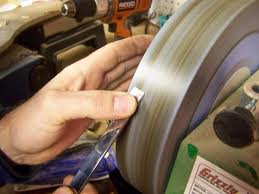
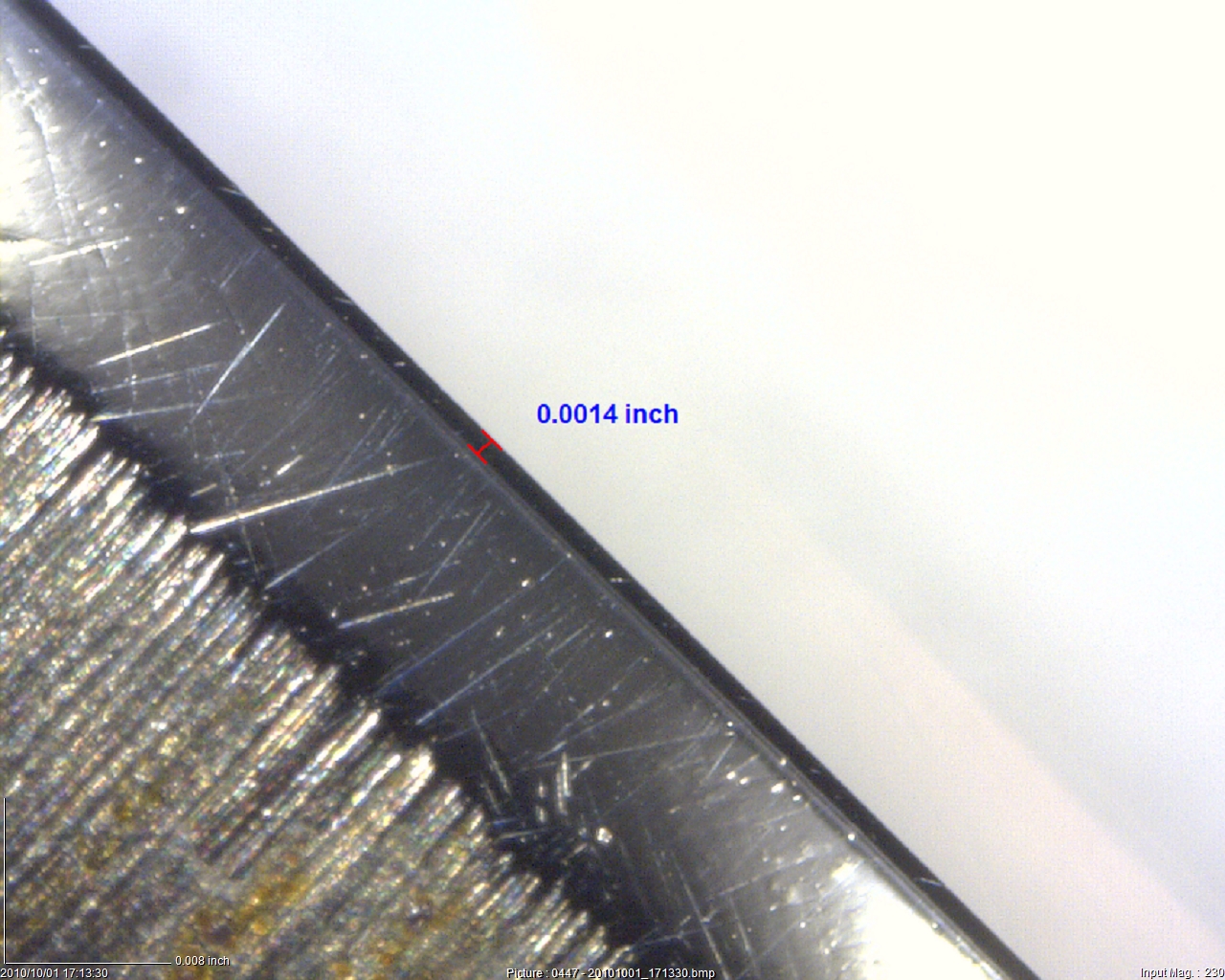
Once the bevels are ground, the next step is to hone the blade. “Again, there are a lot of different ways to hone a blade. Water stones, diamond stones, oil stones, honing film… What you are trying to do is to replace the coarse scratches in the blade with smaller ones as you progress through finer grits. This is going to make that edge where the two planes meet as fine as possible.” This is easy to see when looking at a blade’s edge through a microscope. Deep scratches from a coarse stone appear almost as rough saw teeth, and finer ones help refine the edge.
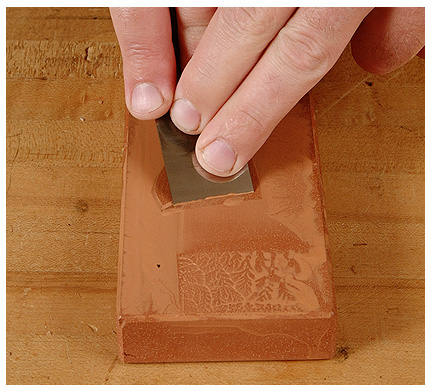
“For hand-held honing, I recommend a hollow ground bevel so the edge and the heel of the bevel can be used as a tactile honing guide. You can feel when the bevel is set properly on the stone. Some woodworkers also like to put a one or two degree microbevel on the cutting edge. You can save time this way because you’re only honing a thin stripe at the cutting edge. The larger angle of the microbevel strengthens the edge a bit, too. But if you hone hand-held, it’s difficult to maintain the angle of a microbevel.” Should everyone put a microbevel on their tools? “It’s all up to you – and your technique. I hear from both sides, frequently and adamantly. Microbevel or no, sharpening is a basic woodworking skill that requires practice like any other skill.”
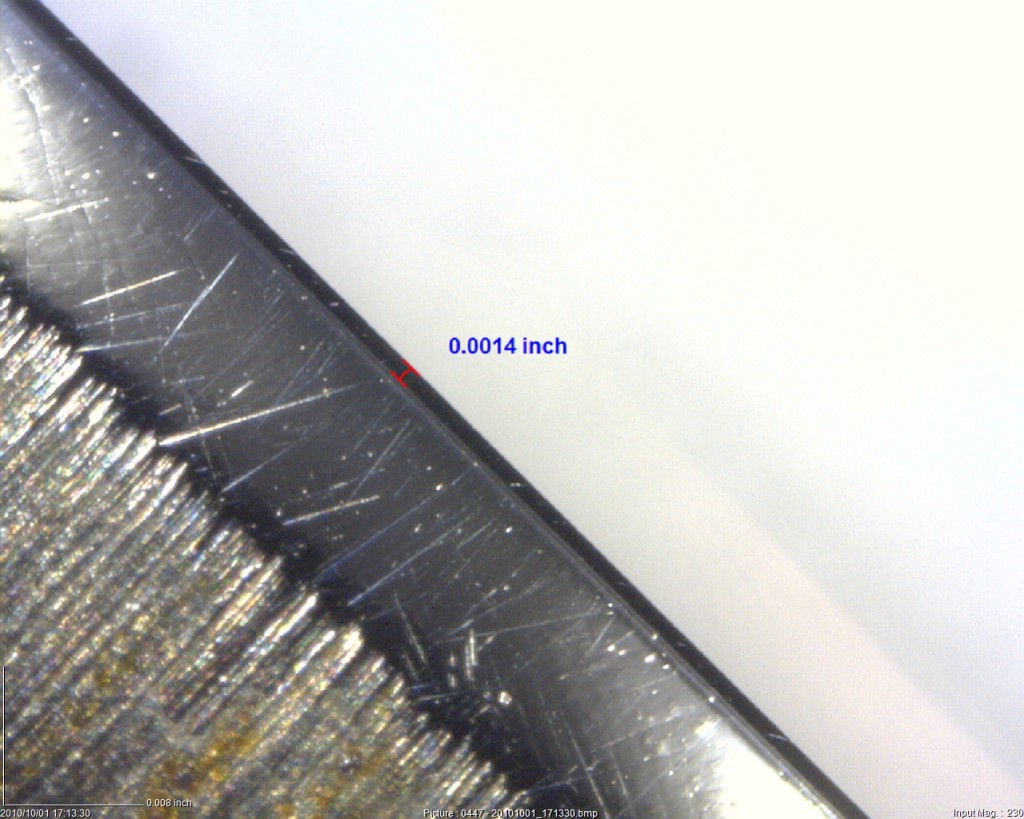
Double bevel tools such as knife blades require more care when sharpening. “Remember, you are grinding two bevels that have to meet at a particular edge as evenly as possible. Practice and consistency are keys here.”

But, how far should you sharpen your tool? “Polished edges do last longer but I’ve seen woodworkers obsess about getting to ultra-micro-fine abrasives to get the ‘perfect’ edge on their tools. I think 8000-grit is fine enough for most applications but woodworkers I know and respect insist on 12,000-grit or even finer for their blades (Here is an excellent chart to help you identify different grit sizes across a variety of honing media). Keep a block of wood, pine works well, in a vise nearby. When the tool can cleanly pare through the end grain with little effort, that’s where I’d stop. After all, you want to get back to woodworking as soon as possible, right?”