Species Spotlight: English Brown Oak

What a big year it has already been for Her Majesty Queen Elizabeth II. First, the entire world celebrated the 60th anniversary of her ascension to the throne. All I can say is that when I hit 60 years of doing something, I hope Sir Paul McCartney will be able to play at my party!

Later this week, she’ll open the 2012 Summer Olympics in London. This will be the third time that the capitol of the United Kingdom will be hosting the games, and the last time, Her Majesty had a chance to take them in as Princess Elizabeth while her father King George VI reigned.

And now, THIS!  A species spotlight on English Brown Oak.  On Tom’s Workbench? Why, it’s a trifecta of royal proportions!

Now, the English Brown Oak is the wood fit for a monarch. These regal trees grow all across the British isles, as much as 120 feet tall and 10 feet in circumference. If you visit the United Kingdom, you will still find forests of ancient oaks, including the old stomping grounds of Robin Hood, Sherwood Forest.  These stately trees were the ones that inspired J.R.R. Tolkien to dream up the Tree Ents in his Lord of the Rings trilogy.
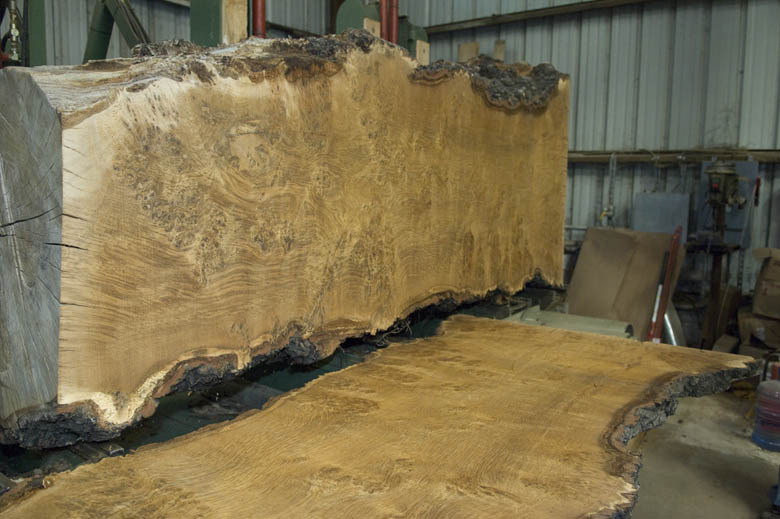
The wood itself is equally as handsome as the tree. While the tree is in the white oak family, it is a darker shade than you might be used to. It is a hard, heavy, dense wood that resists crushing, and, as with other white oaks, displays tremendous ray flake when quartersawn. The wood typically has a very straight grain, making it a great choice for steam bending.
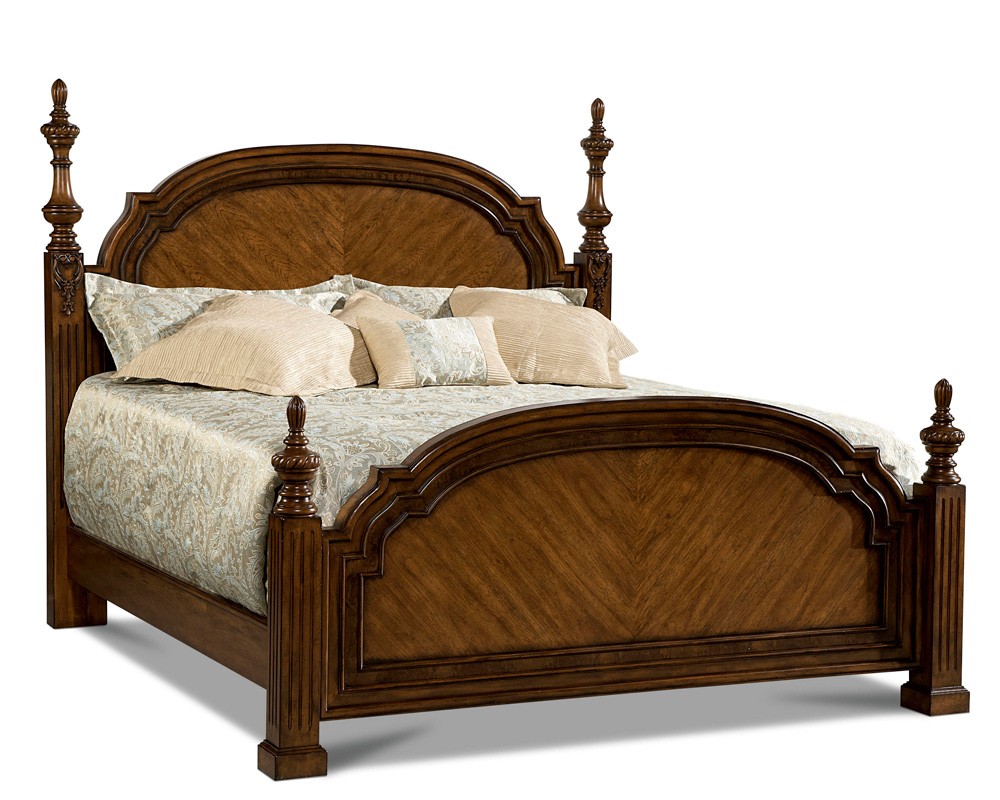
These trees were grown for buildings, ships and furniture. Shakespeare’s Globe Theater was made of timbers cut from oak forests. King Edward’s Chair, the throne on which monarchs are coronated, is made out of this very wood.
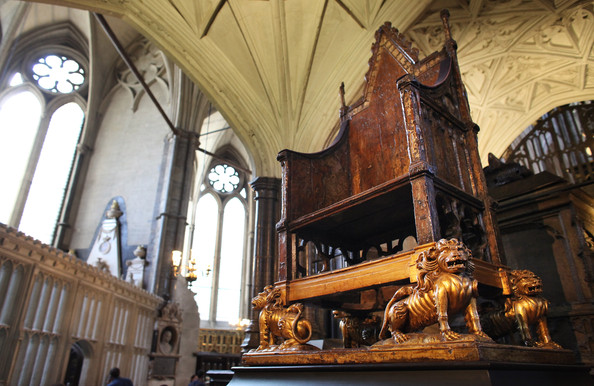
Be warned, though, if you try to use metal fasteners in English brown oak, you might run in to trouble. In fact, you will be learning one of the other uses the wood is famous for – tanning leather. The tannins in the wood are very tough on metal fasteners, and can cause significant corrosion. This tannin also gives English brown oak a moderate amount of decay resistance when used on outdoor projects.

OK, I admit that maybe the whole Tom’s Workbench feature may be a little overblown, I do think Her Majesty will be pleased to see just how much pleasure the stately oaks from her sceptered isle have given woodworkers throughout the ages and throughout the world.

 

Important People: Rhonda Iovino

There have been a bunch of folks who have had a major influence on Tom’s Workbench over the past five years. I wanted to take the time to recognize a few of the folks with which the blog would have never happened.

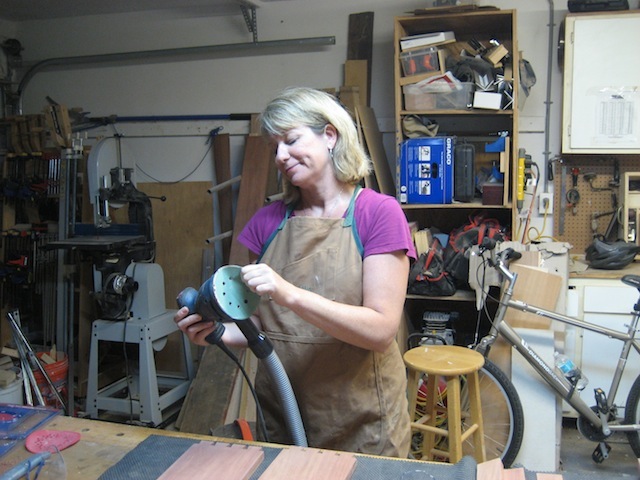
Today, I send a shout-out to my wife, Rhonda Iovino. It’s only appropriate, since today is our 19th anniversary.  (How does she find the patience to deal with me?)

A million years ago, when I first started woodworking as a hobby, I wanted to surprise my wife with a blanket chest. Something I wanted to build for her so she could stash some items which held important memories (items such as the snorkels we used on our honeymoon in Puerto Rico) as well as some useful, but out-of-season things (winter blankets during the long, hot Florida summers).

While that first project was an abomination (come on, Tom, construction plywood?), she never once wavered in support of my new hobby. Over the years, she has encouraged me to go to woodworking events – both locally and long-trips away from home – to help develop my skills. We have worked together in selecting projects to give as gifts for friends and neighbors. She has recently stepped to the plate and learned how to do some sanding and finishing on projects, and has expressed interest in looking forward to possibly building a few of her own. (How on Earth will we decide who gets time on the band saw?)

The best thing about her being part of the Tom’s Workbench team, though, is that she’s always there for me. No matter how many challenges I face, she lends encouragement – and a wise word or two – to get me back on track. And, when I’m sky-high with excitement after building a project, she brings me back to Earth, encouraging me to look critically at the piece I have built to see how I could improve my technique.

It has been one heck of an adventure, Rhonda. Thanks for being there.


About face!

With football season coming up, I always think back to my days when I attended the University of Maryland. I worked on campus all summer, and every afternoon, my co-workers and I would talk about the upcoming season, which games we were looking forward to, and how cool it was going to be to sneak some ‘adult libations’ into the stadium for the games. Ahhh, to be young and dumb again…

After work, though, I would always look forward to the walk back to my apartment. As I crossed Route 1, I had to pass in front of the campus’ chapel and the large field that rolled up the hill toward it. It was at the bottom of this hill where the school’s marching band was practicing, getting ready for performances. And, boy, did they ever suffer in the heat as the band director took more than one hundred individual performers and made a cohesive unit. The staff would teach the band members how to play together. How to create formations. And, most importantly, how to march together. It was always impressive to hear just one command – for example, ABOUT FACE – and see the entire formation of students turn on their heels and change direction in an instant. Such power used with such finesse.

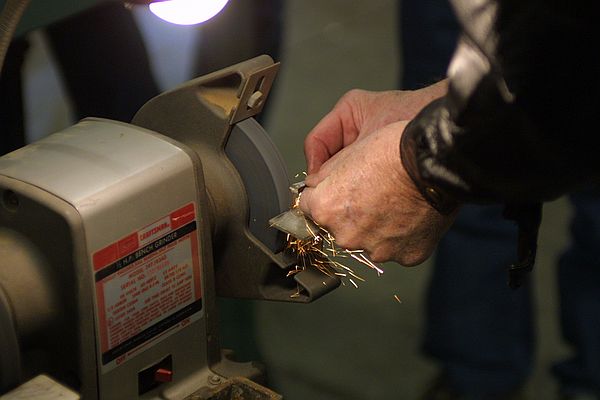
Sharpening is a task where you also need to use more than a little bit of finesse. For instance, if you want to sharpen a hatchet blade, you need to be aggressive to remove enough material to get that edge into fighting shape. But, when my barber hones his straight razor for my post haircut neck shave, he’s very careful with the leather strop.

In much the same way in the shop, there are some sharpening applications where you want to be extremely aggressive with the tool, and times when you need that feather soft touch to ensure the finest edge. Many woodworkers go for a high-speed grinder to get that rough stuff out of the way, then turn to stones to get the fine honing. But, can that be done on a single machine?

Surprisingly, my Tormek can handle both tasks. The wheel on the sharpener can be graded to a coarse cut for edge shaping, then later regraded to a finer grit for the polishing process. Just as important as stone grading on this system is the direction in which the stone rotates.

If you sharpen a blade with the stone turning toward you, the cut is far more aggressive. The wheel can remove a tremendous amount of material in short order (something you do need to pay attention to, otherwise you could totally reshape your tool!) with the turning direction turned toward you. So, if you are trying to get a nick out of your blade, this is a great feature. When you want to put the final polish on the blade, simply turn the machine around, and with the wheel turning away, you lay the blade edge on the wheel and the cut is much less aggressive.

The only problem with this arrangement? The machine is solidly built and kind of heavy. Plus, with a tub full of water keeping the wheel wet, you can get quite a bit of sloshing going on, soaking the stuff on your bench. That’s why I sort of parked it in one configuration – wheel rotating away – and kept it there. It was OK, but it would have been better to have that other option.

That’s why I was so pleased to see a new accessory for my Tormek sharpener. The folks over at Tormek sent me one of these turntables to mount the tool on, making this twist a piece of cake to pull off. The base is solidly built, with gripping feet on its bottom and a smooth ball-bearing guided turntable. The top of the base is relieved to have the Tormek’s feet rest in place, preventing it from slipping.

With this new base in place, I can easily move from the coarser grinding to the finer honing. This has encouraged me to do more sharpening of tools as they dull, instead of waiting for them to all be dull and setting aside a block of time to sharpen them all at once. My tools stay sharper, the quality of my cuts remains high and it can help me make some beautiful music at my bench in the shop.


Quick Poll

It’s happened to all of us.  You are working from commercial plans or a cut list of your own devising.  You follow the plans closely and make all of the cuts.

But, when you move on to the assembly process, you accidentally glue a piece in the wrong place.  For me, I usually discover this accident when I get farther down the road on the assembly process and have to break the pieces apart or cut new ones.  Drats!

Fortunately, most woodworkers make this mistake once, then turn to a method of carefully marking the pieces to ensure it never happens again.

This week, let us know how you keep track of the pieces in a complex project.  Do you use the tried and true cabinetmaker’s triangle or something else?

Important People: Nicole Spagnuolo

There have been a bunch of folks who have had a major influence on Tom’s Workbench over the past five years. I wanted to take the time to recognize a few of the folks with which the blog would have never happened.

Today, I send a shout-out to Nicole Spagnuolo. What? Did you think one Spagnuolo would be enough?

I first met Nicole when I was up at a woodworking school in Indiana. Marc was instructing the Contemplation Bench class I was attending, and Nicole came along for the trip. During the day, Marc spent a lot of time with me, trying to prevent me from cutting a few fingers off or creating a pile of designer firewood, Nicole popped in to say ‘hey’ and help document the build.

It was one night after a hard day in the shop where I really got to know both her and Marc. Nicole was preparing a delicious chicken dinner, and she asked for help snapping some fresh green beans. While we sat preparing the dinner, I realized that these two kids where alright – the kind of folks I wish lived on my street so we could invite over for barbecues and to shoot the breeze.

When Marc suggested that perhaps I might want to start a blog, it was Nicole who did a lot of the legwork getting the tomsworkbench.com domain name and helped me get the infrastructure working on the site.

Early on with the blog, there was a point where I felt as if I couldn’t go on anymore. I wasn’t drawing thousands of readers each day, and I thought it wasn’t worth keeping things up and running. As if on cue, Nicole sent a quick e-mail letting me know just how good she thought the blog was, and that she couldn’t wait to see more content.

So, you have Nicole to blame!

Today, Nicole is a proud mom, a video gamer and one of the funniest people I know on Twitter. And, yes, I have to admit, as an unofficial honorary uncle, I look forward to the pictures of Mateo she shares with the online community.

I don’t think I have said it enough, but thank you, Nicole for all of your help.

Important People: Marc Spagnuolo

There have been a bunch of folks who have had a major influence on Tom’s Workbench over the past five years. I wanted to take the time to recognize a few of the folks with which the blog would have never happened. Today, I send a shout-out to Marc Spagnuolo. This one should probably be a no-brainer, because he’s the guy who got me into this fine mess in the first place.

What is there to say?  If you want someone to blame for Tom’s Workbench, visit the Wood Whisperer’s site.

Marc was just a wee lad back in the day when we first met… online at the Woodworkers Website Association. Although you wouldn’t have ‘ recognized him.  At the time, he was writing his entries under the name MarcSpag, and he was pimping his website Marc’s Wood Creations. I think he got better at naming his website!

When we first met in person up at a woodworking school in Indiana, Marc already had the cool, collected delivery of an experienced instructor. He was funny, easy to approach and knew more about woodworking that I could have ever figured out. It wasn’t until I later discovered that he had studied with David Marks – and that influence showed.

From there, everything with Marc was incremental. “Hey, Tom, could you write a few posts for me?” became “Hey, Tom, can you write a regular post for a site I’m creating called Wood Talk Online?” which became “Hey, Tom, how about your own blog?” which became “Hey, Tom, how about doing a recorded audio tip for my webcast?”

My guess is that when Marc opens the Wood Whisperer franchise on Mars, I might be one of the few folks in line to run it.

But, hey, that’s what a couple of Italian boys from Jersey will do for each other!


Link of the week

John’s Woodworking

Sure, this is a day early, but today we are going south of the border to visit Juan Garcia, a woodworker who plies his trade in sunny  Torreon, Mexico.

Juan learned woodworking up in Canada, and returned to his homeland where he builds custom furniture… from the 3D computer design to the finished project.  And, what projects he builds! From furniture to doors, ceilings to other oddball things, nothing is too challenging for this fearless cabinetmaker.

His site is written in Spanish, but, don’t worry, Google and other online translation services are available to help you enjoy his site.

While his site is just getting off the ground, he does have a great collection of photos of his work for you to check out. Not a bad operation.


part of the Wood Talk Online community