Link of the week

The Flex-Sander

I was recently at a local carving show when I ran into a guy named Jerry Moore. He was sitting at his booth showing off a pretty neat little product for wood carvers called the Flex-Sander.

Jerry explained that when you are doing fine detail carving, it’s difficult to get into the tight areas of your project. Jerry’s solution is a flexible piece of plastic and miniature sanding belts. By simply changing your grip, you can get the sandpaper into the narrow cracks and crevices, and you can rotate the belt to get fresh grit.

Not only is it a clever little invention, it’s also made locally, a few minutes from my house in the city of Pinellas Park, Florida. Here’s to successful local businesses!

Inlay disaster averted

Before I start, I need to issue a full-on apology to the folks at Milescraft. If you don’t know who they are, they make some really nifty router accessories that can add versatility to your setup. Trammel guides, wide bases, rapid-change bushings. Really sweet stuff. You owe it to yourself to check them out.

I was working on a project at the shop when I ran into a situation – I had a project (I’ll show next Monday) that was beautiful, but lacked something special. Maybe an inlay. The only problem is that I have never made one before.

Within a few minutes of tweeting my dilemma, one of the reps from Milescraft offered to send me a copy of their inlay kit for use on the project.
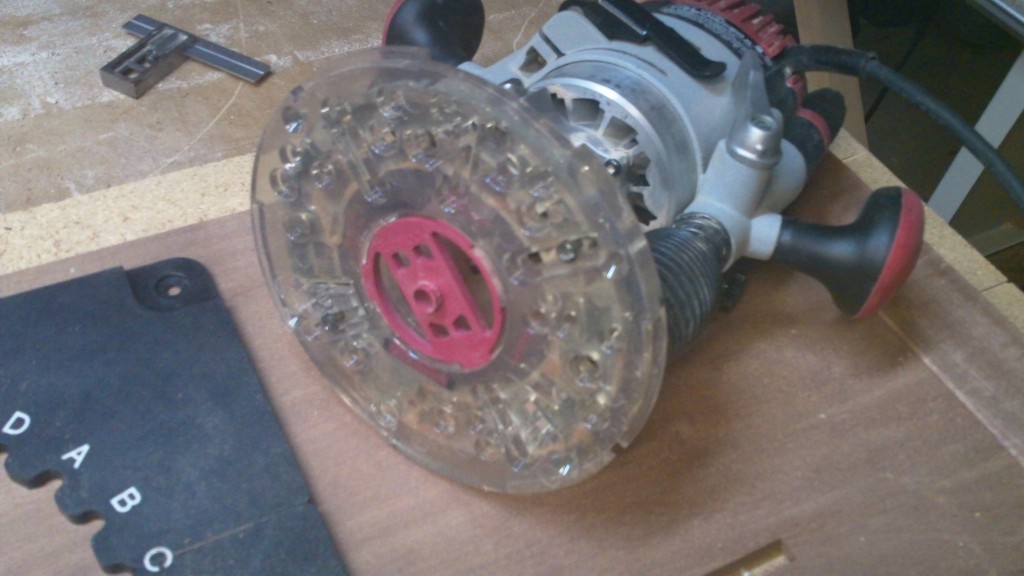
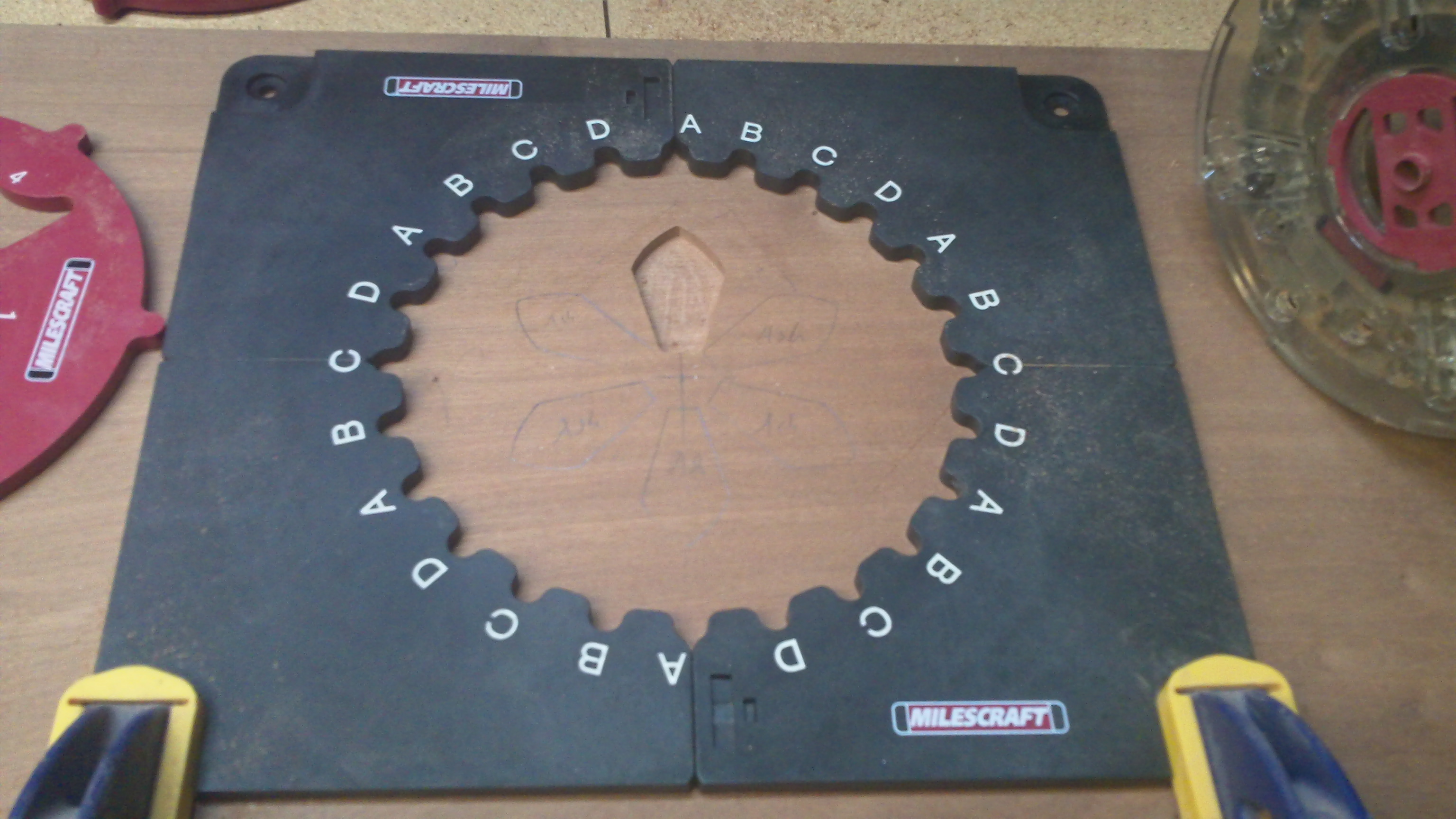
Now, if you have ever made an inlay in a piece using a router and a pattern, it’s a pretty straightforward process. Using a 1/8” router bit and a plunge router, you will cut the recess in your workpiece and then use the same equipment to create the inlay piece from some scrap. The key is to use two different sized bushings on the router – a larger one that pushes the bit further inside the pattern when cutting the recess, and a smaller one that allows the bit further outside. The difference between the two distances is very precise, and it allows the inlay piece to lay inside the recess tightly.

Now, the old expression is that if you practice on scrap, you are practicing on your project. To prevent this, I dutifully found a piece of milled poplar and cut a recess in it. I changed the bushing from large to small, then, I took a piece of scrap and cut the matching inlay into it… they fit very well. So far, so good.

So, I moved to make the cut on my work piece. I set up the pattern jig – an indexible insert that allows for precision placement and rotation for making repetitive cuts. I centered the jig, used the piece I wanted to fill the insert to gauge how deeply to cut, and set to work.
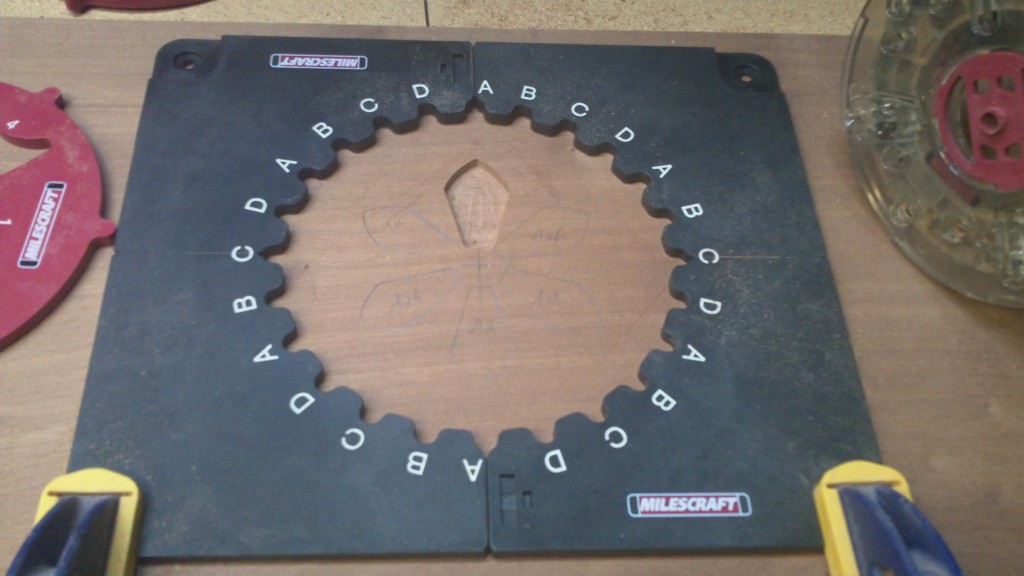
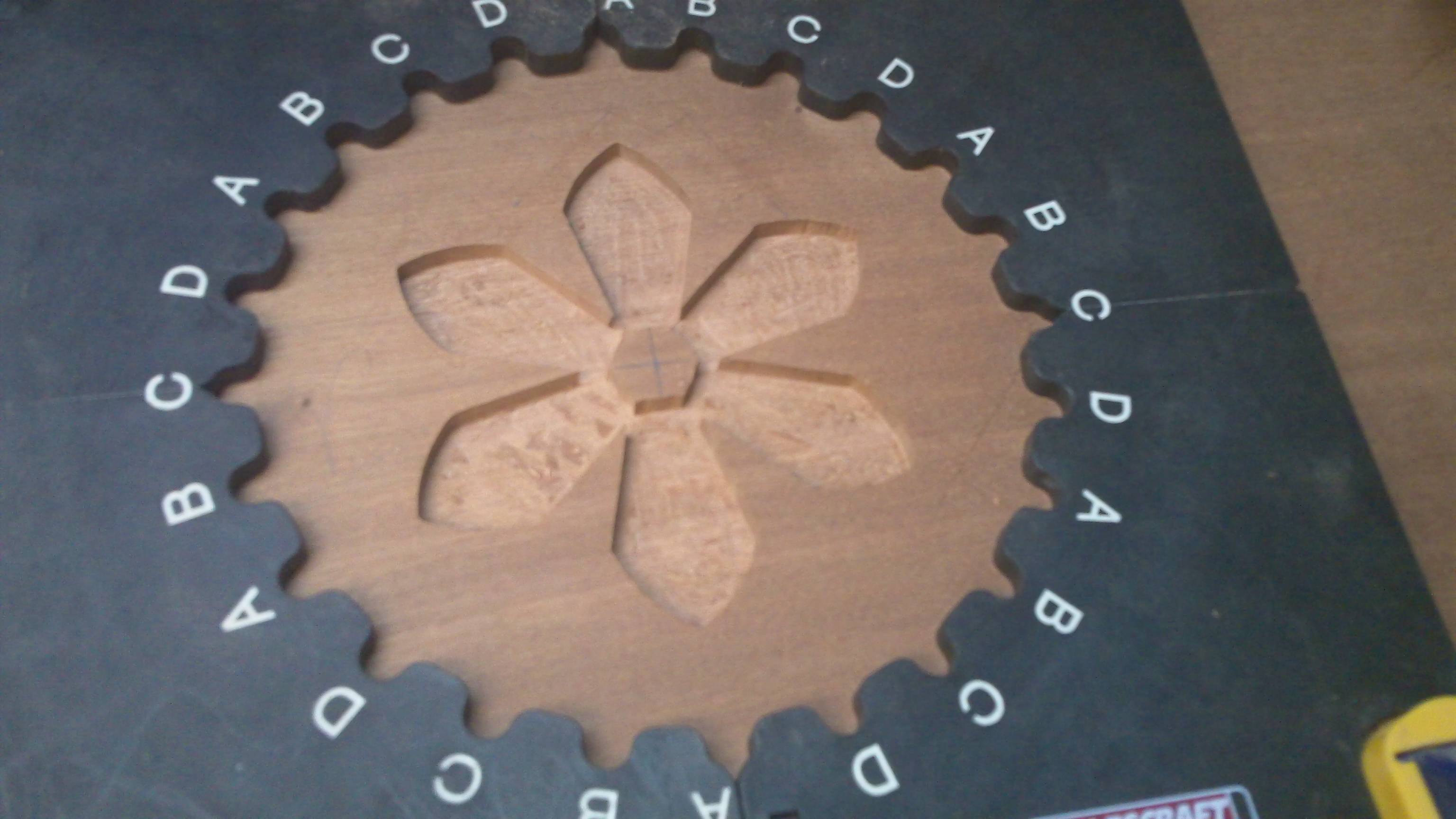
The cutting with a small bit is very smooth, and before long, I had the first cavity routed out. This was going to be a piece of cake.

As I set the router down, a sudden feeling of dread overcame me. Did I remember to change to the large bushing after I cut the sample?

A quick look at the router baseplate told me all I needed to know. Nope.
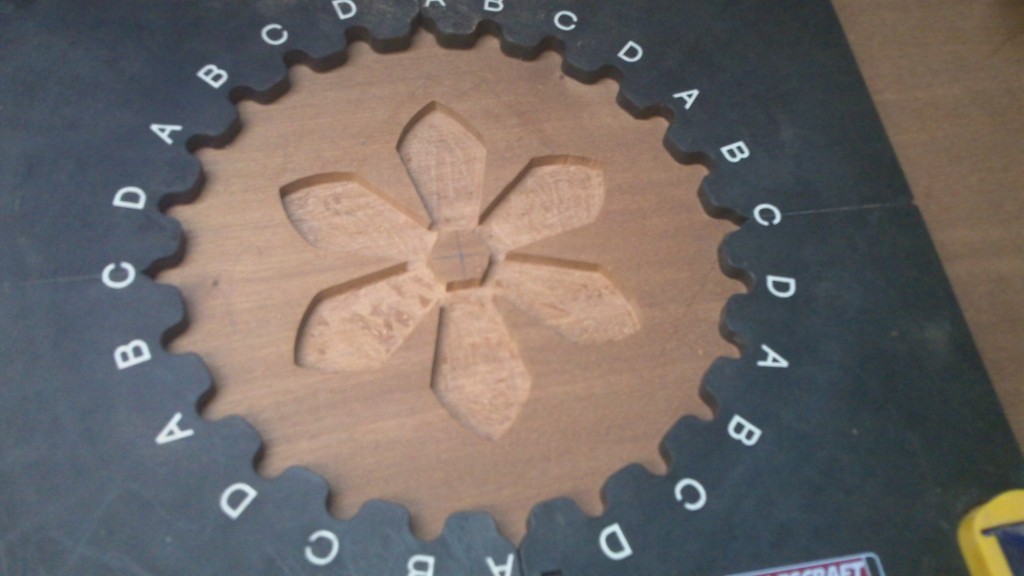
So, now I was stuck with an oversized recess that couldn’t be matched. TOTAL bummer. Thoughts of throwing the entire piece away entered my mind. I had to come up with a solution – and fast!

That’s when I remembered a trick someone had told me years ago – colored epoxy. I grabbed my car keys and headed to the nearest home improvement center.

Epoxy, for those who don’t know, is a two part resin and hardener that glues like nobody’s business. It’s waterproof and has the ability to fill cracks, cavities and other imperfections in wood. In fact, many woodworkers who enjoy working with mesquite swear by it. At the local home improvement center, I found the largest containers of resin and hardener I could find and opted for the 60-minute set version to allow enough time to do what I had to.
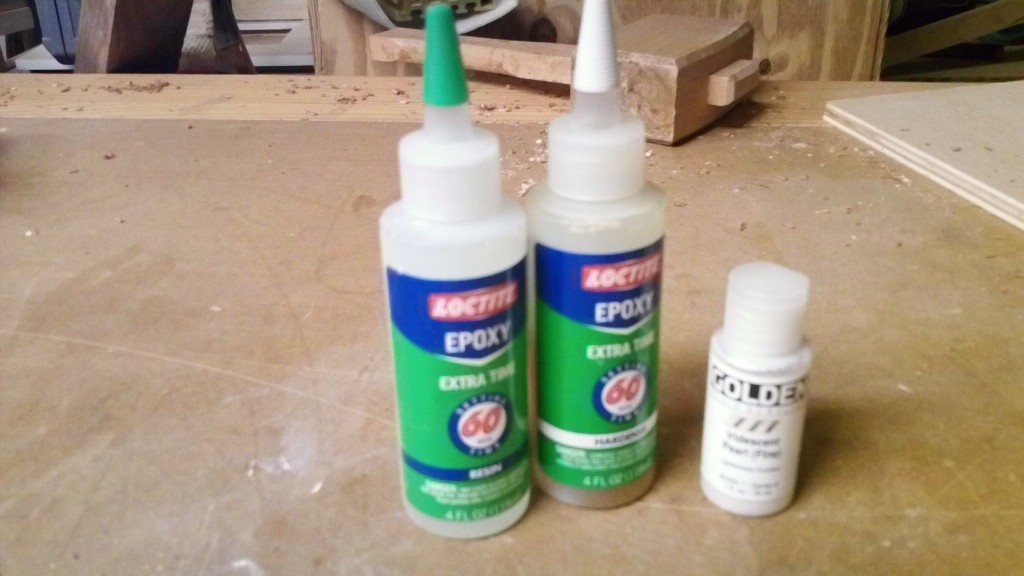
But, how would I color it? Fortunately, my smart phone was able to get reception in the store, and I was able to search for coloring epoxy. Apparently, artist acrylic colors do a decent job. I paid for the epoxy and dashed over to the local Michael’s craft store. There, in the painting section, was a small bottle of pearlescent white paint. Sold.
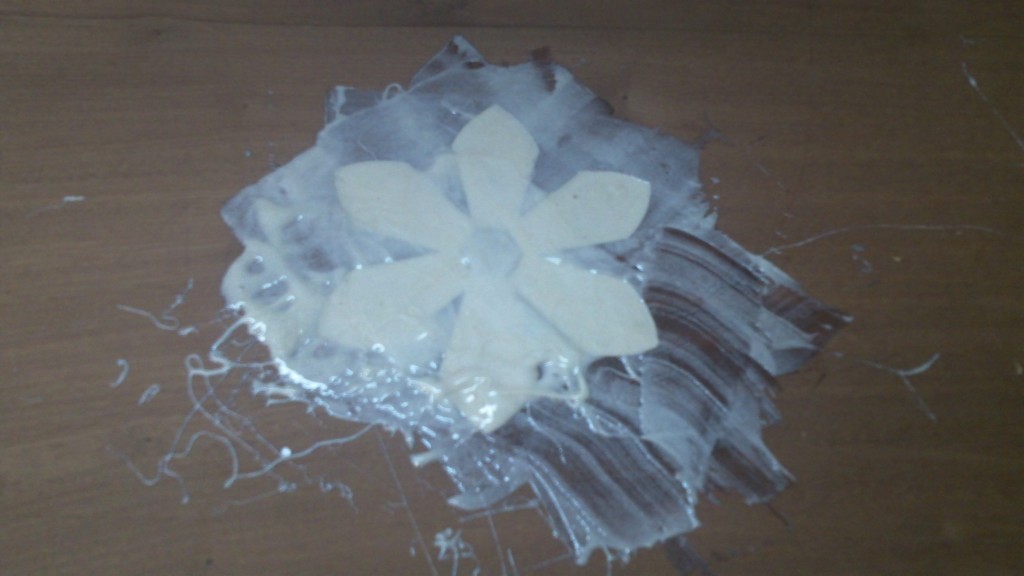
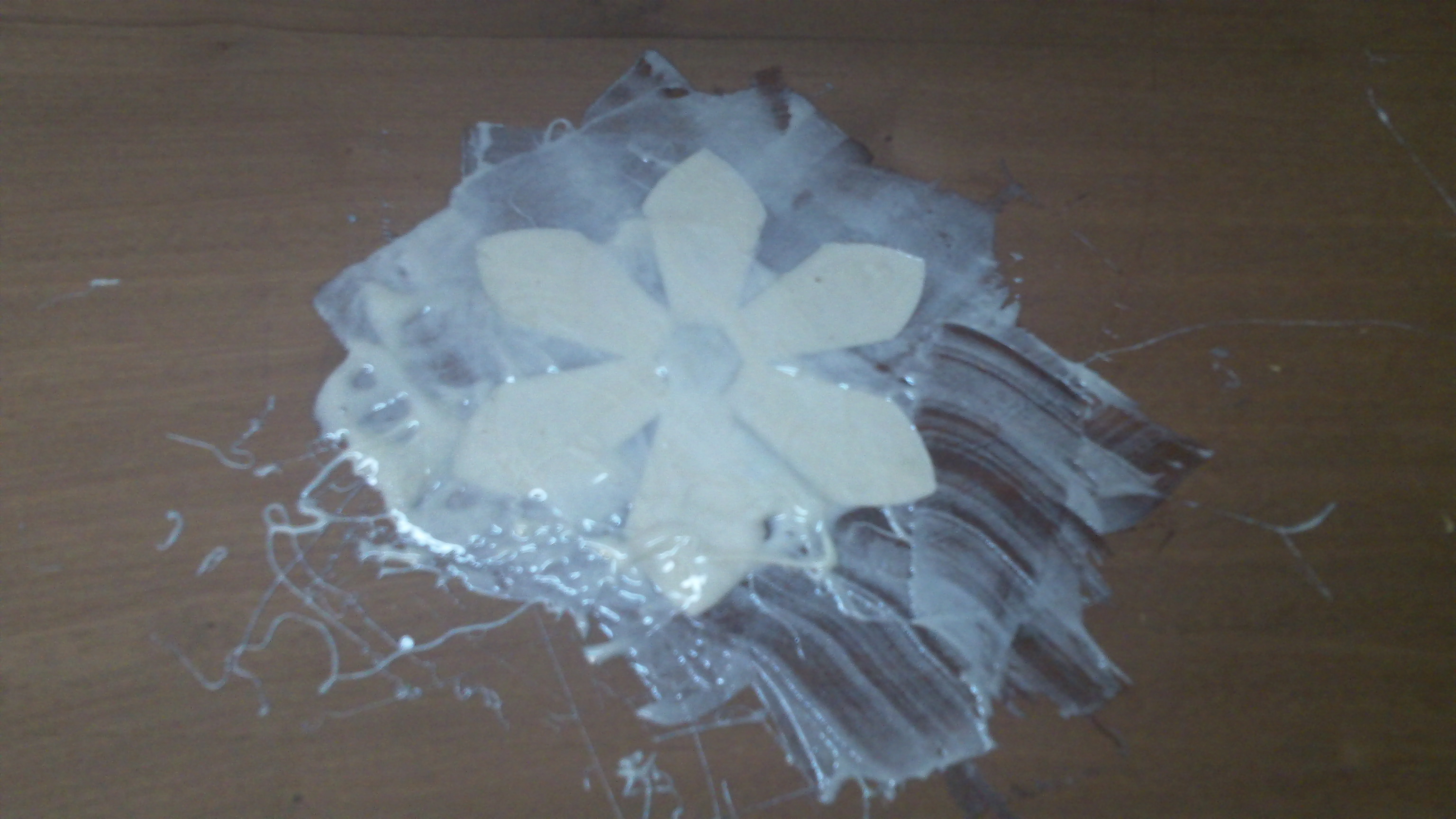
Back at home, I mixed the epoxy per the instructions and added about 10% of the paint to the mix. It immediately took on a richly colored hue. I poured the mix into the recess and smoothed it out with a scrap of wood. Sure, it looked like a hot mess of cake frosting, but my plan was to address this with the next step.

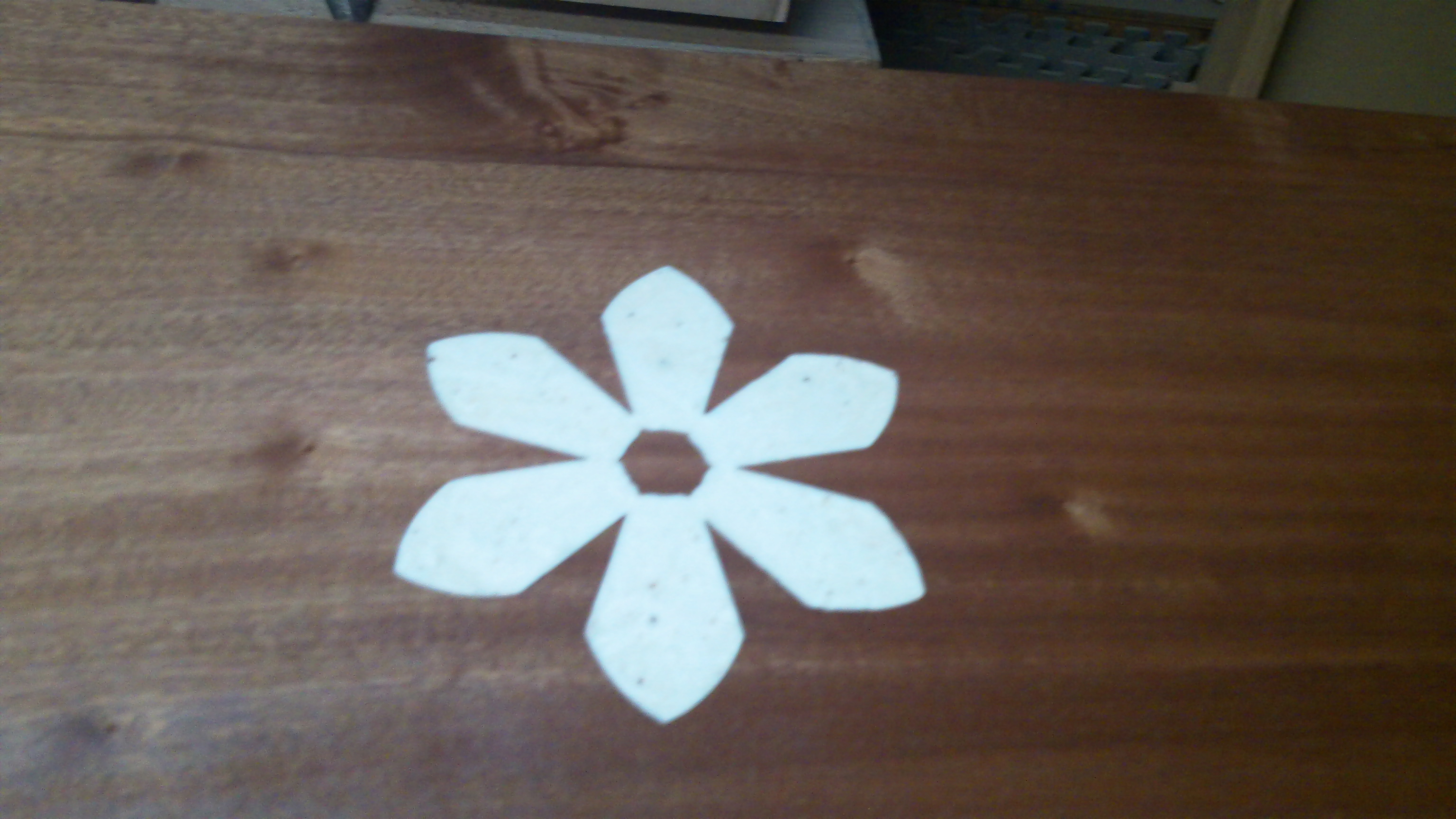
I let it sit overnight so it would harden, then started sanding with 100 grit paper on my random orbit sander. It took a little bit of time, but I could see it was removing the hardened epoxy. Once I began to see the clear outline of the inlay, it was nothing but good. Some more sanding, and soon, I had the piece ground down flush and it started to burnish up nicely. I changed sanding grits to 150 and then 220. The epoxy in the inlay was actually starting to glow with the finer scratch pattern.
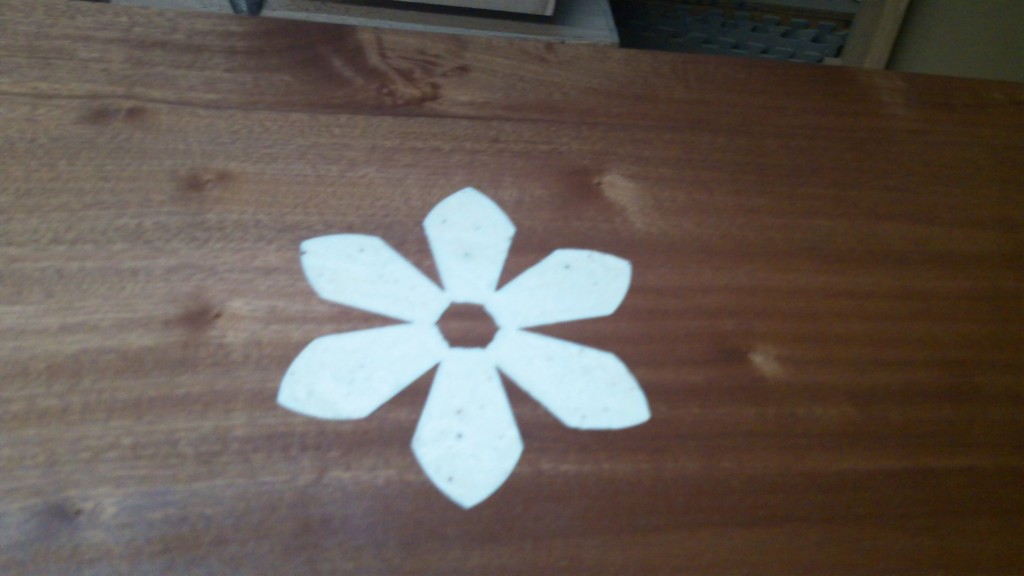
When it came time to finish, I laid on a coat of 1# dewaxed shellac, then sanded it to 320 grit by hand to get the surface smooth. Two coats of Watco Danish oil later, and the project was done.

When you look at the inlay, you can see the color variations showing how the epoxy was poured. It’s not a monolithic looking surface by any stretch of the imagination. In fact, several people have asked if it is some kind of ivory or mother-of-pearl inlay.

You have got to love a trick like this – proving that – at least in my case – creative problem solving is a skill that helps improve woodworking.


Spring out of the trap!

Check your calendars. Yup, THAT day is coming. Valentine’s Day.

V-Day is one of the biggest trap holidays of the year for couples as far as I’m concerned. Think about it – we have just completed the holiday season, complete with gifts, celebrations and even resolutions for the New Year. And, since the spring and summer are the two most popular seasons for weddings, the big anniversary celebrations are coming down the pike.

But, there Valentine’s Day sits, smack in the middle of winter for us in the northern hemisphere. The holiday bills are due, the snow and ice are out in force this year and good luck trying to make reservations for a fancy dinner at a restaurant. Faggetaboutit!

Add to the mix that my wife – as with many other spouses – has told me not to make a big deal out of the day. Hmmm, I’ve heard her say that before – only to find out that what it really means is to not make it look like it was a big deal…

Fortunately, we as woodworkers have an easy way out of this trap holiday – and it involves our favorite pastime of all – woodworking.

“Yeah, this is always a tough time of the year for us,” said Tim Walter of Eagle America. “That’s why we have a few ideas that can get you some shop time AND win some big points with your better half.”

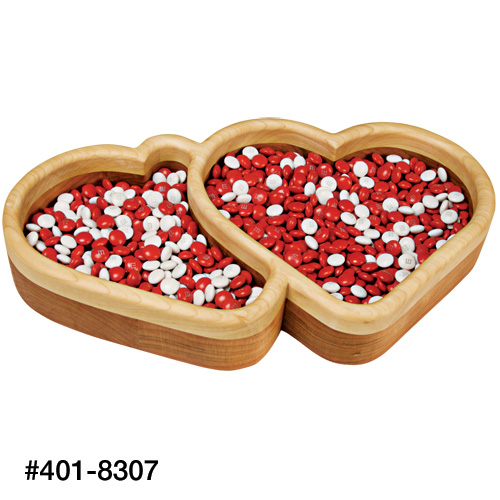
The first idea he shared with me was an appropriately-themed adaptation of Eagle’s wildly-popular tray routing system. “We have templates in the classic Valentine’s heart shape so you can show your significant other just how deep your love is. Heck, if you really want to get fancy, we even offer the double heart template so you can demonstrate just how both of your hearts are intertwined.” (I had no idea Tim was so poetic, but DANG, that would make a great line to put in the valentine card you send your sweetie, no?)

By using the template and special bowl-routing bit, you can easily make a serving tray out of one species or a glue up of several. Just don’t forget to include some nice chocolates with the gift…

If serving trays don’t make your heart go pitter-patter, there are other options to choose from as well. “A special keepsake box is a meaningful gift to give – especially to that special someone in your life.” The beauty about keepsake boxes is that they require such a small investment in wood, but allow you to be as creative as you would like to be. “Material selection, joinery choices for the sides, foot design, interior linings – the options are nearly endless. Imagine using wood harvested from where you first met or spent your honeymoon incorporated into the project. That would be a piece with special memories and show just how unique your relationship is.” (Tim should get a job with Hallmark! He’s that good!)

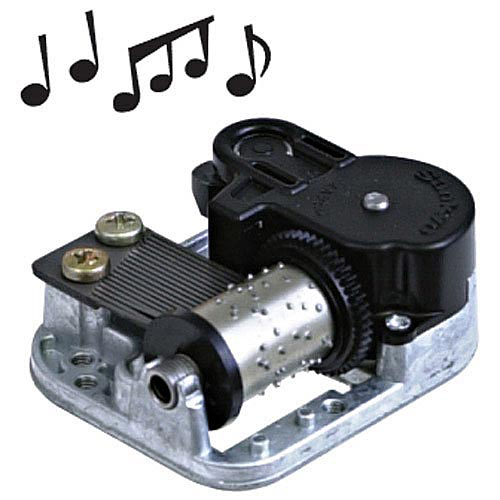
And, if you want that box to do more than just hold stuff, why not consider installing a musical movement? The choices sound like the playlist for a new couple at a wedding reception – Unchained Melody, Let Me Call You Sweetheart, Close to You… Heck, maybe one day they’ll offer a few selections from Barry White to make their collection complete!

While it may be a trap holiday, it’s best to play Cupid – not stupid – when it comes to getting ready for Valentine’s Day.

Quick Poll

Curly. Bird’s eye. Quilted.

Figured woods can bring a great deal of visual interest and drama into any project. As you can tell from some of the things I have built, I just love the stuff.  The Nakashima inspired bench I built in 2009 highlighted the beauty of a maple board that showed curl and bird’s eye figure.

This week, tell us how frequently you use figured woods for your projects.

[poll id=”156″]


Dear Band Saw,

I know this is the time I usually write the Link of the Week, but, after the way I have treated you, I needed to write this letter of apology.

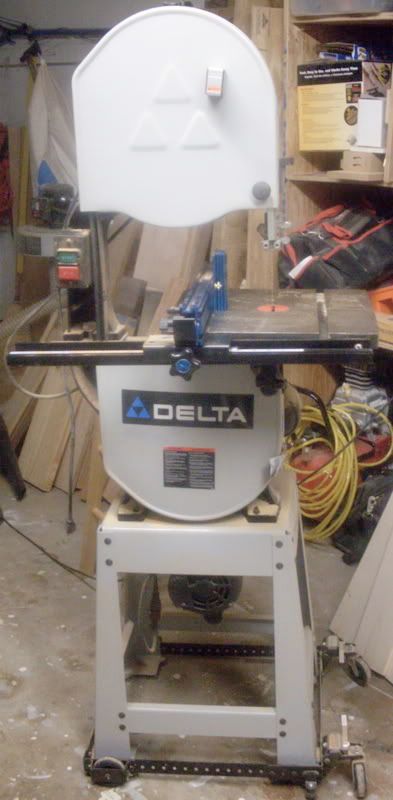
Do you remember the day we first met? It seems like yesterday. I was in that local Lowe’s, money in hand, looking all over the store for someone who could help me pick you up. I had read a lot about you, and thought that you and I would make a great pair. It took me a while, but I eventually got some help, and the sales associate told me to wait where I was.

Oh, how we laughed together when the sales guy brought out the forklift to carry you to our minivan.  It’s a good thing that I remembered to take out the back seat, because you were so big, and you barely fit into back cargo area.

And, when I got you home, and none of the neighbors were around to help me cart you out of the van.  Don’t you remember how I nearly broke my back attempting to haul you from the van to the shop?  How I struggled single handedly to haul your top half on top of your bottom section and bolted you together?

Oh the promise of those early days!  I was going to learn how to resaw, to make band sawn boxes, to cut thin strips for bending around forms…

But, it never felt right. You would struggle.  You would stall. You would drift wildly.

I did everything I could to get you to work better. New highly-recommended blades. Books about how to properly tune you. Cool blocks. A rolling base.A Kreg precision band saw fence.  The sky was the limit as far as I was concerned – you were MY band saw, and nothing was too good for you.

Then it happened. I went on vacation and used another saw. That band saw worked wonderfully. Oh, how it cut! Like the proverbial hot knife through butter.  Everyone asked me when I was going to get my own band saw, and I didn’t have the heart to tell them about you and your pitiful performance.

After that, things were never the same between us. I said bad things about you on this blog and in front of the other power tools in the shop. Do you remember how I would growl at you when I had to resaw even the smallest board?  “Why don’t you work like the other band saws?”

I know it must have hurt your feelings when I showed  you the catalogs with other band saws in them. The Grizzlys. The Lagunas. The Generals. The Rikons. When I told shop visitors that I couldn’t wait to get a ‘real’ band saw that would actually do some work. When I turned to other tools to do the jobs that you should have been able to handle with little or no effort.

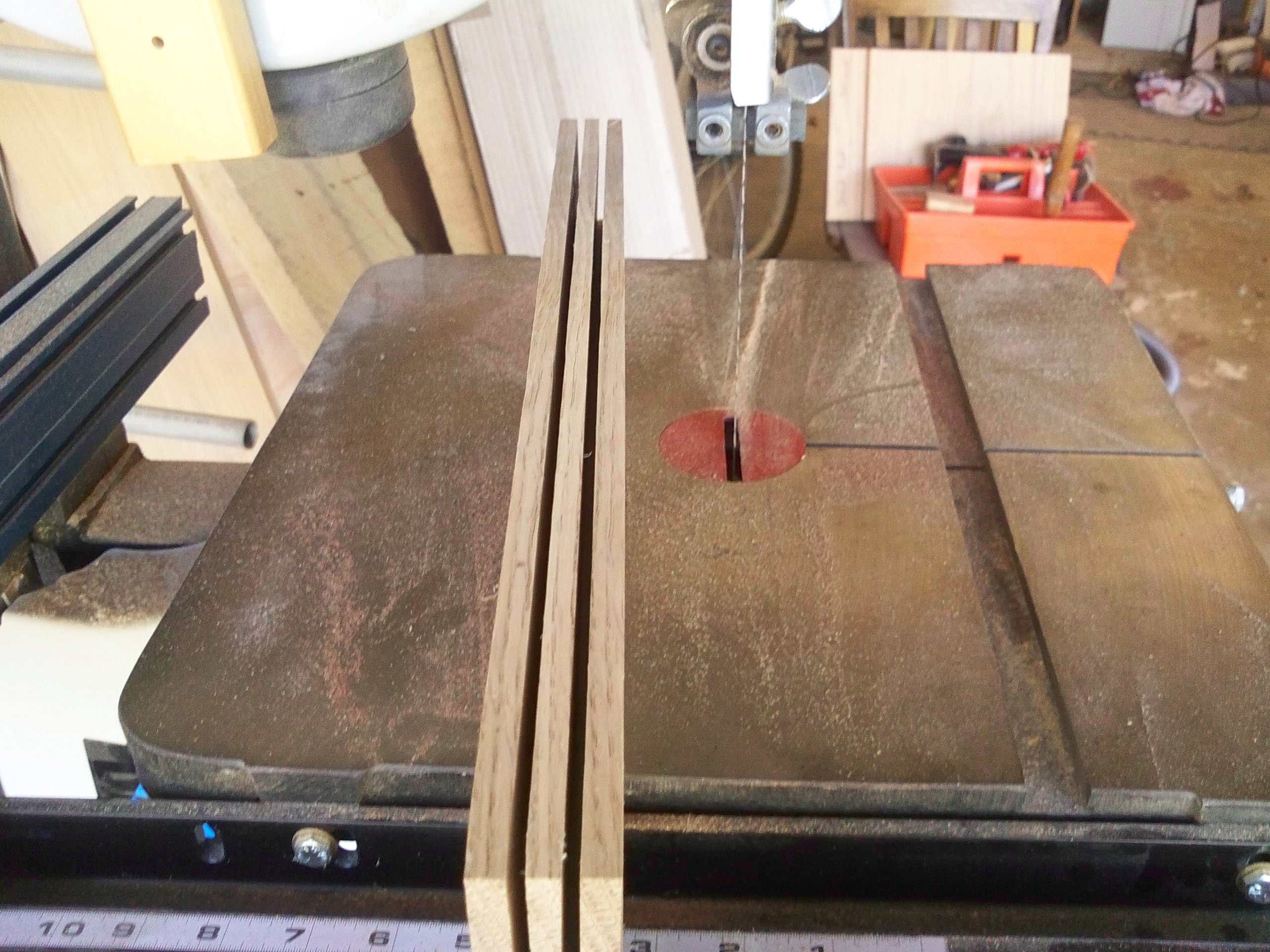
But, after all these years, all of these abuses, all of these libels and slanders, will you ever find it in your heart to forgive me for discovering last night that I never properly tensioned your drive belt the right way when I first set you up, and discovering that three turns of a 1/2″ bolt would have spared us all of this trauma in the first place?

Yours truly,

Tom

P.S. Iggy can’t stop laughing. Seriously. I think he may blow out a lung.

Species Spotlight: Walnut

Tall. Dark. Handsome.

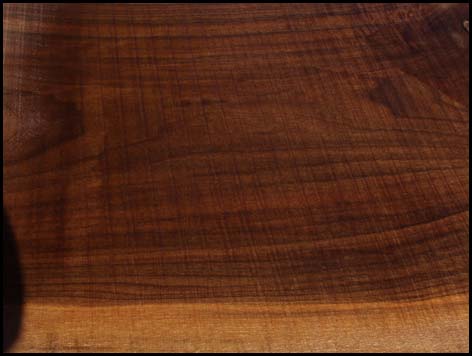
If you ever wanted to apply these adjectives to a species of wood, walnut would be the one you might choose. One of the most traditional and classic of hardwoods found in Europe, Asia, North and South America, walnut is one of those woods that understatedly says ‘class’ when worked into a project.

“It’s one of our most popular sellers year after year,” said Eric Poirier of Bell Forest Products. “And, that comes as no surprise to us. Walnut works beautifully, is very stable and can be finished to a very smooth surface.”

The wood’s color varies from a light cream in the sapwood to a rich chocolate brown in the heartwood. Walnut trees tend to have wider areas of sapwood, which can limit the size of the darkest heartwood boards. If a streak of lighter wood is included in your board, it can easily be dyed to match

When used in cabinetry and other woodworking projects, this dark wood can be paired with a lighter species such as maple to create a striking contrast. “Maple pulls on a walnut project, or vice versa, really makes the piece pop.

Its legendary working properties and strength also make it a natural for musical instruments, and for centuries, it has been the wood of choice for rifle and shotgun stocks. “Soldiers from both sides during World War II were armed with rifles made from millions of board feet of walnut. The German Mausers, British Lee-Enfields and American M-1 Springfield rifles are some of the examples of battlefield weapons made with walnut stocks.” Today, many sporting long arms and handgun grips are made of this tough wood.

Walnut lumber is exciting stuff, but when it comes to burls, that’s when this wood goes off the chart. Walnut burls are easily some of the most coveted woods out there, either being used for turning bowls or to be sliced into veneers for projects, especially on the interiors of high-end luxury automobiles.

One interesting thing to note about walnut and its sawdust – if you compost your sawdust in a garden, be sure to keep your walnut sawdust separate and dispose of it another way. The wood has a substance known as juglone in it, which can kill other plants, especially tomatoes and apple and birch trees. Many animals also have a sensitivity to this as well, so it’s not a good idea for animal bedding.

Stuff I’ve built: Position of Strength

January 2011

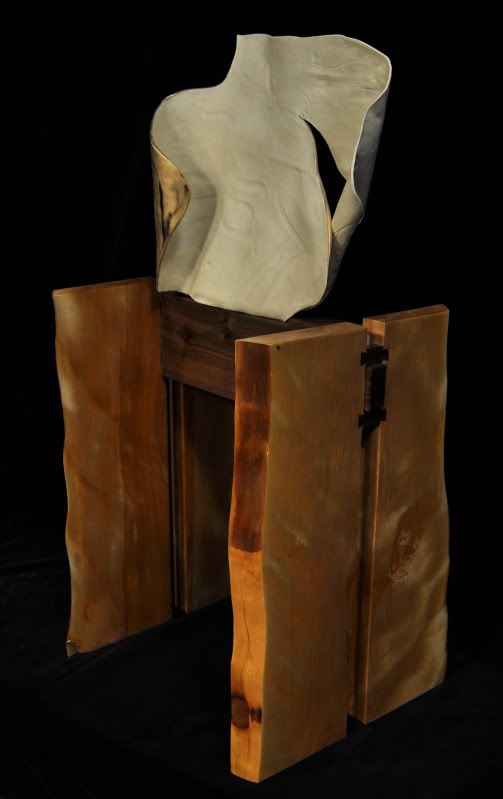
It’s art contest time again at the county courthouse (Brought to us through the National Arts Program), and again, I’m in the contest with a collaborative effort between myself and talented ceramic artist Debra Lansdowne.  Normally, I’ll post multiple views of the project to show how things are made, but the shot below links to a very high resolution image that shows how this simple project was put together.

The base was my responsibility. Debra had showed me her sculpture – an interesting piece made out of a single sheet of clay. It’s sculpted to look like the torso of a well-muscled man (it almost looks like he’s also wearing a cape, floating in the wind off his right side). Unlike last year, she had the sculpture done and was looking for me to create a base.

I had to build something that would show strength and a lot of visual interest. During my lunch hours, I sketched out ideas on a notepad in my office. Maybe something with bent legs like Mars and Venus Rising, the project we entered last year. Nah, we’ve already been there. Maybe something with a Greek influence. Meh… that would be something to easy to expect. Eventually, inspiration struck me, and I sketched up something that looked a whole lot like the final project.

A quick e-mail to Eric Poirier of Bell Forest Products led to a search of the kiln – and this piece of live-edge slab flame birch.  This is the board I was having a bear of a time smoothing a few weeks ago. I cut the slab into 24 inch long segments, then ripped them down the middle with my track saw. They were perfect right off the bat, requiring just a little touching up to get smooth inside faces.  I carefully maintained the order and arrangement of the segments so they would stay in matched pairs as I laid them out.

The slabs are joined by a pair of  walnut ‘pins’ that are joined to both sides by sliding dovetail joints. I went with the sliding dovetail because it would be a tight holding joint and add visual interest to the piece.

Once those pins were in place, the next step was to find a walnut stretcher.  Fortunately, I had a chunk of walnut – 8/4 by 8 inches by 24 inches long. I shortened it a little bit, and then cut a tennon on both ends to fit in the void between the two slabs and the pair of pins.  The fact that the stretcher had some knots in it added to the appearance as far as I’m concerned. On the top of the stretcher, I custom carved out a pocket where the base of the sculpture would fit in snugly when on display.

I affixed the stretcher in place with a 1/2 inch dowel drilled through the pins.  It was a basic, available at your local home improvement center kind of dowel, but it fit beautifully and locks everything together.

Once everything was in place, I finish sanded the piece down to 220 grit.  Once I cleaned off the dust, I coated the piece in a 1# cut of dewaxed shellac and sanded it with 320 grit paper when it was dry. I then applied two coats of Watco Danish oil, sanding between each coat. Finally, I buffed on a coat of wax to finish things off.

The artwork is due to be delivered on January 24, so this one is done.  Meanwhile, I have another project on the bench I made some progress on this past weekend.  I’m hoping to have that one done in time for the contest, but it’s gonna be close.

part of the Wood Talk Online community