Category Archives: Tools

The Hole Truth

Shelves in furniture projects are great.

They can hold books, boxes and clothes.  Important papers, stereo components and bottles of wine. Clocks, pictures and ceramic figurines of pink flamingos that scream “I live in Florida!”

The tough part is getting them mounted securely and having them come out level so the stuff doesn’t roll off onto the floor.

There are several schemes you can use.  Screw cleats into the sides of the furniture and permanently affix them in place. Or, you could rout out grooves to install a metal shelf standard. While these are good ways to get them mounted, the way that many woodworkers go with is the use of shelf pins.
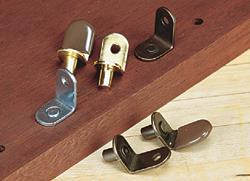
You can find them spoon or L shaped, and they can fit into holes drilled directly into the case sides or into sleeves which fit into those holes. They are exceptionally convenient if your book, electronics or knick-knack collection changes over the years by simply moving the pins to holes above or below to raise or lower the shelves.

The real trick is to get them level.  A typical shelf will use four pins – two on each side – and, if they aren’t absolutely level, you are going to have some trouble with wobbly shelves.

Since the thought of hand measuring and marking every single hole will drive you bonkers in short order, we often turn to jigs to speed up the process. A shelf pin jig can be as simple as a piece of shop grade pegboard or as complex as a production jig for making European style cabinets based on the 32 mm system.

Me, I’m looking for simple, inexpensive and foolproof.  Heaven knows I’m a very advanced fool, so foolproof is definitely a selling point.  That’s why I went with a simple hand drill based commercial system.

Sure, you are probably yelling at your computer right now.  “Tom, why spend money on something you can build from scrap?”  Simple, I’m lazy, and I figure that when I want to do shelf pins, I just want to be able to grab it and go.  No fuss, no muss.
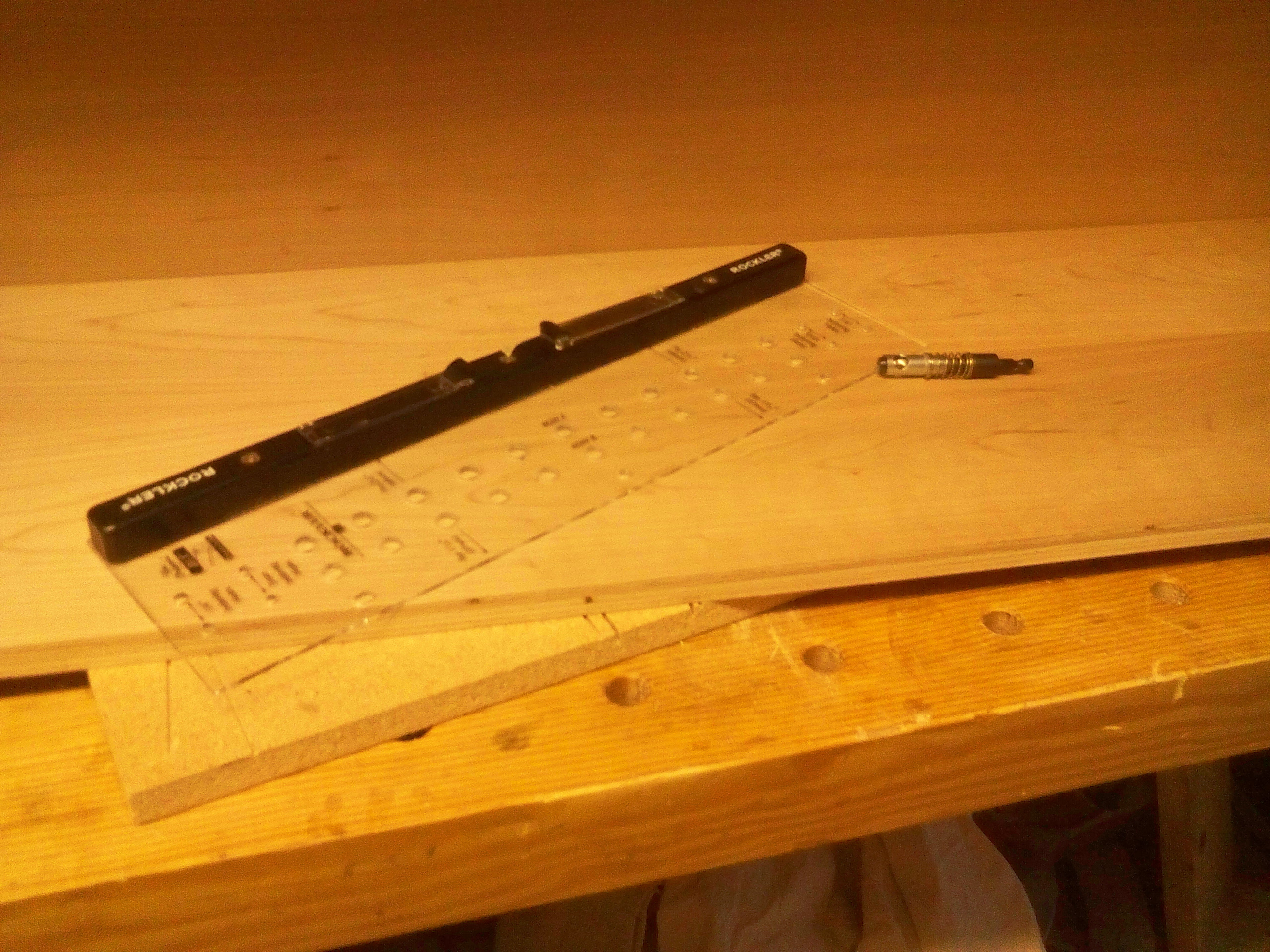
A system like this is insanely simple.  It’s a piece of plexiglass with shelf pin template holes drilled into it. These holes are placed so there is the same distance from either edge of the jig to the first hole.  This way, you can use the jig in any number of configurations and the spacing will come out right on the money.

The secret weapon with this jig is the special bit that comes with the system.  It has a 1/4″ drill bit set in a spring loaded body. When you position the bit, the plastic ring at the top of the bit engages the jig’s hole, preventing it from sliding.  Once you start the drill and plunge, the bit cuts into the wood. The bit also has an automatic stop which allows it to  plunge just shy of 1/2″ deep, which means you won’t drill through your cabinet material.  Sweet.  More foolproofing.
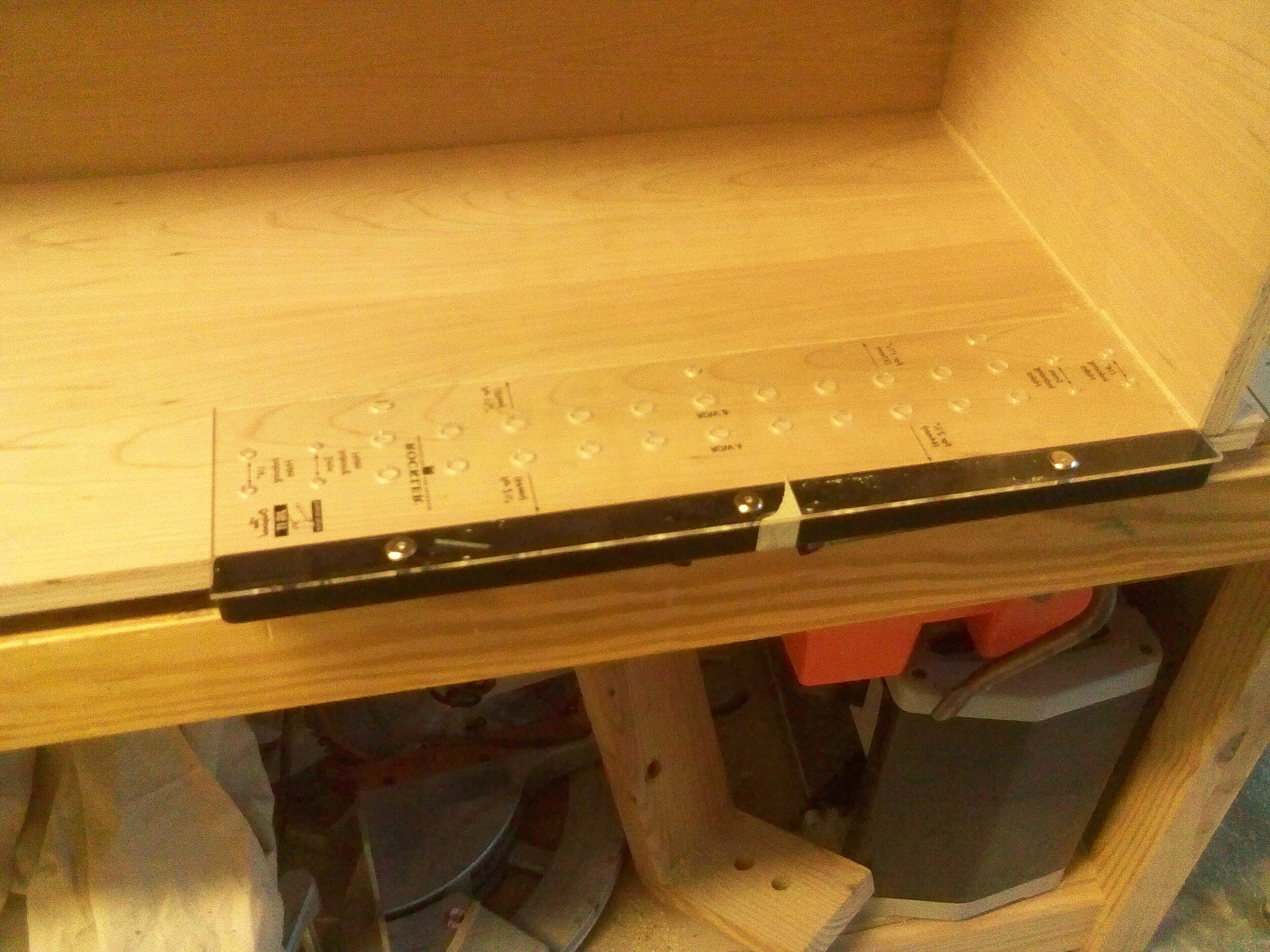
For the two cherry bookcases I’m putting on the top of the cabinet project (which is now entering the home stretch – yay!), I’m drilling holes to hold the shelves.  To begin, I set the jig with the stop facing down and pressed firmly to the cabinet’s face. Then, I push the jig flush to the bottom of the cabinet. I count up a number of holes (I don’t need adjustable pins three inches off the floor of the cabinet, right?) and start drilling.

“But, Tom, the jig isn’t long enough to reach from the bottom to the top of your case! What do you do now?”
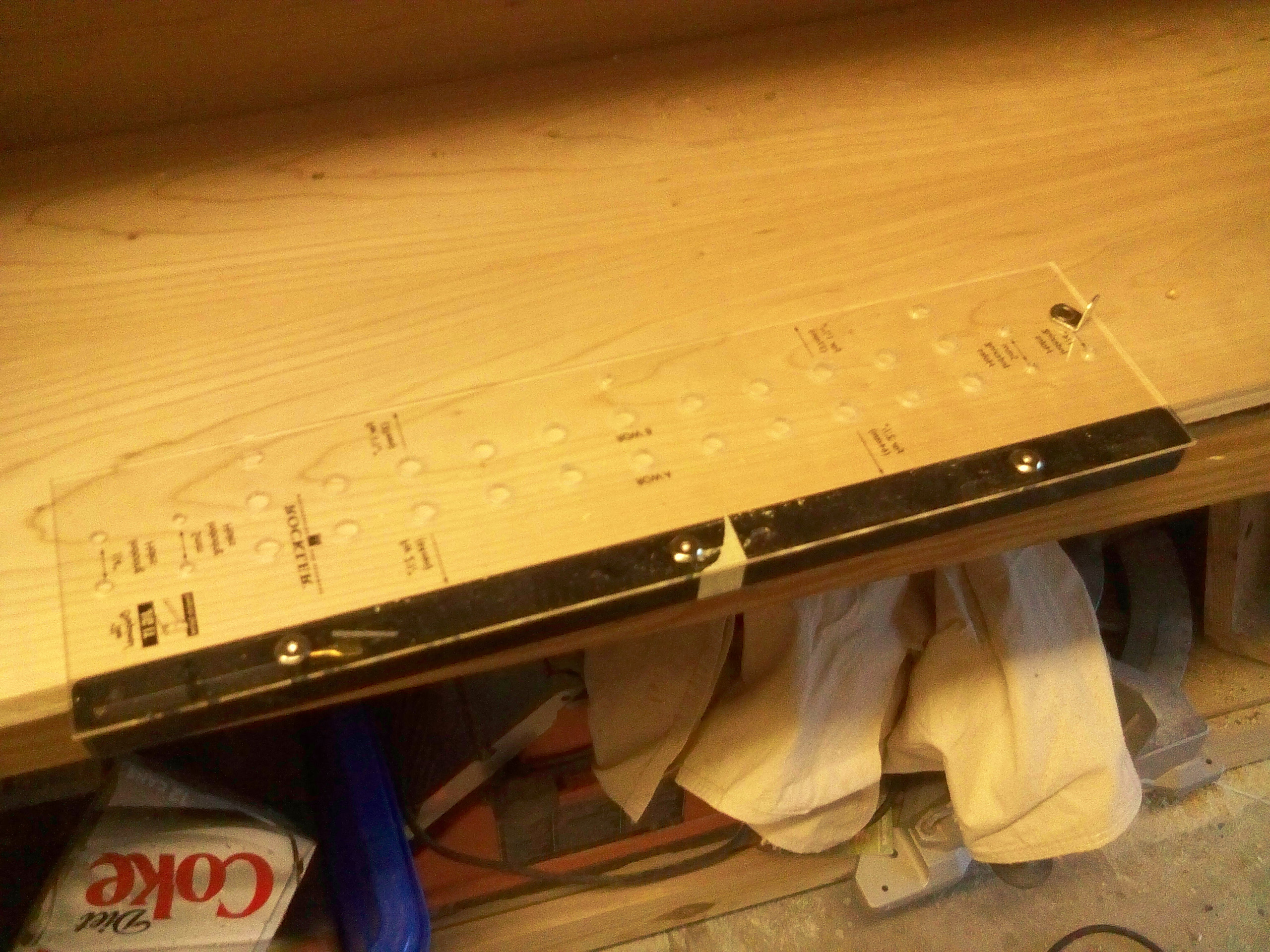
Piece of cake. At either end, the shelf pin jig has an indexing hole. I move it over a hole I already drilled, insert an old shelf pin through the indexing hole and my spacing continues up the case.  I can move the jig as many times as is necessary to go to up the case.

And, when I need to drill the back rows of holes, I flip the jig over, press it down on the bottom of the case and firmly to the back, and drill ’em just like the front.

The one caveat about using this jig is you need to drill at a high speed. Some battery operated drills just don’t get revving as fast as they need to, and you will see some tearout where the drilling happens.  I use my corded drill, which has the RPM to give me clean holes.

I’ve used this jig on a number of projects in the past, and the shelves come out dead on.

And, when I finish the shelves for this part of the project, I’ll show you what it looks like.

Stay tuned for a future post to see those!
The Cutting Edge

What do all woodworkers have in common?

An all-abiding love of wood comes to mind first. Yes, that’s probably the number one trait shared by everyone who works in wood.

But, think deeper. I don’t care if you are carver, turner or cabinetmaker. I don’t care if you use western or Japanese tools. Power tool junkie or hand tool enthusiast to a fault. I don’t care what continent you call home. What is the one thing we all do universally in our shops?

We all do some kind of wood cutting.

Whether is a chisel, router bit, saw blade or even sandpaper, at some point, every woodworker is going to make a chip, a cloud of sawdust or a shaving. You are going to rip, crosscut, shave or sever something in order to craft that chunk of wood into your final project.

“Kind of funny, isn’t it?” asked Tim Walter of Eagle America. “In order to build something, it’s almost always necessary to remove wood.” When you break it down to that level, woodworking is almost a zen-like exercise of addition by removal.

This universal truth means, of course, that woodworkers need tools to cut the wood. For some, this process strictly involves hand tools. “I’ve seen master craftsmen and women work with some pretty impressive tools,” said Tim. “From hatchets and draw knives to very fine hand planes, spokeshaves and paring chisels. It’s an awesome experience to see, and I have absolutely nothing but respect for those who practice the traditional crafts.”

For the majority of woodworkers, however, their shops use a combination of basic hand tools and power tools. “Power tools are great in a shop,” said Tim. “Just think how long it would take to hand rip all of the boards for a fancy bed headboard or gorgeous dining room table…”

No matter how much you pay for your power tools, there’s another universal truth. “Band saws, table saws, routers – each of these tools, no matter how sophisticated – is only as good as the cutting bits and blades they are equipped with.”

To help woodworkers upgrade their woodworking, Eagle America is holding its huge cutting tool sale. “Now is a great time to upgrade your basic bits and blades, and to get your hands on some of the ones you have always wondered about.”

From the Eagle and Price Cutter router bits to offerings from well-known manufacturers are Freud, Forrest and Olson, there are offerings for nearly all budgets. “And, when you throw in savings of up to 20% from regular prices, you have the opportunity to upgrade your collection and improve your woodwork.”

Unlike most sales, Tim reminded me that the sale prices also apply to sets of bits and blades as well as clearance items. Normally, most sales don’t allow discounts on these already marked-down items. “It’s our way of thanking our customers for their support all of these years, and to see what kind of new projects we can encourage our customers to go ahead and build!”

What do all woodworkers have in common?

An all-abiding love of wood comes to mind first.  Yes, that’s probably the number one trait shared by everyone who works in wood.

But, think deeper.  I don’t care if you are carver, turner or cabinetmaker. I don’t care if you use western or Japanese tools. Normite or Neanderthal. I don’t care what continent you call home. What is the one thing we all do universally in our shops?

We all do some kind of wood cutting.  Whether is a chisel, router bit, saw blade or even sandpaper, at some point, every woodworker is going to make a chip, a cloud of sawdust or a shaving. You are going to rip, crosscut, shave or sever something in order to craft that chunk of wood into your final project.

“Kind of funny, isn’t it?” asked Tim Walter of Eagle America. “In order to build something, it’s almost always necessary to remove wood.” When you break it down to that level, woodworking is almost a zen-like exercise of addition by removal.

This universal truth means, of course, that woodworkers need tools to cut the wood. For some, this process strictly involves hand tools. “I’ve seen master craftsmen and women work with some pretty impressive tools,” said Tim. “From hatchets and draw knives to very fine hand planes, spokeshaves and paring chisels. It’s an awesome experience to see, and I have absolutely nothing  but respect for those who follow the traditional crafts.”

For the majority of woodworkers, however, their shops use a combination of basic hand tools and power tools. “Power tools are great in a shop,” said Tim. “Just think how long it would take to hand rip all of the boards for a fancy bed headboard or gorgeous dining room table…”

No matter how much you pay for your power tools, there’s another universal truth.  “Band saws, table saws, routers – each of these tools, no matter how sophisticated – is only as good as the cutting bits and blades they are equipped with.”

To help woodworkers upgrade their woodworking, Eagle America is holding its huge cutting tool sale.  “Now is a great time to upgrade your basic bits and blades, and to get your hands on some of the ones you have always wondered about.”

From the Eagle and Price Cutter router bits to offerings from well-known manufacturers are Freud, Forrest and Olson, there are offerings for nearly all budgets.  “And, when you throw in savings of up to 20% from regular prices, you have the opportunity to upgrade your collection and improve your woodwork.”

Unlike most sales, Tim reminded me that the sale prices also apply to sets of bits and blades as well as clearance items. Normally, most sales don’t allow discounts on these already marked-down items. “It’s our way of thanking our customers for their support all of these years, and to see what kind of new projects we can encourage our customers to go ahead and build!”

Pair-a-vise(s) Under Workshop Lights

For the first few years of my woodworking hobby, I struggled along without one of the most important shop tools. I would make do, use work-arounds and sometimes even do dangerous things because I had not yet gotten one of these important devices. I even got hurt once because I didn’t have one attached to my bench and was working dangerously.

Without a doubt, my bench vises are two of the most important tools in the shop.  They are both very different models that ended up in my shop in non-traditional ways (like going to a woodworking store and dropping a small fortune). I like both of them and if I recall correctly, both ended up in my shop for a grand total of about $25.

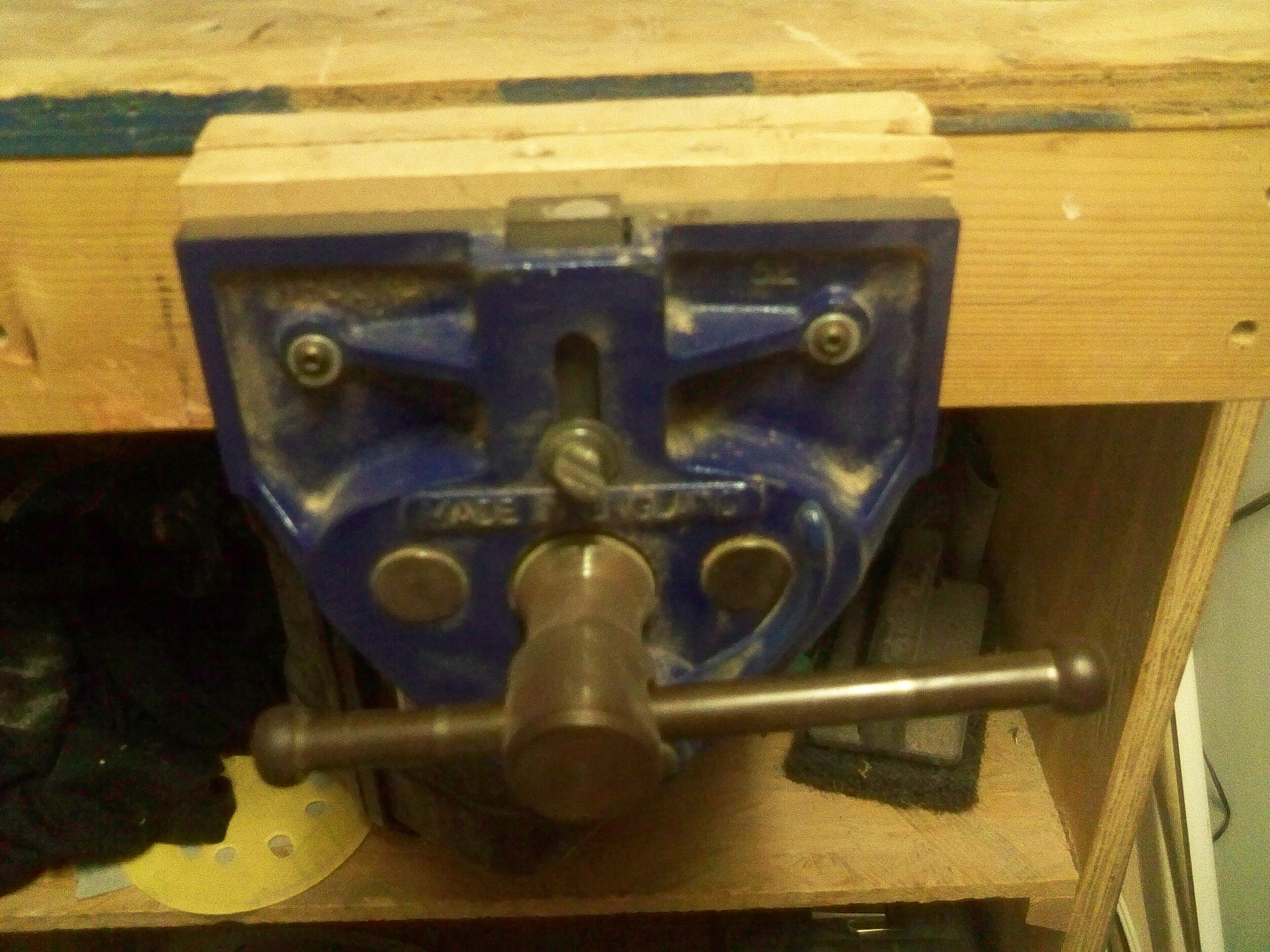
The first one is on my front affixed bench. This is a Record quick-action vise that I picked up at a Big Lots store.  Yes, that’s right – a super cheap discount store that normally sells very poorly-built tools at an enormous discount. I had to go to the store to pick up some inexpensive holiday wrapping paper and moseyed over to the tool aisle to see what was being offered that day. I almost didn’t see the vise at first – the box was scuffed up and buried under a pile of nylon shop aprons. Most of the internal packing was missing, so the heavy iron vise slid around in the box when I picked it up, threatening to fall out onto the floor. When I saw that it was a woodworking vise and how inexpensive it was, I had to get it on the spot.

It took some time to fit onto my front workbench, and I’m sure that I did a ham-fisted job of getting it into place, but it works like a champ for me. In fact, I used to do all of my planing at this front bench.  Unfortunately, the location of the fixed bench was so awkward, it became impractical to work at that location.

It was about then that I got the idea of building my first bench – a discarded entry door from a neighbor attached to a 2 x 4 stand. I was reluctant to move the vise from the front bench to the new one, because I had notched out the framing on the fixed front bench and didn’t want to look at rough opening.

What I needed was a way to get my hands on a second vise.  Inexpensively.

I had been lamenting my workshop situation with my friend Chris down the street. Chris works in the maintenance department of a local educational institution and was struck by an idea. That’s when the fates heard my call and I had the opportunity to get this.

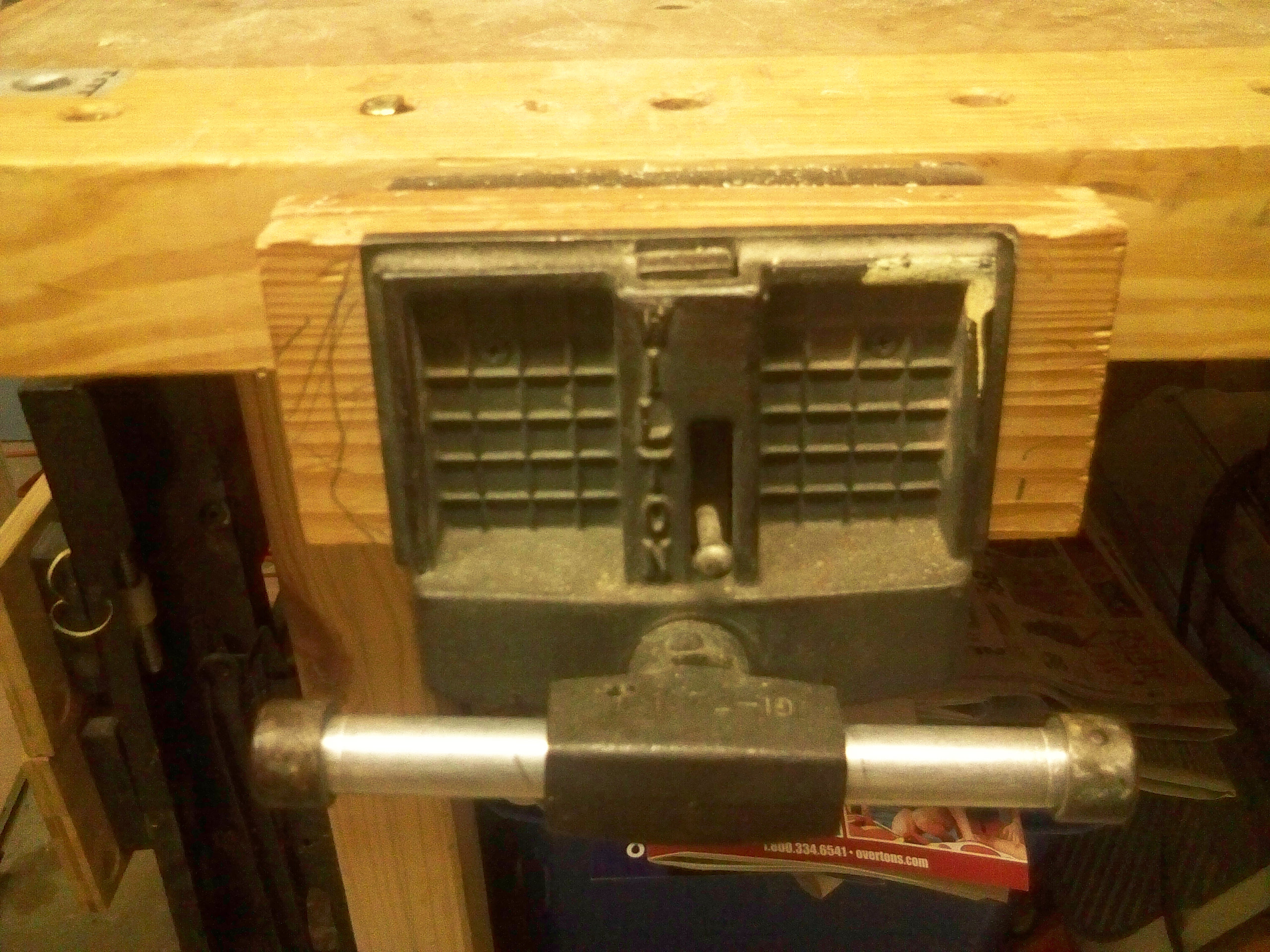
This is an old-school 1970’s era Wilton vise. Chris was able to pluck it lovingly from a dumpster – something that was ready to be shipped out to be busted up and recycled for its metal content. At first sight, I could understand why it was headed to the dumpster.  It was covered in rust and paint splatters. The original handle was missing, replaced by a length of electrical conduit. And, it stank, having sat next to some rather gross items in the trash.  But, my buddy had dived into the dumpster for me, and I was going to have to give it a chance to work.

I disassembled the vise down to its component pieces and cleaned and scrubbed the vise with WD-40 and an old toothbrush, removing decades of grime and other nastiness. When I reassembled it, it functioned beautifully.  No, it’s not a quick release model, so it does take some time to twist the handle to make it fit the board I am working on, but that hasn’t been a hassle for me. I mounted it to my old bench, then moved it over to the new one I built around the holidays in 2008. It still works beautifully, and it’s position on the bench makes it easy for me to get work done with both power and hand tools.

No, these are not hand-crafted leg or shoulder vises, nor are they high-end fancy models from an elite manufacturer.  But, I couldn’t see working without them in my shop.

Just remember to keep your eyes open for deals out there.  Let your friends know. You might be surprised at what you can find on the cheap.

Staying on track

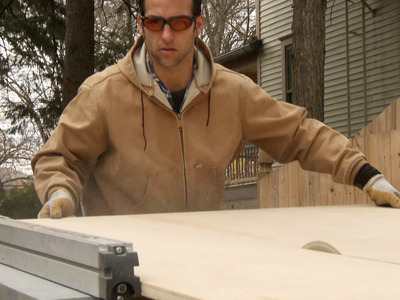
There are few things as awkward as wrestling a sheet of 4 foot by 8 foot plywood onto a table saw.

OK, maybe there was the time I asked the cutest and most popular girl in middle school to go to a dance with me. And, after a long pause, she laughed. Loudly. Now, THAT was awkward …

But, think about it.  A sheet of 3/4″ ply tips the scales at about 80 pounds, has no easy way to grab and hold and is tough to balance on a table saw’s top while keeping one edge against the rip fence.  It’s not easy at all.

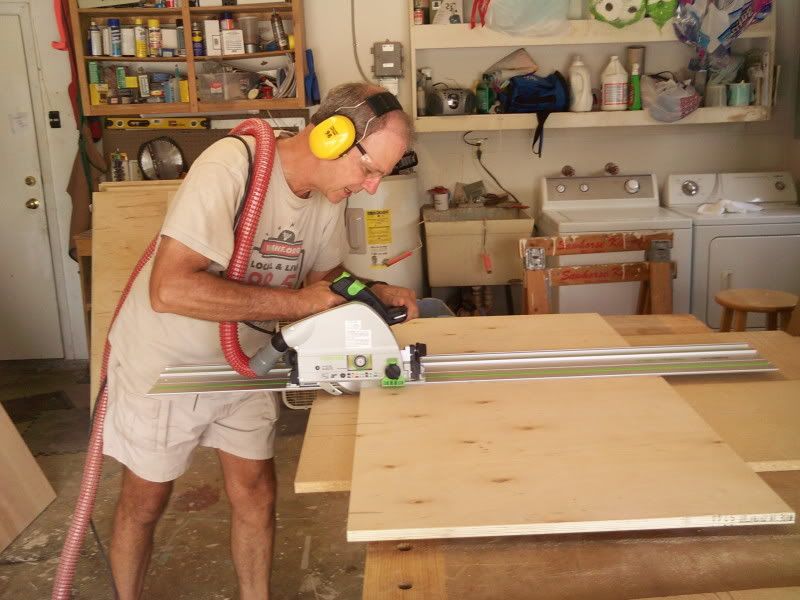
That’s why when Paul and I were just starting the cabinet project, we had a brief discussion about getting our hands on one of the ‘new’ track saws to help break the sheets into more manageable sections without the need to break someone’s back or damage their shoulders. Yes, that someone is me…

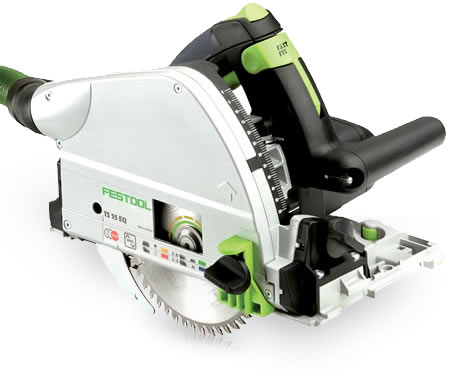
So, just as the plywood delivery came to the shop and the driver and I were unloading it, Paul walked in with a long, skinny box and a plastic container.  Paul had gone out and purchased a Festool TS 55 EQ plunge cut circular saw system for us to use on this project.

Now, Festool isn’t the only company with a dog in this hunt. DeWalt has a model they introduced about two years ago, and Makita also has a track saw system. I can’t really give a comparative review of these other models, but I can tell you that if they work as well at the one we are using, they are worth their weight in gold.

If you wanted to break down some sheets of plywood without one of these track saw systems, you could make yourself a sawboard and use your circular saw on the cut.  I’ve used the finest blades possible on my little Black and Decker saw, but still found the splintering on the piece to be unacceptable. This, of course, required me to go from the circular saw cut to the table saw in order to complete the cut.  This required that I remember to cut the piece strong and take that second step to get an acceptable edge.

Given the number of cuts on this case, the Festool saved a tremendous amount of time.  The cuts came from the saw cleaner than what I could accomplish with my Forrest Woodworker II blade on my table saw. Anything that eliminates a step in the process that doesn’t sacrifice quality is a winner in my book.

The saw is pretty sophisticated. The controls are clearly marked and easy to operate.  The saw does plunge to cut and also brings a riving knife down behind the blade.  If you have ever cut a board that pinched your saw’s blade during a cut, you know how frustrating and dangerous the situation could be.  This plunging action makes inside ‘pocket cuts’ a piece of cake, not a harrowing experience like plunging a traditional circular saw.

The Festool also has an anti-splinter ‘foot’ that presses down on the material just at the front of the blade to prevent splintering along the offcut side.

The track that the saw rides along is also very well thought out. Basically, the saw’s base plate has a square notch worked into its design.  This notch mates with a square track that rises from the track to guide the saw.  The base of this track has two rubber non-skid strips adhered to it, allowing you to place the guide down and not have to clamp it.  However, clamping isn’t the worst idea when cutting a lot of pieces.  It just helps to keep the saw track from shifting if you bump into it.

On the edge of this track that guides your cut, there is another anti-splinter device that keeps the keeper half of your board from splintering. Since this is exactly where your saw is cutting, you don’t have to move it into place… it’s always there.  The cuts off the track are perfectly straight and beautiful.

The saw also comes with a dust collection port.  I was using my shop vac instead of the company’s compatible dust collector, but noticed that the amount of dust generated by the cuts was very small.

The saw’s flexibility in cutting could also lead you to trouble. By not indexing off of a fixed rip fence, you have to be sure you carefully mark the pieces you are cutting.  If you mismark and cut on a diagonal, you will get a perfectly straight diagonal. You also have to remember which side is the keeper and ensure you don’t cut it one kerf too narrow by cutting on the wrong side of the  line.  Just sayin …

Yes, a track saw like the one we picked up is more expensive than just using a sawboard and your circular saw.  However, the time you save having to make two separate cuts could really be a difference maker on a large cabinet project. And, if that time savings also happens to lead to better quality cuts, well, sounds like a winner all around.

The Slicker Way

So, my buddy Lou finally picked up the CD/DVD rack I had built for him. He was supposed to come over during the Independence Day  weekend to retrieve it, but we had some incredible amounts of rain. Seriously. I guess we are now in our rainy season, because my rain gauge with a six inch capacity was overflowing during those heavy rains.

Since I posted  shots of Lou’s project, I had gotten some input from other folks out on the web as to how I could have maybe done a little better. “Those raw plywood edges look cheap, Tom. We expect better than this from you!” Hey, that’s how the client wanted it!

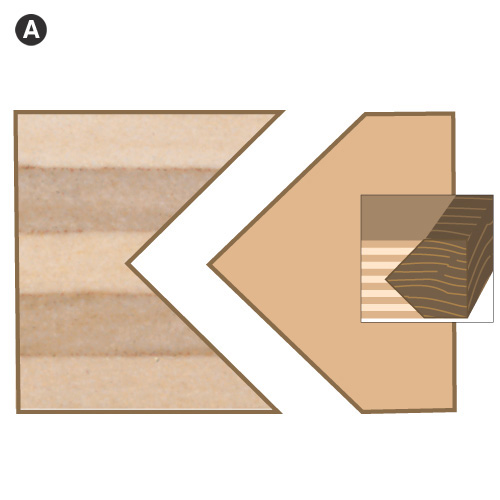
Many of the suggestions offered focused on how to apply wood edging with brads and glue, dowels and glue, biscuits and glue, stepped rabbets and the works. I’ve seen suggestions to iron on an edge tape or cut my own edge tape from the plywood’s veneer itself. While these suggestions are all time tested and work fine, the one that Tim Walter over at Eagle America offered was something that I had never even considered. “Tom… get with the times! We’ve offered two styles of edge banding bit sets for years, and I have a feeling they may have given you a better option.”

Instead of attaching these facing elements with some kind of fastening system, Tim was referring to cutting a continuous interlocking joint that integrates the pieces. “You don’t have to cut biscuit slots or drill dowel holes. And, you don’t need to use screws or brads. Can you imagine your friend staring at brads when he selects a CD? Can you, Tom?”

OK, Tim, I get it! But, why not just use glue and clamps alone to attach the hardwood edging? “You really want to be careful about the edging getting out of alignment during the glue up. Sure, you could try to sand it flush if the glue up comes out all out of whack, but the possibility of sanding through a thin plywood veneer face is just too great.”

Good point. Tim also brought up another point- if I wanted to put a fancy profile on the edge band, the hardwood edge allows for routing a wide variety of profiles. “With this system, you won’t run the risk of hitting a fastener, which would spoil the look. And, hey, it’s the little details that mean so much.”

Of course, using these router bit systems does require some additional care when you use them. “You really want to make sure that the work is held flat to the table. Featherboards are great accessories to provide that downward force when pushing the work past the bit.”

Plywood is a very useful material when building casework. Bits such as these provide an interesting way to help make plywood an even better choice for projects I’m planning on building in the future.

A place for everything…

Organization is not my strong suit.

Navigating my desk at work is an adventure.  I’m getting better, but I routinely  find some important note from a few months ago  – say – about a task I had to do back in March.  Not a good thing, especially when my boss was really counting on that task being accomplished by – say – the second week of July.

The shop?  It’s not much better.  I am really having trouble finding a good home for everything I have amassed over the past dozen years.

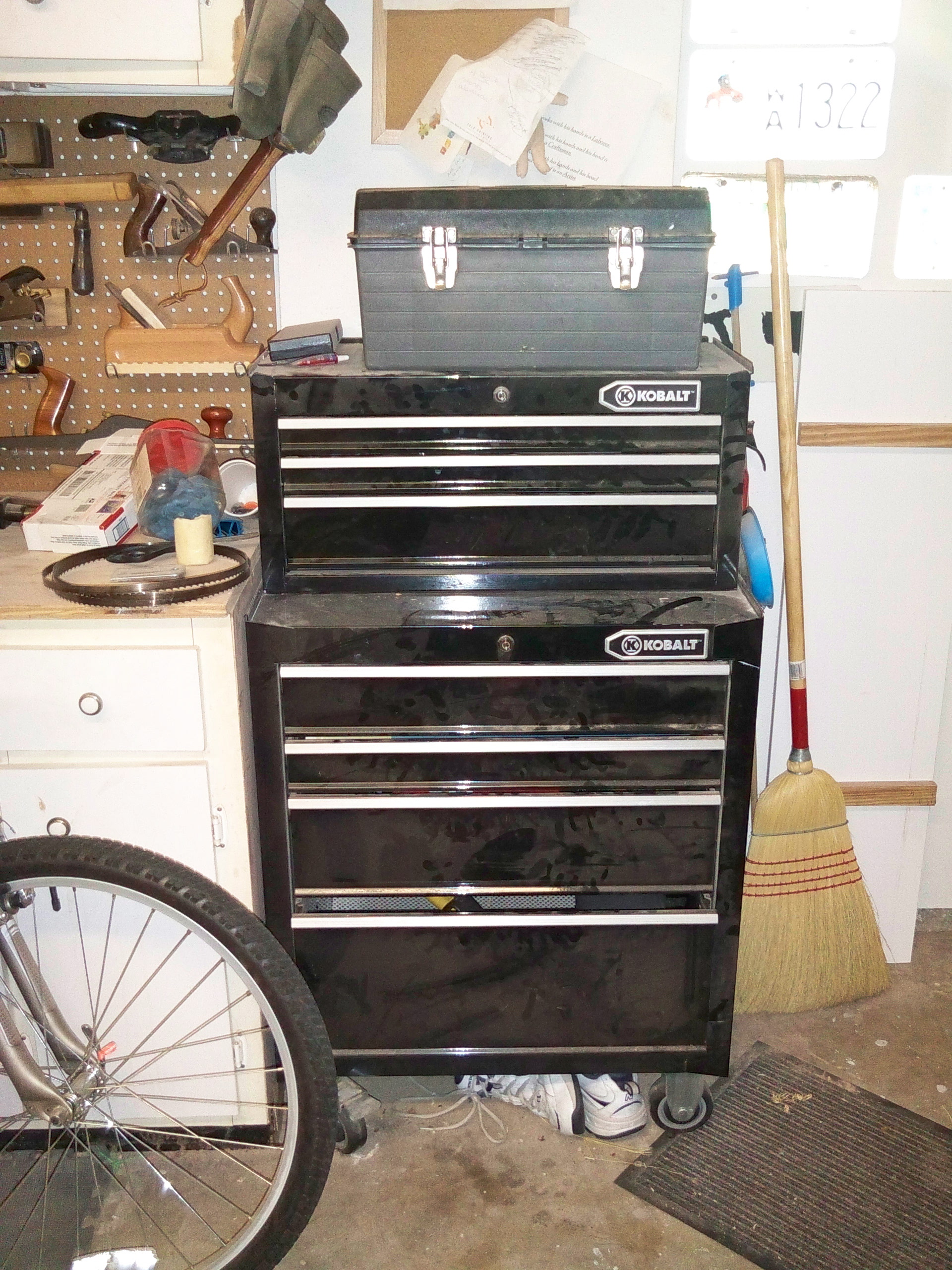
At least in my shop I have one area that stays pretty well organized – my rolling tool chest.  I picked it up during a sweet holiday deal at Lowe’s and call it black beauty. Actually, it’s two stackable units – a four drawer base and a three drawer mid section – topped by my old tool box.

I know what you are thinking… and, yes, you are right.  A glossy black surface in a wood shop?  You betcha. My wife and I used to wipe it down every so often when the dust would accumulate, but now, we just let it get covered and clean it when the layer of sawdust is thick enough to support agriculture.

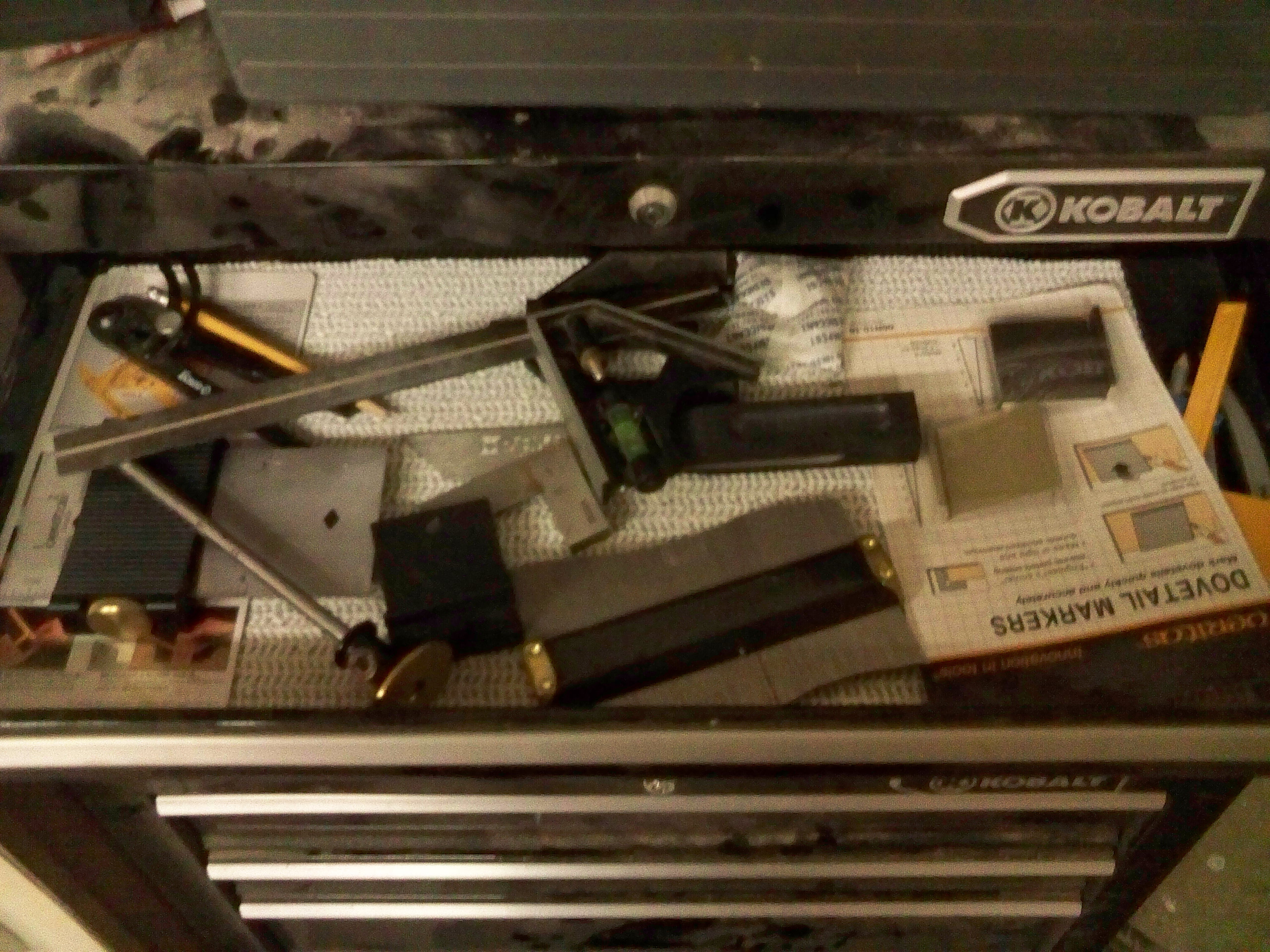
This rolling chest has been a godsend when it comes to holding on to easy to misplace items.  The top two drawers hold all of my fine measuring tools.  Squares, striking knives, calipers… the works.  It’s nice to know that when I have to measure something precisely, I just have to look into two drawers instead of through boxes of other items to find what I need.

The bottom drawer of the mid section holds my scraping and shaping supplies.  Rasps, files, scrapers and all of the items that go along with them are stored here in one place.  So, when my scrapers no longer do what they are supposed to do, all of the items I need to sharpen are in one place.

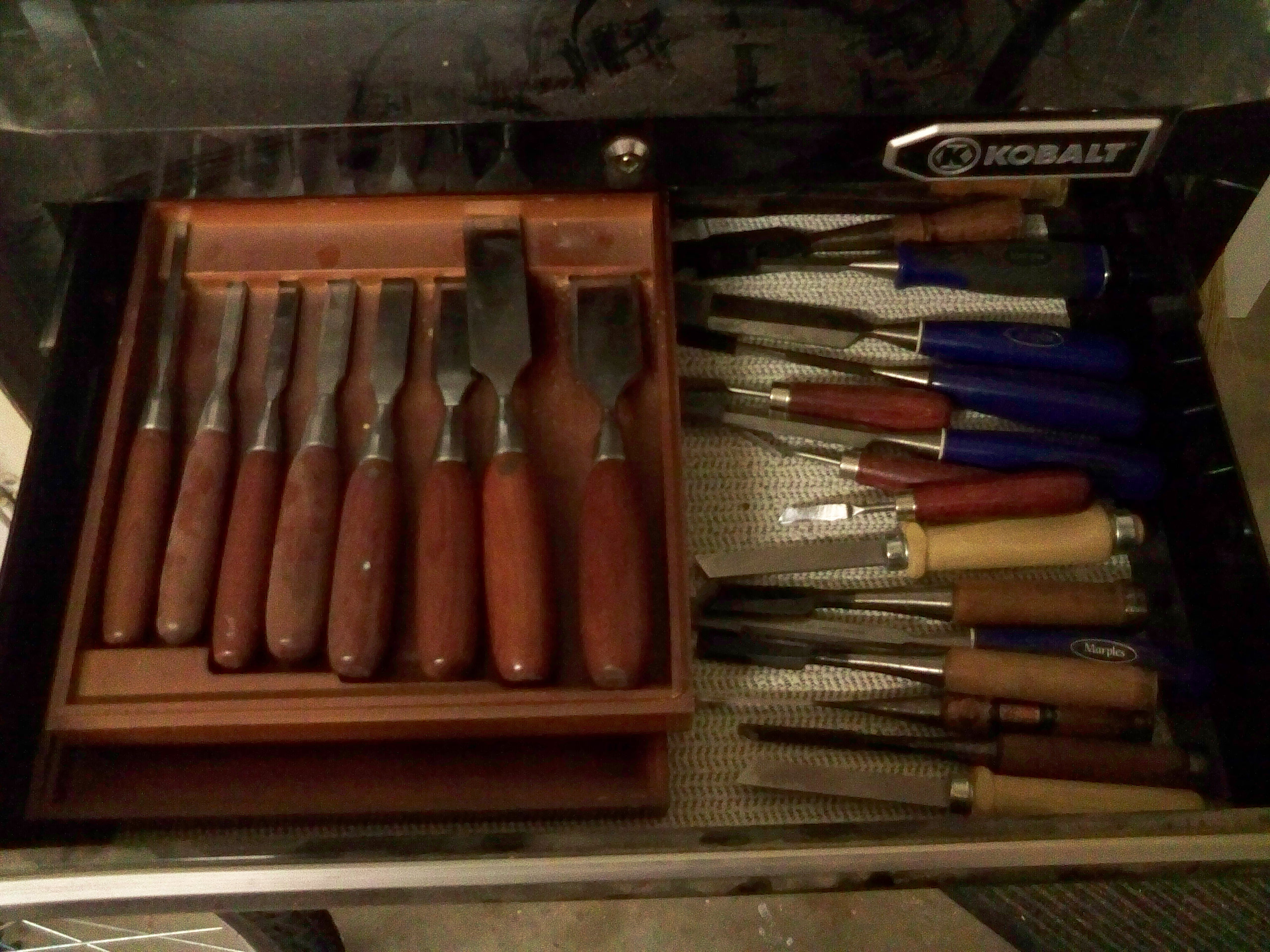
Below that in the top of the base cabinet are my chisels.  Yes, I have recently become a collector of chisels.  I have to admit it as part of my 12-step program.  From the Marples Blue Chips I started with to the set of WoodRiver beauties I traded a drill press mortiser for to the ultra sweet Japanese chisels used by my neighbor’s father, they’re in there.  Keeping them in the drawer protects the tips and makes a handy place to find them.

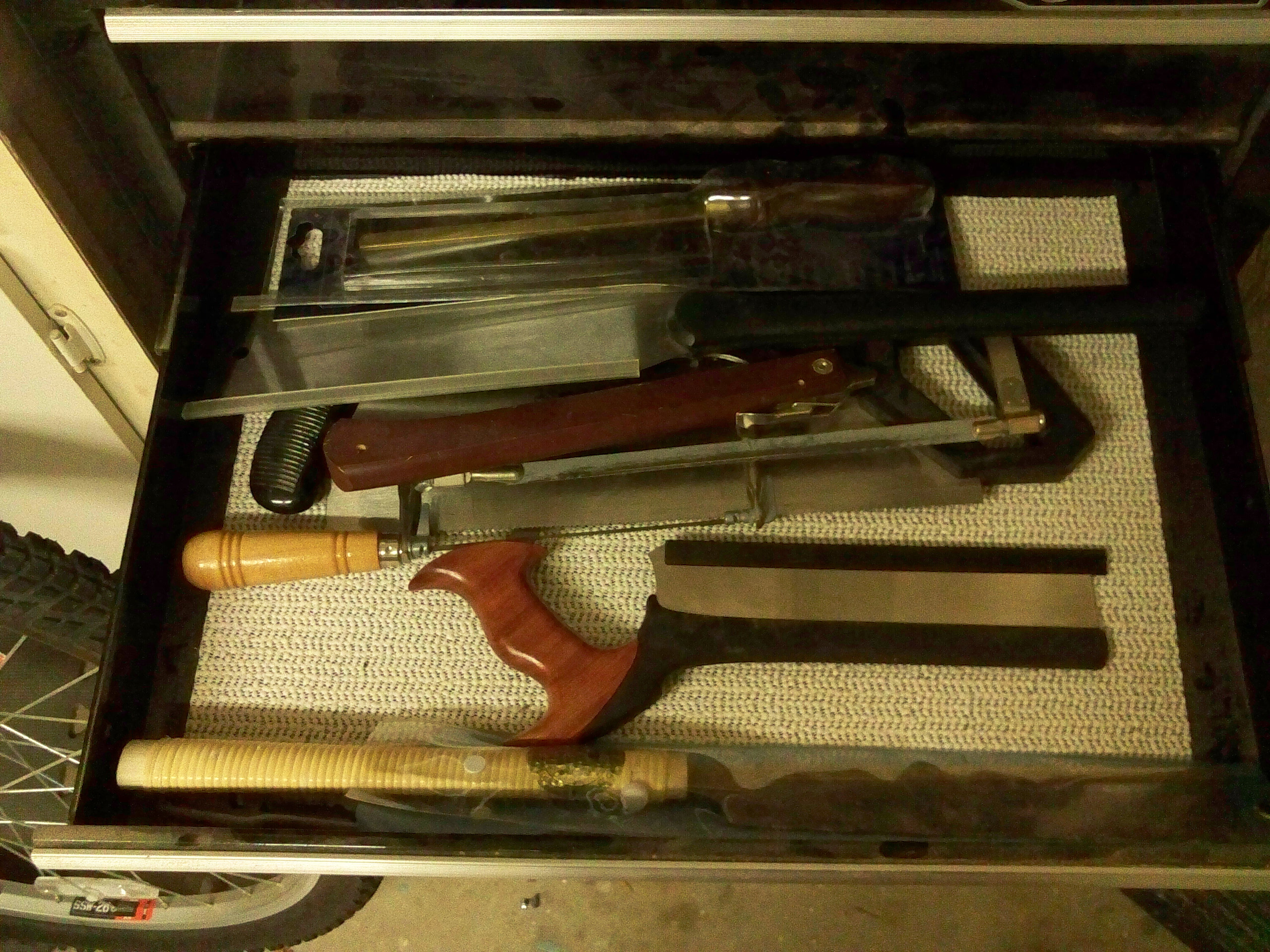
Below that is where I store my fine cutting saws.  One day, I’ll build a proper saw till to display these babies and keep them closer to the bench, but, for now, they are protected from bumps and broken teeth in this drawer.  It does take a little digging around here to find them when I do need them, but I’m good with that.  For now.

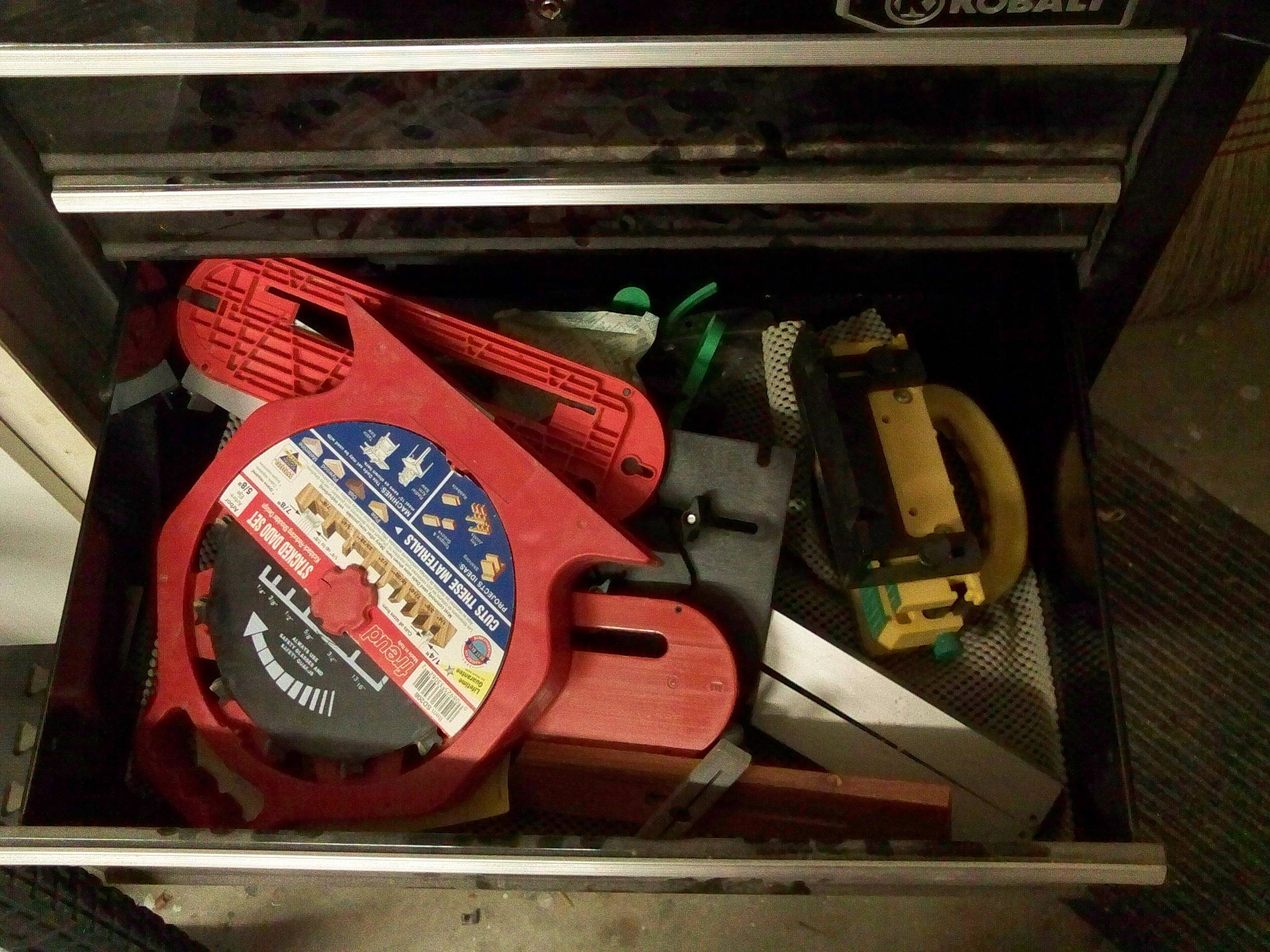
One level down, and we’re in the realm of the table saw.  No, this storage drawer is nowhere near the saw itself, but I have discovered that table saws require more accessories than my children did when they were very young and it took us half an hour to collect everything for a trip to the supermarket.  Dado blades, push sticks, featherboards … again, this is a great place to stash the stuff when I don’t need it.

And, finally, there’s the – uhhh – miscellaneous drawer.  My hammers and mallets are there along with my laser level, cold chisel, pry bar… well, everything I chuck in there.  OK, it’s not so organized.  There, I can’t give up all of my bad habits.

Some folks have told me that by storing my tools in enclosed drawers is a waste of time.  That perhaps I would be better off keeping them out where I can see them and find them easier would be a better idea.

Uhhh, no.  This way, at least, I keep my searching down to a minimum – for me.  That allows me more time to do what I really enjoy… building.

Tools I use: My sanders

I live about ten minutes away from the beach.  My wife and two sons are off for summer vacation. The beach is one of their  favorite destinations to spend some time on a hot, lazy summer day. This means that both of our cars are filled with sand.  Sand on the floor of the cars.  Sand in the trunks.  Sand on the seats.  Sand in the living room.

It’s a constant effort to keep on top of the sand situation.  Sweeping. Vacuuming. Shaking rugs out.

But, hey, I keep my sanding contained to one part of the house!

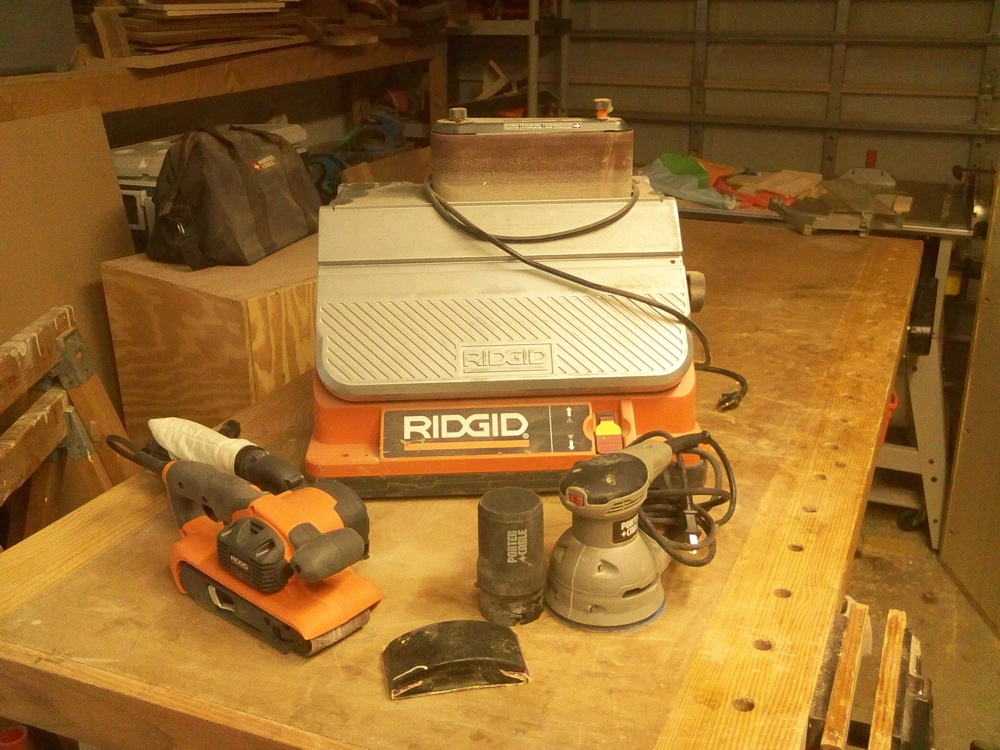
I’d like to introduce you to the sanding team:

Starting in the back is one of the most frequently seen sanders in home shops – the Ridgid spindle/belt sander.  This is one sweet little unit, easily converting from a belt to a spindle sander.  It has plenty of muscle to sand all kinds of wood – maple, hickory, oaks… the works.  I’ve been able to get inside some tight curves and do some long tapers with it.  If you are looking for a small bench type sander, it’s hard to go wrong here.

My new (refurbished) Ridgid belt sander that I recently picked up.  This has the potential to be a very blunt instrument, stripping away wood and digging divots.  However, with a careful hand, this can carefully refine a curve or even out the top of an end grain cutting board.  I never thought I’d get much use out of it, but boy, was a I wrong.

My Porter Cable random orbit sander.  I’m torn when it comes to this sander. The rotating pad does give a very nice finish that typically just needs a little scraping to perfect, and it can work around corners.  The only problem I have with this model is the dust collection cup.  It is held with two plastic clips onto two lugs on the dust outlet port.  For the first six months, I would twist it on and hear a satisfying snap.  That meant that the cup would stay on regardless.  Unfortunately, since those first six months, the plastic clip hasn’t held on worth a darn.  I keep trying to bend things back into place, but it’s a lost cause, and I usually have to end up sanding with a fan on and my garage door open to vent the dust.

Finally, up front I have a sanding block I picked up at a local home improvement store.  Even thought I have the power sanders, I know that for many situations, nothing beats the versatility and control of hand sanding.

For me, I always wear a dust mask, eye protection and hearing protection.  Even though it’s just sanding, I’d much rather not inhale the dust, get it in my eyes or kill my hearing.

Yes, one day I would love to give up on power sanders and be able to finish all of my projects with planes and scrapers, but as long as wood has its peculiar workability properties, there are just some times when power is better.