All posts by Tom

I'm the guy who writes the blog...

Link of the Week

Pyrography.net

Over the past dozen years, I have made plenty of mistakes while woodworking.  Usually, those miscut  pieces of wood end up in a friend’s chimenea, never to be seen again.

But, what if I told you that some woodworkers intentionally burn their projects as an art form?  This process, called pyrography, is a very popular craft that can produce some breathtaking images on wood or leather.

Through the careful application of a heated ‘pen’, the artist can control the intensity of the line, the amount of shading and even how deep the char from the tool travels into the wood.  The results can be spectacular, looking like a pen and ink or charcoal drawing.

Pyrography.net offers a primer on the process, reviews the tools you will need to do the craft, provides examples from other skilled artists and a host of additional information on the craft.

Tools I use: My fine hand saws

One of the most popular ‘family’ of shows on TV is the CSI franchise.  For some reason, people love to watch police crime scene investigators show up at some location, sift through the evidence and arrive at a conclusion of what happened.

There is no doubt in my mind that if they came to my house and investigated my choice of hand saws over the years, they would wonder what I was up to.  It’s a baffling collection of tools, but – I fear – it’s how many woodworkers have evolved their collection over years.

Let’s check the evidence we have on hand, shall we?

Here are the ‘fine cutting’ hand saws I have, in order of when I purchased them, with a brief analysis  about them.  Those with weak constitutions may want to turn away.

My uber cheap plastic Big Box back saw.  I would ask for a Mulligan on this one, except for the fact that the $12 I spent on it 13 years ago makes it not worth the effort.  This ‘saw’ came with a plastic miter box that cut ’45 degree’ angles and ‘square’ cuts on the end of boards.  I did use it for several years, but soon discovered that no, this was just not going to work.  I keep it with my fine cutting saws, but I’m not sure why.

My plastic big box ryoba.  This saw proved to be a step in the right direction, showing that at least my mind was moving up from where I had started.  Rip saw on one side and crosscut on the other, the blade is not supported by a back spine.  This means that technique is essential in order to get an accurate cut.  The only problem is that I’m really not set up in a traditional Japanese style shop where the proper technique is easy to learn and apply.  It gives me better cuts, and I will use it to roughly crosscut boards.  Interestingly enough, I had a saw similar to this one before I bought my table saw, and I used to do most of my rip cuts with it.  Fascinating….

The folding dozuki.  This saw is considerably better than the big box ones I have purchased over the years.  I bought it from Lee Valley tools and it does cut rapidly and accurately.  The steel spine runs along 3/4 of the back of the blade, giving me straighter cuts.  It’s not quite dovetail cutting quality, but I have cut some tenon cheeks and shoulders with it.  All in all, a great saw to put in the tool box, but not for precise joinery.

My ‘professional’ dozuki.  After wasting a ton of money on some older, nasty fine cutting hand saws, I finally wised up and dropped some ‘serious’ money ($75) on a high-quality dozuki.  Everyone I had asked about the saw raved about its accuracy and ability to make fine cuts.  And, this one FINALLY got me into the category of real fine cutting saws.  It cuts beautifully, but the problem I have is that with the ‘stick’ handle, I must not be gripping the saw the same way for every cut.  The blade will often wander, and I’m left shaking my head in frustration.  Practice does make perfect, and I really do need a ton more.

My Veritas dovetail saw.  Now, we’re talking.  I picked this baby up earlier this year, and wow.  It’s a western-style push saw AND it has a handle that pretty much guarantees I’ll be gripping it the right way every time.  I love the cuts it makes and the accuracy.  The only knock on it is that the blade depth is just too small for all of the cuts I want to make with it.  I’m hoping the folks at Veritas will make a larger tenon saw in this pattern for folks who need a little more depth of cut.

What does the future hold?  Well, I do like these saws, and I wouldn’t mind getting my hands on a premium tenon saw.  Right now, however, these guys are the ones I turn to in order to get the job done right.

Case closed.

Be a happy elf…

This past weekend proved to be one of the most productive I have ever experienced in the shop.  There’s nothing quite like getting holiday gifts built for loved ones.  You know they will appreciate the gesture and proudly exhibit the item you build for years to come.  Yes, as an elf at the North Pole, I was totally stoked!

Send your own ElfYourself eCards

Unfortunately, once word gets around that you are a skilled woodworker… well… the jig is up.  Requests start to come in.  “Oh, you don’t have to buy me anything… something from the shop would be awesome!”

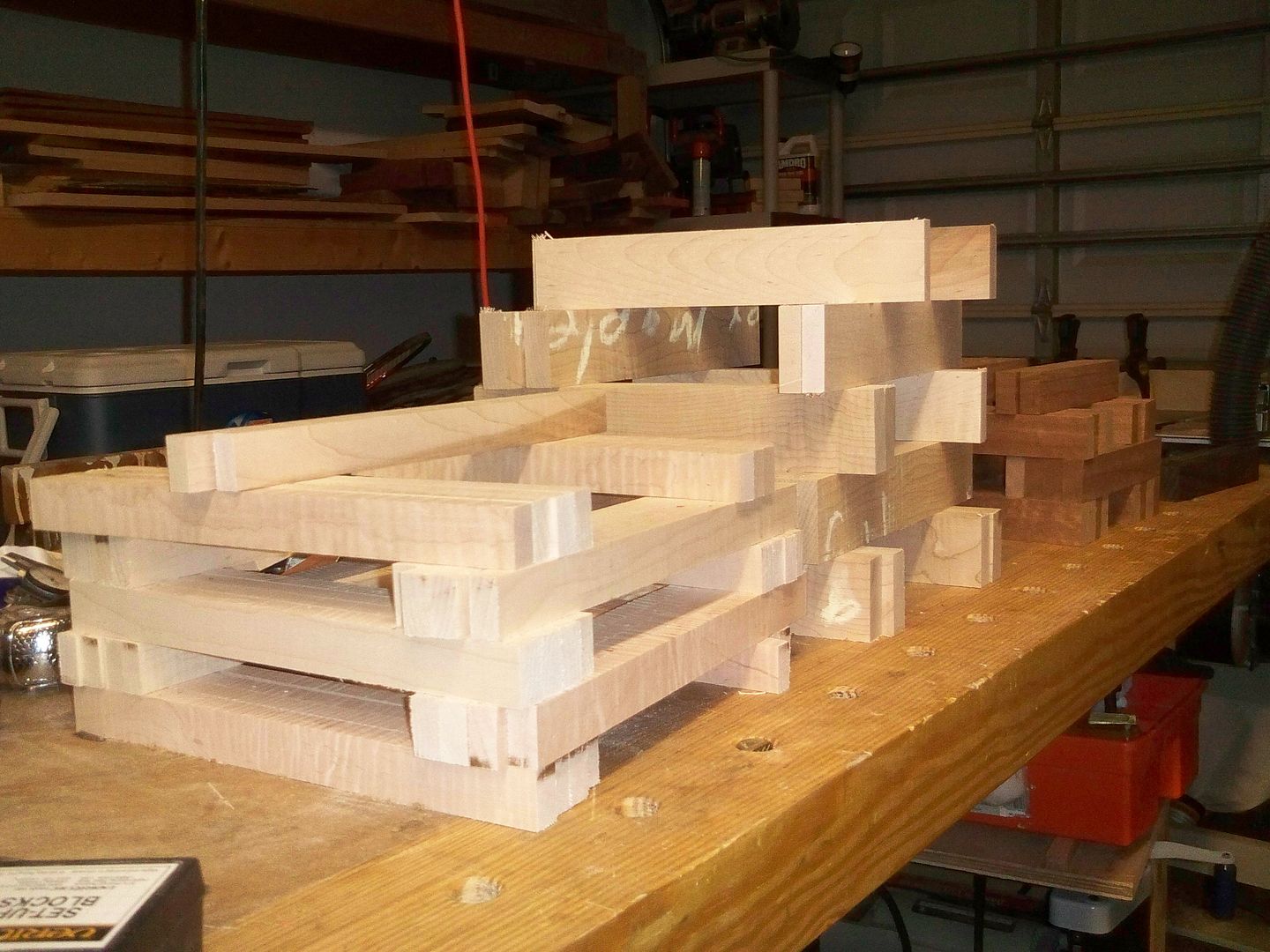
This year, I have now moved up to building ten copies of a project I found in the pages of Wood Magazine.  I can’t show you what they look like all put together, because I don’t want to ruin the surprise for the recipients.

However, I can take you behind the scenes into Santa’s workshop to show you how those elves are busting butt to meet the production deadlines.

Let’s just say that power tools are the workhorses for these projects.  I could easily do the work with hand tools and bang out high quality pieces, but for accuracy, speed and repetition, power’s got it hands down.

OK, some quick math….  since I’m working on a factor of ten, the number of pieces I had to cut includes:

  • 40 uprights
  • 40 rails
  • 40 long rests
  • 20 feet

For joinery for these pieces, I then had to  cut:

  • 80 mortises
  • 80 tenons
  • 80 notches

Needless to say, all of these joinery cuts have to be very precise, since they should all be interchangeable between different assemblies.  I relied heavily on stops, jigs and sleds to get the right set ups for each operation.  Sure, it took some time to get set up to a high degree of accuracy, but once I was there, things sped along.

After about seven hours in the shop over two days this weekend, I managed to have all of the pieces cut to size, all of the joinery cut and the central frames glued up.  From here, there’s more shaping to do on other elements and the final assembly.  Perfecting the sanding will follow, and then the entire project will be capped off by a lovely finish.

I’m hoping that all of the pieces which have to ship to the family will be ready to fly by Thanksgiving week, and then I can get the shop back for a few fun projects that are coming along afterward.

Right now, however, Santa’s little elf has had it…  he’s beat and could use a nap to recover from a long stint in the shop.  Visions of sugar plums – and hitting the shipping deadlines – are dancing in his head for sure.

Quick Poll

Today is November 15…

That means the holidays are very close.  Maybe not as close as the kids (or the young at heart) would like, but we getting close to the ever dreaded shipping deadlines.  If your holiday gift giving list is as long as mine, well, you are going to have to plan in some time to get them all built!

So, in this week’s poll, what’s the current status of building your holiday gifts?  Are you done, or have you even started?

[poll id=”99″]

Link of the Week

Build your own end-grain cutting board

Thanksgiving is coming here in the United States, and the rest of the holiday season is following quickly behind.  And, we all know what that means…

Family feasts!

If you want to help guarantee your feast is one to remember, you have to make sure that the cook has all the right tools at his or her her disposal.  One of the most essential is a solid cutting board for all the chopping, mincing and dicing that goes into the food prep.

The Wood Whisperer himself, Marc Spagnuolo, has an excellent plan for making a classic end-grain butcher block cutting board, complete with an instructional video.  From wood selection all the way to final finishing, Marc shows the way to building a stylish and useful tool for the family chef.

Who knows… if you build one, you may have earned an extra slice of the roast beast.

We’re going bananas!

For all of you Wood Magazine subscribers (and those who may like to get the occasional copy at  the news stand), the Shop Monkey returns!

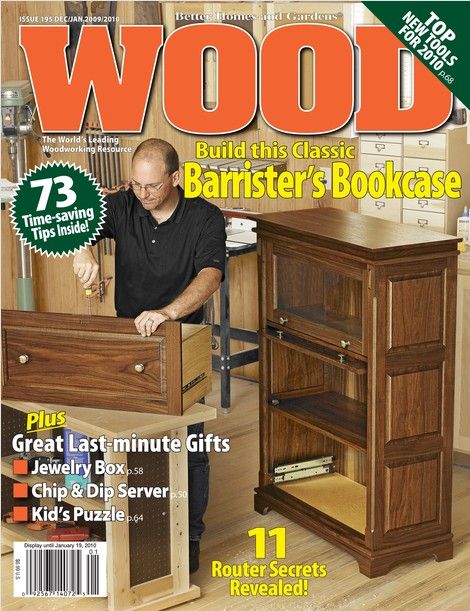
October 2009 Wood Magazine CoverYes, the editors of  Wood must be gluttons for punishment, because they had me back again for a new edition.

Be sure to check out page 16 of the December 2009/January 2010 edition (can you believe that we are now writing the numerals 2010?) .  There, I have a what I hope you consider an interesting discussion about the level of precision required in woodworking.  It’s named, appropriately enough, Precisely how Precise?

If you want to read even more Shop Monkey input, why not check out my blog over at the newly-revamped Wood Magazine forum website?  The new forum software makes it easier than ever to navigate the content and read the input from your favorite bloggers.

Yes, you can even read my content if you have nothing better to do…

The current schedule for the Shop Monkey right now is that the columns will appear in every other edition (the next one is scheduled to appear in the spring).

Now, no more monkey business… back into the shop!

Woodworking Spotlight: Lake Erie Toolworks

In so many things in life, bigger is better.

If you have a bigger hammer, you can drive large nails faster. If you have a bigger offensive line in football, you can block better and move the defense out of the way to score a touchdown. If you have a bigger truck, you can haul more wood home!
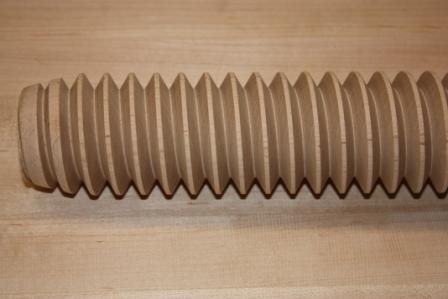
And, when it comes to workbenches, a bigger, more massive model gives you more stability when cutting, planing, routing and doing all manners of other woodworking.

Keeping with this theme, the folks up at Lake Erie Toolworks believe that bigger is better when it comes to vise screws. And, when I mean big, I really mean big!
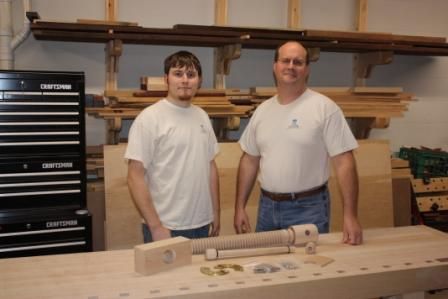
You see, Lake Erie Toolworks currently makes the largest wooden vise screw in the world. I had a chance to talk with Nick Dombrowski, owner of the company, to talk about his enormous vise screws. But first, Nick started with the basics. “First of all, a solid, well designed workbench make woodworking faster and more enjoyable. You don’t have to waste time and energy trying to work around the shortcomings of a table on sawhorses or even most of the commercially available benches out there. There is plenty that already has been said about solid workbenches, and we are working to make our vises an essential part of any solid workbench.”

Nick’s first experience with massive vise screws was when he worked at an organ building shop. “They all used vises with 2 1/2” maple screws, and they all worked great. Very smooth, quiet and fast acting.”

Nick later went on to build his own workbench with a steel screw vise. While the screw gave the vise plenty of muscle, it didn’t have the same ‘feel’ as the wooden models. That’s when Nick set out to make vise screws as good as – if not better – than the antiques he had already worked on.
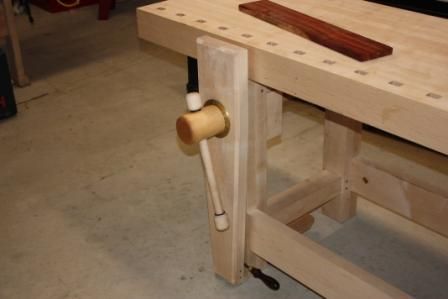
Now, it’s important to disclose the kind of vises you can build with these wood screws – twin screw vises, tail vises, face vises and even a cool vise design that had fallen out of favor for decades – the leg vise. It’s a traditional form that today’s woodworkers should look into building on their benches. “Leg vises have a lot more capacity than the fast-acting face vises. This gives you a lot more flexibility without getting your prized lumber close to guide bars.”

Currently, Lake Erie Toolworks is also working out the details for a shoulder vise screw to build the vise commonly seen on European benches. “Shoulder vises, while a little more complex, are totally worth doing if you like to dovetail.”

“Sure, there are no perfect vises out there; that’s why we encourage woodworkers to consider these other designs.”

Nick’s vise screws are made with a combination of CNC equipment, dedicated machines for internal threading purposes, lathe work and hand finishing. Hard Maple is the wood of choice. It has the highest shear strength of typical vise screw woods (beech, ash, etc), lessening the likelihood of having the long-grain fibers shearing off, or chipping, in use.
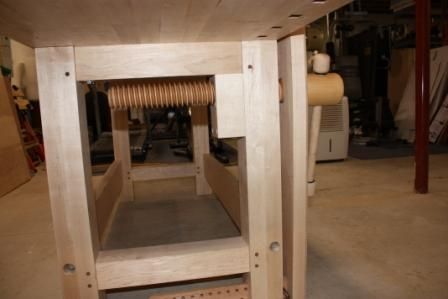
While you might suspect caring for a wooden screw vise would be challenging, it’s not as difficult as you would expect. “We recommend our customers use a penetrating finish on the screw and furniture wax to make sure things move smoothly. The beauty about this screw is that after a lot of use, you may not need wax anymore, as the action against the retaining nut will smooth the wood out on its own.”

Lake Erie Toolworks sells the screw with everything you will need to install on your bench. “You will have to provide your own ‘chop’ for the vise, but all of the running gear is included and is very easy to install.” Nick likened it to building a simple furniture project. The Lake Erie Toolworks site also offers detailed installation instructions, walking woodworkers step-by-step through the process of installing vise on their benches. And, woodworkers also have an option of how they would like to attach their bench screws. “We offer an external brass garter as well as an internal maple garter to hold the screw to the bench. Customers can make their own garter or even go with no garter at all. It’s all a matter of choice.”
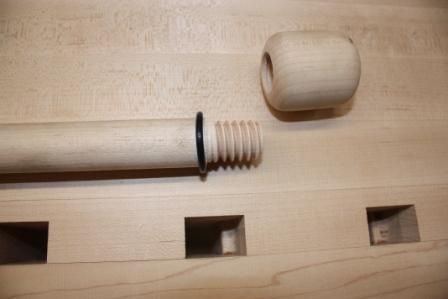
Nick has even gone to the trouble of threading both ends of the vise handle and providing a tapped cap for both ends. “It’s so much more sturdy and durable than trying to friction fit a cap on the end, an if you have to remove the handle, it’s a piece of cake, unlike a glued on cap.”

What does the future hold for Lake Erie Toolworks? “We are very responsive to the needs of our customers. In fact, we have a survey on our web site that lets customers tell us what products that they would want.”

What does Nick like the most about making these massive wood screws? “Tool building really is different than typical woodworking. You get the satisfaction of knowing that someone is using what you’ve made to make other things. Also, I have gotten the opportunity of learning a whole new skill set, that being machining. I’m finding that I like machining about as much as I like woodworking and building tools allows me to exercise both skills on a regular basis.”