All posts by Tom

I'm the guy who writes the blog...

A National Treasure: Cape May, New Jersey

When you think about the Jersey Shore, you might think of boardwalks, sand and sun.  Or that crazy TV show with the obnoxious, ill-behaved teens. But, at the southern tip of the of the Garden State, there is a treasure to behold.

Cape May is one of the oldest seashore resorts in the country. One of the best known features of the town is the unique Victorian architecture. When it comes to Victorian, if it’s worth doing, it’s worth OVERdoing…

Here’s just a quick sampling of the many ornate buildings you can find on a quick walk through the shady tree-lined streets.

Some of these buildings are bed and breakfast inns, so if you were looking for a place to get away for a while and admire some of the fanciest woodworking available, Cape May might be a good place to visit.

A National Treasure: The U.S.S. Constitution

At dock in the Charlestown Navy Yard in Cambridge, Massachusetts is the oldest commissioned warship in the US Navy, and one of the few remaining wooden warships in the world.  Laid down in 1794, this ship was part of an order of six frigates authorized by President George Washington. She took to the seas in 1798 and fought brilliantly in operations during the War of 1812 and along the Barbary Coast.

Today, she rests at anchor in Boston Harbor where visitors can come aboard to see her in all of her majesty.

This is a view of the stern as you prepare to board. The ornate woodwork on the exterior of the ship captures your attention. The windowed areas along the back are the location of the captain’s cabin.

This is one of the cannon positions on the upper deck.  Unlike the guns below, which were designed for range, these upper guns are known as carronades and were designed to fire much larger shells a shorter distance to smash opposing ships hulls.

This is the ship’s wheel, but it didn’t start as the ship’s wheel.  The Constitution originally had a single wheel to steer her over the high seas. During the war of 1812, the ship battled the HMS Java.  A shot from the Java splintered Constitution’s wheel, but the Constitution gave better than she got, leaving the Java as a total loss.  Before sinking the Java, the crew of the Constitution retrieved Java’s wheel and installed it on Constitution.  That’s where it is today.

This is the ship’s capstan.  It was used by sailors to gain mechanical advantage over the massive lines used to rig the sails.  The bronze cap helps to protect the wood.

A view up the ship’s bowsprit.  Imagine shimmying up that…

When the Constitution needs some serious work, she comes to the dry dock.  This huge facility allows yard workers to bring her in, close the gate, drain the water and have the ship’s keel settle on the blocks.  Once there, workers can gain access to the hull for repairs and maintenance.

Quick Poll

Routers are exceptionally versatile tools.  They can hold a number of different sizes and types of bits, tackle a multitude of joinery tasks and can do all of this joinery very quickly and efficiently.

The real fun starts when it comes to how many different configurations the router can be employed. Table mounted. Horizontal table mounted. With any one of several different bases.

This week, let us know if you have a preferred configuration for setting up and using your router.

[poll id=”10″]

Link of the Week

North Bennet Street School

Located in the city of Boston’s North End, North Bennet is one of the preeminent schools of craft in the country.

Students enrolling in the school can pursue a number of disciplines, including bookbinding, locksmithing, instrument building, preservation carpentry and furniture building.

The furniture building course of study is an intensive two-year long program that focuses on developing both the modern and traditional skills that must be mastered to produce high quality product.

Even if you have no interest in enrolling in the program, a listing of alumni websites will give you insight into the quality of the training and work successful students can turn out.

Order in the Case!

So far in my life, I have had the opportunity to actually go to court twice.  The first was for an accident I had gotten into when I was just a wee lad at 16 years old. The second time was when I got pulled over about ten years ago in Tampa for speeding.

In both cases I learned a few important lessons.  First, when you have a court date, it’s vital that you show up – on time – for the hearing. Other folks who didn’t discovered quickly that the judge didn’t take kindly to tardiness.

It’s also critical to know that when the judge is talking, you are supposed to sit quietly and pay attention.  Back during the case when I was just a novice driver, the lady across the aisle trying to convince the judge that I was reckless liked to make snide comments under her breath concerning her opinion of the judge’s abilities – while he was speaking.

That, my friends, is a big time no-no.

Basically, the judge is charged with keeping order in the court.  Things have to go a certain way if a case is to be heard properly and be able to hold up in a court of appeals should someone choose to go that route.

When it comes to woodworking, keeping order in your project process is critical if you want to keep yourself out of trouble during the building process.

Case in point, your honor…

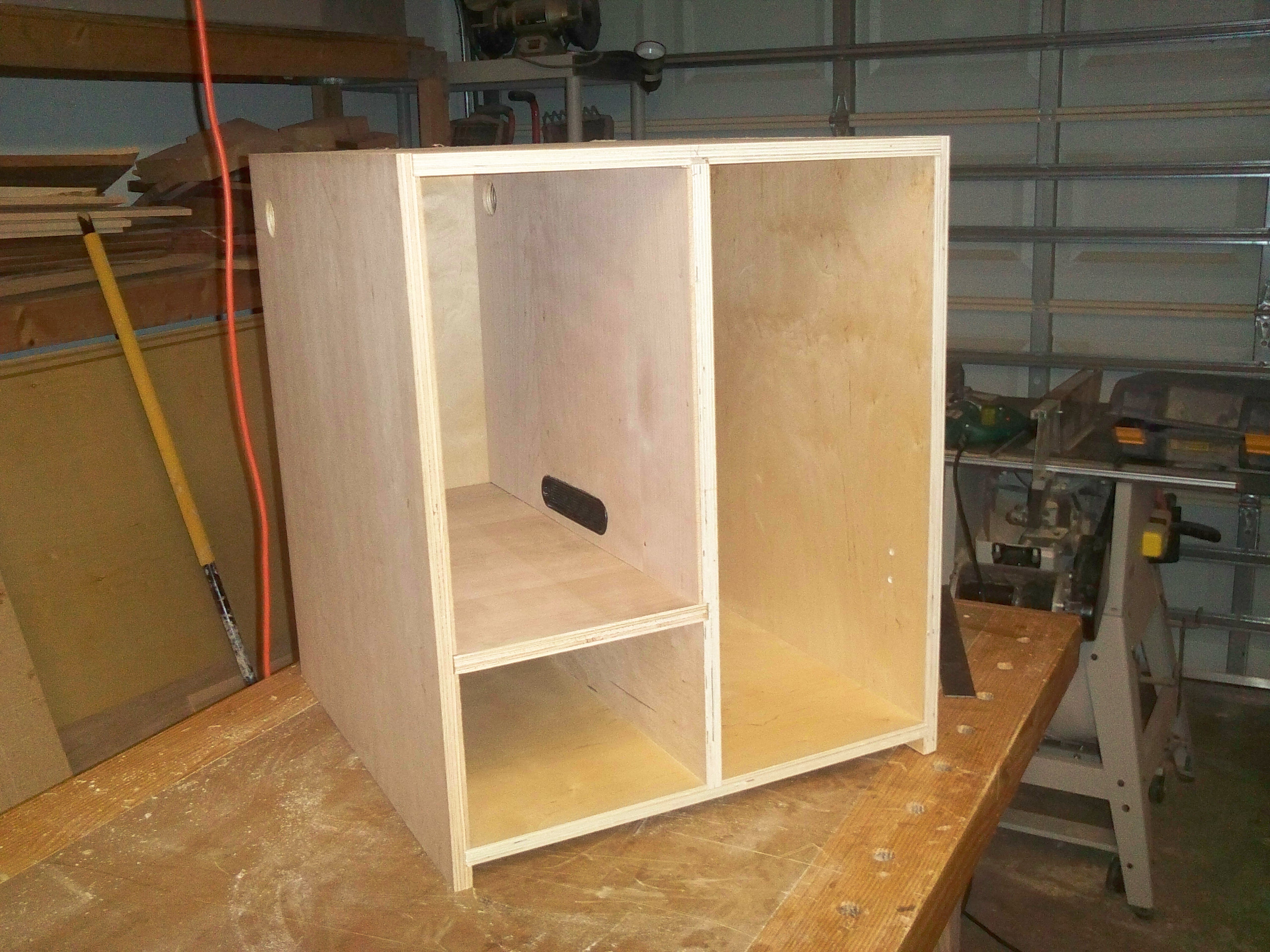
On this project with my friend Paul, this case is the most complicated one in the build.  All of the others so far have just been boxes.  Sides, top, bottom and back.  But, this case is where his CPU will live.  And where he wants to hide his wireless router, networking hubs, power strip, a boatload of cords and other computing essentials.

Sure, we could have built this case as two separate cases, but that would have involved more material, more assemblies and more coordination when joining the separate cabinets together on site.

So, we went with a single cabinet.  Me, I was rarin’ to go. Cut ’em down, mill  the joinery and slap ’em together.  No fuss, no muss.

Fortunately, Paul is a little more level-headed than I. He kept bringing up some very important points that I was missing.  For instance, a number of holes needed to be drilled to allow wires to go from one cabinet to the next. If I tried to feed my drill which, with a hole saw attached, comes out to 14″ long from drill bit tip to butt end, into a 12″ wide cavity, how did I plan on making the hole?

Similar questions were brought up over and over again – just for this one case.  When should I insert the divider which broke the piece into two distinct cavities?  When should I drill the shelf pin holes for a shelf in the equipment side? When and where should I drill a slot to accept a grille that would allow air between the two sides?  Should I notch out an area of the top to receive a vent before or after assembly?

All great questions, and all required a moment of quiet reflection and a bit of mental gymnastics. It got to where Paul and I were talking through each step of production and assembly of the case in order to make things work properly. If I put this piece in now and then drill those holes…

Ultimately, taking the time to mentally walk through the steps of the project helped out tremendously. Before long, we were able to get the assembly together with all of the holes in the right place and pieces where they had to be.

Later, we’ll just need to face frame the piece out and we”ll be good to go.

Of course, the finished product will be the final verdict in judging how well we did.

Staying on track

There are few things as awkward as wrestling a sheet of 4 foot by 8 foot plywood onto a table saw.

OK, maybe there was the time I asked the cutest and most popular girl in middle school to go to a dance with me. And, after a long pause, she laughed. Loudly. Now, THAT was awkward …

But, think about it.  A sheet of 3/4″ ply tips the scales at about 80 pounds, has no easy way to grab and hold and is tough to balance on a table saw’s top while keeping one edge against the rip fence.  It’s not easy at all.
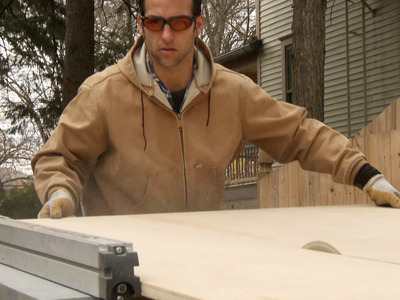
That’s why when Paul and I were just starting the cabinet project, we had a brief discussion about getting our hands on one of the ‘new’ track saws to help break the sheets into more manageable sections without the need to break someone’s back or damage their shoulders. Yes, that someone is me…

So, just as the plywood delivery came to the shop and the driver and I were unloading it, Paul walked in with a long, skinny box and a plastic container.  Paul had gone out and purchased a Festool TS 55 EQ plunge cut circular saw system for us to use on this project.
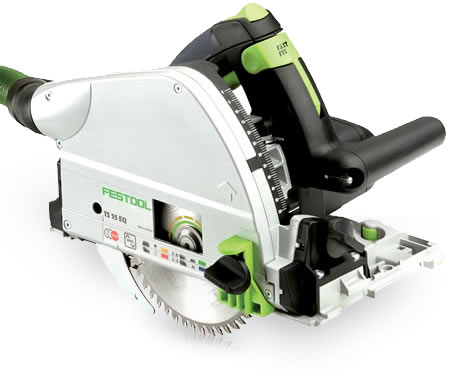
Now, Festool isn’t the only company with a dog in this hunt. DeWalt has a model they introduced about two years ago, and Makita also has a track saw system. I can’t really give a comparative review of these other models, but I can tell you that if they work as well at the one we are using, they are worth their weight in gold.

If you wanted to break down some sheets of plywood without one of these track saw systems, you could make yourself a sawboard and use your circular saw on the cut.  I’ve used the finest blades possible on my little Black and Decker saw, but still found the splintering on the piece to be unacceptable. This, of course, required me to go from the circular saw cut to the table saw in order to complete the cut.  This required that I remember to cut the piece strong and take that second step to get an acceptable edge.

Given the number of cuts on this case, the Festool saved a tremendous amount of time.  The cuts came from the saw cleaner than what I could accomplish with my Forrest Woodworker II blade on my table saw. Anything that eliminates a step in the process that doesn’t sacrifice quality is a winner in my book.

The saw is pretty sophisticated. The controls are clearly marked and easy to operate.  The saw does plunge to cut and also brings a riving knife down behind the blade.  If you have ever cut a board that pinched your saw’s blade during a cut, you know how frustrating and dangerous the situation could be.  This plunging action makes inside ‘pocket cuts’ a piece of cake, not a harrowing experience like plunging a traditional circular saw.

The Festool also has an anti-splinter ‘foot’ that presses down on the material just at the front of the blade to prevent splintering along the offcut side.
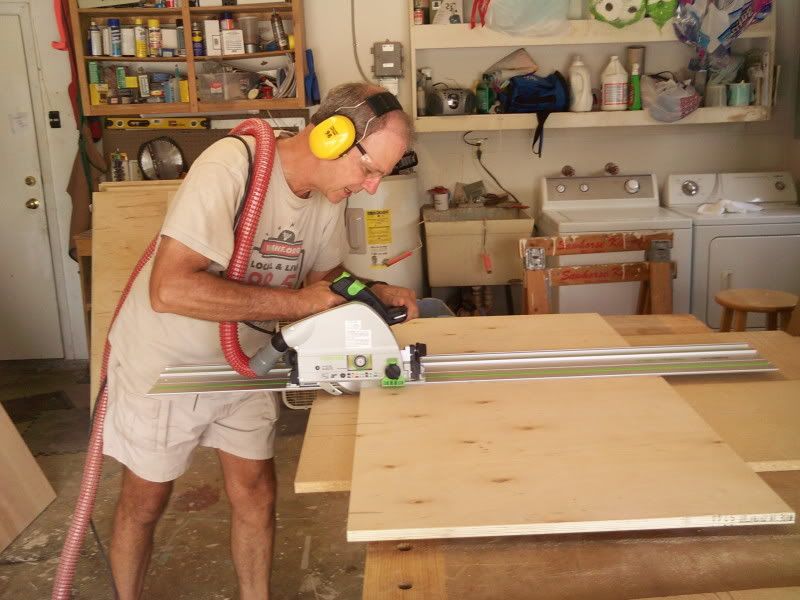
The track that the saw rides along is also very well thought out. Basically, the saw’s base plate has a square notch worked into its design.  This notch mates with a square track that rises from the track to guide the saw.  The base of this track has two rubber non-skid strips adhered to it, allowing you to place the guide down and not have to clamp it.  However, clamping isn’t the worst idea when cutting a lot of pieces.  It just helps to keep the saw track from shifting if you bump into it.

On the edge of this track that guides your cut, there is another anti-splinter device that keeps the keeper half of your board from splintering. Since this is exactly where your saw is cutting, you don’t have to move it into place… it’s always there.  The cuts off the track are perfectly straight and beautiful.

The saw also comes with a dust collection port.  I was using my shop vac instead of the company’s compatible dust collector, but noticed that the amount of dust generated by the cuts was very small.

The saw’s flexibility in cutting could also lead you to trouble. By not indexing off of a fixed rip fence, you have to be sure you carefully mark the pieces you are cutting.  If you mismark and cut on a diagonal, you will get a perfectly straight diagonal. You also have to remember which side is the keeper and ensure you don’t cut it one kerf too narrow by cutting on the wrong side of the  line.  Just sayin …

Yes, a track saw like the one we picked up is more expensive than just using a sawboard and your circular saw.  However, the time you save having to make two separate cuts could really be a difference maker on a large cabinet project. And, if that time savings also happens to lead to better quality cuts, well, sounds like a winner all around.


Quick Poll

Sawdust can be some pretty nasty stuff.

If it’s from an exotic wood you are allergic to, you could end up with a full blown allergic reaction. Bloody noses and sinus infections. Even worse – operations for nasal polyps or cancer.

This week, let us know what your worst run in with sawdust was and how bad was it…

[poll id=”132″]