All posts by Tom

I'm the guy who writes the blog...

Link of the week

Etsy

Sort of a cross between eBay, Amazon and a craft gallery, this online site gives artists, crafters and those who supply them an online marketplace to buy and sell their products.

The site also offers users the ability to set up a virtual storefront and sell their items. There is a fee of $.20 to list the item and an exchange fee of 3.5% should the product sell.

If you are looking to dip your toe into the online selling community, this could be an interesting way to begin.

The results are in…

This past Monday, our county’s art program held its award reception at the PCC-TV studios here in downtown Clearwater. I went to the reception, anxious but confident that Centered and Position of Strength had looked their best and were going to wow the judges.

As in the previous four years, the air crackled with excitement – not only because the contest was about to be judged, but this was the first opportunity for the artists to meet and greet. After looking at each other’s work for the past week, it was great to put faces with names and art pieces.

The National Arts Program’s executive director was also on hand for the ceremony, which proved to be a great honor.

Finally, the names were announced. Here are the results for the adult professional category:

Honorable Mention: “Beyond Petroleum” by Josh Lynch

Third Place: “The Chalk Artist” by Robert Waters
Second Place: “Docked” by Constance Myers

First Place: “The Boyfriend” by Kristina Hopper

As you can see, neither of the pieces placed in the competition. At first, I felt a little bit crushed. I thought these were two of the best pieces I had submitted for judging, and I had yet to walk away from one of these contests without a ribbon.

But, then I quickly realized two things– first, after finishing in the money for the first four years, I think I’ve done pretty darned well. It’s great that this year’s judges saw the work and weighed in on what they liked.

Secondly, and I believe most importantly, I think it’s time to step my game up a little bit. It’s been very comfortable for me to enter pieces into the contest here with the county every year, and I’ve felt like the Big Man on Campus among my peers. But, the time has come to start moving in a bigger direction. That’s why I’m speaking with the Florida Craftsmen Gallery about these two pieces and the Fujiwhara Chest I built a few years ago to see about getting my work exhibited there.

In the meantime, I’m going to start thinking about next year’s entry. You might see me running Rocky Balboa style around the neighborhood, whipping myself into shape for my rematch with Apollo Creed. I’ve got to build something next year to knock the proverbial socks off the judges!

Stuff I’ve built: Centered

January, 2011

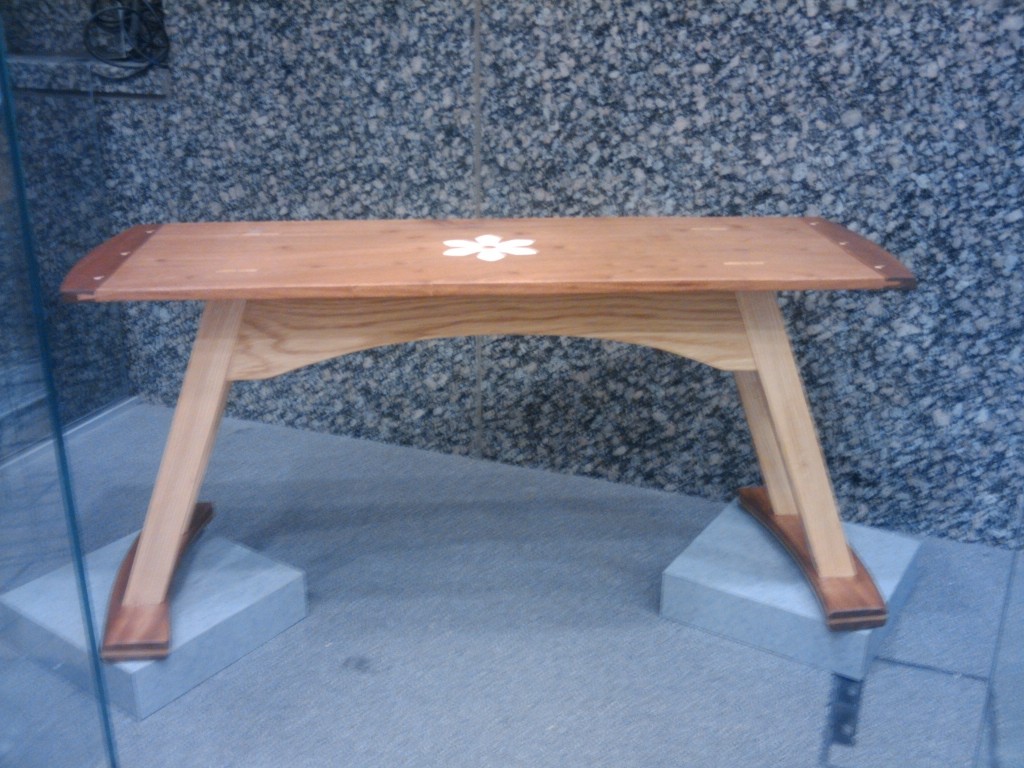
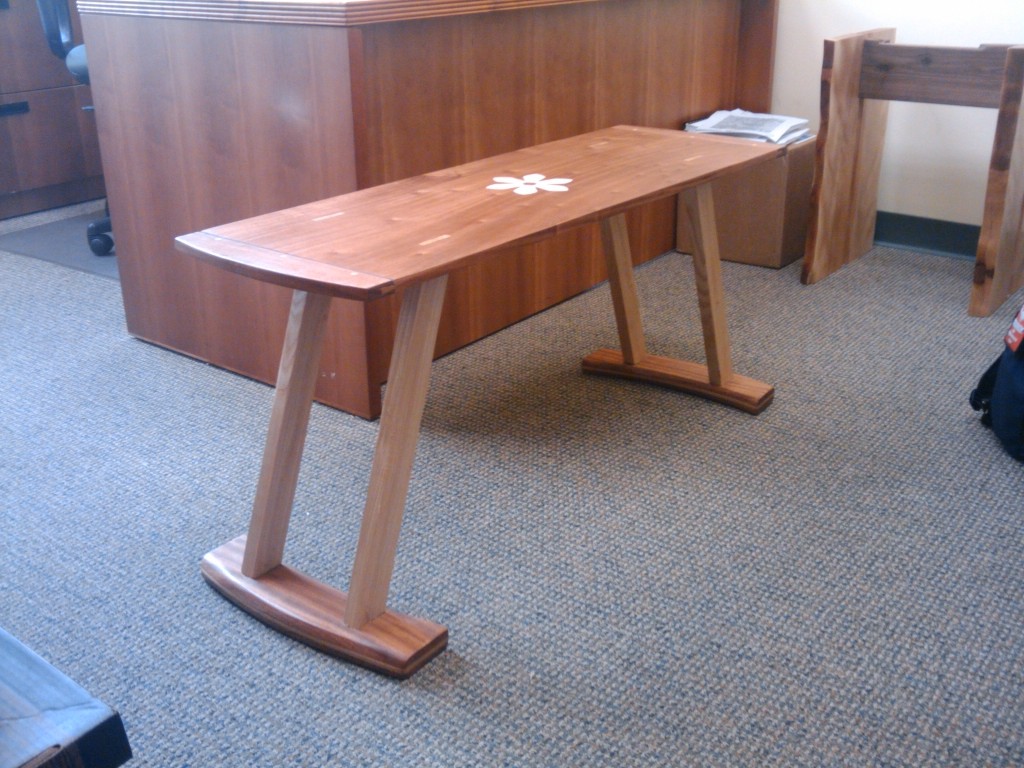
I had to name this piece before I submitted it to our annual art contest. Heck, I had to name it before it was even done. If I had the chance to do it all over again, I would have named it The Cat, because it has used up about seven of its nine lives.

Let me explain. This whole thing started when I found a very wide slab of sapele at my local hardwood supplier’s place a few years ago. I thought, “Gosh, this would make a nice table top one day.” That board sat in my shop for a long time before I had an idea.

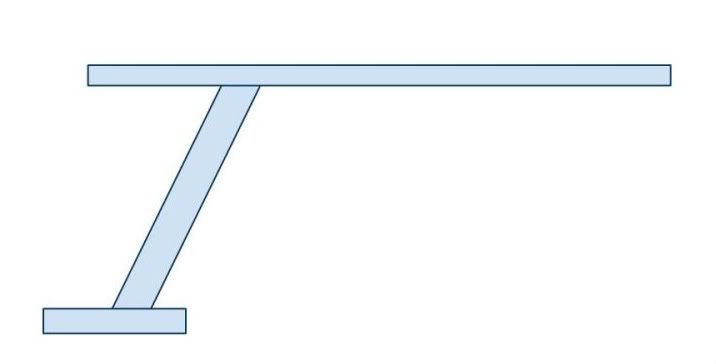
That idea was angled tennons. I should have guessed this was a bad idea from the beginning because online searches brought back few results. But, who am I to let a few details get in the way? After all, it was cheap wood!

Back in September, I finally got around to sketching something out. Cutting angled tennons was going to be the easy part, but, how on Earth was I going to make the angled mortises? Drill them? Hand chisel? Phased plasma rifle?

Before I went too sci-fi, I remembered the article I had written about mortising magic. Now, if it worked for mortises perpendicular to the board’s surface, why not at an angle? So, I marked where I wanted the outside of the mortises to land, set the table saw and ripped the sides. Then I measured the width of the mortises I planned to cut, set the rip fence and ripped the ‘fillers’. Once these narrow pieces were cut, I cut sections out of them at 20 degrees, and then carefully glued the entire top slab back together to restore the wood’s grain pattern. BINGO, baby!

I let the top sit for a few weeks, waiting for more inspiration to hit. How to dress up this big top? How about some breadboard edges? Never cut any in my life, but it’s a good time to learn. I cut two sections of Sapele and grooved them to work as ends. How about the main table top? I tried first to hand-cut the tennons that would fit into the edges, but that didn’t work too well. Sapele is very brittle and splinters easily. I totally messed things up. How now?

Eventually, the idea hit me to lean heavily on blue painter’s tape and a backer board as I pushed the top over the dado stack. So, I trimmed the messed up parts off and taped the snot out of the edges. I set up the dado and pushed the board through. WOO HOO! It worked. I drilled for three dowels, elongated the outer two holes in the tongue and assembled them with some glue right in the middle. I tapped the dowels into place, gluing the middle one and just putting a touch of glue at the top of the two outside dowels. This way, the top could expand and contract, and the dowels would stay put. I cut sweeping curves on the outside of the breadboard edges and sanded them very smooth.

I put the piece aside for a while. Worked on the cabinet pull outs. Worked on the Position of Strength base. Discovered I was wasting too much time, and had to move to the next step. The inlay. You remember the one I nearly messed up but saved with the epoxy fill? OK, got that done, and glued the mortises in place through the top. I’m flying now!

Of course, I had totally forgotten about the feet. When I milled the top, I had taken the opportunity to mill some extra ash and sapele and glued those pieces into blanks. They were just sitting on my side bench, taking up space in the shop. How was I going to make those blocky feet look better? While mulling the options over, I cut the mortises to hold the leg tennons with the mortising chisels my wife and kids gave me for my birthday. That was fun.

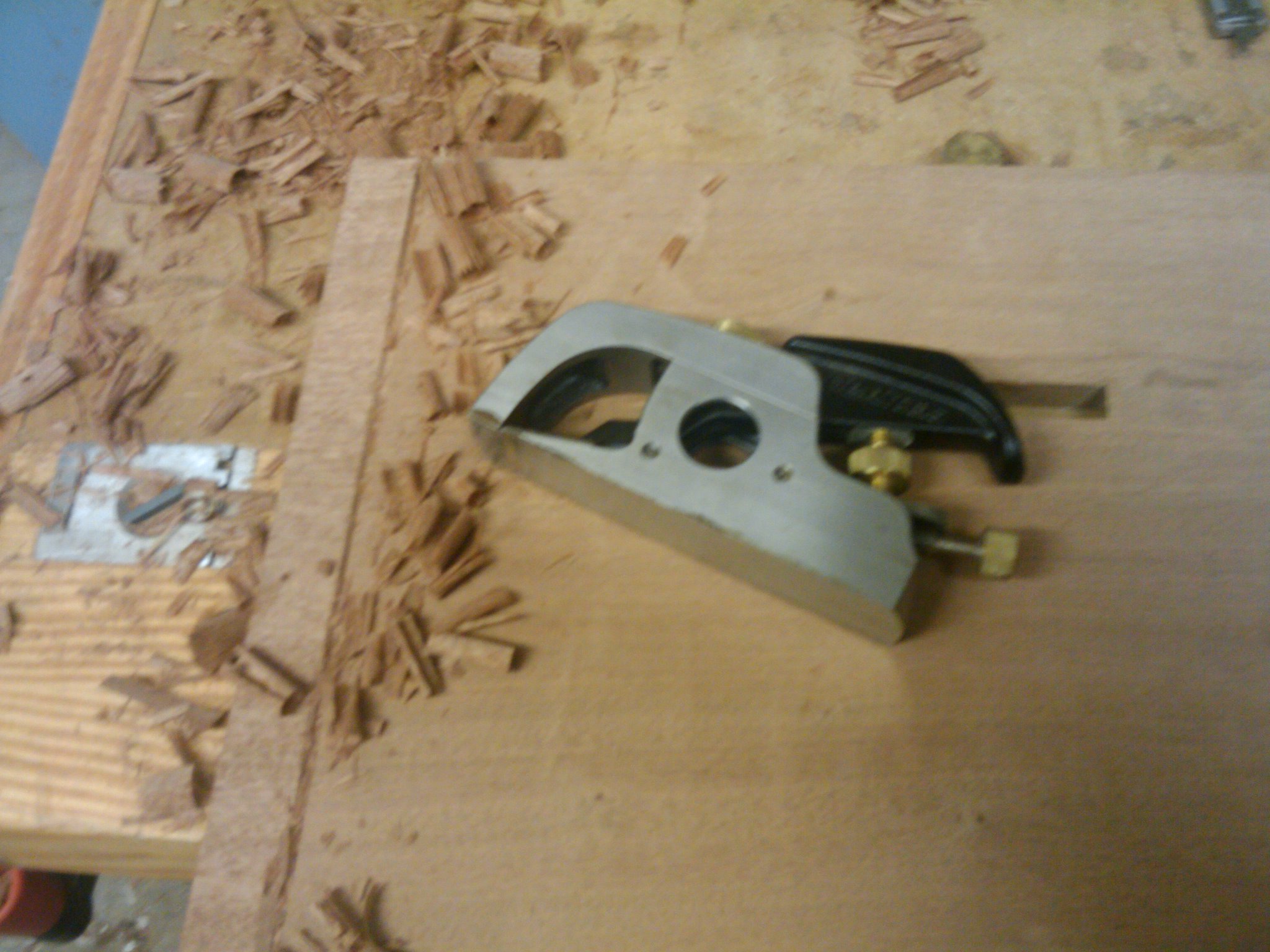
Inspiration hit while I was looking at the breadboard edges. How about curving the outside of the feet? I traced the curve from the top on to the front edge of the legs and used the bandsaw to cut it out. They looked better, but still too blocky. I added a curve on the back side of the feet that mirrored the front curves… better. Then, just messing around, I clamped one of the feet into my vise and started using the spokeshave to bevel the top edge. Soon, I was beveling back both curves at a 20 degree angle to match the legs. Both bevels are parallel, which gives the feet a little more grace and lightness.  Ohh, that was supposed to be the weakest part of the design… looks better now!

I sanded and finished the piece and brought it to work. Hmmm… it didn’t show well. Something didn’t look quite right. The top was just too ‘light’ in comparison to the rest of the piece. It looked like an ironing board. Add to the impression that the first few people who saw it tried to sit on it. Hmm, we had a problem. How to fix it?

I remembered that I had a long rough piece of ash back at home. I opted to put an ash apron under the top. How large should it be? I played around with the proportions and decided that 5 inches would do the trick. I resawed, planed and cut the pieces to size, matching the angles found on the legs. Better, but still too blocky. How about a curve cut out of the bottom? Now it looked better. I glued and pocket screwed the apron into place (my only real option with the piece already glued up), sanded it and finished it to match. The apron added strength to the piece and gave it a more balanced appearance.

I turned the piece in a week ago, and it’s sitting in the locked glass case in the courthouse lobby. The reactions have been pretty positive. I’ve heard it described as ‘whimsical’ – not really something you would expect to see.

At 3:00 today, I’m going to find out how well this and the Position of Strength pieces placed. Hopefully, the judges will decide that my persistence with this piece was worth it. I’ll have an update on Wednesday…

Quick Poll

Woodworking is about accuracy, design and execution. And, when a project is carried out with machine-like precision, well, you have a perfect woodworking project.

In theory, that’s great.  In the reality of our shops, however, sometimes things don’t go according to plan. There could be mistakes in the building or fatal design errors that reveal themselves once the piece is built.   Some of those projects can be fixed, others, well…. some have to go to the great scrap pile.

This week, have you ever had to completely give up on a project?

[poll id=”157″]

Link of the week

The Flex-Sander

I was recently at a local carving show when I ran into a guy named Jerry Moore. He was sitting at his booth showing off a pretty neat little product for wood carvers called the Flex-Sander.

Jerry explained that when you are doing fine detail carving, it’s difficult to get into the tight areas of your project. Jerry’s solution is a flexible piece of plastic and miniature sanding belts. By simply changing your grip, you can get the sandpaper into the narrow cracks and crevices, and you can rotate the belt to get fresh grit.

Not only is it a clever little invention, it’s also made locally, a few minutes from my house in the city of Pinellas Park, Florida. Here’s to successful local businesses!

Inlay disaster averted

Before I start, I need to issue a full-on apology to the folks at Milescraft. If you don’t know who they are, they make some really nifty router accessories that can add versatility to your setup. Trammel guides, wide bases, rapid-change bushings. Really sweet stuff. You owe it to yourself to check them out.

I was working on a project at the shop when I ran into a situation – I had a project (I’ll show next Monday) that was beautiful, but lacked something special. Maybe an inlay. The only problem is that I have never made one before.

Within a few minutes of tweeting my dilemma, one of the reps from Milescraft offered to send me a copy of their inlay kit for use on the project.
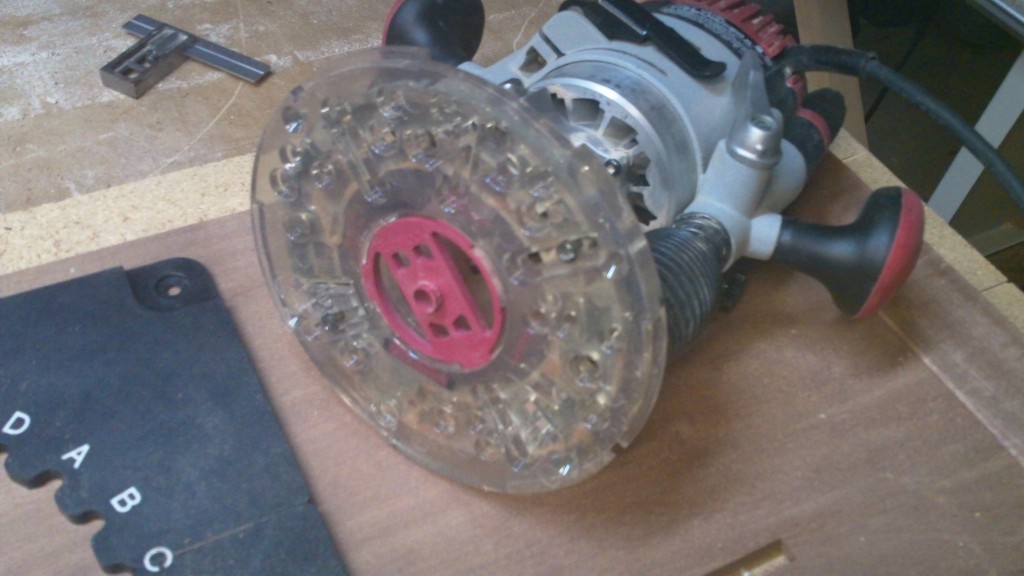
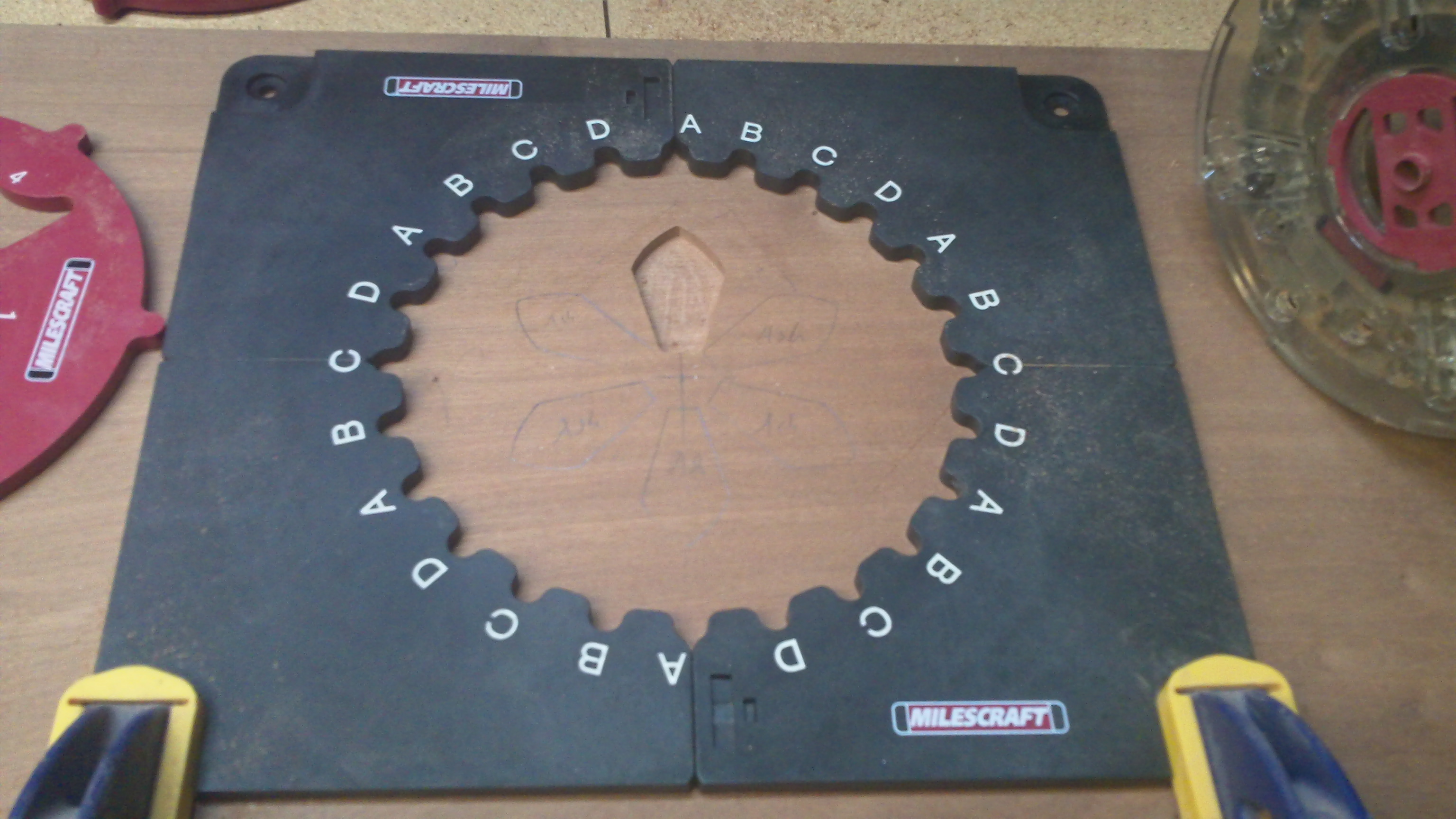
Now, if you have ever made an inlay in a piece using a router and a pattern, it’s a pretty straightforward process. Using a 1/8” router bit and a plunge router, you will cut the recess in your workpiece and then use the same equipment to create the inlay piece from some scrap. The key is to use two different sized bushings on the router – a larger one that pushes the bit further inside the pattern when cutting the recess, and a smaller one that allows the bit further outside. The difference between the two distances is very precise, and it allows the inlay piece to lay inside the recess tightly.

Now, the old expression is that if you practice on scrap, you are practicing on your project. To prevent this, I dutifully found a piece of milled poplar and cut a recess in it. I changed the bushing from large to small, then, I took a piece of scrap and cut the matching inlay into it… they fit very well. So far, so good.

So, I moved to make the cut on my work piece. I set up the pattern jig – an indexible insert that allows for precision placement and rotation for making repetitive cuts. I centered the jig, used the piece I wanted to fill the insert to gauge how deeply to cut, and set to work.
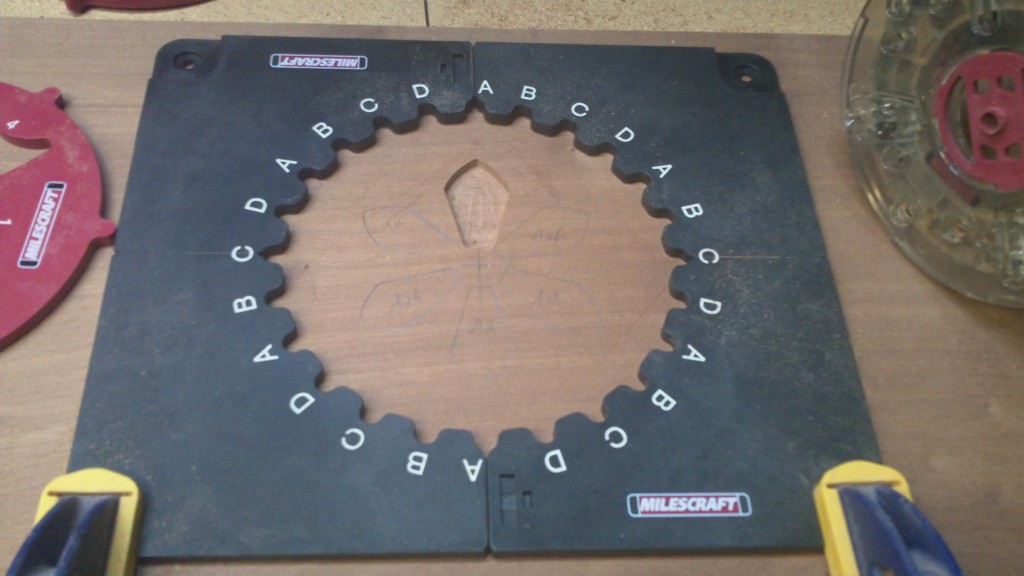
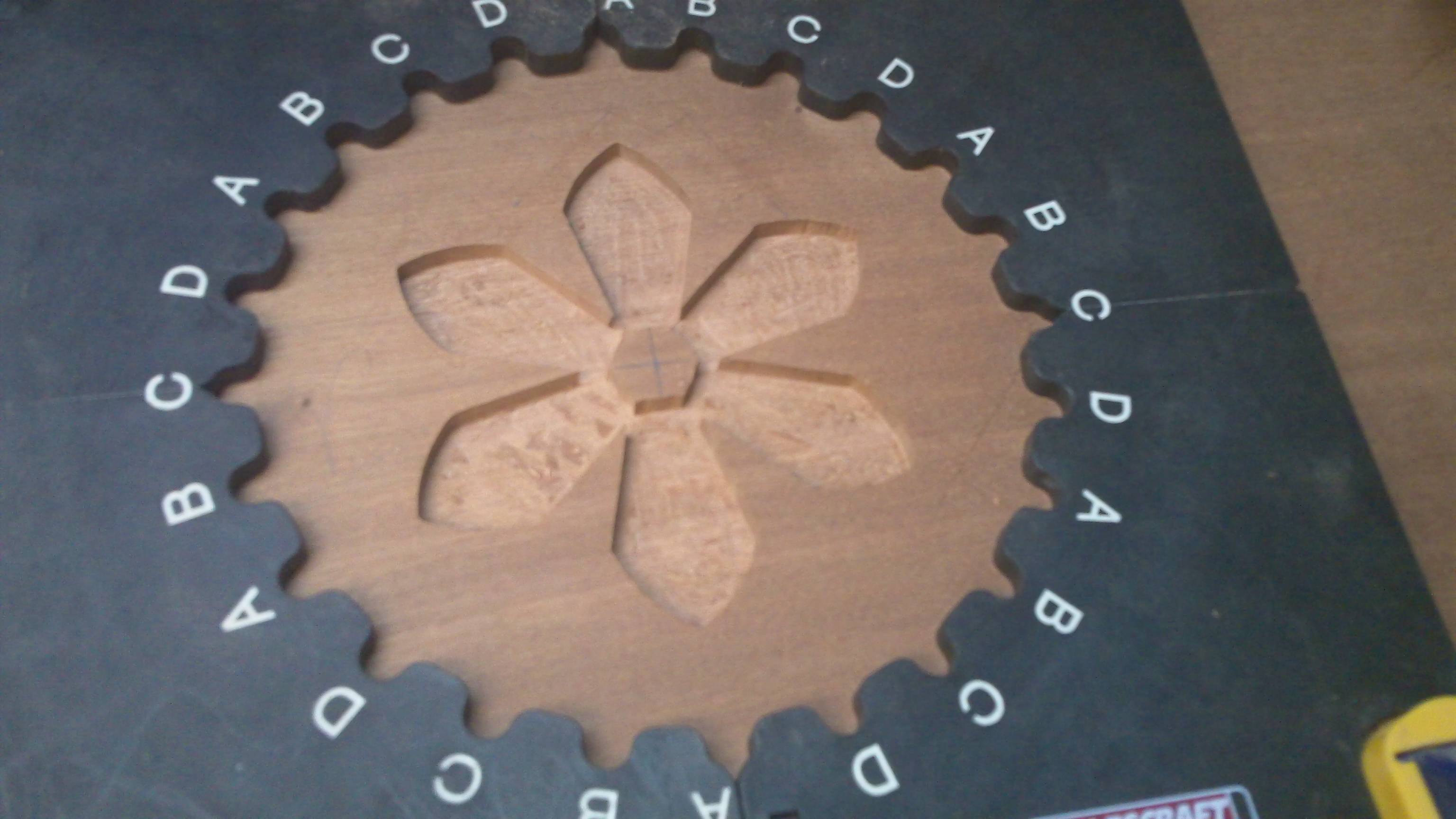
The cutting with a small bit is very smooth, and before long, I had the first cavity routed out. This was going to be a piece of cake.

As I set the router down, a sudden feeling of dread overcame me. Did I remember to change to the large bushing after I cut the sample?

A quick look at the router baseplate told me all I needed to know. Nope.
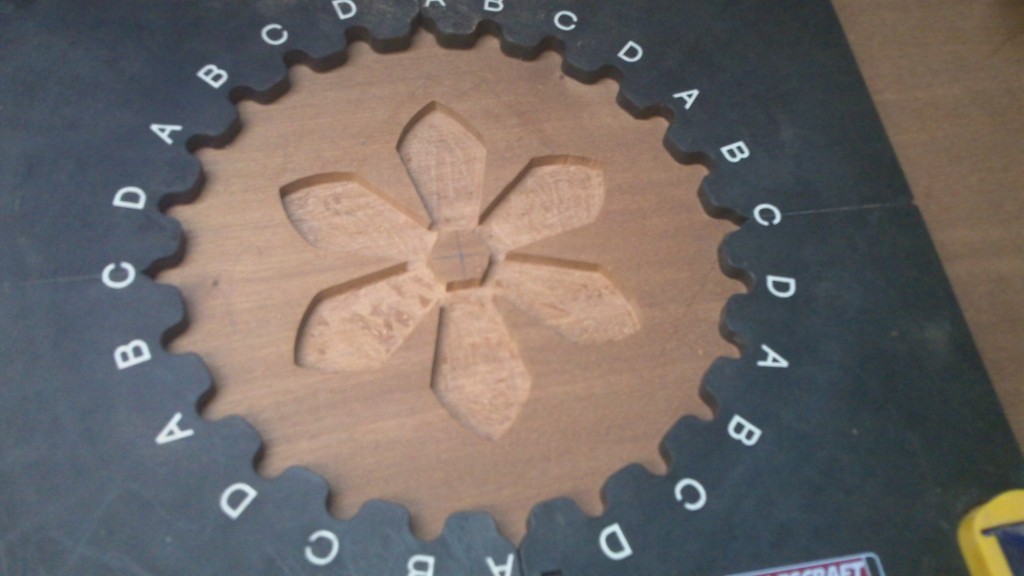
So, now I was stuck with an oversized recess that couldn’t be matched. TOTAL bummer. Thoughts of throwing the entire piece away entered my mind. I had to come up with a solution – and fast!

That’s when I remembered a trick someone had told me years ago – colored epoxy. I grabbed my car keys and headed to the nearest home improvement center.

Epoxy, for those who don’t know, is a two part resin and hardener that glues like nobody’s business. It’s waterproof and has the ability to fill cracks, cavities and other imperfections in wood. In fact, many woodworkers who enjoy working with mesquite swear by it. At the local home improvement center, I found the largest containers of resin and hardener I could find and opted for the 60-minute set version to allow enough time to do what I had to.
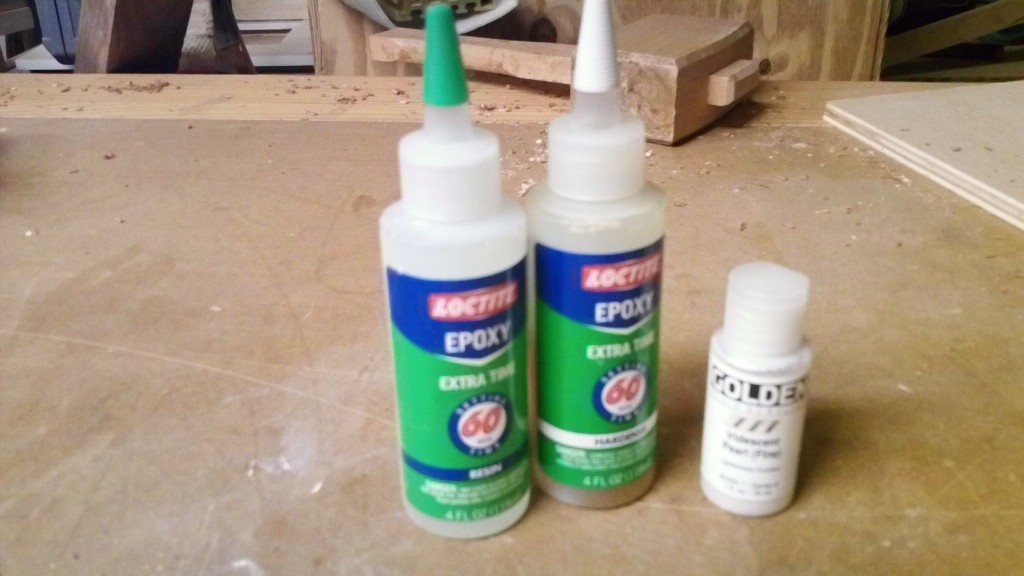
But, how would I color it? Fortunately, my smart phone was able to get reception in the store, and I was able to search for coloring epoxy. Apparently, artist acrylic colors do a decent job. I paid for the epoxy and dashed over to the local Michael’s craft store. There, in the painting section, was a small bottle of pearlescent white paint. Sold.
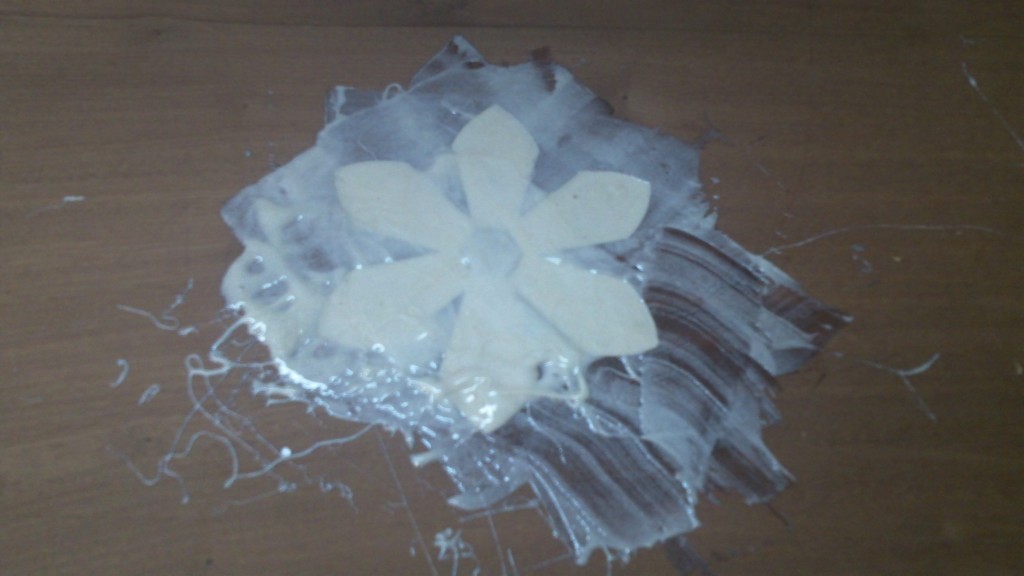
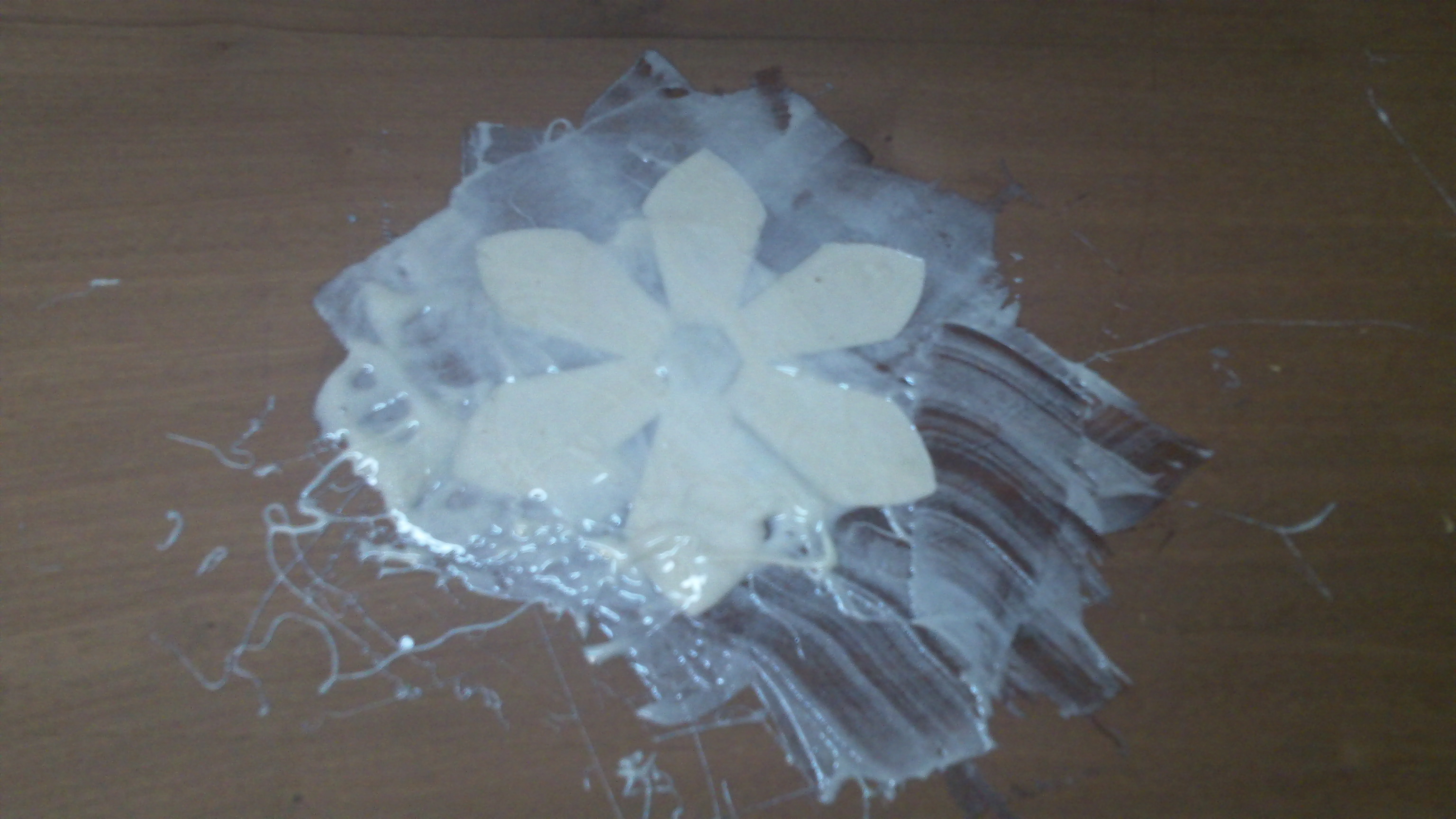
Back at home, I mixed the epoxy per the instructions and added about 10% of the paint to the mix. It immediately took on a richly colored hue. I poured the mix into the recess and smoothed it out with a scrap of wood. Sure, it looked like a hot mess of cake frosting, but my plan was to address this with the next step.

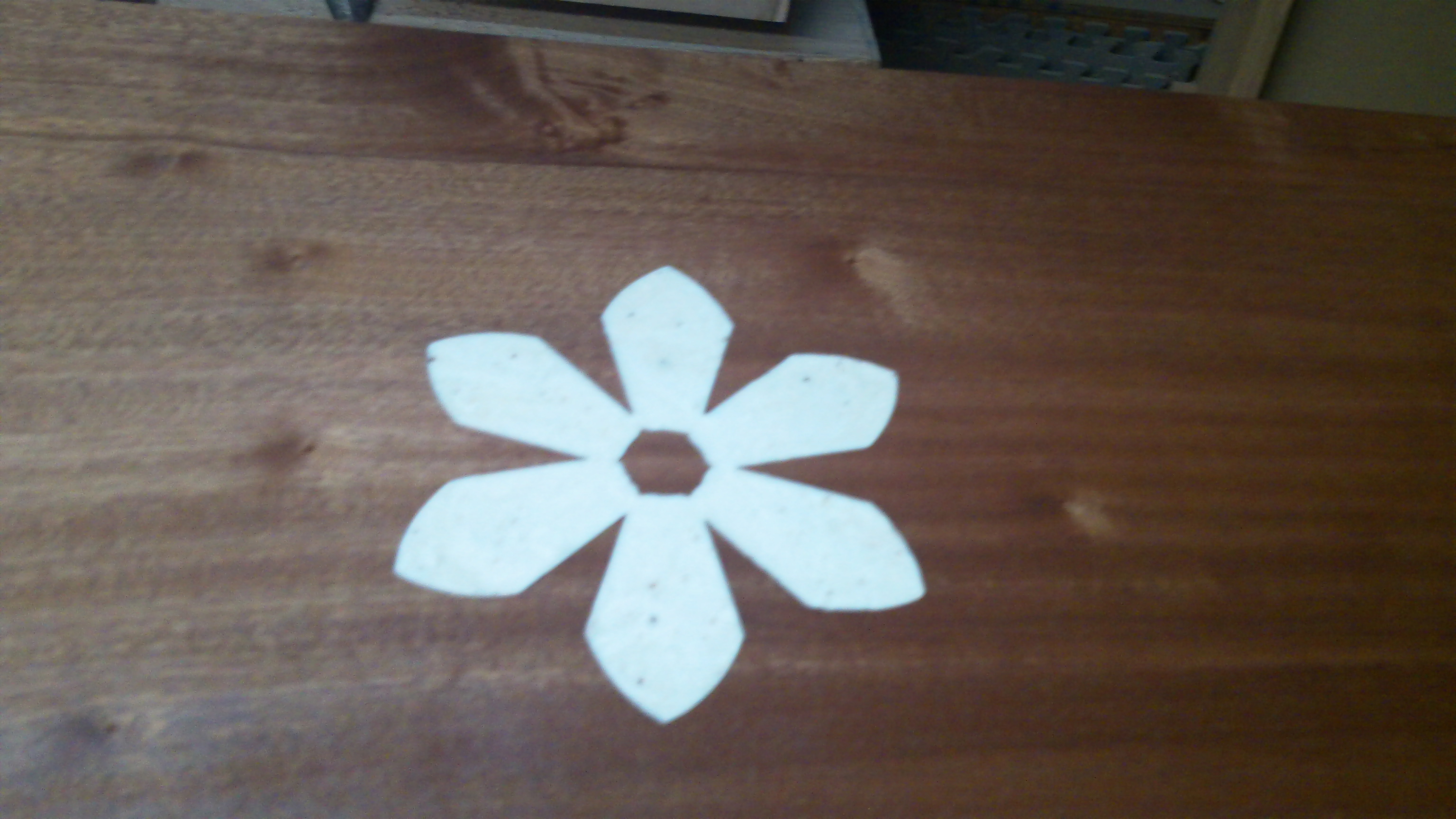
I let it sit overnight so it would harden, then started sanding with 100 grit paper on my random orbit sander. It took a little bit of time, but I could see it was removing the hardened epoxy. Once I began to see the clear outline of the inlay, it was nothing but good. Some more sanding, and soon, I had the piece ground down flush and it started to burnish up nicely. I changed sanding grits to 150 and then 220. The epoxy in the inlay was actually starting to glow with the finer scratch pattern.
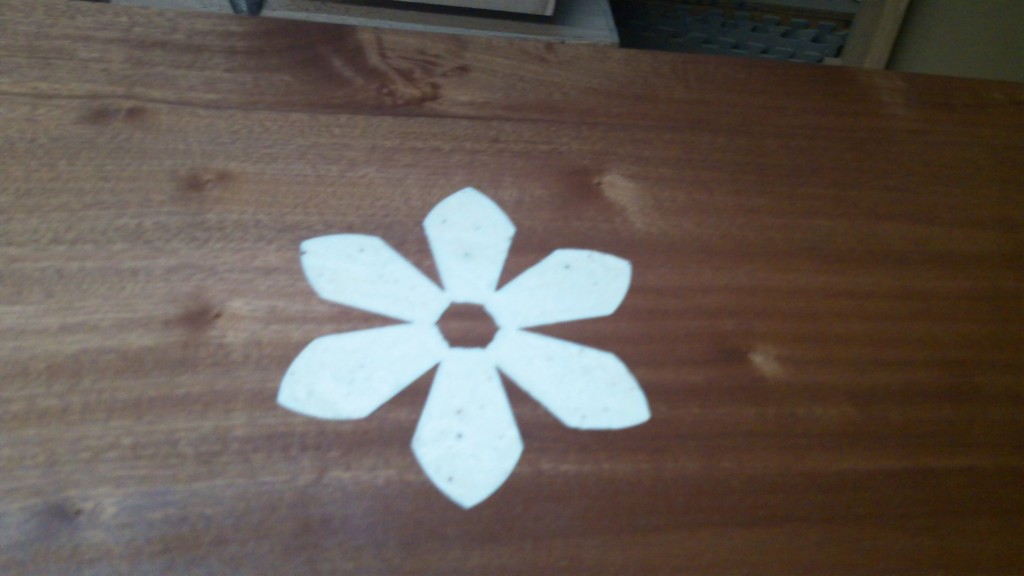
When it came time to finish, I laid on a coat of 1# dewaxed shellac, then sanded it to 320 grit by hand to get the surface smooth. Two coats of Watco Danish oil later, and the project was done.

When you look at the inlay, you can see the color variations showing how the epoxy was poured. It’s not a monolithic looking surface by any stretch of the imagination. In fact, several people have asked if it is some kind of ivory or mother-of-pearl inlay.

You have got to love a trick like this – proving that – at least in my case – creative problem solving is a skill that helps improve woodworking.