All posts by Tom

I'm the guy who writes the blog...

Link of the week

eGuitarPlans

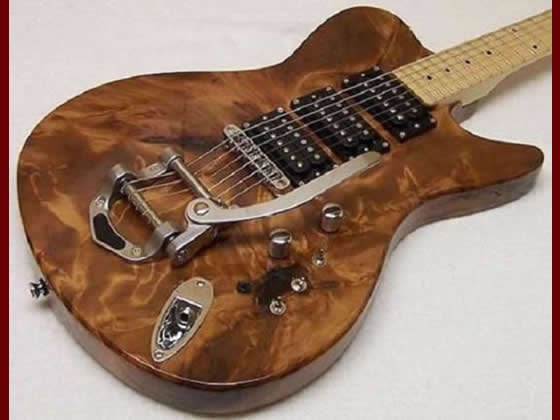
With Les Paul’s 92nd birthday yesterday, and Google’s tribute to this guitar pioneer, it’s only fitting that I link to a site that gives you the know how to build your own electric guitar.

This site is pretty darned amazing.  Not only are there plans for sale for some pretty sweet looking guitars (They cost only $6 each… quite the bargain for detailed plans), there are also links where you can buy pickups, view podcasts on the building process and even buy completed guitars if you would rather just rock out.

I think Les would be proud.

Stuff I’ve built: The microwave shelves

I often wonder why two things that go together often don’t match up.

A few years ago, a hot dog manufacturer proudly announced that their dogs now came in a bun-length size. Color me curious, but as far as I could tell during my 42 years of life, hot dog buns have pretty much been a standard length.  I’m just wondering why dog manufacturers took so long to adopt this new size?  That will make you go ‘hmmm’ at your next cookout for sure.

Another place I have seen this involves the width of a range hood vs. that of an over-the-range microwave.  When my wife and I moved  into our house, we had a pretty standard issue contractor grade range hood in a lovely shade of avocado above our range.  It was disgusting, and we needed to have it ‘taken care of’.  So, I took a can of high-temperature black paint and – heeding the advice of Mick Jagger – I painted it black.

That was great until we noticed that our microwave oven was taking up space in our efficient kitchen. Why not combine the best of both worlds – get an over the range microwave that also functioned as a range hood?  So, about five years ago, I vowed that we would do that.
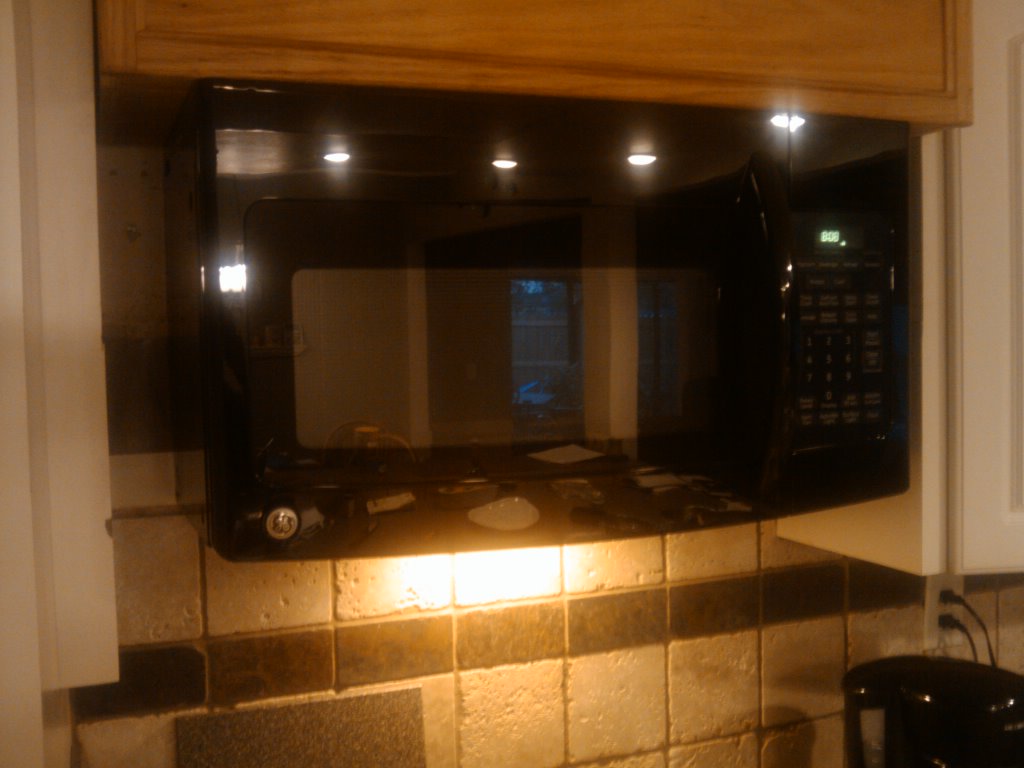
Well, imagine my surprise when I discovered that the cabinet above our range was too low to install a microwave into.  Bummer.  So, my friend down the street and I got ambitious, cut the cabinet free and created a huge void above the range top.  I had to build a simple ‘filler’ cabinet above the range to drop the unit lower than the ceiling and to hide the electrical connections and venting.

When we went to install the new unit, my stomach sank. You see, over-the-range microwaves are about 30 inches wide, but range hoods are 36 inches. What was I going to do?

Back at the home improvement center, they wanted to sell me a ‘filler kit’ – basically a few filler panels to close the unused space in.  But, that didn’t seem right.  After all, we have a number of cutting boards we need to store, and all they do is clutter up the cooktop. So, I thought for a while and came up with this insanely simple yet useful idea.
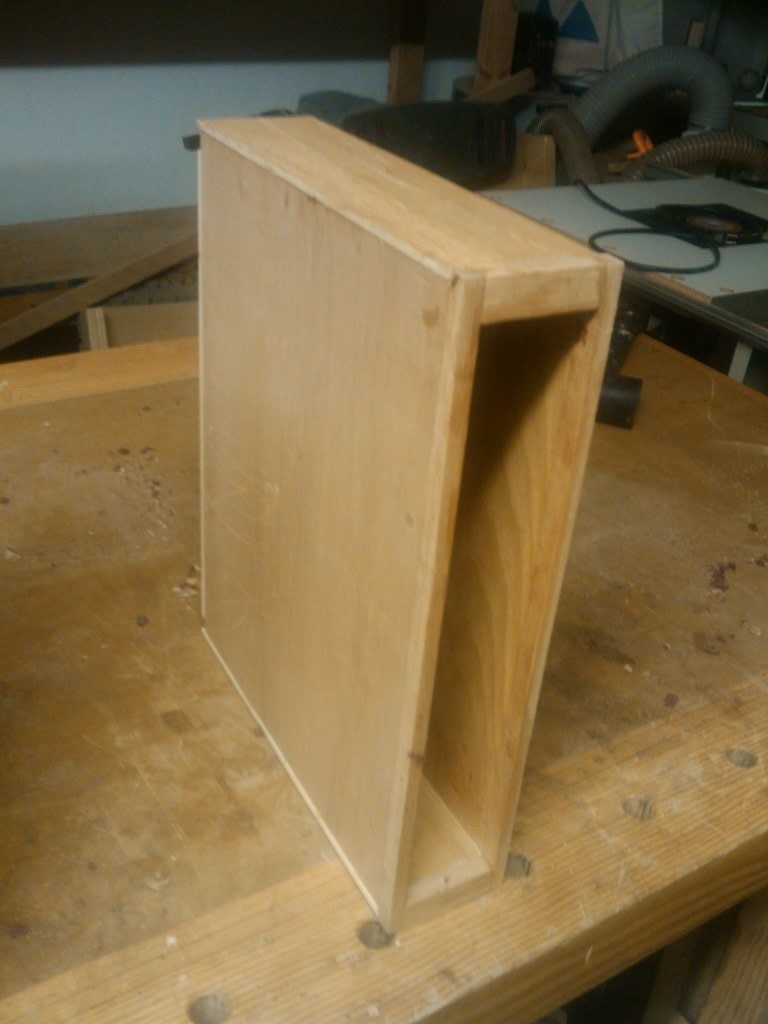
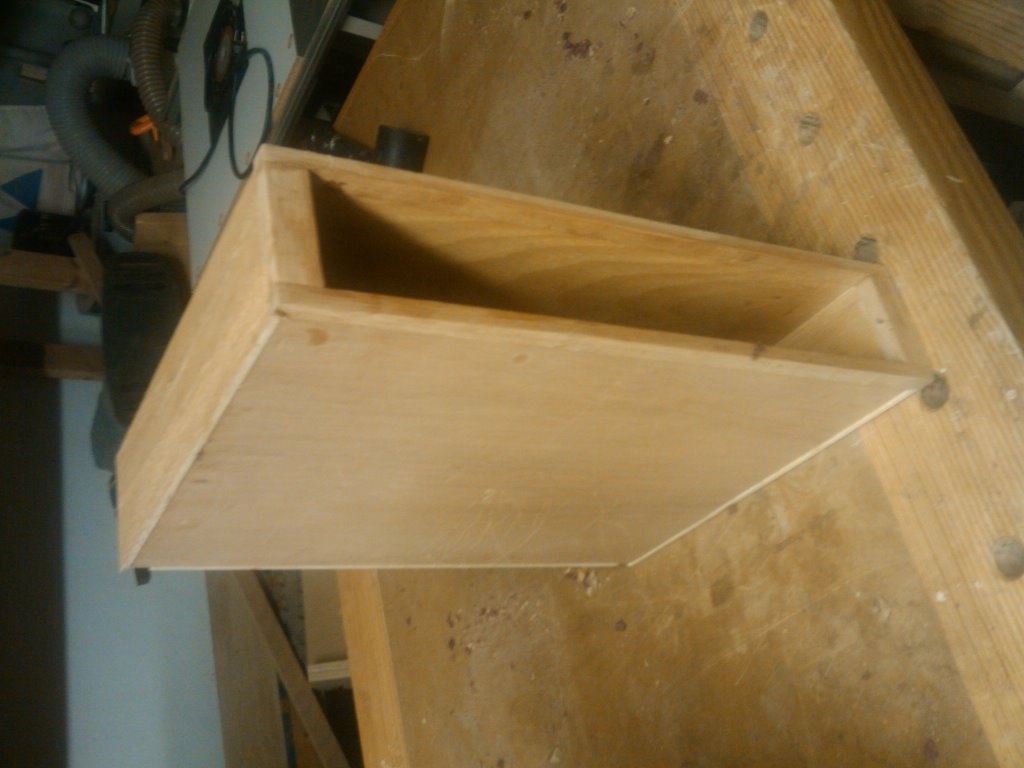
Basically, what I created were two slip bookshelves out of some scrap red oak plywood. They were very simple to build – the tops, bottoms and backs were strips of 3/4″ plywood  cut to width and rabbeted to accept the side panels.  Those were made of some 1/4″ ply which was glued and stapled into place.  They fit snugly into the opening and are screwed into the bottom of the filler cabinet with a pair of pocket hole pan head screws.

In place, they provide a convenient area to stash the cutting boards and keep them off the counter top. They were very easy to build and – I think – provide a convenient place to stash the cutting boards until they are needed.

Why am I writing about them now?  Well, after five years of popcorn, reheating and way too many door slams, we had to replace the microwave.  The new model is a sturdier, brawnier one which – I hope – will be able to handle the force of the two growing lads in my house as they enter their teen years and eat us out of house and home.

 

Book Review: Sand Shading

There are lots of ways you can make a project look good when finishing. You can stain, dye or oil the piece to give it depth or shimmer.

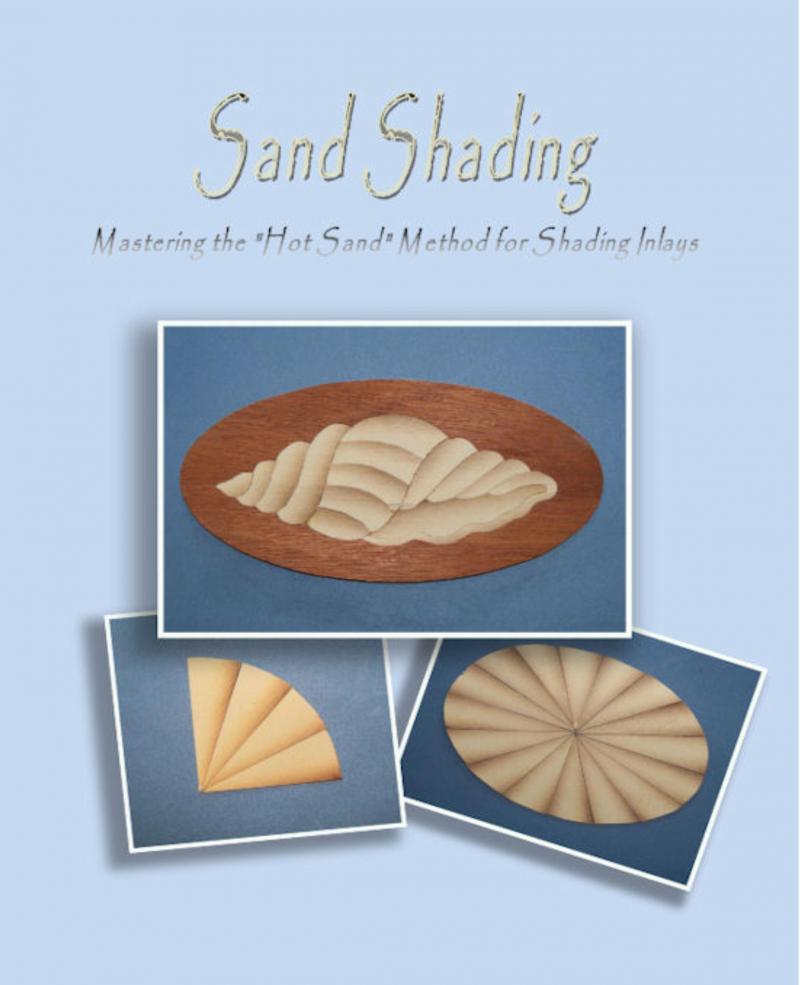
But, there’s a classic technique that uses veneer, sand and heat to add depth to inlays.  Woodworker Ralph Bagnall has written his first book on the subject of sand shading, entitled Sand Shading: Mastering the hot sand method for shading inlays.  It offers very simple step by step instructions on the process that should encourage even the beginner to try their hand.

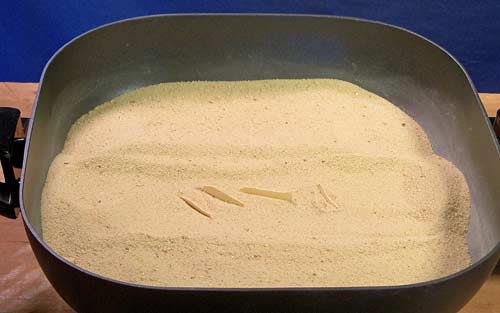
Ralph lays out the process in clear, easy to follow steps. The first piece of ‘specialized’ equipment used to be a ubiquitous piece of kitchen cookware – an electric skillet.  By using the heat control on this appliance, you can get accurate temperature control in the sand, which gives you control over the shade you impart to your inlay pieces.  Ralph observed that while you can buy a new one of these skillets for about $30 in a local mega-mart, you can probably score one at a thrift store or yard sale for uber-cheap.

The next specialized component is sand… but not just any sand. You want to pick up sand with the finest grit possible to ensure a more even shading on the inlay pieces. Ralph suggests leveling sand, used to level patio pavers.  His suggestion to thoroughly dry the sand using the electric skillet is one of those a-ha tips that you expect from a well-conceived book about a challenging technique.

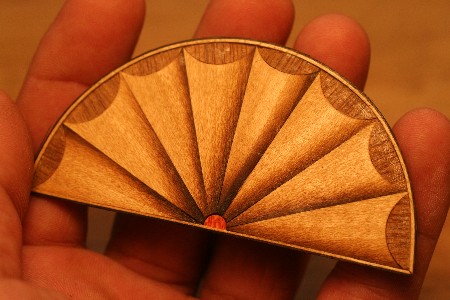
As you might imagine, the shading is achieved by burying the inlay material in the sand and scorching it slightly. During each step of the process, Ralph shows the tips and tricks for shading simple fan inlay pieces all the way to fancier shell designs.  He also goes into the material selection process, showing which species of wood works the best (Ralph loves holly for this), the best way to assemble the inlay for installation into the final piece and how to get creative in designing your own projects.

Ralph’s book brings to light in great detail this classic but seemingly lost technique. Given the clear step-by-step instructions and common equipment and materials, this is going to become one very popular read.

Congratulations to Douglas Bordner who won a copy of Ralph’s book! Thanks everyone for participating!

Now, here comes the fun part.  Ralph has offered me the opportunity for one of my readers to get a free copy of his book for his or her very own.  So, let’s break out a classic game played by radio stations. Send me an e-mail at tom@tomsworkbench.com with the answer to this question:

What was the first project I built  that I ever used veneer on, and what was the species of veneer I used?

I’ll take all the correct answers I receive until 8 p.m. Eastern time today and have one of my sons randomly select from the correct answers submitted.  Good luck!


Quick Poll

When it comes to woodworking, it seems as if we are always in some part of the project building process.  Whether just starting to develop plans and gather materials to buffing out a glowing finish and moving it to it’s place of honor, there are definitely places along the path where we find ourselves.

So, why not share with us what ‘state’ your projects are in?  Right now as you sit to read this poll.  If you need to, poke your head out into your shop and come back to answer… we’ll be waiting!


Link of the week

Ancient Kauri Kingdom

So, you would love to get your hands on some old-growth lumber to work with.  Ya know, stuff found at the bottom of a lake from an old sawmill operation.  That’s cool and all, but what about wood that predates the Roman Empire, ancient Egypt or the cave paintings found in France?

An Apollo guitar made with ancient Kauri wood – http://www.apolloguitars.ca

In New Zealand, huge forests of Kauri trees toppled over as water levels rose, softening the earth around the root balls. As these trees fell, they became buried in the bogs, preserving their wood for millennia. Some of the trees fell over as recently as 3,000 years ago, but the ancient ones being recovered toppled over nearly 45,000 years ago.

These trees are dug up and slabbed into some of the most amazing wood you have ever seen.  This site is the front door to Ancient Kauri Kingdom, an industry leader in the harvest, processing and handling of this treasure from the past. Yes, you can work with it just like any other wood. There’s plenty of information on the site about how the logs are found, how they are processed and how you can purchase some pieces for a special project of your own.

Take it to the edge

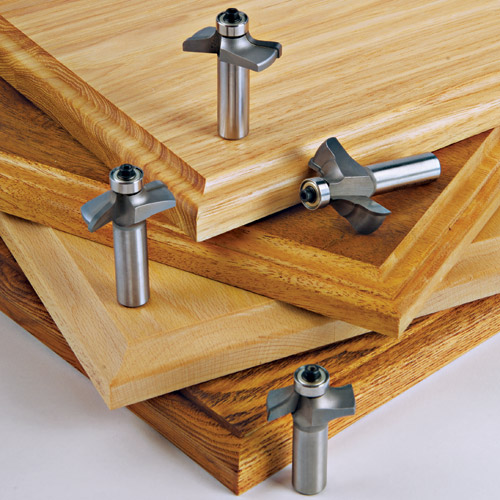
My woodworking world was rocked when I discovered cope and stick bits for my router.  Instead of trying several convoluted methods of cutting and attaching rails and stiles for cabinet doors, I was able to use two matched bits to cut everything. The pieces slid together snugly and the inside bead around the panel was something to behold.

The only problem I began to notice was that while the inside of the doors was pretty, the outside edges were just plain Jane. I noticed the same thing on the tops of the tables I built – there wasn’t much in the way of ornamentation.

“That’s a common design flaw for beginning woodworkers,” said Dan Walter of Eagle America.  “It’s so important to tackle the more complex joinery, but easy to forget that there is an outside of the project that people will see as well. It’s a shame, because the additional detail can take a basic project and really make it noticeable.”

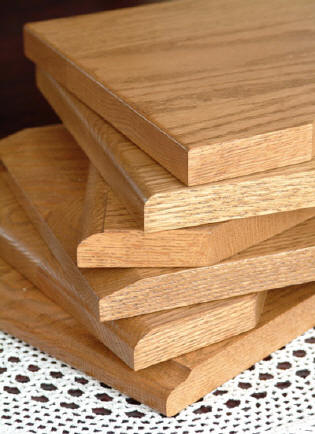
So, what’s a woodworker to do?  “It’s easy to do something like put a roundover on the edge, but why not try something an little more complex?” Profiles that feature numerous coves, roundovers and steps provide much more visual interest, but do some other things for the project as well.

“They tend to make the doors and table tops a whole lot more durable.  Sharp edges on woodworking projects – especially ones that take a lot of abuse like door edges and table tops, can easily be damaged by a sharp blow.  By rounding them over, you create an edge that’s less likely to take a sharp knock, and any force that is applied tends to be more of a glancing impact.”

Dan also went on to describe one of the more visible aspects of woodworking – the play of light across the project. “Shadow lines on anything give the piece a more stunning impact.  Think of the monuments in Washington, D.C.  The fluted columns around the Lincoln Memorial are very intricate, and the way they cast shadow on the while marble casts striped shadows on what would otherwise appear as brilliant white columns. A fillet – or step – on the molded edge of a table top does the same thing, making your project stand out a whole lot more.“

Eagle America has a great deal on one of their most popular four-bit sets for creating table or door edges. “We put together these bits to give woodworkers the opportunity to create some dramatic effects at the edges of their projects. With these bits, you can choose from the simple to the complex, giving you the opportunity to pick the perfect edge to suit your project’s style.”


Remembering the fallen

Today is Memorial Day here in the United States.  It’s the start of the summer holiday season.  A great day to go pick up a bargain on a TV at a local mega-retailer. You can officially wear white again.

Oh, yeah, there’s also the reason why we commemorate the day in the first place… to honor all who fell in battle to preserve, protect and defend the Constitution of the United States.

I am not one who glorifies war. With two young sons who may one day be called upon to serve, I hope and pray that they will never be put into dangerous situations.  I’m sure that anyone in uniform or knows anyone who serves wishes the exact same thing. At the same time, I also understand and respect the ultimate sacrifices made to ensure that freedom and democracy are seen around the world.

Take a moment today and think of those who made that sacrifice, those who served with them and the families who lost their loved ones.

One of the most fitting tributes to help those who lost their loved ones in uniform is to build a memorial flag case to hold the burial flag.  There are lots of plans out there to built them, but this one from Wood Magazine has the added benefit of requiring only 45 degree cuts, dramatically simplifying the building process. Even if you don’t know of anyone who has died in battle, building one to donate to your local American Legion, Veterans of Foreign Wars or other service civic club would be a very touching gesture for those who gave so much.