Tom’s Workbench

Woodworking Around the world

Filed under: Shop Talk, Video — Tom March 20, 2008 @ 8:14 am

So, you think you are a pretty decent woodworker? Do you think you need more tools to get the job done? If so, check out this video from Basit Design Furniture.

The company is based in Colorado, and their manufacturing facilities are in India, Pakistan and Indonesia. These craftsmen can turn out beautiful furniture using mostly hand tools. The work is exquisite, to say the least.


Makes you want to do more work with hand tools, doesn’t it?

Miracles we have seen…

Filed under: Shop Talk — Tom March 18, 2008 @ 5:35 am

Prediction is very difficult, especially if it’s about the future. - Niels Bohr

Y2K for everyone!Ahh, who can forget the heady days of late 1999? The dire predictions of mass hysteria as computer systems crashed around the world. Cults foreseeing the end of civilization and the beginning of the ‘end times.’ Economists hedging their bets on an economic collapse the world hadn’t seen since the Great Depression.

Imagine everyone’s relief when January 1, 2000 rolled around and the world didn’t go into the tank.

If you think the people in the late 1990’s were the first to make predictions of what the new millennium was going to look like, you’d be wrong. People have always looked ahead, based on their observations, and tried to foresee just what the future would be like.

Jetting off to work!I recently came across a .PDF of an article written in a 1950 edition of Popular Mechanics called Miracles You Will See in the Next 50 Years. Wow. This was some real Buck Rodgers kinda stuff. Rocket planes that scoot people across country in less that two hours. Shopping by video phone. Solar energy providing cheap, reliable electricity. A veritable bonanza of clean, efficient life in a technological wonderland…

Who am I kidding? The description of life in the year 2000 sounded soulless, sterile and - in many ways - frightening. Here are some of the predictions that made me stop and say, “huh?”

  • Cooking as an art is only a memory in the minds of old people. A few die-hards still broil a chicken or roast a leg of lamb, but the experts have developed ways of deep-freezing partially baked cuts of meat.
  • There are no dish-washing machines, for example, because dishes are thrown away after they have been used once, or rather put into a sink where they are dissolved by superheated water.
  • Discarded paper table ‘linen’ and rayon underwear are bought by chemical factories to be converted into candy. Yuck.

Doesn’t sound like a place where anything is too terribly permanent or personal. That carries through to the home and furniture as well:

  • Though (the house) is galeproof and weathterproof, it is built to last only about 25 years. Nobody in 2000 sees any sense in building a house that will last a century.

Hosing down the furnitureLater in the article, we see a cheery Mrs. Dobson hosing out the inside of her home - furniture included -to get that nasty dirt and ground-in grime out. The water and detergent disappear into the main central drain, a blast of hot air dries everything and the home is once again sparkling new.

Of course, none of these predictions have come to pass. However, in the 1950’s, we were sure that science would solve all of our problems. Plastics, mass production and advances in technology were supposed to eliminate all of the toil and hard work from our daily lives.

If that’s the case, why did woodworking survive, and why is it a thriving hobby for hundreds of thousands?

It turns out that we can find a historical analog. In the late 1800’s, the Industrial Revolution was changing the landscape everywhere. Mass production of everything was becoming the norm, and that included furniture. Factories could spit out ornate spindles and table legs at alarmingly fast rates, catering to the Victorian fashion sense of the day. Layers of ornamentation could hide shoddy or underbuilt joinery.

But, there were those who didn’t want to go along with the mechanized flow. InStickley Design Elements England and the United States, such notables as William Morris, Gustav Stickley and Edwin Lutyens were driving furniture design into a more craft, hand made aesthetic. Even though they used machinery for some tasks, the furniture spoke boldly to strong lines and the skill of the craftsman. Frilly ornamentation was abandoned nearly altogether in the Arts and Crafts movement, with the new style playing on exposed joinery as a design element.

These pioneers saw a different future than was being offered, and, today, their work is prized for its clean lines and bold showcasing of structure.

In the late 1960’s and early 1970’s, there was a similar renaissance in woodworking. The counter culture movement was rejecting all things technological, and some very creative minds, such as Sam Maloof, James Krenov, Tage Frid , George Nakashima, Wharton Esherick and Art Carpenter came into their own. Magazines such as Fine Woodworking encouraged the average homeowner to try his or her hand in this time-honored craft.

Sam Maloof in his shopThis handbuilt school of design brought with it increased innovation to allow the inexperienced craftsperson to build custom furniture. David Keller perfecting the first through dovetail jig. Delta pushing innovation in table saws. The adaptation of new industrial joinery technology into the home workshop with such items as the biscuit jointer, pocket hole jigs and the Domino.

Not all of these innovations had shown themselves in high-tech tools. Companies such as Stanley and Record, who used to make the hand tools craftsmen relied on, were replaced by forward-thinking outfits such as Veritas and Lie Nielsen. The hand tools built there are, in many cases, an evolutionary leap above the old styles, and will serve their owners for generations to come.

This new rise of woodworking timed perfectly with the advent of the Internet. Today, many techniques, tools and materials are just a click away, and dozens of lively woodworking forums allow a free exchange of information to even the most far-away places.

So, technology has definitely provided a miracle of some sorts, even if it wasn’t exactly as envisioned back in the 1950.

Quick poll - 3/16 results

Filed under: Quick Polls — Tom March 16, 2008 @ 10:27 am

Building on last week’s poll…

What’s your preferred method of cutting tenons?

View Results

Loading ... Loading …

Link of the week

Filed under: Link of the week — Tom March 14, 2008 @ 2:42 pm

George Nakashima, Woodworker

George NakashimaWoodworking master George Nakashima’s influence is still felt in the works he created and at the furniture shop run by the craftsmen who continue his tradition.
After being held in a Japanese Interment camp in Idaho during World War II, George went on to build his reputation and legend. Before his passing in 1990, he received the Third Order of the Sacred Treasure from the Emperor and Government of Japan in recognition of the cultural exchange generated by his work and exhibits.

His work focused on the natural forms and lines in wood, frequently using the waney edge of through-sawn logs as table tops and other important furniture components. Powerful, organic and harmonious are some of the more apt descriptions of his final products.

Today, the talented artisans he trained carry on his work, designing spectacular pieces from the felling of the tree to the final hand-applied finish. Just a look at the gallery of the incredible furniture can serve as an excellent inspiration.

Space - the Final Frontier

Filed under: Shop Talk — Tom March 12, 2008 @ 9:40 pm

The Holy Trinity of Star TrekEvery weekday morning, my alarm clock goes off at 6 a.m. After I grab a cup of joe, I head to the living room and turn on TV Land to catch an episode of Star Trek. Yes, that classic, campy 1960’s gem of television goodness. As I sip my coffee, I wonder what adventures await the USS Enterprise as she continues on her mission to explore space.

We know a lot about the universe - namely, it’s a really big place. I mean, HUGE. We’re talking about more space than can normally be found between my ears. Which may be difficult to believe.

If this is the case, why is it that no matter where the crew of the Enterprise heads, they run into unknown planets with populations that have to be in the millions? I mean, come on - they go to an uncharted section of the galaxy, and it’s more crowded than a Starbucks during the morning rush hour.

Fascinating.

Building the shedIn much the same way, you’d expect that a two car garage measuring 24 feet by 26 feet would be more than adequate to meet all of my woodworking needs and still provide plenty of space for the storage of other family items. Not so.

Recently, my wife and I got into some rather protracted negotiations about space. My two sons are very active little guys, so they have lots of things they have accumulated over the years. Each had more than one bike. A scooter. A wagon. A bucket of toys for the yard. Basketballs, footballs and soccer balls.

You also have to add on the family stuff. Picnic coolers. A tent we never use. Paint cans from previous home remodels.

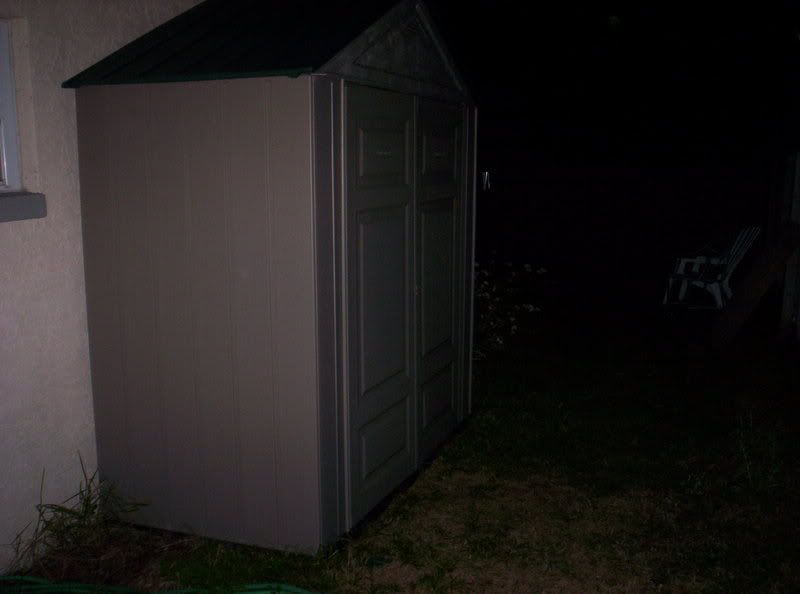
The shed at nightIt got so bad that I couldn’t get to my band saw, clamp rack or dust collector, and if I wanted to use the table saw, I had to spend about 20 minutes moving bikes and other items to the driveway. We couldn’t walk out of our double-width garage door without tripping over something!

I, as Lt. Commander Spock, would reason logically that all of the woodworking tools that I could use to build projects were collecting dust and cobwebs, wasting away in unaccessible corners. My wife, as Doctor McCoy, argued passionately that our kids were still children, dammit, and they had the right to have their toys wherever they wanted. Unfortunately, we didn’t have a Captain James T. Kirk nearby to break the stalemate with his wisdom, charm and unassailable leadership ability.

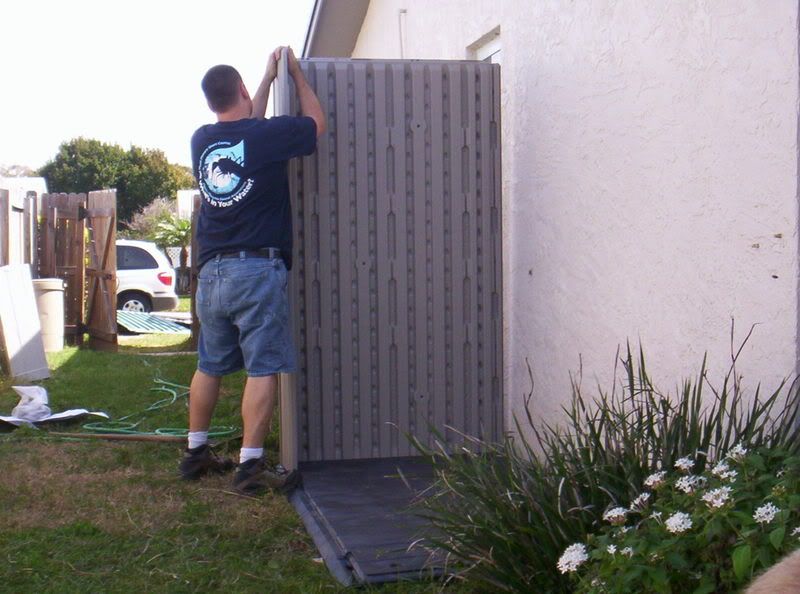
The shed contentsI did the next best thing. I went to the local home improvement center one morning and bought a brand-new storage shed for the side of the house. I didn’t build it. And, at 7 feet wide and 3.5 feet deep, it isn’t the huge, cavernous facility I had envisioned.

At last there is a place to store our stuff out of the path of woodworking progress.

The move, coupled with a controlled purge of items the kids had outgrown (Come on, honey, this doesn’t even FIT the kids anymore!), opened up space that I hadn’t seen in years. Not only is it easier to get around, but the clean up has inspired me to rethink my shop storage practices and plan a few long overdue projects to help beat the clutter.

Peace has returned to our corner of the galaxy. For today, at least.

The Golden Years of Woodworking

Filed under: Spotlight — Tom March 11, 2008 @ 5:39 am

If you think about retirees in Florida, your thoughts might turn to leisurely rounds of golf, early bird specials and people driving slowly in the left lane.

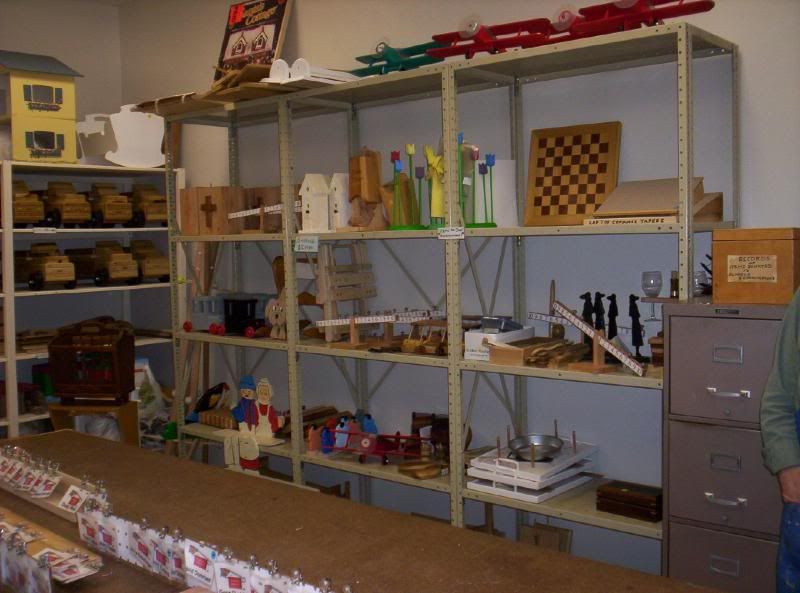
For some retirees in Sun City Center, just outside of Tampa, Florida, retirement is definitely covered in sawdust. That’s where you’ll find the Sawdust Engineers, a group of woodworking retirees who are making a difference in the local community.

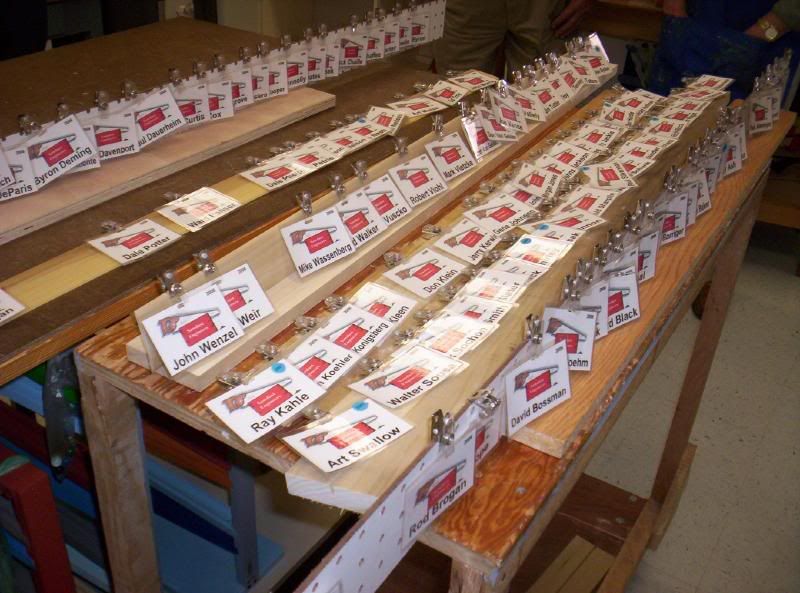
The name badges(click on images for larger versions) This tight band of nearly 350 woodworkers help to make this 501(c) 3 charity work. The Sawdust Engineers tackle many charitable projects from their shop. From building math and spelling puzzles for Hillsborough County, Florida school teachers to use in their classes to foot lockers for teens at a local shelter, each of the woodworkers feels pride in the work that they do to help others.

The assembly RoomOne of the most interesting projects they are undertaking is the nationwide Personal Energy Transportation (PET) project. Templates for parts of hand-powered wheelchairs hang from the wall, and when members have the opportunity, they cut, sand and drill a few dozen parts for each of the chairs. The parts are sent to assembly facilities and put together. They are then sent overseas to countries in Africa, Asia and Central America where diseases such as polio and hazards like land mines have disabled many residents. “Even though the people getting the PETs may be maimed, they still want to be independent to provide for themselves and their families,” said PET program coordinator Jerry Beavon. “These chairs returns the freedom to them that they thought was lost forever.”

The Sawdust Engineers had their humble beginning back in 1962 with Sun City Center developer Dell Webb. Mr. Webb knew that many of the retirees moving to this sunny spot were cabinetmakers and carpenters during their working year, or spent time in the shop a hobby. Mr. Webb started the tool collection by donating a table saw, drill press and some space in the community center.

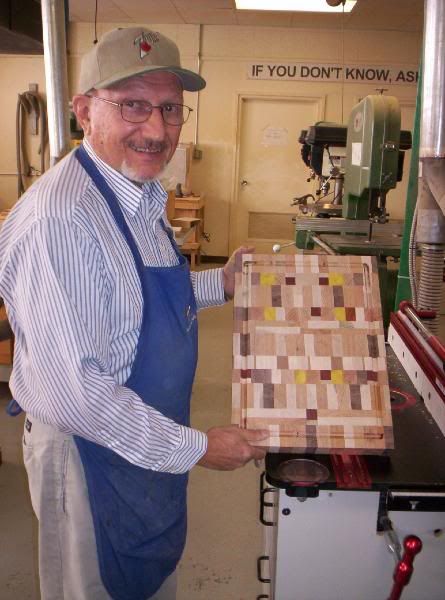
A nice cutting boardWhile the original tools are gone, the Sawdust Engineers are not wanting in that category. A large, comfortable shop is stocked with cabinet saws, planers, jointers and the other large shop machinery any good workshop needs. Another room stores the routers, sanders and other hand held power tools to round out the complement.

Most of the tools are donated by members or their families when they can no longer use them. Others are brand new, selected for safety as well as performance. The group recently bought a brand new Saw Stop cabinet saw. “You can’t stop thinking about safety.”

When new members sign up to become Sawdust Engineers, they must take a seven hour safety class - regardless of their level of experience. “Every shop has its own peculiar ways of operating,” said Houck. “It takes some time to get used to each of the machines, no matter how much you know.”

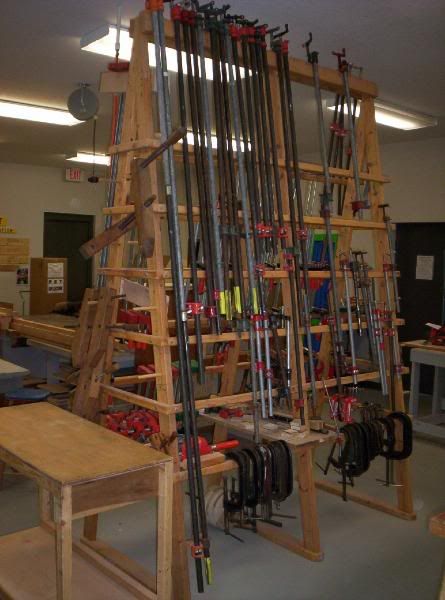
Hauck is a typical example of how most members join. A retiree since 1985, heThe Clamps and his wife found their spacious home and yard in Maryland too much to take care of. In 1999, he and his wife came to Sun City Center to find a smaller home and warmer weather to enjoy during the cold winters. While they were touring the community to see if it fit their needs, Houck discovered Sun City Center was the place for him. “Oh, it looked like a great place to move to, but when the agent brought us through the shop, my decision was made right then. I turned to my wife and said, ‘this is the place for me!’”

While the shop does a great deal of charity work, members also have the opportunity to use the facilities to build their own projects. Since the Sawdust Engineers are a charity, members have to abide by the rules - the projects can be for their use or to give as gifts, but the members can’t make a profit from the sale of the items. Needless to say, some of the most popular personal projecs include cradles,cribs and toys for grandchildren back north.

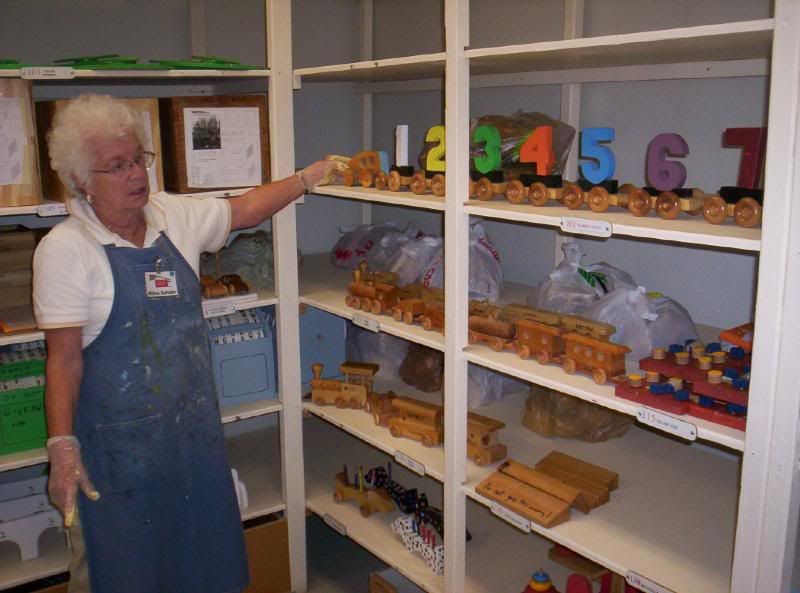
The facility contains nearly 5,000 square feet, which is divided between the machine room and a spacious assembly area. There is also an office (which doubles as the group’s reference library), a tool room, a dedicated paint room and a toy display room for area teachers to look for items for their classroom.

In the paint roomIn the paint room, I met Wilma Schafer, the paint coordinator. Hands covered in bright yellow paint, she explained how the painting crew, as some of the ladies in the club are affectionaltely known, takes great pains to lovingly sand each piece slated for school projects and coat it in non-toxic paint. “You never know when one of the little ones will put this into their mouths.”

Members pay annual dues of $15, and other community organizations and indivduals help with donations. Each year, the Sawdust Engineers set up a booth next to the other craft organizations to sell a number of their projects at Sun City Center’s annual Fun Fest.

School toysThe Sawdust Engineers’ charitable work is well known in Sun City and in the surrounding areas. They get a great deal of their supplies and lumber for their charitable projects donated by local sawyers and hardwood dealers. And, when one of their long time contributers unexpectedly stopped donating, anonymous contributors sent in money so the club could continue turning out projects. “It gave me a very good feeling to see that outpouring of generosity,” said Houck. “I guess we’re doing a pretty good job, and people are recognizing it.”

Quick Poll - 3/9 results

Filed under: Quick Polls — Tom March 9, 2008 @ 10:46 am

What’s your preferred method to cut mortises?

View Results

Loading ... Loading …
<<< Previous Page - Next Page >>>