Tom's Workbench

|

part of the Wood Talk Online community

Archive for March, 2008

Link of the week

Friday, March 7th, 2008

Cabinetmaker at Colonial Williamsburg

Learning the craftVisiting this site is like taking a trip in a time machine. Learn how Colonial Virgina masters of the craft built furniture – from the rough lumber do the expertly crafted pieces that grace the homes in this painstakingly restored living history museum campus.

In a recreation of Anthony Hay’s cabinet shop (he was one of the original craftsmen at Williamsburg), watch today’s craftsmen explain the cabinetmaking trade to visitors as they produce furniture with the tools and designs of the era. Today the shop also practices the trade of harpsichord making, documented as part of the shops offerings in 1767. This was a unique service from a colonial Virginia shop; harpsichords were typically English imports in the South.

Beyond the wood shop, Colonial Williamsburg is a great place to discover how the colonists in tidewater Virginia lived day-to-day.  Definitely worth the trip.

Buying lumber: The hardwood supplier

Wednesday, March 5th, 2008

When you want to buy hardwood for your woodworking project, there are a few different routes you can go. There are Internet dealers, home improvement centers and – if you are lucky – you know a buddy with a portable sawmill and access to a lot of trees in your area.

While these are all good options, if you want the greatest selection and the ability to load and go, look for a decent hardwood supplier in your area. How do you find one? Look in your local yellow pages under hardwood supply, visit Wood Finders and start your search for suppliers near your zip code, or look for local cabinetmakers. No doubt, they deal with at least one reputable supplier, and might be convinced to give you their information.

Jeff Weiss in his showroomI recently paid a visit to Weiss Hardwoods in Largo, Florida to see what happens in a well-stocked, full service hardwood supplier’s warehouse. There, I met owner Jeff Weiss in his well-appointed customer idea center. “Here, we show off some of the interesting things people can build – or have built – from our supply.” A sapele bar trimmed topped with a specially-treated leather top gleamed among the floor samples, fireplace mantles and stairway components. It’s not difficult to get more than a few decent ideas there.

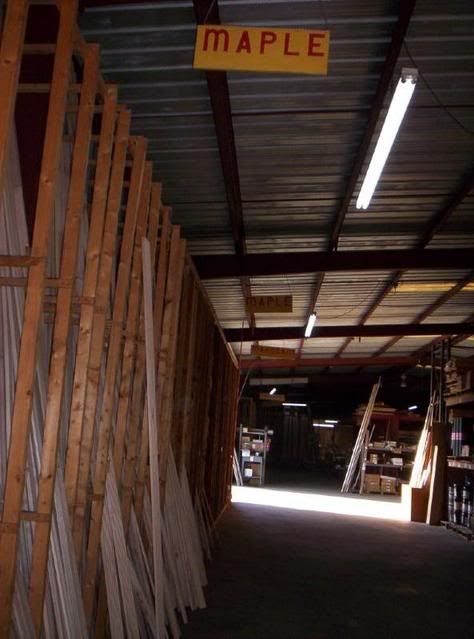
Racks of MoldingThrough a very plain looking door to the right of the service counter is where the fun really begins. The warehouse is abuzz with contractors and employees getting the supplies they need for upcoming projects.

Dozens of tall racks hold common molding profiles in maple, cherry, mahogany, oak and poplar. Some pieces of molding are greater than 20′ long and all clear. Other racks toward the back of the warehouse contain planed dimensional lumber in the same common species. The middle of the massive warehouse holds racks full of premilled staircase supplies and cabinet grade plywood of different species. “We serve a lot of different people here – contractors, homeowners working as their own contractor, hobby woodworkers… the list goes on and on. We try to have enough variety on hand to suit everyone’s needs.”

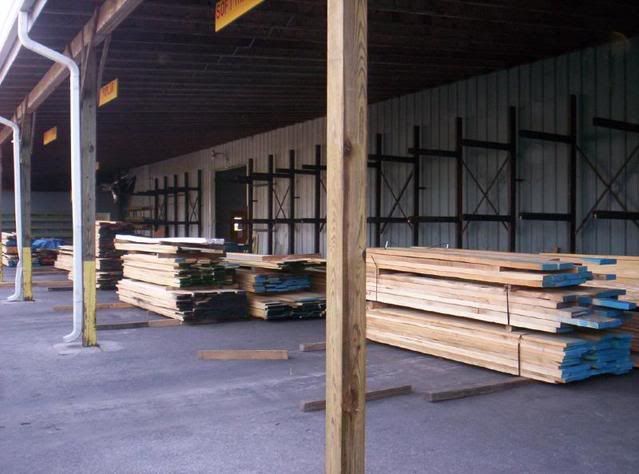
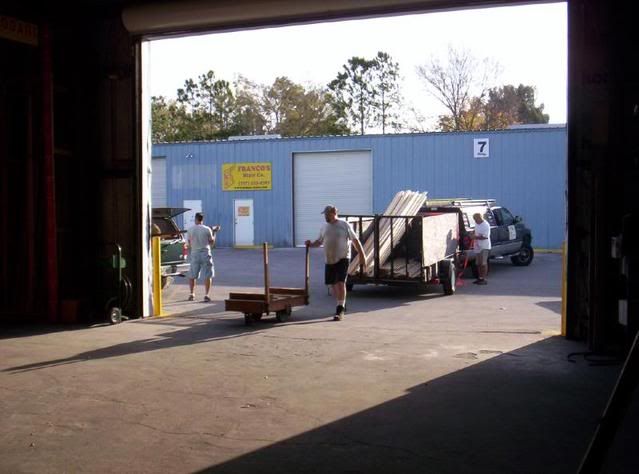
The rough stuffThrough two massive garage doors, there is an outside covered lot where the rough timbers are stored. Some planks up to 8/4 and 16′ long are stacked by species. Besides oak, maple and poplar, customers can choose soft maple, hickory, walnut and several other species that you can’t find in your local home center. If you have the tools and like to mill your own, this is the place to look.

And, if you are looking for something a little more exotic for a project, you can get your hands on zebrawood, cocobolo, bubinga, rosewood, ebony and others. These can really give your project the character it deserves.

Helping the customers outWay in the back of the warehouse is the milling operation. I had a chance to watch Earl Ogden, one of the millwrights, plane some boards down to a customer’s specs. Earl has even skip-planed a few boards to give his customers a chance to see what the final wood grain will look like. “We’re kind of like Burger King here – you can have it your way. We’ll mill exactly to a customer’s specs because that’s the kind of service they want.”

Since these hardwood suppliers do a lot of milling for the trades, you might want to ask to see their shorts – also known as offcuts. These shorter boards can be purchased at a lower cost and are perfect for smaller scale projects like boxes and clocks.

From rough boards to fully milled pieces, a full-service hardwood supplier can meet just about all of your woodworking needs.

Book Review: Working Wood

Tuesday, March 4th, 2008

Jim Tolpin's Working WOod Jim Tolpin’s Working Wood (ISBN: 978-0871923011) was the first reference book I ever bought for my shop – and I really haven’t needed any more since.

This book has nearly everything that the aspiring woodworker would want to know. Two extensive chapters go in to great detail about hand and power tools – complete with clear illustrations showing the major features of each tool – a HUGE plus. From the lowly sheet of sandpaper to the largest cabinet saw, Jim shows what the tool looks like, tells its purpose, offers safety suggestions and gives tips on how to get the most of the tool.

The wood section goes into great detail on each type’s properties (nailing, gluing, finishing, cutting, etc.), wood movement factors, crush strength, bending characteristics, etc. All of this information is provided in easy-to-read table formats, which allow for head-to-head comparisons of wood species (i.e. – what’s the difference between red oak and white oak? How much softer than hard maple is soft maple?)

Want to know how to cut the most commonly used joints? Jim offers a primer on how to hand cut dovetails, build a finger joint jig, use biscuits to make a strong connection in sheet goods, etc. For example, the section on cutting dovetail joints, it shows step by step how to lay out the depth line, the best way to lay out the angle to get maximum strength in the joint, how to cross-hatch the waste so you don’t accidentally remove the wrong part (a very common mistake among beginners) and how to remove the waste with a coping saw and chisel.

How do you build a door or drawer? Jim answers these questions and offers a host of options and how to build each one (Frame and panel doors, batten doors, slab doors, etc.) The drawer joinery options spelled out were very informative, and ran the gamut from simple rabbet drawer joints all the way to half blind dovetails. Very thorough.

Where should you put your jointer or band saw? Shop layout gets a section, and it goes in to great detail about the rationale for placing which tool where (for instance, grouping the planer, jointer and table saw to true a board and cut it to the proper length and width without hiking all over your shop).

Then, there is a whole chapter of tables which tell how tall to build a bar stool, how wide to build a desktop, where to put drawers and doors on kitchen cabinets, etc. There are also illustrations that clearly demonstrate the relationship of furniture parts to people parts (where will an average male’s knees fall in relation to a bar stool and the bar top). Very useful information when you get into the design phase.

What’s the best finish to use? Tolpin brings out all the stops to explain the difference between penetrating finishes and surface building ones. Stains and dyes get a strong mention and a description of which one is best to use in different situations. Ever wanted to learn how to mix your own milk paint? Tolpin gives his recipe so you can whip up a batch of your own home brew and give rustic pine pieces the old schoolhouse look.

Even more chapters on adhesives, fasteners, how boards are cut, and others round out a very full tome that fits into a very small footprint. Tolpin took the time to illustrate what the individual types of fasteners look like. Rather than explain what an oval head screw looks like – the book illustrates it! Just bring the guide to the local hardware shop and point at the drawing. It’s that useful!

The design of the book is even well thought out – it’s spiral bound so it will lay flat on your bench while you refer back to it. Beats having to find something heavy to lay across a saddle stitched or perfect bound book that wants to close itself. Little touches like this further increase the utility of this very important ‘power tool’ in any shop.

Quick poll – 3/2 results

Sunday, March 2nd, 2008

Uh, oh! You cut a board too short! What are you most likely to do?

View Results

Loading ... Loading ...

I’ve got a cold – yuck

Saturday, March 1st, 2008

OK, I’m sitting here in my living room, reading the same woodworking magazines over and over again and watching a few taped episodes of the New Yankee Workshop while I suffer through a bad cold.

I'm so sick...I’m sure you are not the least bit interested in hearing about my health. However, this does remind me of a woodworking experience.

Back in 1999, I had promised my sister-in-law that I would finish a little train table for my nephew. He was huge into Thomas the Tank Engine, and she wanted a place to set up his tracks.

As I was getting to the end of the project, I got nailed by a bad bug. I was running a low-grade fever, my head was clogged and I could barely get out of bed.

But, there I was in the shop, trying to concentrate on getting the final coat of finish on the project in time for the tyke’s birthday party.

If you have a similar story, send it my way at tom@tomsworkbench.com, and I’ll post some of the more interesting entries. I can’t promise you any fabulous prizes, a new Unisaw or a whole catalog’s worth of Lie Nielson planes, but, can I interest you in a few dirty tissues and cough drop wrappers?