Hey, everyone, Iggy here. I wanted to alert you that Tom is now *ahem* teaching certain things about woodworking. In fact, he was asked to speak at a recent meeting of the St. Petersburg Woodcrafter’s Guild about veneering.
I’m actually stunned, because I mean – it’s Tom. The guy who cut his finger with a set of hedge trimmers. I’m rather impressed he was able to get up and talk in front of a group without putting his foot in his mouth.
The other thing that impresses me is that Joe Gorleski of Veneer Supplies trusted this Mook enough to let him mention his company. I mean, what was Joe thinking?
Anyway, here’s the big guy attempting to make everything work. I hope you were able to make some sense out of his rambling.
There. Did any of that make any sense? He actually seemed to have his act together. Maybe he was on his meds that night – who knows? While you might be impressed, try not to be too impressed. Check out some of his other video stylings here..
Ahh, silly boy. I guess once a Shop Monkey, always a Shop Monkey, right? Shesh…
Now, for me, back to the shop.
=========================
I TOLD you Tom was up to no good. Joe was nice enough to e-mail me and give some corrections to Tom’s ramblings. Here they are:
Plywood is a great substrate (my favorite) but maple plywood can be a pain. Why? Because maple is one species that many adhesives struggle with. It is the standard by which glue makers do their testing because its such a finicky wood species. It also is one species that expands more than normal when moisture is applied (such as from a veneer glue). When I use plywood, its birch or oak.
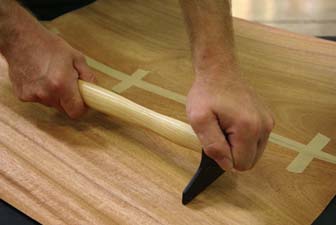
The veneer saw is right handed only. The blade is reversible but the handle is angled for right hand use only. I’m a lefty though and I’ve never had any trouble using my right hand with the saw.
Three hole tape can actually be used on the glue side. I only do this on species where the veneer has a tendency to take the stain differently if the glue from the tape does not complete come off when I sand the panel. In those instances the 3 hole tape can be used on the glue side. The holes in the tape actually provide enough surface area to let the glue keep the seam line tight and well bonded.
Never use yellow glue for any type of veneer. End of story. Never ever use it for veneer.
Contact cement is not suitable for raw wood veneer simply because its not strong enough to prevent the seasonal expansion and contraction of wood cells (even when a finish is applied). This can allow lifting and bubbles in a raw wood veneer. With a paperbacked veneer, the bond to the paper minimizes expansion and contraction so contact cement is fine.
A J-roller is not my choice of tools for spreading glue. The foam rollers I have are much better.
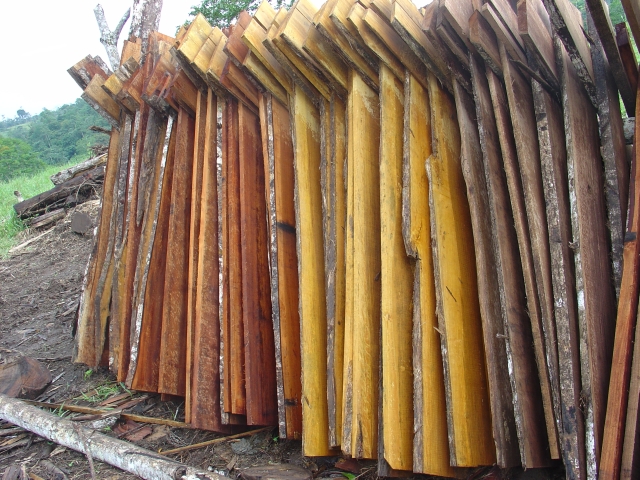
While local hardwoods can be a pleasure to work with and can leave you with a gorgeous project, tropical hardwoods can be eye-poppingly beautiful. Whether the vividly colored bloodwood or purpleheart from South America, the highly desirable bubinga or wenge from Africa or the hard wearing teak or rosewood from Asia, these boards from the planet’s tropical areas can be a woodworker’s dream, giving your projects a style all their own.
They do come with some drawbacks, however. First, they have different characteristics than the native wood you work with, leaving a splintery mess where a clean cut should normally be. They can also be very expensive, since they have to be harvested and shipped great distances to your supplier. And, the harvesting of these trees isn’t always done in a responsible manner, possibly being pulled from forests without consideration of their future health.
This week, let us know how you feel about using these tropical hardwoods.
Looking for personal protection equipment to wear in the shop? How about a new motor for that old table saw your grandfather left you? A new cordless drill?
Did you know there is a place you can go to find all this stuff? Grainger Industrial Supply has all of these parts – and millions more. I ran into one of their reps this week at the Governor’s Hurricane Conference, and he showed me the catalog of the stuff they offer… Boy, was that one thick book! They are worldwide, have locations all over the place and have all of those oddball pieces of hardware you can’t seem to find.
(Hey, folks, please take the opportunity to read my editorial statement at the head of Monday’s column. There are several points of clarification that need to be read.)
So, here I at the Governor’s Hurricane Conference and man – I’m keeping busy. I’ve been teaching a basic Public Information Officer class the past few days… my voice is shot! With hurricane season just a few weeks away, it’s time to get ready for what the season may bring. That’s what we’re here to do this week – learn from the experts.
As a hurricane public awareness spokesperson, it’s my job to pass information on to folks who may be in danger about the importance of having a disaster plan. While I normally talk to residents in all types of organizations and communities the county, I recently had an opportunity to speak with the St. Petersburg Woodcrafters Guild about the topic. In fact, I was the presenter that night (Great, I get to work for my dinner there as well!).
I had two topics to cover that night. The second one was veneering (that video will be next week, I promise!), but the first topic was about how to prepare your shop for the potential of a disaster.
Now, I know many of you won’t ever experience a hurricane in your lives (Unless, of course, you order one at the bar), but there are a number of other disasters that can befall your shop. Floods. Tornadoes. Wildfires. Theft.
In this roughly seven minute presentation, I covered many of the basics, especially when it comes to insuring your shop and tools so you can recover from a disaster.
(Shop Monkey Note: After discussion with the folks at Fine Woodworking, it has been determined that the title of the Shop Talk Live podcast applied to a segment later in the show and not to the online blogging community. That said, the folks at the magazine have admitted that they weren’t careful in how they expressed their concern toward the online woodworking community, and have issued an apology.)
It’s not often that I react to what other folks post, but this one couldn’t slide by the wayside. The folks at Fine Woodworking Magazine posted a shop talk live video podcast, their fifth, called “Perfect Storm of Stupidity.”
Nice title.
The podcast goes into a discussion about the online woodworking community… And, at first, the comments were pretty complimentary and tame. It’s a great way for people to share their experiences – to show what they are building and how they are growing in the craft.
Had the conversation ended at the five minute mark, It would have been a great topic to cover and things would have sat OK with me. Alas, they couldn’t leave well enough alone. In the next five minutes, I learned that the Internet is basically awash with a bunch of idiots claiming to be ‘experts’ on every topic, leading the poor beginning woodworker down the ‘wrong path’ to frustration and a lifetime of failure.
Woah. Hold the phone, fellas. I do get that some folks may or may not have a total grasp on the finer point of technique. But, I know a great number of woodworking bloggers, and I really have yet to run into one who claims to be an ‘expert’ on the topics they write about.
The claim was made that no one is vetting the level of expertise of these bloggers, and there is plenty of bad information floating around out there pretending to be the voice of authority. I have seen people cut joints that I’m not sure would be the best for the particular situation, but I have seen plenty of techniques that are plenty sound. Besides, if those techniques work for the particular woodworker, why not see how they are done?
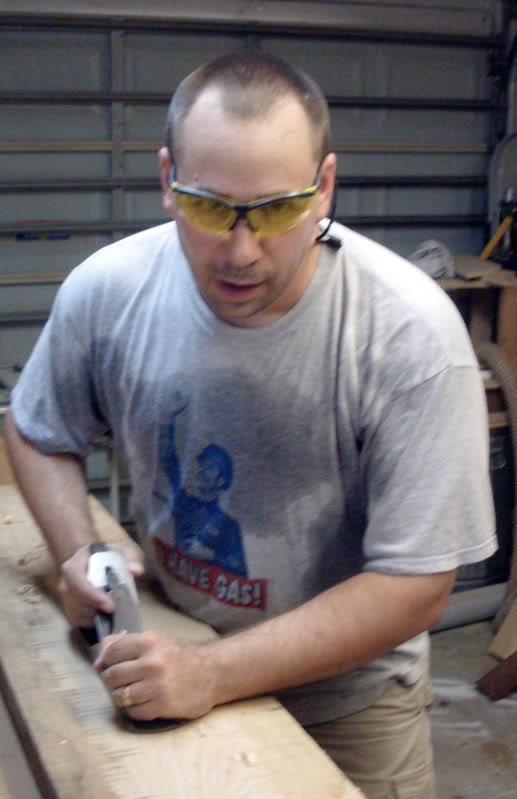
The question of shop safety was also brought up. Some of the videos out there can be downright frightening to watch, with the one I posted here being example A. But, believe me, if someone goes out and puts up a post that’s not safety-conscious, the readers are going to be the ones who weigh in it. This was identified as crowd sourcing, and trust me, it works. Heck, I’ve had folks weigh in when I don’t have my safety glasses on while I hand plane.
Another point of emphasis is that the more stuff a woodworker builds, the better they are. Therefore, if someone build dozens of pieces of furniture of one style, they should be looked to as the expert in the field. I can see the logic in this, but it would be a stretch to say that this is a 100% guarantee that they are truly better. Think of it this way – if a person has been practicing the violin for 40 years and has perfect playing form, but can’t make the instrument sing, why would I want to listen to the performance? If someone has been playing for five years and can bring down the house, why would I not want to hear that? When I see younger woodworkers who have less than several decades of experience – David Marks, Rob Bois, Shannon Rodgers, Kari Hultman – cutting tight joinery and making it work -I am encouraged to see the new generation of woodworkers coming along to help pass the craft to my children and their kids.
The video hosts went on to say that only people vetted by the woodworking magazines or by well-known schools are the ones who really truly understand and can teach the proper methods. With their high level of expertise, they are the ones truly qualified to teach how to build. Nonsense. People who can woodwork are an awesome bunch of people, but it also takes an incredible amount of skill to be able to teach others about the craft. Communication, interpersonal skills and desire mean a lot. I had the honor of taking a class from Marc Spagnuolo when he was in his late 20’s… and his teaching skills were light years ahead of some of the other ‘more experienced’ instructors I have taken classes from.
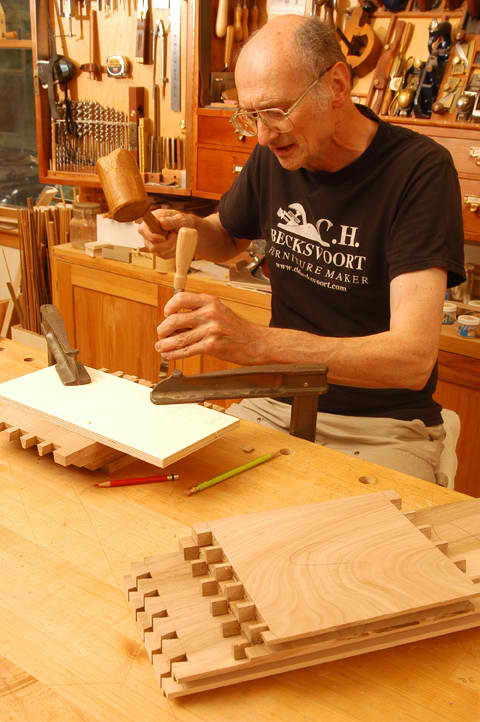
Another thing that struck me as odd … we know that all woodworkers have their own preferences on joinery. And, after years of doing things only one way, they tend to rely on those same joints and techniques for most – if not all – of their projects. I contest that it’s good to get a wider, more diverse vision of how things can be done. If I have said it a once, I’ve said it a million times – there are about a thousand ways to cut a particular joint, and they are all right if they make for tight joinery that can take the abuse. So, say, if Chris Becksvoort hand cuts his dovetail a certain way, does that mean that machine cut dovetails are inferior? How about box or finger joints? Splines? Should they not be considered valid because someone prefers another style of joinery?
And, while passing on the information is fine, what about the inspiration? David Life is a woodworker I have profiled before, and he does his work in spite of being legally blind. I find it fascinating to learn from David how his techniques have had to evolve as his eyesight faded. Hearing stories about woodworkers like David help make me a better woodworker. Just reading about or watching ‘established and vetted’ woodworkers leaves me flat. I need to see the stories of woodworkers like me – toiling away in their shops and turning out great work on the weekends and after hours – not just the ones who do it full-time for a magazine or at a woodworking school.
I contest that online woodworking is far from the perfect storm of stupidity. In fact, this online collaboration has done more to get new woodworkers off their behinds and into shops that many of the established woodworking sources care to admit. And, it offers exposure to a rich variety of techniques I may not have considered in my woodworking. Is it perfect? Nope, but either is the other option where only a few ‘masters’ control what content is released to the masses.
If you would like to hear about why I or other bloggers do what we do, check out our take on things on the fifth edition of the Modern Woodworkers Association’s online discussion.
Oh, and keep on blogging and building. I see the perfect setup the way things exist.
This past weekend, I was knocking around in my shop and I realized I was starting to break a sweat. A glance at my combo shop clock/thermometer showed me why – it was a balmy 87 degrees in there – at 9:30 in the evening! Yes, we’re starting to enter the long, hot season here in Florida.
As we start to gain on the summer (or we move from the warm summer months to the much cooler winter months south of the Equator), it’s time to start thinking about climate control in our shops. Today, let us know whether you have a totally tricked-out full-on AC/heat setup or you rely on nature to create your ambient shop temperature.
Back in the days when items shipped in wooden crates, many woodworkers got their start building projects out of that packaging material. With cardboard replacing wooden crates, there is still one excellent resource for finding project wood on the cheap – wooden pallets.
This green online green site offers some interesting inspiration for projects that can be built with recycled shipping pallets. From the whimsical to the uber-practical, readers can find all types of links to plans to turn trash to woodworking treasure.
Sure, there are several standard caveats when dealing with pallets:
They may belong to a shipping company, so ask before you take them!
They are typically assembled with a bajillion staples and nails, so be sure to go through them carefully to ensure you get all of the metal out before you start to work
They are also usually filled with all kind of grit which can easily dull your blades. Clean them thoroughly with a wire brush and a blast of compressed air to dislodge the worst of it.