A boring conversation

My cable service offers more than one thousand channels. I have four movie megaplexes in a 20 minute drive from my house. The Internet can bring me thousands of movies on demand.

So, you can understand why I don’t like to be bored. I have plenty of opportunity to make sure that I never get that way.  Woodworking also helps me stay out of that dreaded state or boredom.

That’s why I can’t understand why talking about drills and what they do is called boring. It’s anything but. Whether in a drill press or a hand-held unit, there are dozens of things you can do with the right selection of bits.

Just as with the router, drilling tools are nothing but fancy paperweights without bits. The bits come in a bewildering array of sizes and shapes to do a great number of tasks. Don’t be misled by looking at the selections in the local home improvement center.  There, you will typically see your basic twist drill bits which do an OK job on wood and metal. But, if you haven’t tried bits specifically for fine woodworking, well, let me be the first to welcome to you a brave new world!
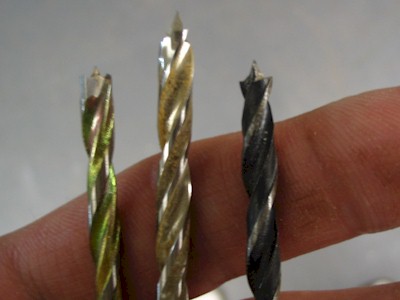
When it comes to drilling smaller diameter holes in wood, it’s hard to beat the brad point. They look very similar to the regular twist bits, but have a sharp brad point at the business end with two cutting spurs at the outside diameter. These two features allow you to start your drilling without the fear of the bit wandering. And, with the cutting spurs, the hole is very clean. If  you are the kind of woodworker who likes to drill your mortises, these are two very important traits you want in your drill bits.

For larger holes, there’s another specialty bit that you should consider – the Forstner bit. These bits feature straight shanks with a larger sized cutting head at the bottom. Forstners excel at cutting smooth, straight holes with flat bottoms.  But, not the only thing you get with them. Since the bit is large and the rim of the bit does the cutting, you can bore on an angle, or just use part of the bit to drill an arc. And, if you are looking to mount something like a clock insert, it’s as simple as chucking the right sized bit and drilling until you get the proper depth. Since the cuts are so clean, there’s little – if any – clean up required.

You can also pick up a forstner bit extender, which allows the user to drill deeper into the work. You may not use it every day, but when you need that extra little bit of reach, well, it’s a very handy attachment.
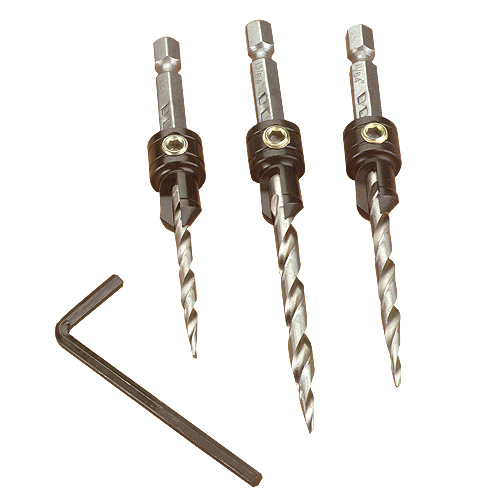
There are also  a number of other specialty bits available. For instance, for most countersinks, the drill bits are tapered.  It seems like a small thing, but if you are using traditional tapered wood screws, a tapered bit is going to give you excellent thread contact for the entire length of the screw.  More thread contact means better holding power.

From there, well, where can you go?  Plug cutters? Tenon cutters? Hole saws? Spade bits?  Hey, let’s talk about them later.  I’ll need something to do the next time I get bored!
 

The doweling mysteries

One of the first real woodworking ‘tricks’ I learned was how to join two boards together without using metal fasteners. I had gone to a building supply store that was going out of business to buy wood, hinges and a special tool I had heard a lot about – a doweling jig.

While my first woodworking project wasn’t anything to look at, it marked a real monkey-and-the-monolith moment in my woodworking avocation – using wooden dowels to join project parts together.

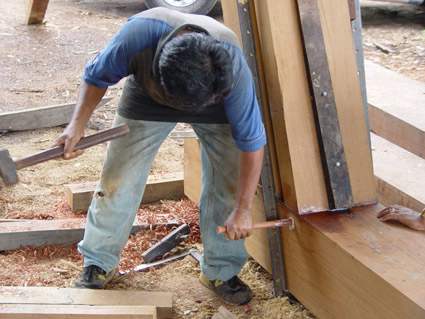
Using dowels is a tried and true woodworking technique that stretches back thousands of years ago.  The massive joints in timber-framed buildings are set in place with treenails – wooden dowels across mortise and tenon joints. Craftsmen have similarly pegged smaller mortise and tenon joints in their furniture projects for just as long. Masters such as Krenov and Maloof used dowels in their projects as well.

If we’re going to get to the bottom of dowels, we need to break them into two groups…

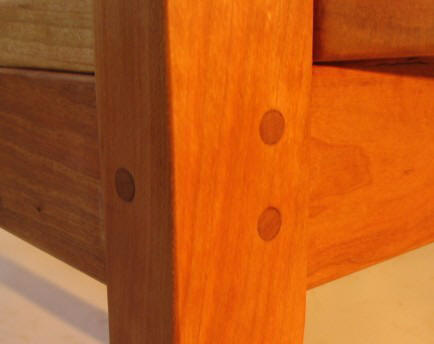
The first group involves visible dowels. These joints are created by drilling through a project and driving a dowel in.  How versatile is this joint?  I dunno – how creative can you be? I’ve seen through dowels being used to affix breadboard edges on tables, to join sides to fronts on drawers – even just for decoration.

Do you need glue for the joint?  It depends – is the joint permanent (locking together a mortise and tenon joint) or is it part of a project that can be disassembled (like locking a stretcher on a trestle table base in place)?

The dowel material can be a simple ambiguous ‘hardwood’ dowel picked up in a home center, a dowel of a specific species ordered from a supplier or even one you custom turn from a treasured blank on your lathe.

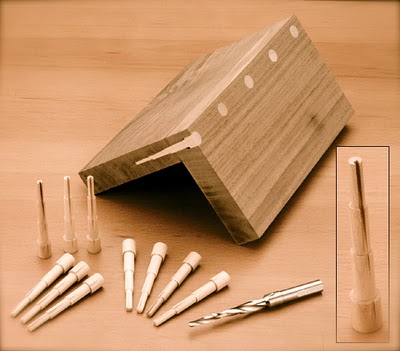
While these joints can be made with a drill and the right sized bit, there is a product that allows for through dowel joints that get extra bite. The Miller Dowel system relies on a tapered drill bit and specially formed dowels that step down in diameter. These steps on the dowel allow it to be driven into the tapered hole and get a solid grip. They come in an assortment of commonly-available species.

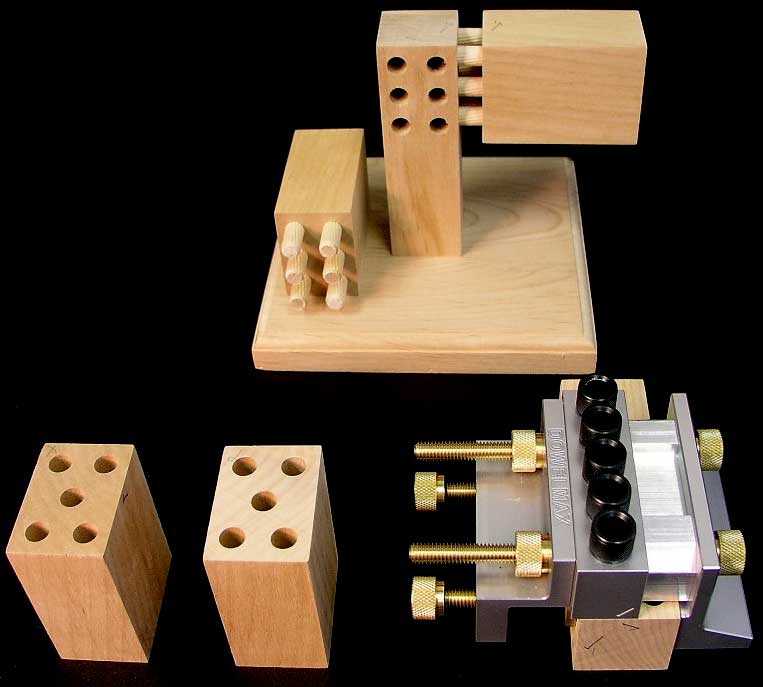
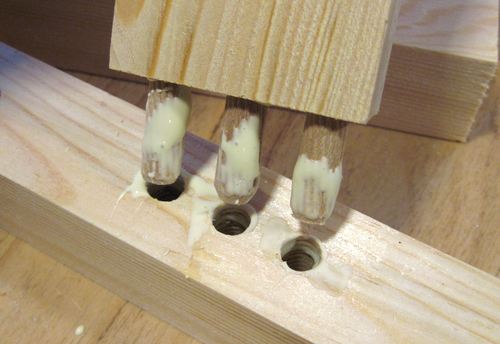
The other type of dowel joints involves hidden dowels. This is when you drill mating holes into two parts of a joint and insert a length of dowel that’s hidden from view. These dowels work like a small floating mortise and tenon joint.

Needless to say, the two holes had better be drilled accurately into both pieces, or they won’t mate properly. You can lay out these holes with a ruler and pencil… and, if you take your time and work carefully, yes, you can do a fair job.

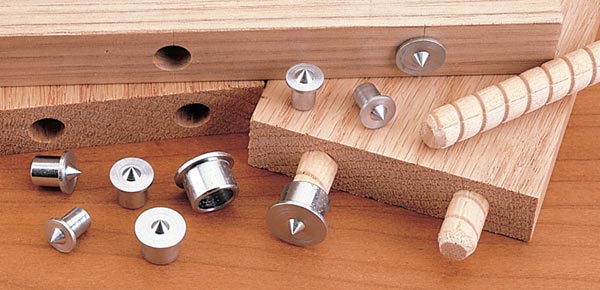
One tool you can use to help ensure better accuracy is called a dowel center.  After you drill the first hole, you insert one of these centers in it. The part that sticks out from the hole has a sharp point that – when pressed against the mating board – accurately marks the center of the hole you will need to drill.

The next step up is the basic dowel jigs you can find on the market. The most popular of these models are self centering, with adjustable jaws that grip the work and hardened steel bushings in the guide itself. Simply line up your center marks, clamp the guide in place and drill with the properly sized bit. These jigs no only help ensure the dowel hole is centered on the edge of the board, but also perpendicular to the face you are drilling.

If you are looking for more flexibility, there are some high-end doweling jigs that offer even more usefulness. The DowelMax and Joint Genie are two models that allow you to drill just about anywhere and get accurate holes.

When it comes to the hidden dowels themselves, you can certainly use lengths of store-bought dowel cut to size, but there are also dowels designed specifically for the task. These dowels have flutes or spirals carved down their sides to allow room for excess glue to move to, preventing hydraulic pressures from letting the joint come together.

Dowel joints are fairly strong joints, especially when larger dowels are used.  Also, when drilling the holes for the dowels, you want them clean and as straight as possible. To get the best holes, opt for brad point drill bits.


Have you kept your promises?

I can remember exactly where I was. Work had just started for me at my office in Clearwater, Florida, and a few of my co-workers and I walked next door to the convenience store to get some coffee. As I walked in, there was some confusion between myself and the guy who was walking out… I walked in when he thought he should have been walking out, and as he passed, under his breath, he muttered what kind of a rude son of a bitch I was. I dunno why I remember this so vividly, but that’s just how crazy the memories of that day are.

After that, I came back to my desk to get started with the work of the day, when the lady who worked one just beyond the wall of the next cubicle said loudly enough for everyone to hear that a plane had flown into the World Trade Center in New York City. That split second before I turned the corner into the office’s conference room that had the television was the end of something.  The end of the thought that the United States was invulnerable. The end of the period of relative peace that we had been living in.


An awful lot changed that morning as I  – and hundreds of millions around the country and the world – sat transfixed, watching the deadly terrorist attacks unfold. As the towers burned, my mind flashed back to a church youth group trip I had taken back in the summer of 1985 to New York City. We had seen Wall Street,  the South Street Seaport, had a late lunch in Little Italy on Mulberry Street, and, the last trip of the day was an elevator ride to the observation deck of the World Trade Center. As the bright summer sun started to fade into the west, I gazed down upon Manhattan and New York harbor.  Billy Joel’s song New York State of Mind was on my Walkman, and I was humming along to it.  As a tall skinny kid from across the Hudson River in New Jersey, I felt a connection to the city I had never really felt before.

And, as I blinked back the tears in my eyes that morning, I knew that peaceful memory was being taken away from me. It would never be the same.

As that fateful Tuesday wore on to the end of the day, my co-workers and I spent a lot of time talking about what was going to be different. We talked about living in a new world, where friends and family in the military were going to be thrust into warfare in a far-away land, removed from their loved ones. We talked about how we would never feel truly safe again inside the borders or our country. And we vowed that we were going to take the time every single day to love our families more, work to bring more beauty into our lives and the lives of those around us, and how we were going to pull together as a nation, putting aside our differences to realize that ultimately – at our core – we are all Americans.

Today is the tenth anniversary of those terrible moments in New York City, Arlington, Virginia and Shanskville, Pennsylvania.  And, as I look back on that terrible day one decade ago, I wonder if I have been keeping my promise.

Have I done everything possible to show my family how much I love them? I feel like I have, but I think today is the time to redouble my efforts to do so. My two sons were three years old and six months old when the attack happened… what have they learned over this past decade? Have I done everything I could to show them how much I love them and spend the time with them? Have I taken the time to show everyone else how much they mean to me? Or, were those words an empty promise that I made?

Have I done what I can to bring more beauty into my life and the lives of others? Somehow, I feel that woodworking – my fledgling hobby back in 2001, has done so. The pieces I have built have not only brought happiness to me and the people who have received them, but it has also allowed me to meet dozens – if not hundreds of other woodworkers I would have never met before who have inspired me through the years. Not only by their woodworking ability, but by the obstacles they have overcome, the determination they have shown and the friendships we have shared.

Have we pulled together as a nation? I think – tragically – that we haven’t. The partisan bickering today  in Washington D.C. is a far cry from the can-do spirit that existed after the attacks. When everyone – Democrat or Republican, liberal or conservative pulled together to tell the world in one voice that we are Americans, and no cowardly act is going to make us forget that.  I hope and pray that our leaders will find ways to make our country the place we envisioned after that horrible day.


Today, we think back at the loss of that day ten years ago and feel the strong pangs of loss and sorrow. But, I can guarantee you, I am asking myself I have kept the promise I made in my office’s conference room ten years ago.

And, I hope I have.


Link of the week

Wooden Gear Clocks

Part art. Part practical timepiece. All woodworking challenge.

Making a wooden geared clock puts your woodworking precision, artistic talent and grand vision on display for all to see. Plus, the clocks are also practical WORKING time pieces, so no one will question when you put your lovely project out to be enjoyed.

If you are looking to get into building your own wooden geared clock. the folks at Wooden Gear Clocks. com offer precut kits for you to assemble, or for the more adventurous, plans and hardware to build your own from whatever wood you choose.

Don’t you think it’s about time you built your own?


Bon Appetit!

So, with my recent illness, I spent a goodly portion of my holiday weekend lying on the couch watching TV. And, the only thing drifting through my mind most of that time was Bruce Springsteen’s  song from 1992’s Human Touch album entitled 57 Channels (and nothin’ on). (Yes, mom, I finally got a Bruce reference in for ya!)

Fortunately, I had a few other diversions to occupy my time. I read a book about the Apollo program, brushed up on a few tool manuals I had neglected to read and I surfed for online movies.  Yup, I was putting my Netflix subscription to the test!

Love ’em or hate ’em, Netflix is one of the largest players in the online DVD rental and streaming video world. And, as I glanced through the offerings, there was plenty of material to choose from. Action movies. Sci Fi. Comedies. Classics. While I was searching for movies, I came across one called Julie and Julia I had seen last summer. This 2009 movie told the story of Julia Child as she struggled to interpret archaic French recipes, and the story of Julie Powell, a blogger who set out to cook every recipe in Child’s classic work Mastering the Art of French Cooking.

Why did this movie stick out for me?  Well, as far as I can tell, it’s the only movie that is based around the struggles, trials and successes of a blogger.  The other part was the towering achievement Julia was able to make reality. The movie showed in great detail how this one time OSS operative (Yes, she was a spy!) during World War II had to struggle to merely be accepted as a student at the prestigious La Cordon Bleu culinary academy.   Her work in bringing these arcane cooking techniques to American kitchens was a seminal moment for home chefs and foodies. Yes, people who list cooking as a hobby owe much to Julia’s determination.

Why bring this up?  As you can imagine, there are many lessons that a woodworker can learn from Julia Child. For instance:

  • Method is essential. If you are going to make Hollandaise sauce (one of the five French mother sauces), should you melt the butter and pour it in to your egg yolk and lemon juice mixture? What if you put the butter in cold and stir off the heat?  How about using more lemon juice?  These may seem like trifling details, but they can mean the difference between a rich sauce that will make your Eggs Benedict the stuff of legends and bringing an oil slick to the dinner table. The same thing goes for woodworking – should you cut your dovetails before or after the final sanding of each component? What order  should you glue up that complicated project so you don’t get yourself into a sticky situation?  When you think your process through, you can save yourself a lot of headaches later.
  • Make the most of everything.  “Save the liver!” Oh, how I laughed when Dan Aykroyd lampooned Julia on Saturday Night Live. While it was a funny sketch, the lesson was profound. Chicken livers could be saved and made into pate. Bones from cuts of meat could later be boiled down to a rich stock – or, even better – a demi glace that can transform a ho-hum meal into a dish you would be proud to serve your guests. This one’s easy to take to the shop. If you leave a larger offcut, be sure to stash that sucker somewhere you can get to it later so you can build something smaller. Look at your tools as multi-taskers… how much more can you get out of your table saw or plunge router? if someone is throwing out an old piece of furniture that has seen much better days, maybe saving the classic pulls, knobs and hinges would help make your next project something special.
  • Nothing is insurmountable. Just imagine sitting down to learn all of the intricacies of French cooking.  Now, go beyond that and attempt to take these centuries old techniques and methods and translate them for the average American kitchen. When no one who is instructing you believes that 1) you can do it and 2) that it should even be done in the first place. So, when you balk at cutting your first mortise and tenon joint, making those dovetails or building your own doors for a project, why let something as simple as ‘I’ve never done it’ get in the way?  Just remember, someone had to go down to the water’s edge, grab a craggy looking stone-like animal with sharp edges from a reef, break it open, look at the glistening sliminess, scarf it down and say, “Hey, I think oysters taste delicious! Who’s going to invent Champagne?”
  • Enjoy the final product. During the production of The French Chef (one of the first cooking shows on television), Julia would whip up some exotic recipes from her masterpiece.  She did the show live to videotape (the woman had some serious guts to have attempted that), flubs and all – to show how to prepare those sumptuous dishes.  And, just before the credits would roll, she would turn to the camera, her face beaming with her trademark smile, and bid her viewers farewell with a cheerful “Bon Appetit!”.  I often find myself at the end of a project eager to get it out of the shop and off to the client. But, that’s just so anticlimactic.  One thing I’m going to start doing more is to take the time to appreciate that final piece. Take pictures of it.  Run my hands over the smooth surface one more time. Just notice what I have built and appreciate how happy it’s going to make the client.  That’s why I got into woodworking…

As for me? Well, I’m more of an Italian food guy myself.. but, I’m giving serious thought to changing the approach I take to my work. Ya know, that French chef really knew her stuff.


The only labor I’m doing today…

Is labored breathing.

What a total bummer on a holiday weekend here in the States. I mean, three days off from work, and the head cold I had last week came back with a vengeance as an upper respiratory infection.  Complete with antibiotics… Grrrr….

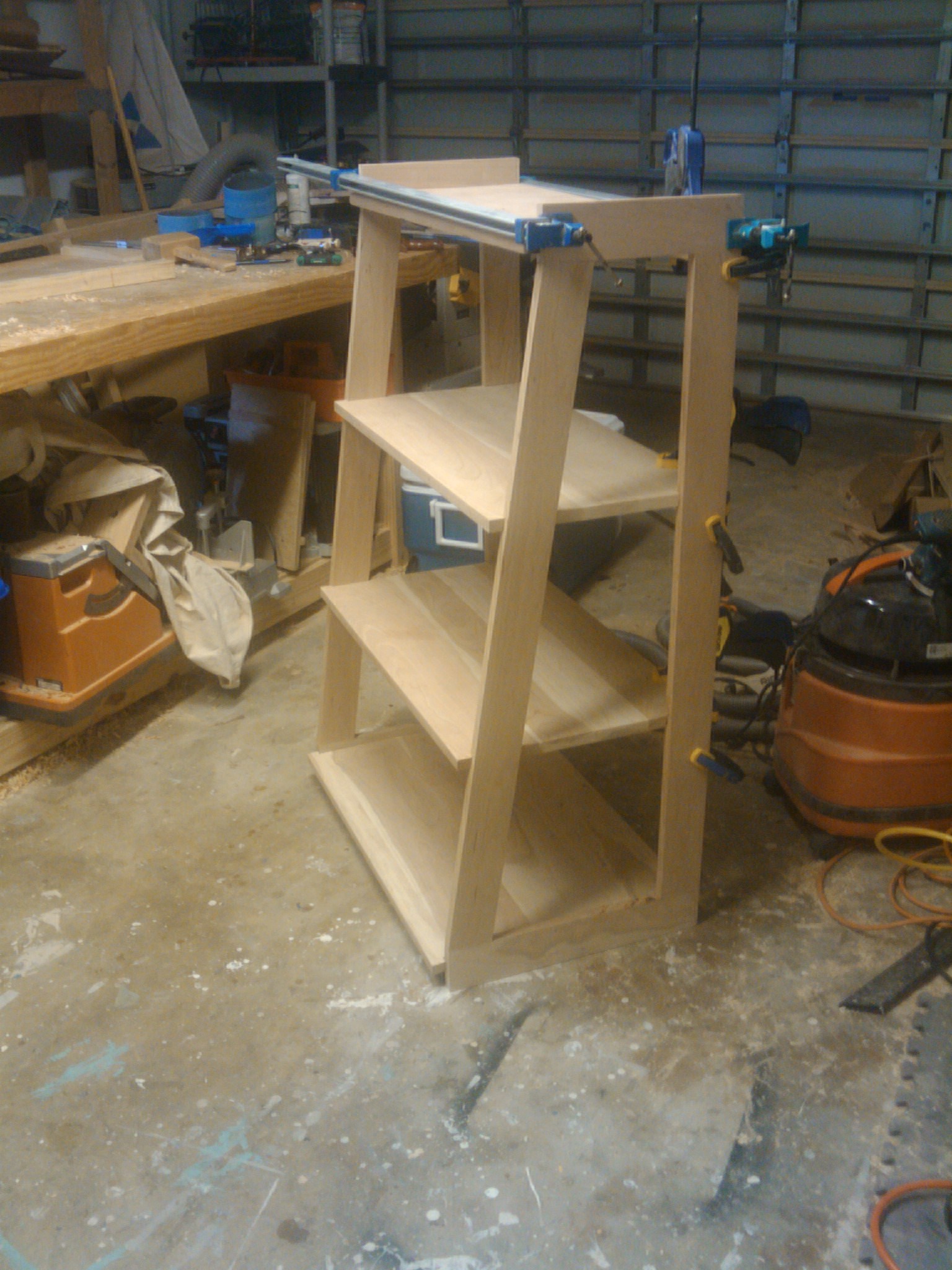
Before I was totally laid up, I did manage to get a little shop time in on Saturday morning. That bookshelf project that’s taking me forever to get done with it finally moving into the final phases. I took the opportunity to finish rabbeting the shelves and fit them into the notches I cut in the sides.  Here’s a look at the piece clamped up …

Now, I just have to cut some back pieces to be mounted across the back of the shelves that will prevent items from being pushed back too far and to provide some resistance to racking.  I hoped to have both units assembled this weekend, but hey, that’s the way life is.

I also discover that sharp tools start to lose their edge  while you are in mid project.  Rather than hook everything up to do a total resharpening, I ran those dulling blades over the strop wheel of the Tormek.  They were back slicing cleanly after just a minute or so of work.

The cherry that the guys over at Bell Forest Products sent is  something else! I’m really digging the way it works, and this project is going to look some kind of sweet when it’s done!

Now, if I can shake this bug, maybe I can squeeze in a little shop time this week!


part of the Wood Talk Online community