Tom’s Workbench

Planing a bevel on a panel

Filed under: How-to — Tom April 9, 2008 @ 8:45 pm

So, you want to put a bevel on the edge of a panel? Well, you could use a special router bit. Or, you could rig up a high fence that works on your table saw. But, what if you don’t have the bit or feel uncomfortable with a large panel on edge?

Have you tried hand planes?

The tools you needIt’s not as tough as you think. In fact, with just a few tools, this is a fast method that will work quickly on any size panel.

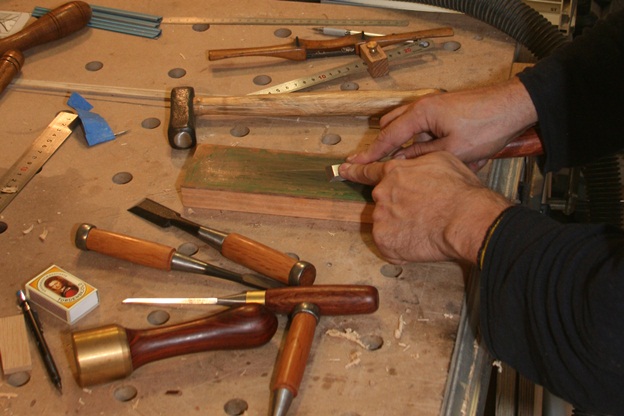
First of all, you have got to have at least one tool, and the other one makes the job a whole lot easier. The tools I used are an old Stanley Bailey No. 5 Jack plane (essential) and a wheel marking gauge. The gauge is going to mark out what needs to be removed, and the plane’s gonna do the removing.

.

Marking the depthMarking the width The next step is pretty essential, I’d say. You have to carefully mark the depth and width of the area you want to bevel. This way, you know exactly what you need to remove, and you’ll be able to keep a consistent bevel. For this exercise, I used one inch wide and one quarter inch deep.

.

.

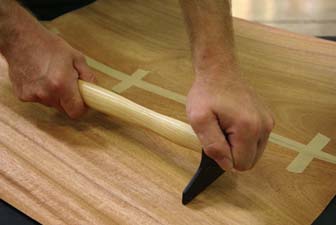
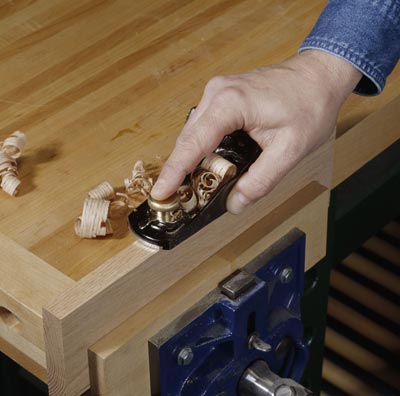
Planing the bevelNow, with the panel securely clamped to your work bench, you can use your plane to remove the material to form the bevel. I start with the end grain, planing slightly ‘down’ and ‘out’ with the plane to prevent tear out. Once that’s done, then I move to the edge grain to remove any tear out - just as when you use a router.

.

.

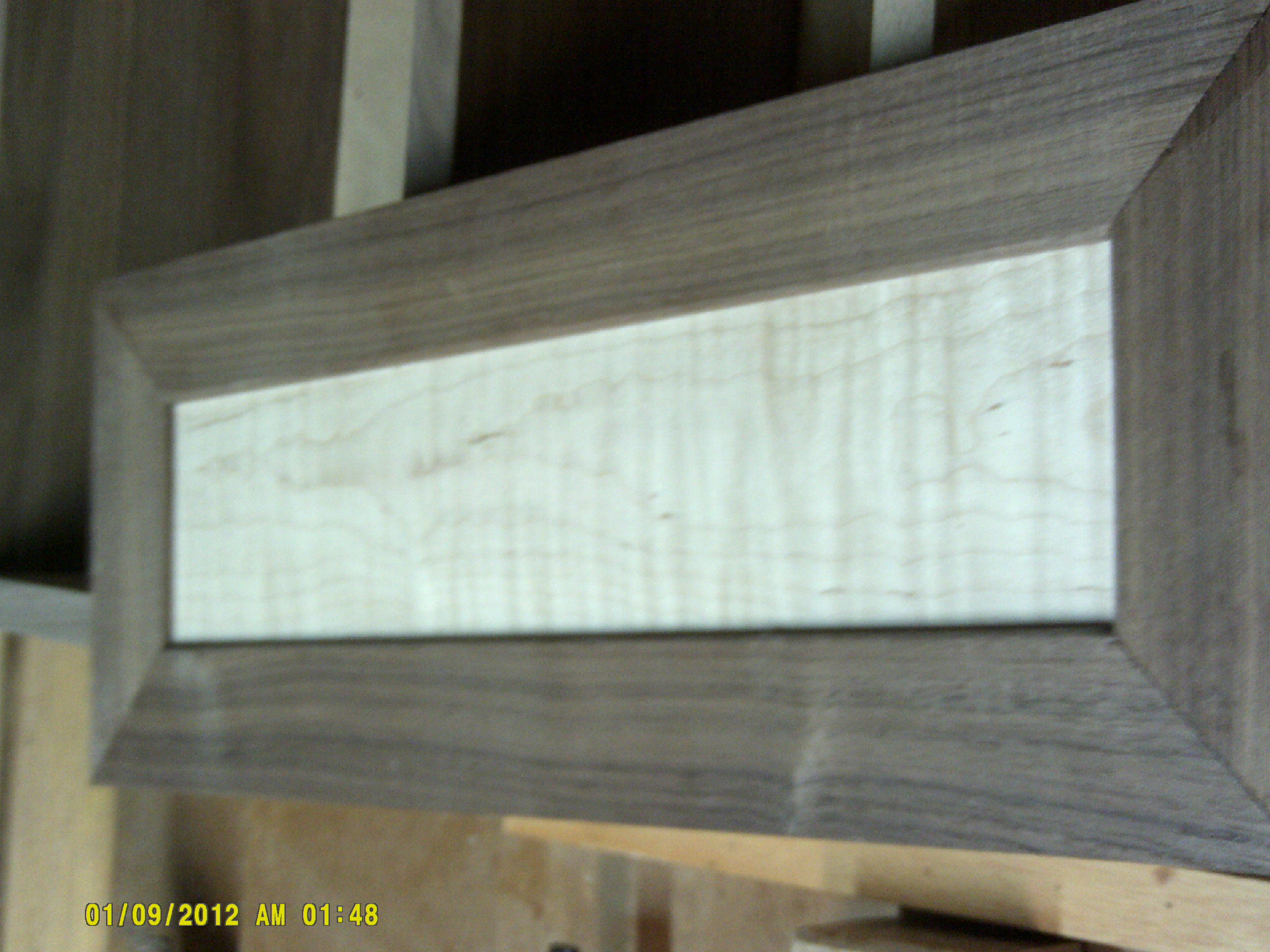
Finished bevelFinally, what you are left with is a crisp bevel that just needs a little sanding - especially on the end grain bevel. The beauty about this method is that you can use it to create any number of different bevel geometries. And, if you want to bevel a door panel, table top or any other piece of furniture, well, this method doesn’t require complicated jigs or expensive router bits.

.

Buying lumber: The hardwood supplier

Filed under: How-to — Tom March 5, 2008 @ 3:31 pm

When you want to buy hardwood for your woodworking project, there are a few different routes you can go. There are Internet dealers, home improvement centers and – if you are lucky – you know a buddy with a portable sawmill and access to a lot of trees in your area.

While these are all good options, if you want the greatest selection and the ability to load and go, look for a decent hardwood supplier in your area. How do you find one? Look in your local yellow pages under hardwood supply, visit Wood Finders and start your search for suppliers near your zip code, or look for local cabinetmakers. No doubt, they deal with at least one reputable supplier, and might be convinced to give you their information.

Jeff Weiss in his showroomI recently paid a visit to Weiss Hardwoods in Largo, Florida to see what happens in a well-stocked, full service hardwood supplier’s warehouse. There, I met owner Jeff Weiss in his well-appointed customer idea center. “Here, we show off some of the interesting things people can build – or have built – from our supply.” A sapele bar trimmed topped with a specially-treated leather top gleamed among the floor samples, fireplace mantles and stairway components. It’s not difficult to get more than a few decent ideas there.

Racks of MoldingThrough a very plain looking door to the right of the service counter is where the fun really begins. The warehouse is abuzz with contractors and employees getting the supplies they need for upcoming projects.

Dozens of tall racks hold common molding profiles in maple, cherry, mahogany, oak and poplar. Some pieces of molding are greater than 20′ long and all clear. Other racks toward the back of the warehouse contain planed dimensional lumber in the same common species. The middle of the massive warehouse holds racks full of premilled staircase supplies and cabinet grade plywood of different species. “We serve a lot of different people here – contractors, homeowners working as their own contractor, hobby woodworkers… the list goes on and on. We try to have enough variety on hand to suit everyone’s needs.”

The rough stuffThrough two massive garage doors, there is an outside covered lot where the rough timbers are stored. Some planks up to 8/4 and 16′ long are stacked by species. Besides oak, maple and poplar, customers can choose soft maple, hickory, walnut and several other species that you can’t find in your local home center. If you have the tools and like to mill your own, this is the place to look.

And, if you are looking for something a little more exotic for a project, you can get your hands on zebrawood, cocobolo, bubinga, rosewood, ebony and others. These can really give your project the character it deserves.

Helping the customers outWay in the back of the warehouse is the milling operation. I had a chance to watch Earl Ogden, one of the millwrights, plane some boards down to a customer’s specs. Earl has even skip-planed a few boards to give his customers a chance to see what the final wood grain will look like. “We’re kind of like Burger King here – you can have it your way. We’ll mill exactly to a customer’s specs because that’s the kind of service they want.”

Since these hardwood suppliers do a lot of milling for the trades, you might want to ask to see their shorts – also known as offcuts. These shorter boards can be purchased at a lower cost and are perfect for smaller scale projects like boxes and clocks.

From rough boards to fully milled pieces, a full-service hardwood supplier can meet just about all of your woodworking needs.

Edge Jointing using hand planes

Filed under: How-to, Tools — Tom February 19, 2008 @ 6:34 am

So, last time I showed how I face plane using hand planes. Now, we move over to the edge of the board. Believe it or not, this is actually easier to do than face planing… No, really, it is.

Planing aid(Click on images for larger versions) First thing you have to do is secure your board to your bench. You can do that with a regular woodworking vise and a special ‘appliance’ you build to hold the wood. Mine is made of two pieces of southern yellow pine dovetailed together (it’s a VERY rough dovetail…) with holes for some inexpensive hold-down clamps. This is the end of the board that doesn’t fit into the vise.

Can you use two face vises? I don’t see why not… but the one to the right (for right handers) is not going to get a lot of use in a traditional set up… this appliance can be removed when not in use… and it costs a whole lot less!

Board is securedThis is what your wood should look like when you get it all set in the vise and appliance. In this arrangement, there is little - if any - chance the board will slip. That is essential when you plane - you want the wood to stay still while you move the tool.

Once it’s locked in, sight down the length of the board. Get as close as you can to the edge and squint, looking with one eye to see if there is a crown or dip in the board. If you notice high spots, mark them in chalk or with a pencil so you will know where to do the first work.

Transitional Fore PlaneThe next thing I do is take out my old No. 32 transitional fore plane set for a heavy cut. I want to get those high areas out of the way quickly and get that edge as straight as possible. This task can also be done with a No. 5 jack plane with a metal sole. I just prefer the wooden soled plane because I think it slides more nicely on the wooden edge. As you can see, the shavings aren’t curls… they are much more like wood chips. I’m not going for finesse here, I’m roughing in.

From there, I get out my trusty Veritas bevel-up jointer plane. Yes, I bought a newly minted plane instead of finding a quality used one. I haven’t had much luck finding a complete No. 7 Stanley jointer - most of the ones I have purchased had ‘issues’ that were beyond my abilities to repair. Since my shop is relatively crowded, and the plane was less expensive than a powered jointer, I figured I would spend the money I was saving for a powered model on this beautiful tool.

Tom is planingI also bought the 90 degree fence for the plane. True, if I was edge jointing two boards for a glue up, I could plane them both side by side in the vise, with any variations in angles canceling each other out. But, I have found that true, crisp 90 degree angles glue together more nicely. That’s my experience - of course, your mileage may vary.

The technique is very simple. When you start planing, push down hard on the front knob while you push the plane along. Once the plane is completely on the board, push down evenly as the plane glides along. When you get to the end, relax your pushing down on the front knob and bear down on the tote (the back handle). Think about scooping up a bucket of water. Practice, practice, practice and it will come easily.

Veritas Bevel-up Jointer PlaneAs you can see, the are the nice, board-length curls you come to expect from a hand plane. When I get to the jointer, that’s when I want to make the cuts a lot finer to refine the edge of the board.

The real test comes when you run a square along the edge to confirm you have planed at 90 degrees, and you remove the board from the vise and appliance and lay it down on the bench top. You should not be able to see any light passing under the board.

Total time to edge a board? I dunno - three to four minutes. No snipe. No screaming motor. No chance of losing fingers or the board exploding if a jointer knife snags a knot. There’s a lot to be said about those hand planes!

Face Planing using hand planes

Filed under: How-to — Tom February 8, 2008 @ 6:30 am

Have you ever needed to face plane a board without a jointer? It’s not as difficult as you might think.

Checking out the board(Click on the photos for larger versions) For this example, I used a rough piece of cherry that needed to be face and edge planed. If I had a jointer, I would simply run the piece over the cutter head and get a flat face through multiple passes. In my shop, however, I don’t have the room to keep a jointer, and I don’t think I’ll be able to get the money out of the household budget to buy one any time soon. Being a hobby woodworker requires a little ingenuity, and a willingness to try other ways. In this case, it’s the old-fashioned way – hand planes.

planes for the taskHere’s what I used - a jack plane, a jointer plane and a No. 32 transitional fore plane. I purchased all of the planes from eBay for a combined total of about $40. All were in pretty good shape and required just a few touch ups and sharpening to be usable. The thickness planer will come into play later on in the process.

After I cross cut the board to rough length (there’s no need to do the entire board – that’s just a waste of time and wood), I placed the board cup down (it had a cup) and rock the sides and edges looking for the board to wobble. Sure enough, it did!

Mark with chalkOnce I identified where the board was highest, I flipped the board over and marked the high areas with chalk. This way, I wouldn’t lose track of where I need to work first. Yes, that happens in my shop, too.

Before I used bench dogs and other more traditional hold-downs, I clamped across the bench and got to work with the No. 5 and No. 32 planes. If you have only a jack or a fore, you can do this with only that one plane. I just prefer to use the fore plane for the roughest removal, then the more finely-tuned jack plane to even the work out. My first task was to shave down the high areas.

Wax the plane soleOnce the high areas were down to a manageable level, I switched to the No. 7 jointer and waxed the sole with the stub of an old candle. Waxing your plane sole makes the plane slide nicely.

After working on the board with the jointer, and flipping it back onto its face to make sure I had removed the warp, the board sat solidly on the work bench. At this point, I knew I had one side of the board flat enough to go through the thickness planer.

Measure the thicknessNow, I found the thickest part of the board - in this case, a hair under 1 1/4″. I set the planer’s head, plugged in the cord and watched the wood chips fly After getting the top side completely smooth, I flipped the board over and planed out the rough areas on the bottom and got the piece to its final thickness.

Total time from start to finish? Maybe five minutes…

A nice board!Now that the board had flat and parallel faces, I took it to the table saw to straight-line rip the board and joint the edges, but, that’s for another post!

Who says those old planes are just wall decorations?

<<< Previous Page