Tom's Workbench

|

part of the Wood Talk Online community

Archive for the ‘How-to’ Category

Laying up a matched veneer sheet

Wednesday, September 23rd, 2009

If you have been a long-time reader of Tom’s Workbench, you can remember about a year ago when I demonstrated my first hammer veneer project. Since then, I’ve dabbled in laying large sheets over smaller pieces of substrate, making easy yet eye-catching veneered projects.

Well, for my latest project, I wanted to veneer the top of a circular stand I’m building.  I went to veneersupplies.com and looked at the walnut burl sheets.  While I could have gone for a bigger sheet to cover the entire project in one fell swoop, a less expensive and smaller lot of walnut burl veneer caught my eye.  Never one to pass on a good deal, I placed my order and waited for delivery. I also bought some ash banding to wrap around the outside of the project and some veneer tape to help hold the sheets together while I laid them up. Yes, this was going to be my first attempt at joining veneer sheets to cover a larger area.

After I tore into the package to see the lovely veneer inside, I misted two of the pieces down with Super Soft 2 veneer softener I had purchased during my last veneering attempt.  This makes the veneer very supple and easy to apply. I put them under a corian platen and let them sit overnight.

When I was ready to get to work, I discovered that the veneer edges look straight, but they aren’t really dead straight and need to be trimmed.  I stacked the two sheets on top of each other and used a very sharp Japanese carpenters knife to slice them cleanly.  Once I was satisfied, I turned the blanks 90 degrees and cut them in half, giving me four quarters. I arranged them until they looked pretty.

Then, I identified the ‘good’ side of the veneer (Both sides were gorgeous…), flipped it upside down and taped the ‘bad’ side together using some blue painter’s tape.  I had to make absolutely sure that the seams butt together tightly without overlapping – a very important step to take.

Once I got this all taped together, it was a simple matter to flip it up back to the ‘good’ side and get ready to work with veneer tape.  This is some very interesting stuff – it’s gummed just like a lick-and-stick postage stamp and it’s covered in holes.  While using it to tape up the seams, I discovered two very important things:

  1. The condensation on the outside of my cold glass of water was plenty to moisten the tape when the adhesive side is dragged against it, and
  2. The row of center holes allows you to see and ensure your seams don’t open up while gluing it down.

It took one long strip one way and one the other, and bingo, I was ready to glue the veneer down. I flipped the assembly back upside down and removed the blue painter’s tape, and all four pieces held together beautifully with the veneer tape.

I made up a batch of hide glue and laid it over the top of the 3/4″ plywood circle I had cut, making sure to spread it out evenly.  Then, I set the taped up piece ‘bad’ side down into the glue.  I used the veneer hammer to push from the center of the assembly outward, forcing air bubbles and excess glue off to the side.  After a while, the veneer gripped tenaciously, exactly where I wanted it.

After I had it pushed into the glue, I flipped the assembly over with the veneer face down on some craft paper on my bench and set a corian platen on top of that, and finally rested my thickness planer on top of that and let it set for two hours.

When I came back, I trimmed the excess veneer from the perimeter and proceeded to sand the edge of the assembly smooth.  I also wrapped some 180 grit sandpaper around a block of wood and sanded the surface. The burl has no grain direction, so I sanded in circles.The result is just stunning, needing a little extra sanding on the outside of the circle to finalize the round shape before I edge band it and to finish sanding the top.

Now that I know the basics of using veneer tape, I’m looking forward to laying up some more intricate designs.

Bow, Bow, Bow Your Wood…

Monday, August 3rd, 2009

Are you looking to add some flair to your next woodworking project?  Sure you are!  You are a woodworker, and after building lots of square things, you are ALWAYS looking to do something out of the ordinary to spice up the woodwork you are doing.

But, how can you do it?

Well, there is an easy way you can add graceful curves.  And, if yesterday’s link of the week is any indication, there are LOTS of people who want to give bending wood a go.

By no stretch of the imagination should you look to me as an ‘expert’ in wood bending.  In fact, I am building a table to hold a piece of custom pottery that a co-worker will be throwing, and this is the FIRST time that I have tried to bend wood.

From all that I have read, there are three primary methods of bending wood.  The first is kerf bending, which involves cutting saw kerfs into the back side of a piece of wood in order to make it bendable.  It could work if I was building something where only one side was going to be visible, but that’s not what I am going for in this project.  So, that method is out.

The next method under consideration is steam bending. I went to school at the University of Maryland, so I have lots of experience with steaming – blue crabs – YUM!  The process is very similar – you have a container (a pot for crabs – a box for  wood) and you have a source of heat to boil water.  You place your lovelies into the container and put the spurs to the heat. After a set amount of time (20 minutes for crabs, a different calculation for wood), you can pull the lovelies out of the container and do what you have to with them (crabs = eat, wood= bend).  Some species of wood do exceptionally well with steam bending (Ash is the first that springs to mind), and it is a time-honored way to do this, but it was too involved for me.  Besides, the feels-like temperature in Florida right now is about 105 degrees F – definitely NOT steam bending weather.

The method I settled on is making a bent lamination.  I have seen this done before at a woodworking school I attended, and it looked like a neat trick.  Basically, you take wood and rip it down to several flexible pieces. I was using ash, which has legendary bending ability, and walnut… which I wasn’t so sure of.  I was going to alternate strips of ash and walnut to give the piece it’s own set of racing stripes.

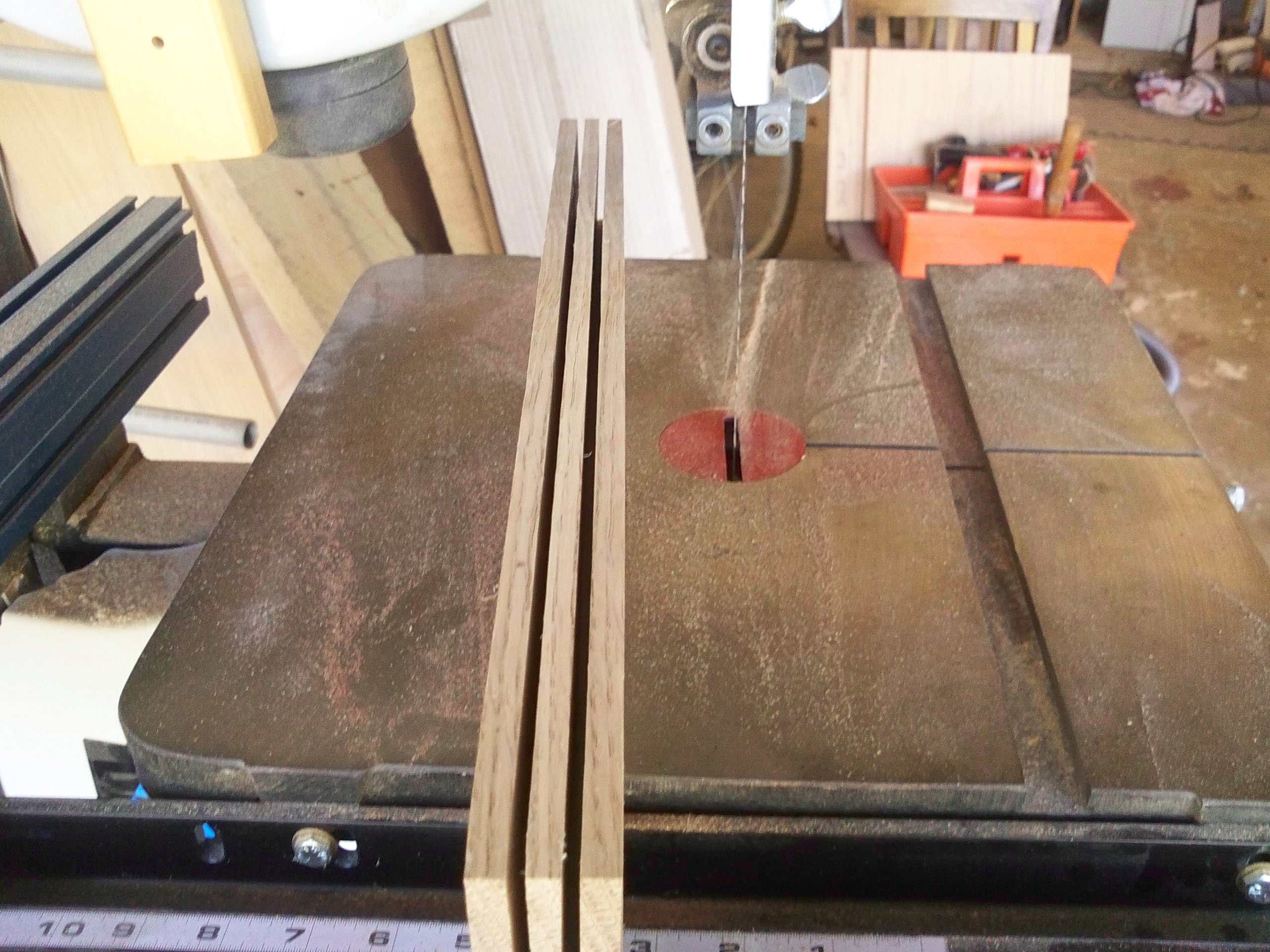
For the pottery stand legs I am building, I aimed to have the wood rough sawn to 3/16″ thick. I then used an auxiliary planing bed at my planer to get the wood down to 1/8″ thick.  I understand that you can make the slices thinner if you have a more radical bend, but all I needed was the arc of a circle to for the legs.

Now, I had 9 strips of ash and six strips of walnut, and I had to get them glued up into a coherent shape.  My first thought was to use a form to bend them over.  This is the way it should be done.  I bought a sheet of particleboard and cut it into six 15″ wide by 48″ long blanks.  Then, I tried my best to make a fair curve nice and smooth in the stuff.

Perhaps I was a bit hasty or careless, but that form I built was terrible.  I couldn’t bend the wood to meet the form, and I wasn’t about to start cutting tissue-thin slats to showcase my bad cutting job.

So, I struck on an interesting idea.  Grabbing my band clamps which see very little action, I made my stack of boards and slipped them into a loop.  From there, I pulled the strap tight while guiding the wood to flex in one direction.

The result kind of looked like a bow under tension.  I had a perfect arc for the pieces with little effort.  If you are planning on doing this, some ratcheting tie-down straps might be cheaper than buying outright band clamps.

I took the pressure off the stack, then I started to glue them up.  I have heard several times that yellow glue will ‘creep’ over time when tension is applied.  Since these legs will be under a considerable amount of tension, I decided to go with a traditional, less-toxic glue, bottled hide glue.  Hide glue gives a more rigid bond, and is very creep resistant.

This stuff is just like hot hide glue except it stays fluid at room temperature.  I spread a generous amount on both sides of each slat to be glued and made myself a sandwich of ash and walnut.  Then, I looped the band clamp around the stack again and tightened up the group until I had the amount of bend that looked good to me.  I took strips of packing tape and wrapped them around the stack at several places to serve as clamps, and – for good measure – I added more small clamps to the assembly to ensure everything held together well.

I gave the piece 48 hours in the clamp setup, then pulled them out.  They came out looking decent, with only a few separations of the plies on the edges.

Hmm….

I guess maybe next time, I’ll have to work more carefully to build better forms and try a different method or try a different glue.  But, with a little more glue and a few clamps, the big issues have been taken care of and the legs look as if they are ready to work with.

Will I ever bend wood again?  You bet I will.  Taking that first step of just doing it has gotten me off the straight and narrow path.

Mortising Magic

Wednesday, July 8th, 2009

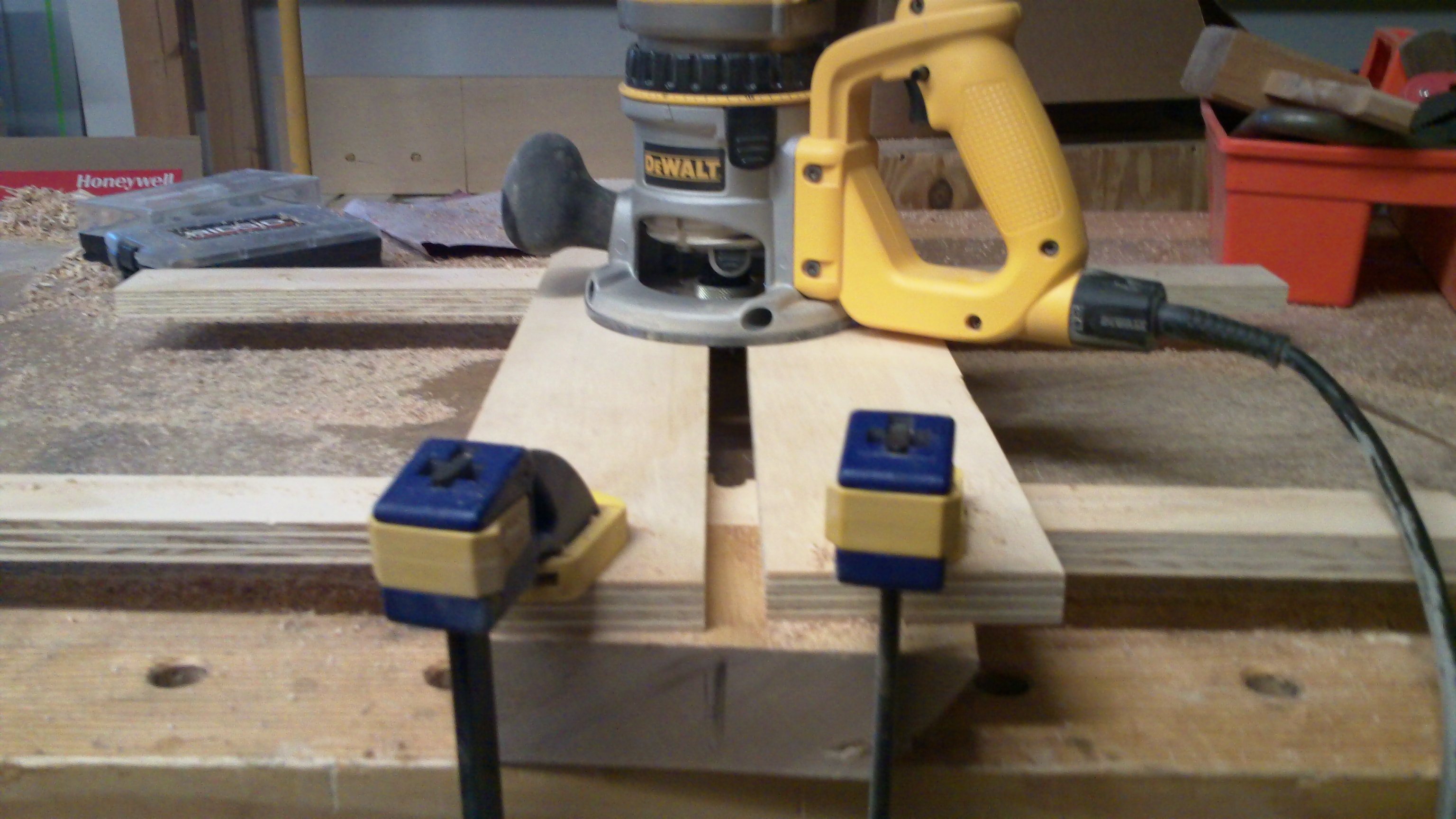
Step right up, ladies and gentleman.  I, The Great Trained Shop Monkey,will amaze and astound you with the paranormal mortising abilities taught to me by the mystic woodworkers of Exotic Imperial China and the Indian Subcontinent.  Using no more than a common table saw, I will cut a crisp-shouldered through mortise with absolutely no tear out which can accent any piece of work you want to add it to.  That’s right, folks.  No mortising machines.  No fancy chisels. No router jigs.  No new expensive tooling of any kind. Notice… nothing up my sleeve, nothing between my ears…

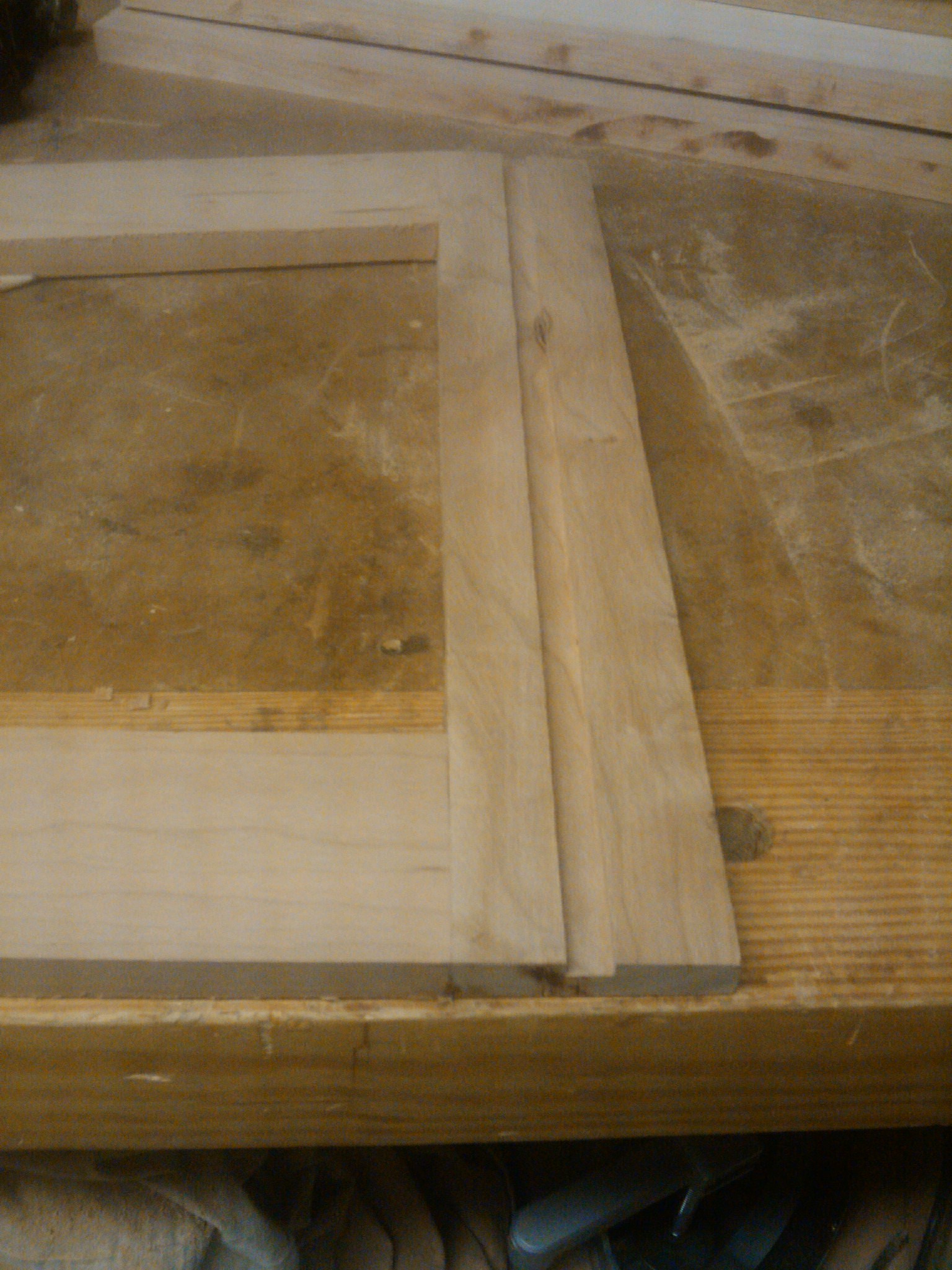
First thing I’m gonna do is cut some pieces of mahogany and maple.  That’s right, the mahogany will serve as the bulk of the leg stand for a bench, and the maple strip will serve as an accent piece to show some interesting contrast.  I also cut a length of tenon stock the exact dimensions I need the mortise to be.

From there, I set up the two side pieces of mahogany on the clamps, giving some room for the maple accent strips to be glued…

Then, I glue up the first maple strip, set it to the magic line of measuring, and clamp it in place, keeping the faces flush.

Without further ado, I wedge the tenon stock in and glue up the second maple strip, insert the tenon stock in the gap and glue the top maple strip into place, again keeping it flush with the faces.

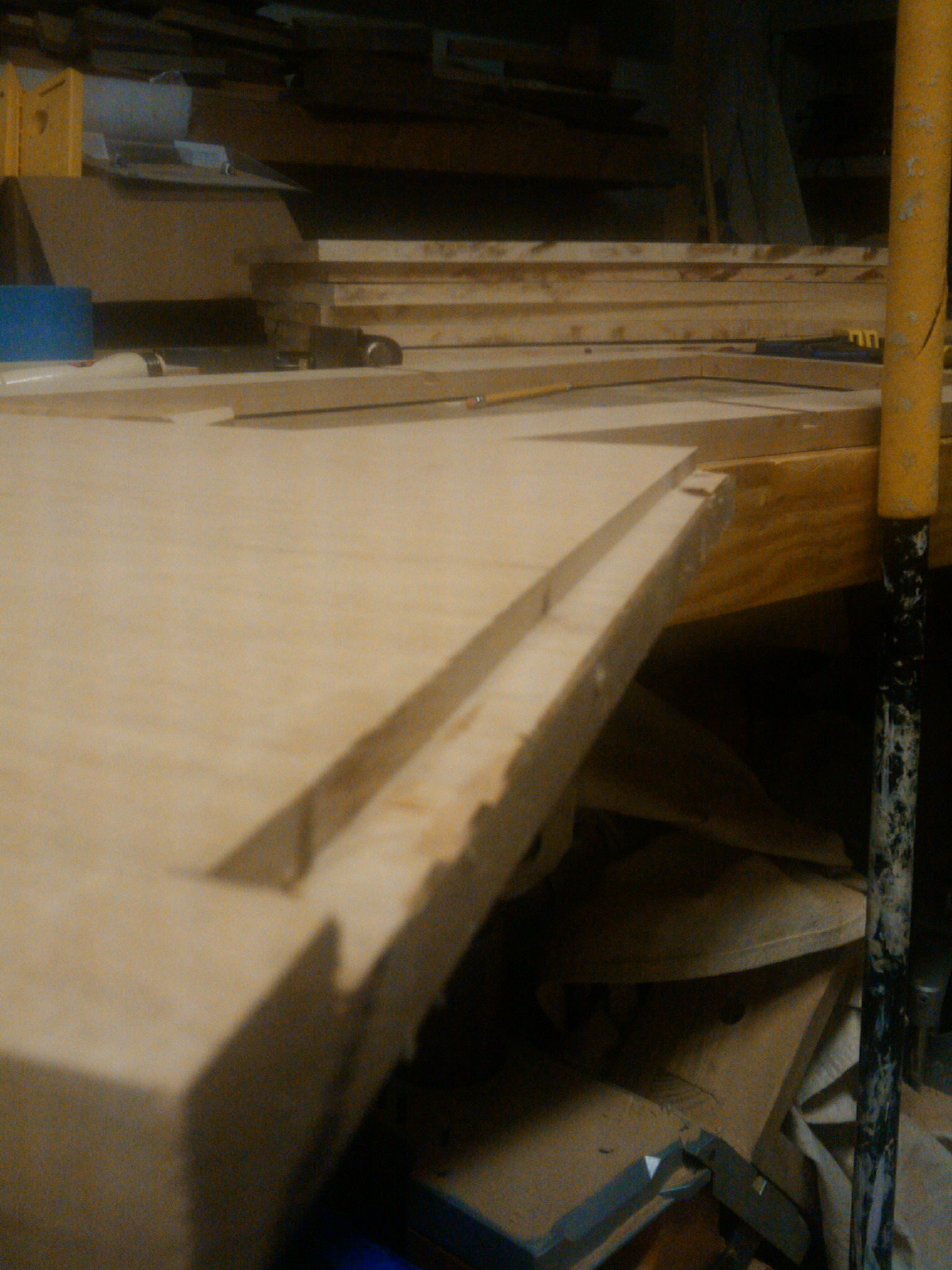
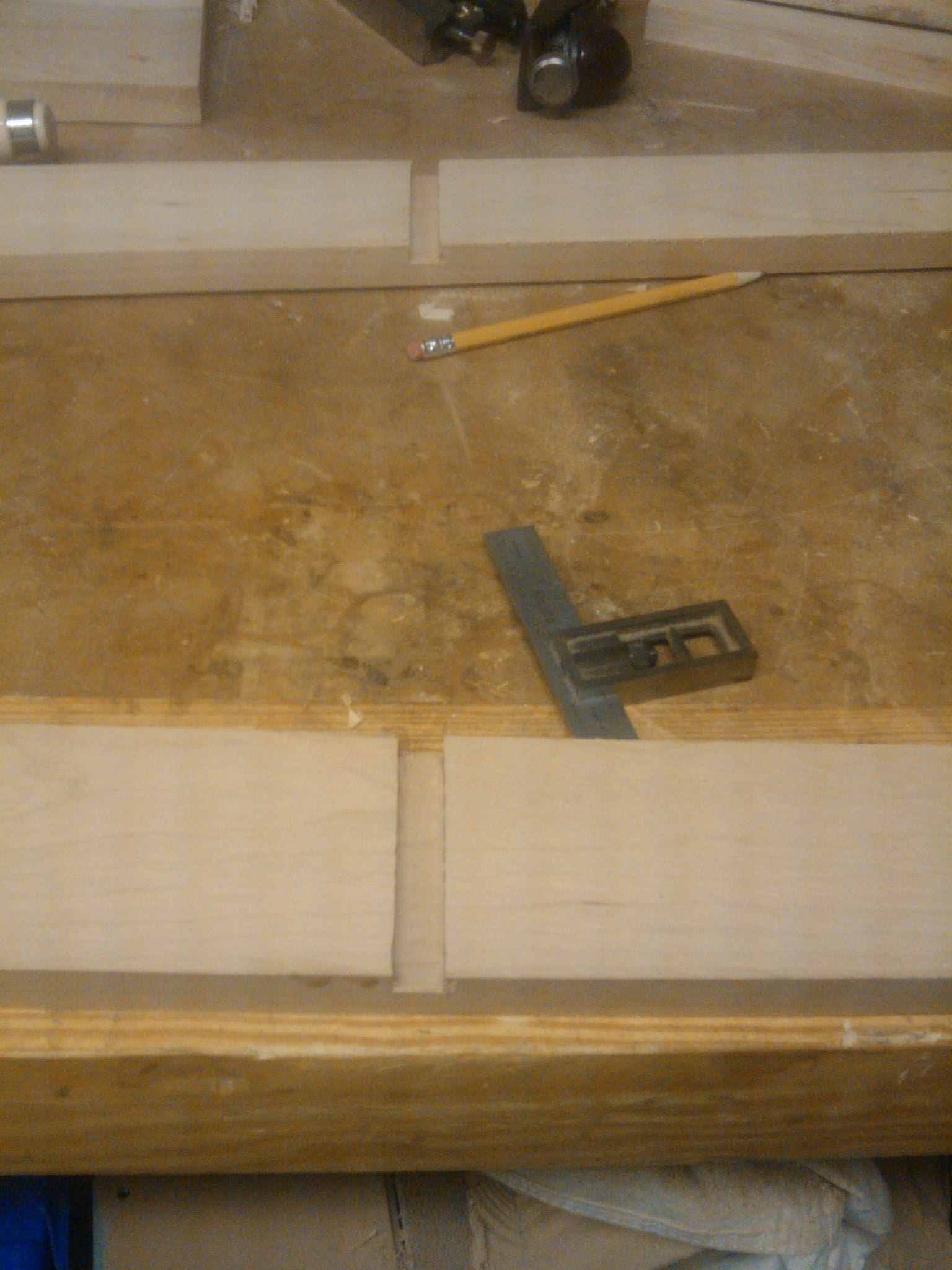
Now, I say the magic works – Abra cadabra, hokus pokus, alakazam -  and blammo – I knock the tenon stock out of the hole leaving a perfect nothingness surrounded by a square-shouldered mortise with absolutely no tear out.  No mirrors, no tricks, no sleights of hand…

Now, all I have to do is work a little magic on shaping the legs of this bench….

Stuff I’ve built: my kids’ step stool

Monday, March 23rd, 2009
  • April 2000

Being a dad is one of the best things that has ever happened to me.  Watching my two sons grow up from birth has filled me with awe and amazement.  From hearing them cry for the first time to hearing them figure out their math homework has been nothing short of a miracle.

Oh, sure, it’s had its ‘moments’, but those rough times have been more than compensated for in all of the good stuff.

The Kids' Step StoolOne of the toughest things to do as a parent is to let your kids discover their independence.  When that three-minute-old child is handed to you, he or she is 100% dependent on you.  Later, they will learn how to turn over, sit, stand, talk, eat for themselves, walk… then run.  All of this is preparation for the day they leave home and make their own way in the world.

To help my boys on their road to independence and self-reliance, I built this – a plain pine step stool.  After all, kids are pretty short and can’t reach all of the adult-sized amenities. Very roughly based on a Shaker design, it was – to that time – the most involved project I had ever tackled.

I built the sides out of pre-glued pine panels I picked up at the local Home Depot.  Those panels are pretty convenient for the beginner woodworker – they have tight joints and are made of solid wood.  The piece I bought was long enough for me to cut out both sides.

After I notched out for the step with my jigsaw, I also notched out for a back stretcher.  I saw this piece done for the fancier step stools Norm Abram built on the New Yankee Workshop and figured it would help strengthen the piece.

The step treads and back stretcher were cut from leftovers of the panel . Assembly was pretty easy – some glue and finish nails. I glued and nailed the little stretchers under the fronts of the treads to give them extra support.

I sanded the piece down with my 1/4 sheet finish sander and brushed on two coats of Minwax’s Poly Shades honey pine to give it a ‘pinier’ look.

While this step stool wasn’t made of high-end exotic hardwoods and put together with dovetail joints, it has held up for the past nine years under some pretty tough use.  Its primary home was parked in the kids’ bathroom, so the little fellas could reach the sink to brush their teeth and wash hands.  The stool even served the boys well in the kitchen where my wife and I gave them their first cooking lessons.

And, amazingly enough, my wife and I would use the stool to stand on when we painted the rooms in our home.  It was just tall enough to make trimming out the ceiling an easier chore.

Today, the piece is just as solid as it was the day it was completed.  It’s still sturdy and easily holds the weight of my boys (Who both now tip the scales over 65 pounds) and their dad (Who tips the scales at a much higher weight than when he built it).

While I would build something like this much differently now, this project wasn’t as tough as you might expect, and was pretty easy to build for a beginner with few basic tools.

Stuff I’ve Built: The Simple Cross Project

Monday, March 9th, 2009

I’m from a pretty large Italian-American (read Roman Catholic) family.  My wife’s family is also Roman Catholic.  This means that during the spring of every year, we get notified about upcoming First Communions and Confirmations for nieces and nephews.  These events are pretty special, and buying a gift card to Target really won’t cut it as an appropriate gift for the child being honored.

What I came up with was the simple cross project.  This is not only a memorable hand-made gift, it’s also a great way to practice your skills on a small project and use up some of that really choice scrap wood lying around your shop.

Cross BlankIn order to make the cross a little more visually interesting, you will want to do a glue up of some contrasting woods into a blank anywhere between 1 1/2″ – 2 ” wide.  Maple and walnut make a classic combination, but any combination will work.  For this cross, I used some tiger maple and padauk that had been lying around for a while.  I glued the pieces together into a strip that measured approximately 22″ long.  You won’t need all of the length, but it’s better to have more than less…

Once the glue is cured, that’s a great time to pull the piece out of the clamps and either sand or plane them flush.  You want the pieces to be a uniform thickness, but the exact thickness isn’t that critical.  I shoot for 3/4″ thick using my thickness planer.  I’m left with a pretty sweet looking strip that’s ready to work.

The next step is to square up the ends.  I did this on my table saw with my Osborne EB-3 miter guide.  If you left your blank long and you had snipe, you will be able to clip off those affected areas.  This is also the time to start cutting the pieces to size.

Cross BlankNow is a good time to tell you that when I built these crosses in the past, I would use a half-lap joint.  It’s a very good joint for this application, but they took a long time to cut and it seemed no matter how careful I was, I could count on something going wrong… maybe the joint would be a wee bit too sloppy, maybe the thicknesses weren’t perfect.  Now, I’m using dowels to do the joinery, and I have found it to be an easier way to go.

The upright piece – with my project’s width at 1 3/4″ – should be 12″ long.  That’s what looks right to my eye.  I also like to keep the upright intact from top to bottom – I feel this makes the cross look more ‘uplifting’. The crosspiece should measure out about 2/3 of that length – 8″ side to side.  Using the half-lap method, you would cut this 8″.  Using dowels, subtracting the width of the piece and dividing the remainder in half, I came up with two pieces 3 1/4″ long.

The hanging slotBefore you get into the joinery, there’s one more step that is critical to perform.  If the cross is going to hang on a wall, you will need to provide some method for that.  Sure, there are keyhole router bits that will give you the properly shaped slot, but I have found that a small diameter dovetail bit will be adequate.  Just plunge the work down onto the bit installed in a table mounted router somewhere above where the crosspiece will be, and push the work so the bit travels toward the top of the upright.  This will give you the right shape so someone could hang this on a nail in the wall. Do it now, or it will be tough going around the crosspieces.

The Joint GenieFor the dowel joinery, I turned to the Joint Genie. I have found this to be a very precise dowel jig that gives a lot of flexibility.  It consists of a nickel plated body with through holes spaced evenly.  It also has fins on the edges – by using the fins, it’s easy to roughly center the dowel spacing on the board and allows you to index all pieces to this same spacing.  A tail fin sets the position from the end of the board consistently.

Drilling the dowel holesUsing the block with the 1/4″ dowel openings and the supplied 1/4″ bit and stop collar, I clamped the jig in place and using the dowel holes at the bottom of the jig, drilled two holes.  I repeated this operation on the other side, flipping the fins to the opposite side of the jig to get the same reference.

From there, I used the jig to drill into the ends of the cross pieces.  Again, the Joint Genie allowed me to get the proper spacing the first time out – a very useful feature.

Ready with dowelsHere’s a shot of the cross dry-fitted with the dowels in place.  I know that dowels aren’t going to provide the strength of the cross-lap, but this is a decorative piece – and I have found myself having to make lots of these (My record for one session was five).  The dowel process really speeds my joinery and still provides all the strength I need.

All I need to do now is glue it up, sand and finish, and it will be ready to package and ship.  This one is going to my Godson for his Fist Communion, but I’m sure I’ll  be building more…

Mortising ‘Under Glass’

Wednesday, December 17th, 2008

Remember that Frank Klausz guy?  You know, the fella who can cut dovetails with his giant bowsaw in 3 minutes flat?

Well, he’s back at it again!  Frank was a presenter at the recent Woodworking in America conference held in Berea, Kentucky. This time, he offers viewers a unique perspective on how he can quickly and efficiently cut a mortise in a block of wood with a proper mortising chisel.

Some things you might notice about Frank’s technique:

  • He works well within the scribe lines of his mortise, only paring to them at the very end of the process
  • Even though the walls of the mortise are kind of rough looking, a mortise cut this way is just as strong as one cut with a hollow mortising machine or plunge router.  Remember, craftsmen cut millions of copies of this very joint with little mechanical help for thousands of years.
  • Notice also that he never scratched the glass…
  • Sure, this does require some skill, but Frank is using some pretty smart mallet blows to cut.  It’s not a skill that requires a long time to master or an overly gentle touch.
  • Again, a mortising chisel is the only way to achieve such results.  Bench chisels aren’t designed for this kind of application and shouldn’t be used for such work.
  • For projects that require only a few mortises, this method might be faster than dragging out and setting up a hollow chisel mortising machine.

In case you were wondering, the photographer is none other than Roy Underhill, from TV’s The Woodwright Shop.  I’m kinda surprised – I didn’t know Roy knew how to use a modern tool…

Using the Kehoe Jig

Monday, December 8th, 2008

After my recent article I wrote about the Kehoe Jig, I decided I would have to get my hands on one and give it a test.

The Kehoe Jig partsWhen the package arrived at my shop, I unpacked it and found it had quite a few pieces in it.  Namely, the jig itself,  the sled and magnetic stops used to make the splines, a corner inlay kit (I didn’t use it for this project), 14 degree dovetail router bit with a guide bushing, spring clamps, instructions and a paper bag containing some sample splines.

While reading the instruction manual, I discovered that – as with any other dovetail operation – there are two setups required.  While traditional dovetail joints require you to change router setups for the pins and tails, the Kehoe requires one router setup for the grooves and one table saw setup for the splines.  That’s convenient, because, unless you are lucky enough to be using two separate routers to cut your dovetails, you will have to change the router setup between the different cuts.  By setting up two different tools, it helps eliminate errors and confusion.

To try the jig out, I used it to assemble the base of a photo frame bookend.  I cut my oak base and riser with a 45 degree miter joint and glued it up without any additional reinforcement.  The dovetail splines will take care of that.

Jig set upThe next thing I had to do was to put the work piece into the vise and set the jig in place.   This is made pretty easy, because the bottom of the jig is shaped at a 45 degree angle.  This rides on the corner of the work, and the flat top gives your router plenty of support as you make the cuts.

Before you cut, lower the bit until the bearing rides on the edges of the groove template without breaking through the inside of the joint.  As you might imagine, the most critical part of this operation is to keep the router absolutely flat on top of the jig.  If you lift the router while cutting, you will spoil the cut.

GroovesWhat you are left with is a dovetail-shaped groove in the work.  Since the  groove is relatively deep, you can now see why it is critical to not use metal fasteners.  Biscuits and dowels might be OK, but, again, once the splines are driven home, they will do an excellent job in reinforcing the joint.

Next, you will have to move over to the table saw.  First, a few notes about the splines.  You want to make them by making rip cuts.  You need the long grain to run the length of the splines or the joints you make will be very weak.  Secondly, the spline sled gives the splines a oSpline jig setupne degree taper over their length, which means when properly cut, they will only fit one way.

The setup consists of  the spline sled, which clamps to your miter gauge, a magnetic stop (The device to the left of the sled with two magnets) that sets your spline’s width and a magnet that serves as a stop for the miter sled.  This stop keeps you from cutting all the way through the spline sled.

To get started, first, I would strongly recommend that you glue up some panels of the wood you want to use for splines in order to get about a 12 inch width.  Remember, you want these splines to be long grain.  Wide boards are great, but I wouldn’t want to use a wide walnut or cherry board for this kind of operation – it’s too valuable.  Set your saw’s blade to the angle of the dovetail bit you use – in this case, 14 degrees.

First, cut off one edge of your spline stock.  This gives you the necessary 14 degree shoulder on one side. Next, you want to get a rough measurement of the groove at it’s widest point.  In this case, about 3/4″.  Mark that measurement on the stock, and set the blade to leave the mark.  Push the work through the saw blade carefully, all the time holding the piece tightly to the sled’s back fence.

Take the spline to your work and see how it fits.  My first attempts were too narrow. To adjust the jig, you can gently tap the stop away from the sled to widen the spline or toward the sled to make them narrower.  For your first attempt, plan on making several tests to get things dialed in.

Once you hit the butter zone (where the splines slide in about halfway and then stop), cut as many splines as you need for the project.  It’s always a good idea  to check the spline’s width just to make sure you have’t knocked anything out of whack.

Splines in placeOnce you get the splines ready, it’s a simple matter of  gluing them up, orienting them narrow side in (remember, they have that one degree taper) and tapping them into the groove.  Now, don’t club on them – you could run the risk of splitting your workpiece.  Just make sure they go in tightly.  Most of the glue will squeeze out of the joint as you do this, but, that’s to be expected.  The very thin film of glue will hold the pieces in place very well.

Finnal jointAfter the glue dries, you can cut the splines as flush as possible with a fine toothed hand saw (or maybe even a flush cut saw if you use a shim between the saw’s teeth and the work – you don’t want to scar the pieces) to get rid of the majority of the spline waste.  From there, you can use a block plane or a belt sander to flush the splines with the work.

The result is a strong decorative joint that goes together faster than by using many other dovetail jigs.

Pros -

  • Easy to use
  • You don’t have to change router settings between tails and pins
  • Ability to variably space
  • Decorative

Cons -

  • Takes time to zero in spline width
  • Can drive joint apart if  you are too aggressive with your hammer

All in all, I can recommend the Kehoe…   You can find out more about the jig at their website:

http://www.dovetailspline.com/