All posts by Tom

I'm the guy who writes the blog...

My new tool

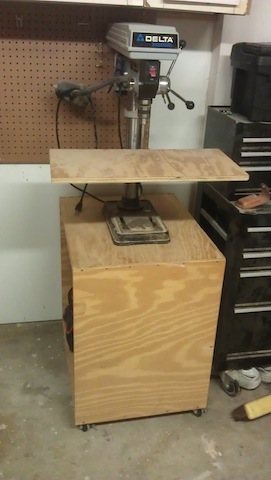
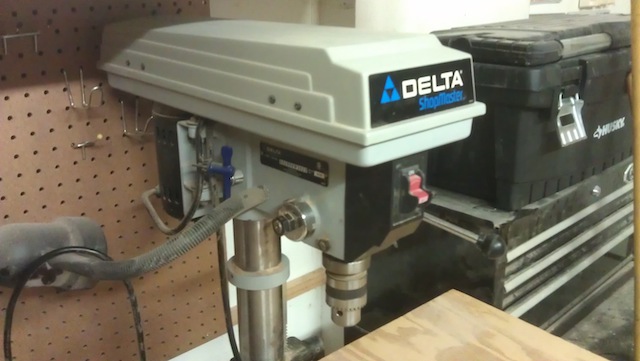
Look at this baby right here! Yup, I’m just strutting as proud as a papa, because now I am the happy owner of a drill press.

The only problem is that I bought this tool back in 2003.

Lemme explain. I have heard from other woodworkers that a drill press is a piece of must-have equipment for the shop. You can do all kinds of stuff with it. Why, you can bore holes. But, you can also use a circle cutter. And a plug cutter. And a sleeve sander. Gosh, there are a ton of tools you can use!

As far as applications? Sanding. Cutting mortises. I mean, drill presses are Jacks of all trades. So, I collected my pennies back in the day, and I went out to the local Lowe’s and purchased this.

Now, it’s not the most tricked out drill press out there. Not by a long sight. There are no lasers, no hold downs, no expanding tables… Just a really basic, smallish sized unit with a fairly powerful motor, an adjustable table and the ability to drill nice straight holes.

The only problem I have ever had with the unit? I couldn’t find a place to put it. Just as with my miter saw, it sat, tucked neatly away behind a piece of shop furniture for the better part of a decade while it got covered with dust.

There were times I used it for sure. I would have to squat down and manhandle the unit out from its hidey-hole, find a place for it – usually on the workbench – and use it to do the five or six things I needed done. After that, I would manhandle it down into storage again.

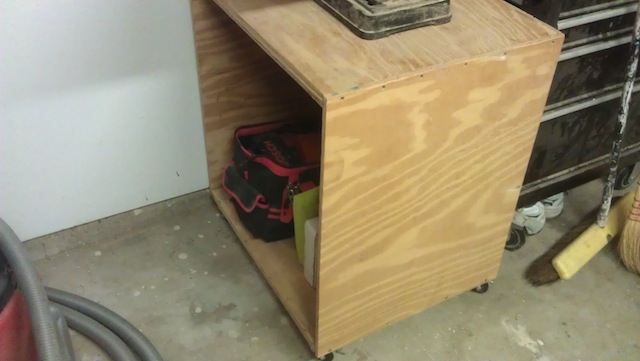
I tried to make it more useful by building a rolling cabinet for it. Some plywood, a few casters, a handful of screws and BAM, I was there. I even made the piece the same height as my workbench so I could use that for infeed or outfeed on my table saw. But, the vast amount of time, the drill press sat in its case.

When I pulled the side cabinet out this past weekend, I was wondering if I could fit the drill press under there with the drill mounted to the top. The stack was about six inches too tall. Flummoxed, I spent the better part of my evenings after work trying to figure out how I could make this arrangement work. That’s when the idea hit me… how about a cabinetectomy?

Using my track saw, I set the case on its side and sliced it apart about six inches from the bottom. Once it was free, I banged the bottom of the case free from the three sides and screwed it back into place. I stood the drill press up on it and wheeled it over to the new area. It fit with about two inches to spare! I used a pair of screws and some fender washers to attach the drill press to the top of the cabinet, and then cleaned the caked-on sawdust off the tool. Much nicer.

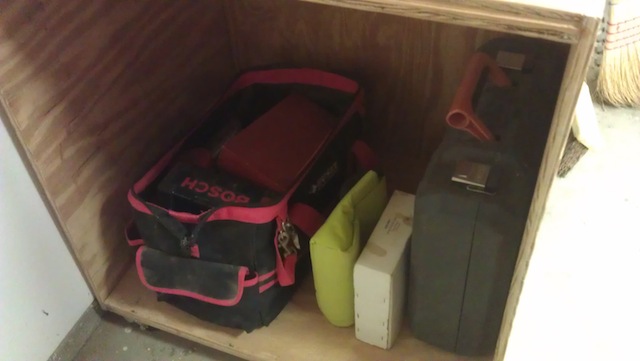
I also took the opportunity to gather up all of my drilling supplies and stash them in that cabinet. This way, when I need to do any work at the press, I can simply reach in, find the bit and get to work.

The best part of this whole operation? It took maybe ten minutes to get the stand cut to size! Now, I have to build myself a little bit more useful table to expand the small machinist table – something with a little T-track to help make drilling a pleasure.

I’m looking forward to getting some good use out of my nearly decade-old brand new tool.

Found space

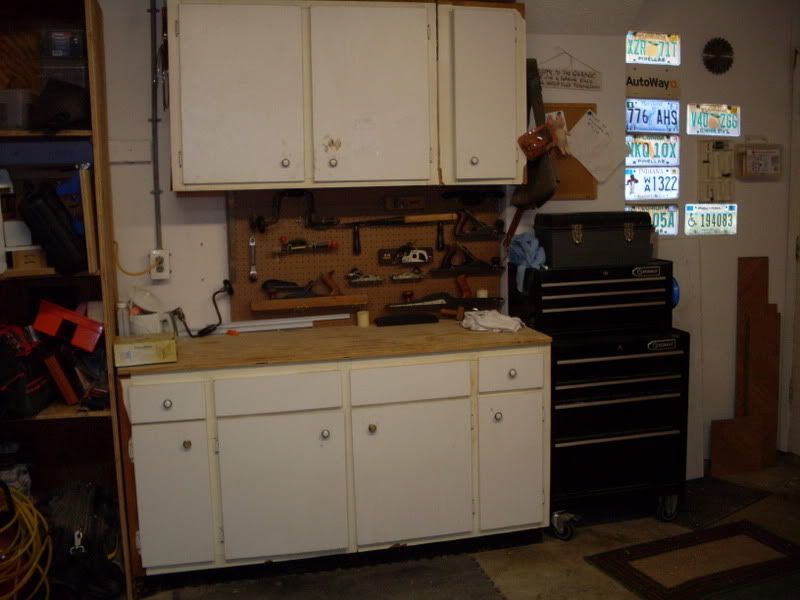
My shop fills a standard two-car garage in a typical Florida ranch house. Which means I have about 400 square feet of area to work with.. a pretty decent amount of floor space to do woodworking. But, only if it’s laid out well. Otherwise, you are going to end up with huge areas of dead space and tools you can’t access.

I recently reclaimed a ton of space when I built my miter bench setup across the back wall of my shop, but I still needed MORE space!  Why? Well, I have got to have some more locations to set up a few new tools. But, where the heck will I find it? Knock down a wall and expand?  I looked around the shop for a while, and then a thought hit me…

What exactly is in this side bench?  This is an old base cabinet I had gotten from a friend who was redoing his kitchen. And, I had put it into the shop about six years ago, and it was a nice area to put some planes onto, and it collected a lot of stuff that just ‘landed’ in the garage from the living area. But, what was inside?  I decided to reach in to see what was there. I was stunned.

The two pull-out drawers were full of useful stuff. Safety glasses, gloves, new respirator filters.  That was nice. But, under the cabinet, behind the drawers? Holy smokes. Some miscellaneous hardware. A few attachments I was never going to use for my air compressor. Empty blow-molded tool cases. A few old sheets to use as drop cloths. Man, what a bunch of junk! This stuff should have been pitched years ago, but for some reason, I held on to it. I guess I was waiting for it to age to perfection.

Since this served more as a place for my plane till to sit (and my bike to rest against), I decided that it was going to have to go. At nearly six feet long and two feet deep, I figured if I removed the cabinet, I was going to get myself quite a bit of square footage to work with. So, that’s exactly what I did this past weekend.

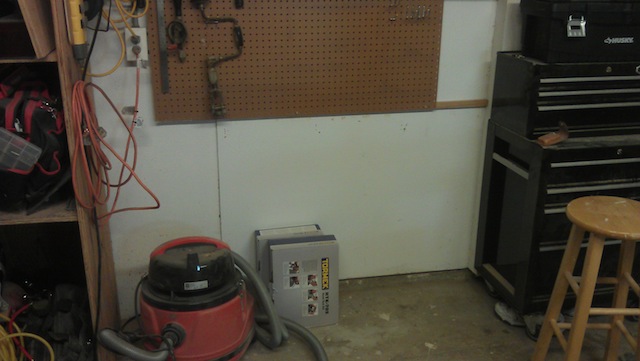
Fortunately, it took removing only a few screws to get the cabinet free, and with a healthy tug (I’m glad I didn’t put my back out), the entire cabinet pulled out from the space. Sliding the cabinet across the shop floor stunk as well, but I managed to muscle it outside into the side yard, ready to be chucked this coming Friday in the huge trash pick up day.

The area was very grungy. Lots of dust got behind and under the cabinet, so the broom and shop vac made an appearance to get the area cleaned up and ready to be thrown back into use.

Right now, it’s full of stuff that’s being stored, but over the next week or so, I think there will be some new shop features taking up space there. But, those are some other posts for another day…


Quick Poll

For professional woodworkers, it’s the way they keep food on the table and a roof over their heads.  For amateurs, it’s a sign that they have arrived as respected crafts person.

Yes, selling your work is a big step to take.  Whether you are building pieces on spec to be sold  at a craft show or you are building on a commission or contract for a particular customer, there’s nothing quite like the thrill of the exchange of money for a completed woodworking project.

Now, given the current economic climate, it may have been a while since you have sold a piece, but we’re looking to see if you have ever sold one of your creations.

This week, we want to know if you have ever sold a piece of your work and what the experience was like for you.

Link of the week

Ron Hock’s Sharpening Blog

After this past Wednesday’s post on tool sharpening, I just had to make a link of the week to my good friend Ron Hock’s blog.

Sure, Ron has his Hock Tools site, but on his blog, you get to know more about this metal maestro. Ron really opens up, giving readers an insight into the mechanics of sharpening, furniture design and building and other items that catch his interest. He’s had articles on the DIY heat treatment of steel (don’t try this in your kitchen, OK?), features on notable woodworkers and he’s even helped me out by posting about Get Woodworking Week!

One of my favorite posts, however, was the one where he recommended a movie about the Steinway Piano company… even his movie reviews are worth a read.

Thanks, Ron!

How sharp?

When it comes to sharpening tools, you can always take things to extremes. I mean, there are people who say they won’t go to the bench unless they have tools that gleam like mirrors and have come off a 10,000 grit water stone. That’s an awful lot of work to do to get your edge sharp, when you really don’t have to go that far. In fact, you can stop the sharpening process a whole lot earlier when you get your edge to the proper degree of sharpness.

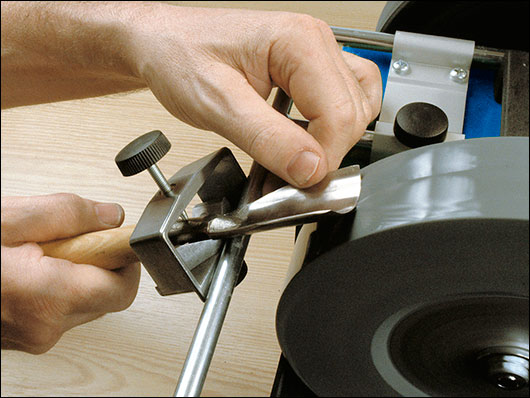
But, how can you tell if you have gotten there? I know of five common tests to gauge the sharpness of your chisels, plane irons and other edges. And, when I’m done sharpening my edged tools on my Tormek, I like to give them the once-over to ensure they are as sharp as they need to be.

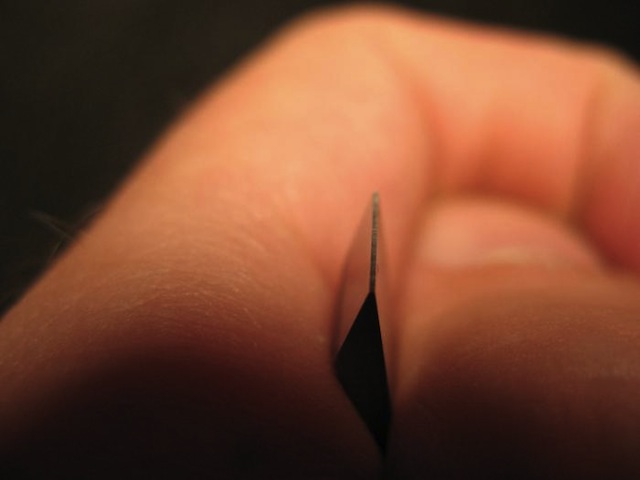
The glint test. Kari Hultman of the Village Carpenter told me about this one. Under a very bring light, hold the edge of the tool pointing at you. If you see any glint of light reflecting back from you from that edge, it’s not sharp enough. Remember, sharp is the point at which the two planes of the chisel’s back and the bevel meet, and any flat on that edge indicates that your sharpening job has more to go. It’s a very subtle thing to notice, so you’ll have to build some expertise. Oh, and using a magnifying glass, jeweler’s loupe or some other sight aid helps tremendously.

The fingernail test. Your fingernails are made out of keratin –  a tough and smooth protein, so it takes quite the sharp edge to scratch them and not just slide off. When you pull your blade off your sharpening medium, GENTLY drag the edge over your nail. Again, a dull edge will glide over the nail, where a sharp edge will bring up shavings. Again, BE GENTLE!  You can hurt yourself badly if you push too forcefully.

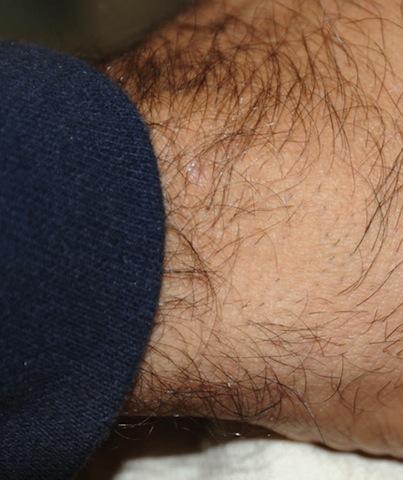
The shave test. It’s called woodworker pattern baldness. You’ll see sharpening enthusiasts sporting bald spots on their arms (or even legs) after time at their sharpening stations. It’s not a surprise, a very sharp edge has the ability to slice hair as it is dragged across skin (don’t try to shave your face with a chisel or plane iron… it will be a rough shave, no matter how sharp you have your irons. Razors have a much more acute angle). A keenly-sharpened edge can clear a patch of hair with minimal pulling.

Steve Branam of closegrain.com shows his sharpening prowess

The paper slicing test. If you hold a piece of copy paper in your hand and a sharp edge against, you should be able to cleanly slice the paper with minimal fuss. Again, we’re talking about very sharp tools here, and the finer that edge, the easier it will be to slice. In addition to demonstrating how sharp your edge is, it’s also a great party trick that will make your guests ooh and ahh with pleasure.

The end grain slice test. This is the test I use, and I think it works best for woodworkers. Before I set up for a sharpening session, I will clamp a block of wood in my bench vise. Normally it’s just something out of my scrap bin, but I have found that softer woods give a better indication of just how sharp the edge is. When I pull the edge off the Tormek, I will go over to this block and use the edge to slice a ribbon of end grain off the board. If the chisel or plane iron just pushes right through with minimal effort and leaves a sweet looking ribbon of end grain, I know I am there. Softer wood gives a great indication – if it slices cleanly, but doesn’t push the end grain down, you are there.

Ultimately, the proof will be when you work with the tool at your bench. If it cuts nicely after you sharpen it, you are good to go. Just monitor how the cut feels, and when you don’t get clean cuts anymore and it takes more effort to use the tool, it’s time to think about breaking out the sharpening medium and getting back to work.


A mile together

The measurement we use to mark distances – a mile – has a very interesting history.

In some areas of Europe, the mile could have been as long as 10 Kilometers – more than six miles. There are several other lengths, some of which we still use today. A statute mile measures out at 5280 feet, yet a nautical mile equals 6076 feet. Thus, you get different measurements when looking at speeds. A boat traveling at 50 miles per hour is hitting 43 knots.   Confusing, eh?

The origin of the term came from the days when the Roman armies marched through Europe, the Middle East and Northern Africa as they built their Empire.  As those soldiers marched to far away battlefields, commanders needed a way to gauge how far they were from home base, and how much more they had to travel to get to their new posts.  So, as the solders marched, each thousandth pace was noted as one mile (think millimeter.. 1,000 of those suckers make up a meter). Since the average Roman soldier’s pace was about five feet, a mile measured out to about 5,000 feet. The Romans were also excellent record keepers, and this distance became a standard in the ancient world, helping guide travelers for the past 2,000 plus years.

Today,I am posting my thousandth post on Tom’s Workbench. What seemed like a goal waaaaaay off in the distance back in August of 2007 is now here, and I often wonder how I have made it this far.

No doubt, you have read enough of the early days of the blog. I have spent the past two months throwing bouquets to the folks who have helped make the blog what it is today.  I have meant every word of those articles. Sincerely. There were several times during the early days when I asked myself, “Why keep going?”  Each of those people at one time has helped me put one foot in front of the other, keeping the blog’s slow and steady pace.

There is another group of folks that I didn’t have a chance to thank yet – the most important ones. Each of you. Sure, if I had no readers every day, I’d still probably be out there putting up post after post for my own personal enjoyment. But, sharing this journey with each of you has helped to make this a far more enjoyable trip.  I have had folks walk up to me at woodworking shows and energetically shake my hand, happy to have met a ‘celebrity.’

In reality, it’s me who is far more excited to meet you!  I mean, you suffer through what passes for content on this site, and you do it willingly!  There’s a sainthood in it for you somewhere!

While today’s post is a big milestone, it’s not the end of anything.  I’m reminded of a question my friend Scott Morton asked me  at Allan Lindsey’s dining table near the end of Woodworking in America 2011: What are your goals for the blog?

Talk about your  loaded questions!  Of course, I would love for my blog to make a million dollars for me so I could quit my day job and woodwork full time.  Yeah.  That will happen about when Iggy gets his PhD and takes a rocket to the Moon. Instead, I want to keep offering my quirky insights into this somewhat  maddening yet incredibly rewarding craft. I’m sure I will still make mistakes. And, yes, I’ll make decisions that you will look at and wonder if I have possibly lost my mind. I might even build some nice looking furniture and have you gawk in amazement that all of the pieces actually came together.

Regardless of what the next posts have in store, I’m glad to have each of you along for the ride.

Thank you for everything you have done.

Now, what to write about for Wednesday.. 😉

Winner Winner Chicken Dinner!

I know it has been two months since I posted the announcement of the big thousand post giveaway. I thank you for your patience.

I have a feeling that you are going to be relieved that the moment is now upon us, and I have this feeling that the folks who won are going to be very happy!

First, though, I have to thank the people who contributed to the give away. Actually, I am humbled by your generosity and the fact that you believe enough in my blog to stand behind me.

Now, for the moment you have all been waiting for. Part of the reason for rigging the contest this way was to get your input as to how the blog has changed the way you woodwork or fit into your routine. I have taken the time to reply to each of the folks who submitted their entries, and I thank you for taking the time to get to me.

First up, reader Lawrence Richards replied to the call for entries. He is the winner of the set of four Revo clamps and clamping blocks (Set KRK2440) courtesy of Bessey Tools. His entry reminded me of a post I had written about him back in 2008:

Thank you for all you’ve done for me and my family- not just over the last 1000 blog posts, but at the WWA forum.  Your contest got me to thinking about our interactions over the last few years.  I remember with humbled gratitude the “Spotlight” article you did on me while I was deployed back in 2008 as well as the cool mentions of other folks overseas like David Wert..  I can’t tell you enough times how much this meant to me while I was overseas for what turned out to be the final deployment of my Air Force career.  The magazines you sent downrange were almost as valuable to me as the words of support, and I read and re-read them many times over.

The next winning entry came from Nick Sandmann who stumbled upon my blog just in time for a new addition to his family. Hey, Nick, you will probably have plenty of late nights coming up, so why not peruse the DVD with the complete Wood Magazine collection with issues from number one through 209. That’s 25 years of content to keep you busy during those feeding sessions!  Nick wrote:

About a year ago when my wife and I started trying to have kids I decided that I would build the crib myself and started googling for information on cribs.  I stumbled across this article which didn’t have all of the information I was looking for, but I browsed through some of your other articles(unrelated to cribs) which caught my attention and I have been following your blog ever since!

This one came in from my good friend Eric Rusch. Eric has been a loyal reader since the blog’s beginning (not sure how he found me in the first place) and has been an active participant in the process. Hey, Eric, what do you think about a 10 board foot project pack (no, wait, Eric Poirier of Bell Forest Products has upped the ante – it’s now a 15 board foot pack of bird’s eye maple AND a 15 board foot pack of tiger maple!) for you to work with? Eric Rusch wrote:

Do you have any idea how much woodworking information you have disseminated to a whole group of hobbyists that would have otherwise been left to figure things out for themselves? Or worse, get the wrong information from some lesser reputable sources? You have really done a big service to the whole woodworking community, and have done it in a way which makes it fun AND interesting.

I have a face for radio, and a blog that has inspired a number of others to try their hand in online woodworking. Steven Taylor either liked what I was writing or thought he could do better, and launched his own blog. Either way, he’s been a long time reader and wrote in about the influence on his own blog. Hey, Steve, how about something for you to use in that shop of yours?  I think your choice of a K8 or K12 jig courtesy of Kehoe Jigs might just fill the bill.  Steven wrote:

My favorite Tom’s Workbench moment was when I found it. Your site was one of the first woodworking blogs I came across and it became a gateway to discovering how big the online woodworking community really was. It was so influential you were the first reference I made when I started my own woodworking blog.

One of the funniest entries I got was from reader Ethan Sincox. He was relating how he likes to read People magazine (only when it’s in the bathroom and there’s nothing else to read!), and he occasionally stumbles across their “They’re Just Like Us!” article. It shows celebrities doing mundane things – like George Clooney picking up after his dog. The idea is that these folks are just like us! Well, when Ethan reads woodworking magazines, he thinks that every woodworking ‘celebrity’s’ shop must be a hyper clean, uber organized model of efficiency. Hey, Ethan, how about a scratch stock kit courtesy of Hock Tools, ’cause you were surprised to see how messy my shop was:

But then one day you had a picture of a workshop in one of your posts and I was like, “Man, what a mess.  I wonder who’s shop Tom posted a picture of…” And it was yours! Oh!  He’s just like us!  I feel better now. All joking aside, I enjoy the shop organization posts.  They aren’t always ideas I have done or even plan on doing, but they at least spark ideas in my head about what I can do to suit my own needs.
Next up, Greg Westbrook. Sometimes, I write posts that are about one thing, but people walk away with some other quick tip or trick to help make their woodworking easier. Greg liked an trick I used when I was setting distances for my finger joint jig – I used a drill bit as a spacer.  Something clicked with him on that post. Hey, Greg, how’s about a  a complete set of  Pocket chisels courtesy of FastCap Tools?  Greg wrote:
My favorite moment was the one about the box joint jig. Not because of the jig because I’ve seen those before but because of one little detail of one photo: using a drill bit as a spacer. For some reason this was a face palm moment where I said out loud: “Why didn’t I think of that?!” Before then I’d always tried to actually use a ruler to measure such things or in a few cases, made a ‘gauge block’ but at that moment I realized I already had an indexed set of gauge blocks already – my drill bits. That changed my way of thinking.
Some folks are just doing such good work, it was impossible not to recognize them. John Little represents a group called the Toymakers of East Lake, a group I had spotlighted many years ago that builds simple wooden toys for children in hospitals, low-income child care facilities and the like. . John wrote in to enter the contest, and I was amazed that his group was going strong. John, how about a PM2650 portable tool stand courtesy of Bora Tools for your volunteer’s shop? That should make things work better there. Good work, guys!
Here’s what John wrote:
Today we are going strong and will have completed 5 years in existence making simple wooden toys for kids in hospitals, homeless shelters, abused women’s shelters, low income child care facilities, and all kinds of places where children are in  difficult situations.  At about the same time you reach your 1000th  post we will reach one of our own. At our current pace we will deliver our 20,000th toy during our quarterly delivery this September.
Besides being a total goof on my blog, I also like to use it to help promote education – if we can expose some more folks to woodworking, there will be more incentive for companies to build high-quality tools and people to develop a love for the craft. Ian MacKay wrote in and commented about that. Well, Ian, since you like woodworking education, why not enjoy a semester one Hand Tool School registration courtesy of Shannon Rogers?  Ian wrote:
Ok, so you wanted my favourite post.  I’d have to say it’s the one where you first went into your kids’ school to talk about woodworking.  Watching you ‘perform’ to a bunch of smarmy teens was good for my soul.  It wasn’t the humour that made it #1 in my books, it was what it represented.  I see it as the seed that grew into the whole ‘get woodworking’ movement.  A lot of us are willing to ‘talk’ about saving woodworking and doing our part, but no one I know lives and breathes it like you do.  First, a huge thanks for being an inspiration on that front, and second, thanks for keeping me motivated when life gets in the way.
Some of the winners are newcomers to the blog. For instance, Val McPherson wrote in after finding out about the blog from a link on the Infinity Cutting Tools website. She and her husband are avid readers, and it is good to see them on board. I hope they like their one-year membership for the Wood Whisperer Guild courtesy of Marc Spagnuolo.  Val wrote:
I must admit, although I am new to your blog, I began perusing a few posts and, realizing the wealth of woodworking information and humor that you provide, I quickly bookmarked it as one of my Favorites — and this was BEFORE I saw your giveaway!
Steve Stutts found the blog very early on when he was just starting out, and one article he enjoyed concerned my finishing method called Becoming your own Mixologist. I’m surprised that he’s still sticking with the method, and I’m very happy he wrote in. Hey, Steve, how about learning a new woodworking skill – veneering?  I hope you enjoy a Veneering Essentials Combo pack courtesy of Veneer Supplies.com
As a novice woodworker in 2008, I found a formula for wood finishing that has not been replaced. I have used the formula many times. My largest use of the formula was to refinish the pews at my church. I had a crew sand down the pews and I applied the finish. It was fast and beautiful. Over the last three years I have shared your article with many woodworkers of all levels. I have used is on many furniture projects and many crafts projects. Large and small pieces. The formula lays down a sound basic method of enhancing my hard work in a good looking durable finish. Thanks for the formula. Thanks for the science discussion on finishing. Thanks for the blog. And thanks for making me laugh. I have really enjoyed and learned from your work.
Some of the other winners we have include:
Thanks again for everyone who participated… Tomorrow’s the big day!