All posts by Tom

I'm the guy who writes the blog...

The secret ingredient

My other favorite hobby is cooking. I love it. I can’t really get enough of thinking out a menu, getting the ingredients and working through the recipes to bring a  great meal to the table. From appetizer through dessert, I love the whole process.

As an enthusiastic home cook, one of my favorite magazines of all is Cook’s Illustrated. Yup, I’m a subscriber, and I’m not sure who loves the subscription more – me for getting the magazine and great recipes, or the family, who gets to eat what I’ve cooked!

A few of the things I love about the recipes in that magazine are that they are very thorough (they will often make a dozen – or more – iterations of the same recipe to ensure they get the best results), they often rethink classic recipes in new ways to improve the product, and they will often reveal a ‘secret’ ingredient that can take the recipe from eh to WOAH!  A splash of cola in barbecue sauce adds a deep, sweet flavor. A little powdered gelatin helps keep meatloaf juicy. And, amazing enough, a dab of anchovy paste can make most meat dishes taste a whole lot more savory…

In many ways, finishing is very similar to putting together a delicious meal in the kitchen. You have to have the right technique, the right ingredients and do things in the right order to get the best results. And, sometimes, you have to have the secret ingredient that makes your final product something that folks will rave about.
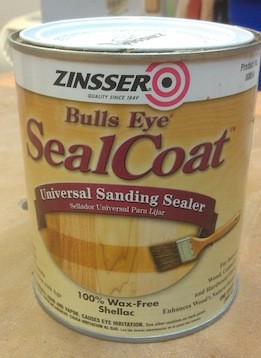
For me, this is the secret ingredient. Zinsser’s Bull’s Eye Seal Coat. While I have never used this as a final finish for a single project, it gets used more than anything in my finishing cabinet.It is a dewaxed shellac dissolved in denatured alcohol. Now, I’m sure you can buy your own shellac flakes and dissolve them when you need them, but I have found the prepared version is a whole lot more convenient, and I have yet to have it fail on me.

I’m not sure what the exact pound cut is, but it’s a little bit too thick for my tastes. What I do is take an old glass jar and fill half of it with denatured alcohol. I will then top the rest of the jar off with the Seal Coat. I recap the jar and give it a good shake or two to mix the liquids together (probably unnecessary, but it’s a habit). Now, I call this mix my spit coat… sort of a pre-sealer kind of arrangement.

When it’s time to finish a project, I will sand, scrape or plane the project until it is nice and smooth. Once I get to that point, I will brush, blow or vacuum off as much dust as I can. Then, I’ll grab the jar of my solution, dip a clean piece of cloth into the mix and wipe it on in nice, long strokes with the grain.

Now, you have to let this dry for a few hours at a minimum. Yes, this happens before you apply the finish, effectively sealing the wood.  Why on Earth would you do that?  Well, on blotch-prone woods such as pine and cherry, this prevents the wood from absorbing too much stain, dye or finish, especially in the wavy grain of hardwoods like cherry or the earlywood of softwoods.
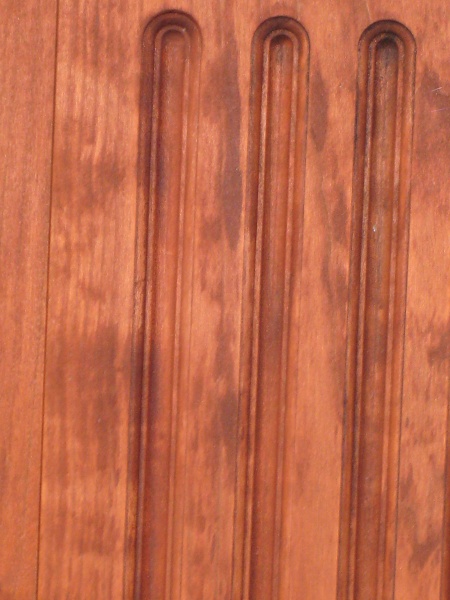
The next step is to sand that finish down with some 400 grit wet-dry sandpaper. Really go to town on it. What you are doing is removing the bulk of the finish on the surface, but leaving enough of it down in the pores of the wood to prevent the blotching. Also, the shellac freezes the wood fibers as it dries. So, when you do this sanding, you will get the surface ultra-smooth. Like baby’s bottom smooth. There’s a lot to be said for a very smooth finished surface! After that, simply apply your finish of choice over top of that, you are good.

Since Seal Coat is shellac, if you are building a project for a child –  who may decide to try teething on the toy – it’s a safe, non-toxic finish that will work like a champ. After applying the thinned down sealing coat, apply some full-strength layers to finish it off.

OK, it’s not the most glamorous of ingredients, but if you are looking to take your finishing to the next level, give this secret ingredient a shot. I think you might just like it.

 

Quick Poll

Some are funny. Others focus on traditional methods of work from the 18th century. Still others focus on turning, veneering or marquetry.

Yes, woodworking blogs cover a tremendous number of topics, styles and techniques.

This week’s question was sparked by Chris Wong at Time Warp Toolworks – just how many blogs do you follow on a regular basis?  Not the blogs you look at once every blue moon – blogs you follow at least once a week.  (I wonder if Tom’s Workbench is part of your list? I can only hope!

Link of the week

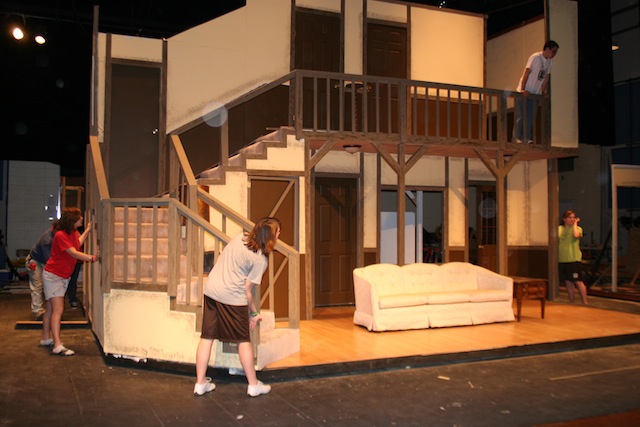
Suite 101’s tips for theatrical set building

Sure, the actors are the ones who deliver the lines and make the action happen in a play, but a well-built theatrical set can help transport the action to far away lands and helps the audience suspend their disbelief.

This brief introduction to building theatrical sets is a must read for the budding set designer. Tips on how to save weight, effort and money are sprinkled throughout the article, with sound advice on where to spend the money and where to save a few pennies.

So, if you are cobbling together a quick set for a child’s school play or working with a much larger budget for a community theater, the tips here can help lead to a standing ovation for your work.

Don’t be a ding-dong

Do you know what these things are?

They are known as kettlebells. They look kinda like a cannon ball, and were invented in Russia back in the 1700s. They were used by drill instructors in the Czar’s imperial army as a strength-training device for the soldiers.

In the past decade or so, they have become popular in the United States as a personal training tool. Basically, you hold on to one while you do a prescribed series of moves, and the extra weight afforded by the kettle bell helps develop strength, improves coordination and – because you do the moves in very rapid succession – gives a great cardiovascular workout.

I call them implements of torture. This past weekend, Rhonda invited me to come out to an early Saturday morning kettle bell class at the local rec center.  “It’s a great workout,” she assured me. “You’ll love it.”

I should have known I was in trouble when the trainer handed me a 20 pound kettlebell, but everyone else in the class was holding ones half the weight.  Rhonda also commented that the instructor was pushing the participants much harder than he had done in previous classes. I can recall getting the tunnel vision thing three times during the class, and my legs were left a quivering mess after the session was over. That was until they stiffened up the next morning, leaving me looking like I had ridden a horse for too long.

Now, I’m wondering if I should go back this Saturday.

What does this have to do with woodworking? Plenty.  You see, when it comes to woodworking, there are always new skills to master. Veneering. Hand cutting mortise and tenon joints.  Sharpening. And, there are always those advanced projects we look to build – the sooner the better.  That Chippendale Highboy. That massive trestle table for our family dinners.   It’s great to want to get out there and do it all.

But, sometimes in our rush to master these tasks, we can bite off more than we can chew, and we end up frustrated – sometimes to the point where we swear off doing that task forever.

Just as with my kettlebell class, I should have recognized two things – I needed to be working with less weight, and I should have been a lot easier on myself.  In the same way, when trying a new task, think for a minute about what you are going to undertake. Maybe instead of thinking you will hand-cut the dovetails on a dozen drawers for a big chest of drawers, maybe you should be perfecting your techniques – cutting to a line, getting your chisels sharp, learning how to use a marking knife properly.  By easing into the task – and making sure you have all of the basics down cold – you will develop your skills faster than if you just throw yourself into the process headlong.

I know that this kettlebell thing isn’t going to be easy. And, while physically lifting my legs with my arms to swing them into my driver’s seat this week, the thought of giving up on these classes has crossed my mind several times. But, from what I have heard from others who have been where I am, the post-exercise pain will be considerably less after this week’s class, and soon, the major benefits of working out with these kettlebells are going to show.

Understanding that you will have difficulties in mastering new woodworking skills is a part of learning the craft. Will you ‘waste’ wood?  Of course. Will that joint be gappy?  Could be. Will that finish give the wood the depth you want?  Perhaps. But, every success, every failure, every up and every down goes into your bank of woodworking experience. And, when you add that all together, eventually, you become a very talented woodworker with a strong knowledge of the craft.

And, unless you have an accident in the shop, it probably won’t hurt nearly as much as my legs do this week.

Let there be shop light

When you woodwork, you really need to be able to see what you are doing. Clearly.

Part of that is being able to extract the dust, chips and shavings from your work area. You probably also want to wear some high quality eye protection – corrective if needed. And, you need light. Lots of it.

There are many schools of thought when it comes to lighting your shop. Some advocate 100% natural sunlight, allowing you a raking view of the project you are working on. Others recommend flooding your shop in scads of overhead light bright enough of attract the attention of 747 pilots on a landing approach.

For me, well, my lighting situation stinks. Although it is much better than it used to be. At one point, the garage had one single ceramic screw-in light fixture. That was it. Man, was that place a dungeon.

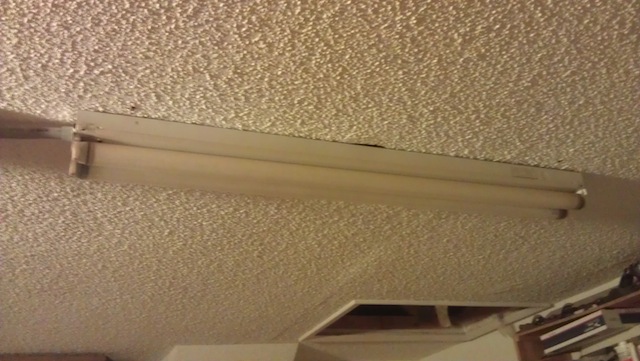
Since then, I have installed a pair of two-bulb fluorescent lights. Those suckers throw a whole lot more light than used to be there. And, for a while things worked out well. I even added a hanging shop light over my bench to get some additional light where I was working. But, ya know, that arrangement always seemed awkward. I had to turn the lights on, and then pull a switch to add more light. Invariably, I would forget to turn the light over the bench off, and there were times when I would walk out to the shop after a day or two, and discover it hadn’t been turned off.

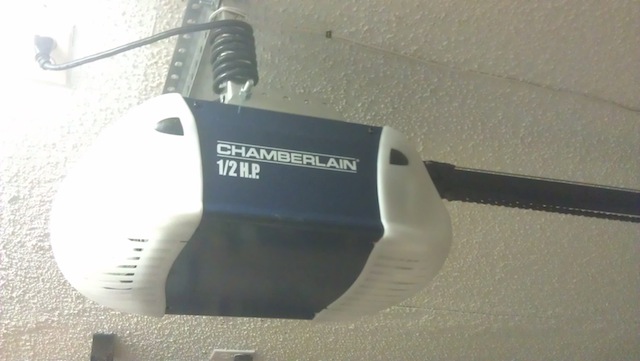
So, I decided to do a little something about my lighting situation. First things first, however. My automatic garage door opener hadn’t worked in about two years. I would manually open the door when I needed access to the shop, but the vast amount of time, it would stay closed. Recently, the big home improvement mega store was offering a great deal on a garage door opener, and installation included lubrication and balancing of the garage door.  The best part?  The unit came with two lights – one in front and one in back. I put a pair of compact fluorescent light bulbs in them that have the equivalent of 150 watts. Since the run on considerably fewer watts than advertised, they really boosted the light output.

What next? Well, My plan is to reuse the existing lights, placing them in more advantageous locations to help light more of the shop. The next step is to install a new eight-foot long shop light in the middle of my shop. This unit is pretty cool, because it uses four four-foot long bulbs, instead of the much more expensive eight foot bulbs. I will also link the three separate lights together so they all come on with a flip of the switch. With these new lights and the garage door opener, it will definitely brighten up the area.

I also need to put some lights up at the miter bench to throw off a little more task lighting, get a magnetic base light to get some more light over by the band saw, and I think I’ll be good to go.

And, if I do it soon, I might have all the lighting upgraded before I have to start wearing cheaters!


Link of the week

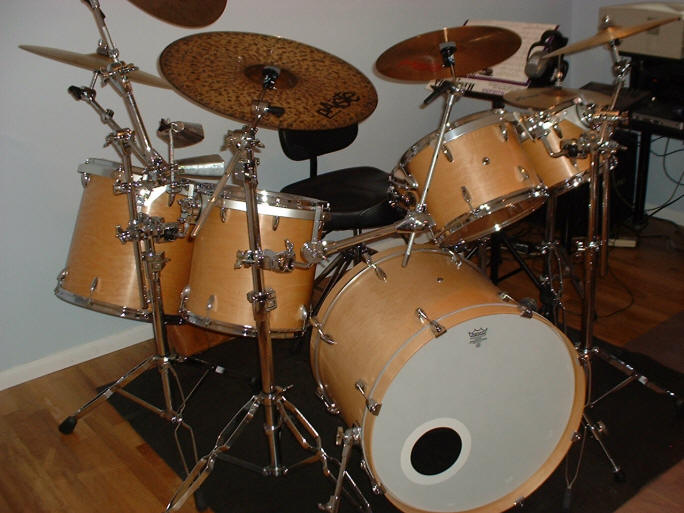
PD Good’s How to Build a Drum

When woodworkers talk about building an instrument, a guitar usually comes to mind. Maybe a violin. Maybe a dulcimer.

But drums?  You bet!

This site, run by PDGood, goes into very good detail about the materials, methods and special hardware needed to build a drum kit. Whether you choose to go with plywood, segmented, steam bent or solid construction, there are plenty of options for the budding skin smasher. Hardware selection, wraps, glue choices and drum heads are all described in detail, giving in-depth insight into the building process.

Build your own drum set?  That can’t be beat!