I’m sure there are one hundred ways to build a work bench, and all of them are correct if they meet your needs.
…………………….– Danny Proulx, Building Woodshop Workstations
You wanna brew up an instant argument? Find a group of woodworkers and ask them their opinions about brands of pick up trucks.
For the record, I drive a Toyota Corolla. I chose this car because it gets me from point A to point B with a modicum of comfort while using as little gas as possible. It has a reputation for reliability. The fact that it also happens to be able to hold my entire family is a bonus. Other than that, I really couldn’t care what make the car is.
 But, when you drag Ford, Chevy, Dodge, Nissan, Toyota and other manufacturers into the mix, people become defensive about their trucks. Boastful. Arrogant. “My Ford will tow your Chevy to the junk yard when it dies.” “My Dodge is a beast and will out perform both of your toy trucks.” This conversation can drag on for hours while people go back and forth essentially over what is a utility vehicle designed to carry a load of items.
In much the same way, woodworkers have a tendency to look at their workbenches and compare how they stack up to others. Whether a woodworker believes a huge steamed beech bench modeled after some European standard is the only way or a solid door on sawhorses is their preference, a great deal of personality is invested in the decision.
I have been looking at my workbench recently. Sure, Big Ugly still answers the call without a whine or whimper each time I go into the shop. She serves me well. But, I’m thinking it might be time to do some upgrading. Some extra features. A little more heft.
 That’s where I’m getting stuck.
At the recommendation of many woodworkers, I recently picked up Workbenches, the first book written by Popular Woodworking Editor Chris Schwarz. The book has been touted as a seminal work, required reading for woodworkers of all levels of experience.
I’ve got to hand it to him. I think Chris has written a very well researched book on the topic of workbenches. Besides old photos of woodworkers actually using their benches from bygone ages, his book is replete with drawings, block prints and ads from tool and bench manufacturers from years gone by. This really helped me get an idea of just how these specialized shop tools has evolved from the first flat rock to today’s high-tech offerings.
Chris offers outstanding plans with measured drawings and step-by-step instructions in exacting detail. Chapters devoted to stock selection, bench accessories and the best methods to accomplish certain tasks make this book an invaluable reference for any shop. It’s written in a style where – yes – I didn’t want to put it down.
But, I do have a quibble with the author on a few points.
 No doubt Chris is imminently more qualified than I to write about all things woodworking. He’s worked with the best. He’s held some of the most expensive tools ever manufactured in his own hands. He’s perched in an enviable position from where he can monitor the latest developments in the craft. When he speaks, his voice carries with it a great deal of authority.
For some reason, his book hit me the wrong way. Chris makes excellent points about the shortcomings of many bench designs. He validly points out that many benches today are glorified kitchen counters – with no access to clamp materials from below – or overgrown dining room tables. However, the way he belabors the point seemed to set uneasily with me.
 He speaks about other designs – some of which he designed for Popular Woodworking – as if they are somehow beneath a serious woodworker. “Build it like that, and you’ll be terribly disappointed,” is a common refrain. Perfectly serviceable benches such as the 24 hour bench and the $175 bench are dismissed as ‘starter’ benches, perfect for customizing as you would an old Volkswagen Beetle.
What iced me from the book was when he pointed out the shortcomings of the benches found in the shops of Tage Frid, James Krenov and Frank Klausz. There is no question that these men have built incredible works of craft – and art – from their modest benches. While maybe not the ‘perfect’ forms, the quality these men have produced speaks volumes for their ability to use these benches effectively.
And, that’s without saying a word about the Japanese masters such as Toshio Odate who create their masterworks without even touching a western-style bench.
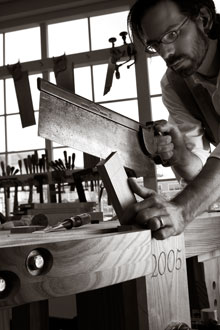 Chris describes his first exposure to the French-inspired Roubo workbench as a near religious experience – divine inspiration into the perfect form and function of what a bench could become. In some ways, I wish he would position himself as less of a Zealot when considering bench forms. Unfortunately, there will be many starting woodworkers who will walk away from this book thinking that any workbench – other than those recommended by Chris – would be a waste of time. Indeed, I can see many up-and-coming woodworkers stymied by the impression that they MUST build a Roubo before they dare touch a tool.
Listen; there are dozens – closer to hundreds – of published plans out there to help you build a workbench. From ultra-quick, ultra-cheap weekend benches knocked out a few 2 x 4’s and some plywood all the way to the could-double-as-an-altar-in-some-minor-woodworking-religion uber-benches – there’s something out there for everyone.
Before you go out and build your bench – consider doing what I’m doing. Look at plans. Lots of ’em. Ask yourself some questions. What am I going to use this bench for? What’s my budget? What skill level do I have? How much space is there in my shop?
 Sure, you can’t plan for any eventuality. I could hit the lottery next week, quit my day job and woodwork full time. Of course, my kids could need glasses, braces and piano lessons too…
What kind of bench you work on is a personal decision you will have to make. Ask around. Take all of this input with a grain of salt, understanding that everyone will offer his or her opinion based on what works for them.
Then, go boldly, build your bench – and get back to the fun stuff – woodworking!
By the way, here are some resources I’ve already checked out:

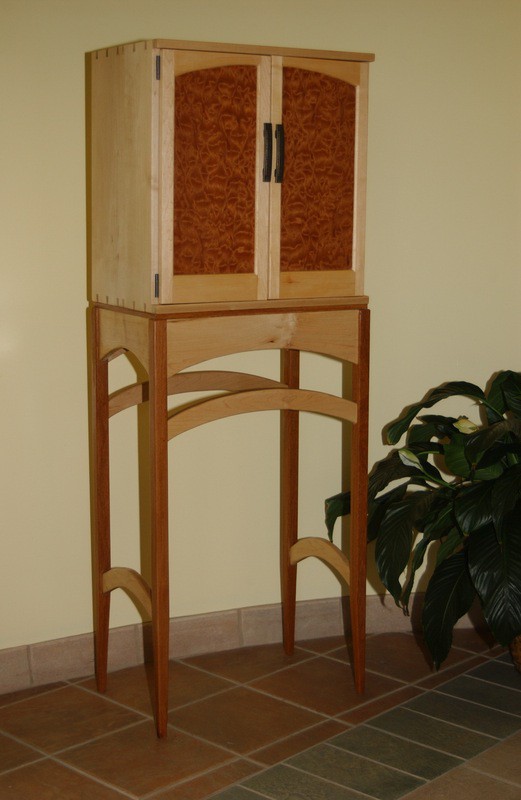 For those who follow along at the Wood Whisperer Blog, Marc Spagnuolo has featured one of my latest projects as his featured Project of the Week.
 Since its invention by Raymond DeWalt back in 1923, the radial arm saw has had quite an interesting history. Once held as the ultimate home woodworking machine, the saw could crosscut, rip, dado, cut joints and do other tasks with specialized attachments.
 As woodworkers, when it comes to cutting boards, if it’s not made out of wood, it’s not worth using.
 For centuries, the venerable craft of carpentry and furniture making has been a rather secretive affair. After all, trade secrets needed to be guarded jealously by master craftsmen and passed down through a long and arduous process to the apprentice and journeymen workers who longed to learn the craft.
 From there, John’s development as a woodworker got a boost from a shop teacher who drilled him relentlessly in cutting joints.
 Not one to just sit idly, the accident provided the opportunity for John to review some of the new woodworking websites that were just making their debuts on the fledgling Internet. “The sites I saw didn’t really have the depth of content I was looking for. Rather than waiting for someone to come up with the right site, I started WoodshopDemos.com.”
 And, that he shares his shop with several helpers. The fact that many of those helpers are attractive young women has not escaped the notice of many of his visitors. “My flip answer is wouldn’t you rather see them than the old bald guy?” The tradition of these shop helpers actually has a very innocent – and accidental – beginning. “Where I first set up shop, I was renting the facility and had several very attractive neighbors. When one of them stopped by to say hello and see what I was making, I suggested that she get into the picture and liven up the site. She did and enjoyed having her pictures on the website. Later, she went on to become a lawyer in Los Angeles.” Since then, he has had a dozen assistants, ranging in experience from brand new to exceptionally talented, and John enjoys passing his woodworking knowledge on to these newer woodworkers.
 Look at any blade maker’s catalog, and you’ll see dozens of blade designs to choose from. Combination, plywood, crosscut, rip, glue-line rip… the average woodworker could go well into debt buying just one portion of the offerings – and that’s just from one manufacturer!