All posts by Tom

I'm the guy who writes the blog...

Quick Poll

Woodworking is many things to many people.

For some, it’s a fun and easy way to spend a Saturday afternoon.  For others, it’s the continuation of a family legacy, carrying on the work of a parent or grandparent.  Some may even consider it a form of therapy, getting them out of their daily routine.

While it may seem clear cut to some, for others, it’s a debate.  Is woodworking an art, or is it a craft?

Sure, this is typically discussed among the high-minded folks at some fancy gallery opening, but it’s an interesting question. Since most woodworking projects have a function, they are considered craft.  But, come on.  A George Nakashima table, with its use of live edges of boards and tastefully placed butterfly keys certainly isn’t the same as a plain old coffee table.

So, this week’s poll is trying to get to the heart of the matter – do you believe woodworking is art, craft or something else.

[poll id=”83″]

Link of the week

Extreme How To’s Mortise and Tenon Page

So, you’ve never cut a mortise and tenon joint?  Or, maybe you have only done it with power tools, and you want to try it with hand tools only?  Maybe it’s the other way around, and you are looking to find a faster, machine based method?

Well, if any of these fit your situation, or you just want to learn a little bit more about this venerable and strong joint, Extreme How-To’s page on mortise and tenon joints is worth a visit.

The page starts off with descriptions of common mortise and tenon arrangements (blind mortise, haunched mortise, through tusk tenons…  the works) complete with illustrations.

The site then goes on to describe how to cut these joints with hand tools (chisels and hand saws) and power tools.

A great E-Bay find

There’s nothing quite like stumbling upon a great old hand plane at a flea market, a garage sale or online.  What’s even better is if that plane can fill a void in your collection.

And, that’s just what I recently found.  While cruising the collectible woodworker’s tools category on eBay, I came across this great little scrub plane.IMG00087
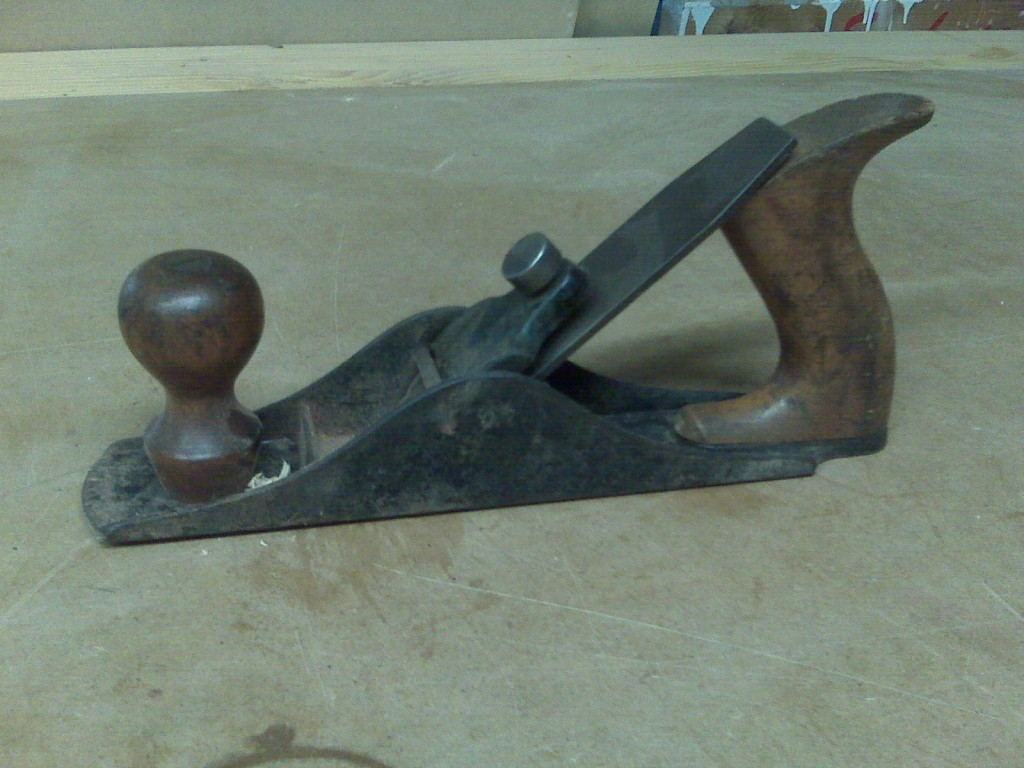
The description was exactly what I had been seeking to add to my collection:

Fresh from a recent barn sale here on Cape Cod a Stanley scrub #40 plane complete with an about full Sweetheart blade. Good wood no cracks or repairs just minor wear from use. Being sold as pictured & found uncleaned, please note there are a few minor rubs in iron bottom sole that could be buffed out if desired by new owner, not bad & clearly shown but needed to mention.

I put in a bid, and the seller accepted it.  As I always do after buying something on eBay, I restlessly waited for the plane to arrive in my shop, counting the minutes until the UPS delivery guy showed up.

I really do need a hobby…

Wow.  It was in great shape – exactly as described.  What surprised me most once I had removed it from the box was the outstanding condition it was in.  There was some minor rust down on the cap iron, but nothing a little buffing with steel wool couldn’t remove.  The handles were in superb condition, and besides a wipe with some paint thinner to remove the dust, the plane was ready to roll.
IMG00089

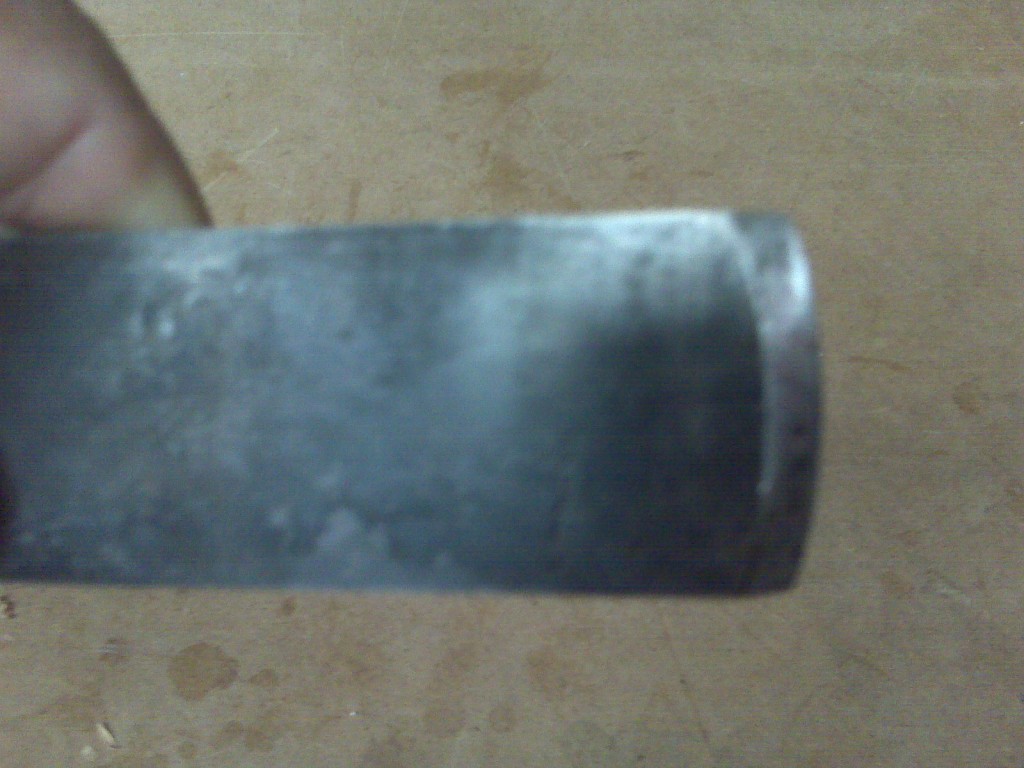
It took the iron out and inspected it closely.  Indeed, this was a 1930’s era Stanley Sweetheart plane with its distinctive mark. I was stunned to see the shape of the working end – it was definitely rounded.  This is, of course, to help hogging off the wood in the roughing phase a whole lot easier.

The Japanning on the plane body is in outstanding shape, and the sole was very flat.  Again, for a hard working plane such as a scrub, this one is in outstanding shape.

Once I had touched up the blade a bit (it still needs a more advanced sharpening) I was very surprised by how light and small the plane was.  I had been hogging off waste from boards with a No. 5 jack plane, and this thing was nothing like the jack.  Small, easy to grip, manuverable.

Then it dawned on me – what a clever idea to make it lighter… I was wearing out my shoulders and back hogging off the waste with a much heavier plane.  The scrub  would make quick work of the high spots without wearing me out.  And, in a day when EVERYTHING was hand planed, well, lighter was better!

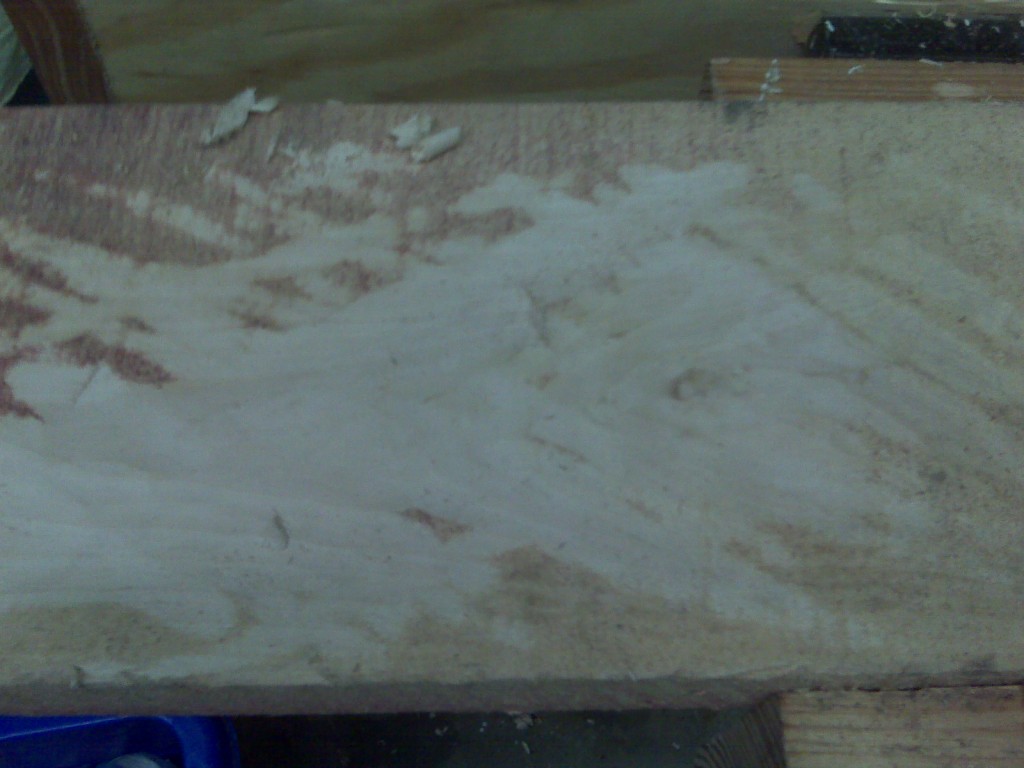
The cut on the scrub plane is definintely something you have to get used to.  You are certainly not making whisper thin shavings.  This is a rough tool for roughly surfacing a board, and does it ever leave a rough surface.  I ran the scrub over this piece of birch to give you an idea of what the cut looks like.
IMG00088

Of course, you will need to use the heavier follow on planes to perfect the surface.  But, with all of the grunt work done with the scrub plane, that smoothing process will be a lot faster – and a lot more pleasant.

A woodworking vacation

Wow.  What a weekend.  My family and I just got back from a quick vacation to the oldest continuously occupied European settlement in North America – St. Augustine.

Now, it was so impressive standing in the Castillo de San Marcos, walking down Caroline Street (the oldest street in the United States) and being tempted to sip from the Fountain of Youth.  It was fun taking one of the ghost tours, seeing where the first Catholic mass was celebrated in North America and sampling the beers at the A1A Ale Works (if you ever find yourself in St. Augustine, you owe it to yourself to try the beer cheese soup at A1A).

But, by far, one of the most breathtaking stops is the old Ponce de Leon hotel, now part of Flagler CollegeHenry Flagler, a railroad tycoon who opened up the east coast of Florida to tourists, had built the buildings to be one of the most lavish and impressive structures in the city.  He built the structure in the 1880’s complete with running water, electricity (brought to the hotel by Flagler’s good friend Thomas Alva Edison) and one of the most valuable collections of Tiffany glass in the country.

While the buildings today are all part of the working college, the impressive plaster work, art pieces and unbelievable woodwork are all there for visitors to see. And, wow, what woodwork was there! From your first step into the grand rotunda, your head will be spinning as you look at the impressive oak woodwork and plaster frescoes.

While the entry rotunda is impressive all by itself, when you are led into the student’s dining hall, your jaw will hit the floor.  Of course it’s first life wasn’t for slinging hash for hungry college kids – some of the most well heeled and rich folks took meals with Mr. Flagler.  Having been a student at the University of Maryland and eating in their dining halls, I was stunned.  Besides the stunning Tiffany windows that frame the views onto the grounds, the amazing woodwork and plaster paintings make it difficult to believe that students take their regular meals there.

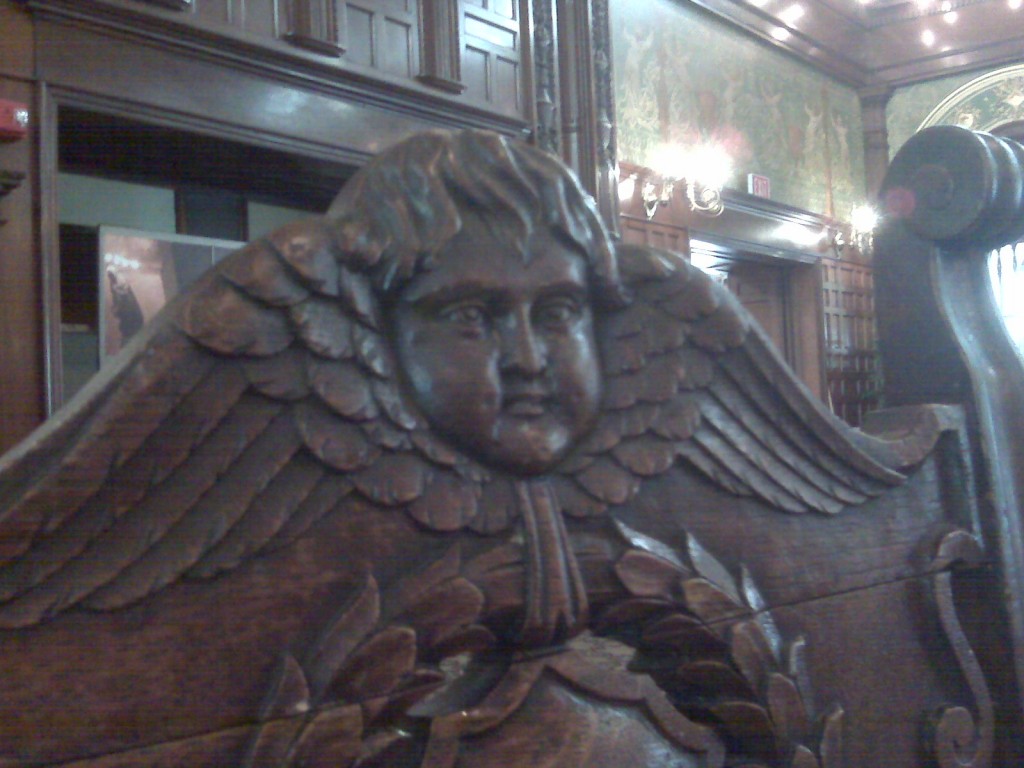
Now, even MORE interesting are the chairs the students sit on.  When Mr. Flagler commissioned the furniture for his hotel, he – of course – went to only the finest artisans he could hire. Again, he turned to  Tiffany and Sons to carve some elegant dining chairs to match the original mahogany tables.  The chairs were stoutly made, with full mortise and tenon construction, with intricate brass tacks securing the horsehair stuffed leather tops.  The original chairs also have casters on the front two legs of the chairs, so they can easily be swung out from the table to allow the ladies wearing the heavy dresses and gowns of the day easier access.

A close up of the tiffany carving

Over the years, many of the original chairs were sold at auction, and many reproductions were commissioned, which roughly mimic the appearance of the originals.  While many have been sold off, there are still a few of the original Tiffany pieces on the dining room floor… where students today can sit in and take in a bite to eat.

I could go on for a while longer, but I still have to unpack dirty laundry and get ready for work tomorrow. But, if you are a woodworker and find yourself in St. Augustine, Florida… well… bring your camera and get ready to drool.

Quick Poll

Let’s face it – our woodworking projects are something we can be very proud of.  Whether a perfectly executed set of kitchen cabinets or an expertly turned piece, we want that work to be identified with us.

For some people, they will name the project they are working on, much as an artist will name a painting or a sculpture.

Some names are basic – “A dining room table”

Some are more descriptive – “Aunt Marge’s Dining Room Table.”

And, some names are very creative and further identify the piece – “The Thanksgiving Tableau.”

This week, I want to know if you have ever named one of your work pieces, and which naming scheme you have used.

[poll id=”82″]

Link of the week

The Apollo Lunar Surface Drill

Nearly every time I go into the shop, I reach for my DeWalt 12v cordless drill.  Driving screws into pocket holes, drilling pilot holes and many other grunt work projects are handled by this convenient tool.

Sure, I have electricity in my shop, and I could always plug a corded drill in, but the cordless is always handy and ready to go.

Now, imagine being 385,000 kilometers away from the nearest electrical outlet.  A cordless drill would quickly become an essential tool in your toolbox.

With the events surrounding the 40th Anniversary of the Apollo 11 mission, it’s only fitting we look at the Apollo Lunar Surface Drill, one of the granddaddies of all cordless drills.

Sure, the ALSD wasn’t developed until 1971 for the later Apollo missions.  However, this 430 watt baby really helped astronauts do the geological experiments they weren’t able to tackle on earlier fights.

One of the Apollo Lunar Surface Drills is on display at the Smithsonian Institution’s Air and Space Museum.

A long e-mail chain…

In case you haven’t yet guessed, I love to write.  And, when readers of Tom’s Workbench send me an e-mail, I enjoy the back and forth that takes place.

Some people have called me a know-nothing hack, while others have said I’m pretty decent with a saw.  While those are intersting to read, the ones I really enjoy are those that come in from readers asking for my opinion or assistance because – for some strange reason – they want to use a technique I had described.

This past April, reader named Big Bill McDonald wrote in, asking what appeared to be a simple question about the finishing recipe I had described in my post I’m So Finished.

Little did I realize that for the next four months, Bill and I would be exchanging a series of e-mails back and forth about finishing methods and philosophies.

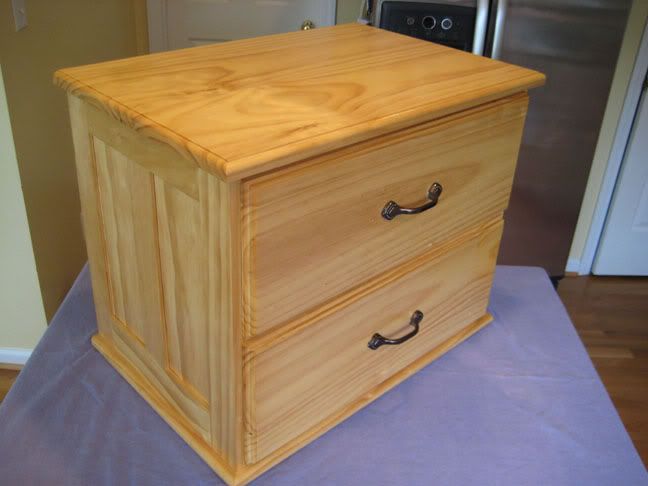
Bill stared out asking about using the Rude and Crude finishing method on a pine toy box he had built.  Concerned about splotching on the piece, we communicated about the shellac seal coat and its purpose and the rest of the finishing regimen.  Judging from the results he got, I’d say this piece came out beautifully, and his son Ben should be one very happy camper to have such a nice piece in his room.

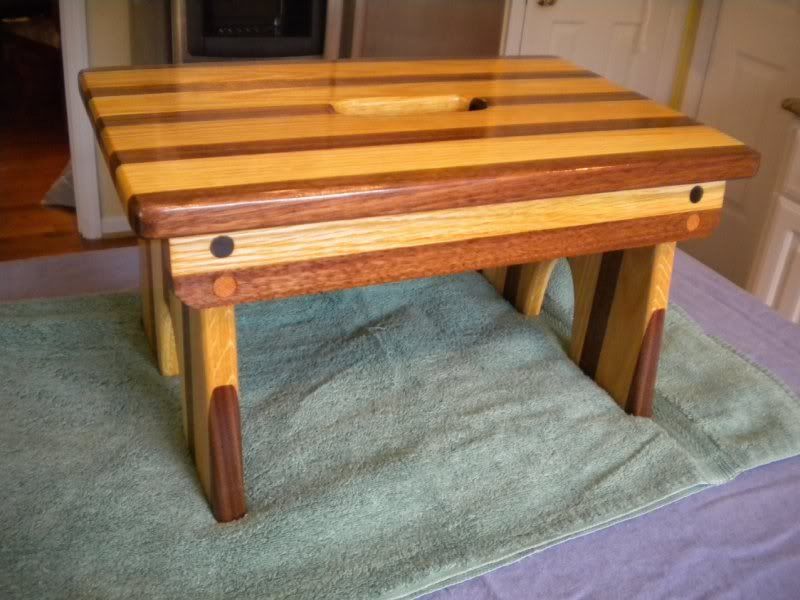
Being that we are both dads, we quickly understood that one project was going to lead to many more. The next one he tackled was a very sweet looking walnut and oak step stool, so his kids would be able to do those important tasks we always hope they will learn to do WITHOUT us having to hound them… (OK, go back into the bathroom, flush AND wash your hands with soap…)

Ben had based his design on a piece he saw on the Internet.  Using strips of walnut and oak to laminate the panels, Bill did a very good job, building a sturdy step stool that will see many years of good use.

Of course, the stool presents its own challenges – it will stepped on by clean and not-so-clean shoes and will undoubtedly see a lot of water.  Bill was concerned that the finish recipe may not be durable enough to survive those rigors.  Once I assured  him that the step stool I built for my sons managed to survive with very few marks, he seemed relieved.

Now, to be fair, Bill did start this last series of e-mails with the line:

Ok – this is my LAST finish question, I promise ! (I say that to myself every time – sigh.  Finishing, I have learned, is it’s own whole world).

However, that’s OK if you keep e-mailing, Bill.  It has been fun discovering this world of finishing with you, and you are teaching me a great deal about your methods along the way.

E-mails like yours are some of the best I get in my inbox and prove, once again, that the online woodworking community is an active and vibrant one.