All posts by Tom

I'm the guy who writes the blog...

Extinguishing characteristics…

There are three things most woodworkers never want to see happen in their shop.

One would be an accident where someone got seriously hurt.

Another would be a theft of tools.

And, probably the worst of all would be a shop fire. In most shops, you will find plenty of combustibles.  Wood, sawdust, planer shavings, finishes… the works.  Add to that the fact that many shops house a serious investment in tools and are also attached to the living area of a home, and, well, let’s just say that’s something no one wants to deal with.
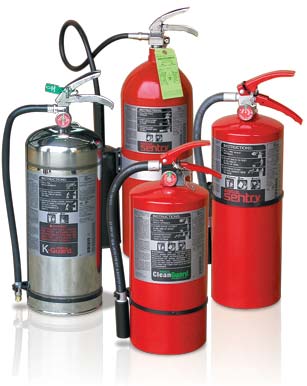
To help prevent such a catastrophe, many woodworkers consider investing in a fire extinguisher… something to keep handy to extinguish a fire should the worst happen.  But, which ones are best on which fires?  When should you use one and when should you run to call for the fire department?  Where’s the best place to mount one?

To help make sense of fire extinguishers, I went to the best local source I could find – my local fire department.  The City of Largo, Florida’s fire department provides fire suppression, inspection and education services to the more than 75,000 residents who call my town home. I met with Deputy Chief James Warman, a fellow woodworker himself, who gave me the rundown on fires and their causes.

First, you have to know a little bit about fire.  It takes three things to get one going.  Heat, fuel and air – oxygen, to be specific.  If you cut one of these legs out from under any fire, it will be extinguished.

When it comes to what’s fueling the fire, you have to brush up on your ABC’s.  There are three main ‘classes’ of fires that can be faced in a typical workshop.

Class A fires are fueled by any combustible source that leaves an ash when burned. (Yes, think A for ash to remember this one)  This could include wood  (sawdust, planer shavings, etc), cardboard, cloth.. your basic fire that you think of most frequently.

Class B fires are fueled by flammable liquids.  (Think B for the barrels you might carry these liquids in) Finishes, thinners, oils and paints fall into this category.  Putting water on a class B fire is about the worst thing you could possibly do, as the water aresolizes the liquid, expanding the fire.  Don’t believe me? Watch as the Mythbusters show how it works.

Class C fires involve electricity, and have their own concerns…  you don’t want to use anything conductive (like water) to fight them.  So, if that overloaded circuit decides to ignite a fire, you have to use something that won’t hurt you to put it out. (Remember that C also stands for current…)

There are also class D fires which involve burning metals.  Since the average home workshop won’t have a ready supply of something like elemental sodium lying around in quantity, we’ll leave that for the industrial users.

Since you want to react quickly in the event of a fire, there’s no time to waste trying to determine what’s burning.  To make your decision easier, it’s best to select an ABC fire extinguisher for the shop.  One of the most effective is filled with dry chemicals.  Besides working on all commonly-seen fires, these are also some of the most economical choices out there on the market.

“An average 10 pound dry chemical ABC extinguisher is a great choice for a home workshop. It’s going to do a good job on the smaller fires you could see in a shop,” said Chief Warman.  Some of the other rules of thumb to keep in mind are to mount the extinguisher to a wall (if you just set it on a shelf, you will push it to the back and not be able to find it when you need it), mount it near a doorway leading out of your shop (this way, the fire can’t get behind you if you need to make a very hasty exit) and use the extinguisher on fires about as large as you would expect to find in a small wastepaper basket.  “Any larger, and you could be in a lot of trouble.  At that point, get everyone out of the structure and call for the fire department.”

And, no matter how large the fire, even if you are able to put it out with your extinguisher, you should still call the fire department just to make sure nothing is still smoldering. “We get called out to a lot of fires where the person thought they had put the fire out with an extinguisher, but it flares up again hours later.”

Learning how to properly use an extinguisher is a simple yet critical step in the process.  I met with Jeanine Green, the department’s public education specialist. She showed me the sophisticated Bullex laser based fire extinguisher training system and explained the process using a simple to remember word… PASS.

Pull the pin. Almost all fire extinguishers use a safety pin to prevent accidental discharge.  And, you would be surprised how many people – in a stressful moment – forget this first simple step.

Aim the extinguisher. Either your extinguisher will have some kind of hose or just a small nozzle right by the handle.  Be sure to point this at the base of the fire, not the flames.  “Remember,” Jeanine said, “the fuel for the fire is at the base.  You want to cool that down and cut off the air. Shooting at the flames isn’t going to do much.”

Squeeze the handles. Once you squeeze the handles, the canister of compressed air inside the extinguisher is punctured, and that pushes the dry chemical out of the extinguisher.  If you release the handle, the flow will be interrupted.

Sweep the base of the fire. Play the chemical across the base of the fire to ensure it is covered.  Use the extinguisher until it is empty, then go and call the fire department.  Preferably from a cell phone outside the building or from another building.

While this information is helpful, both Jeanine and Chief Warman were very clear about the most important point of all.  When it comes to fighting fires, the easiest ones are those that never burn.  Take the time to clean your shop, unplug tools when not in use and store your finishes and other chemicals securely. “We love when people come to visit us to learn about what we do,” said Jeanine, “but we don’t want to have to come to your home during an emergency if it can be prevented in the first place.”

Quick Poll

OK, folks, today’s poll didn’t go up this morning. I was busy making eggs benedict and taking someone very special to the beach.  Yes, it’s Mother’s Day, and that’s where my priority was today.

With all the hoopla about Mother’s Day, it got me thinking.  I’ve build stuff for my mom, and she’s been out to the shop to watch me work. But, she’s told me on more than one occasion that she’s worried about me getting hurt in the shop.

So, this week’s poll is about your mom and whether or not she ever worried about you being out in the shop.

[poll id=”123″]

By the way, Happy Mother’s Day to all the moms out there!

Link of the week

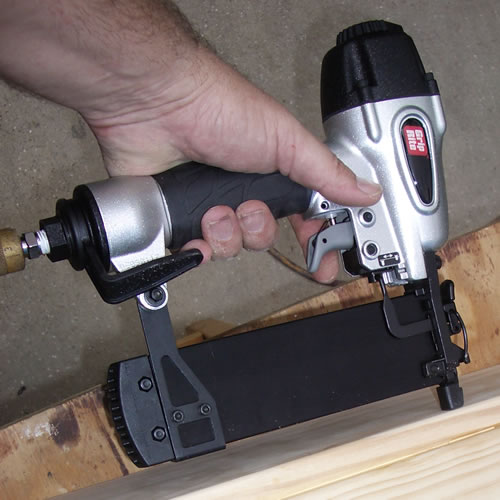
How to work a pneumatic brad nailer

Pneumatic nailers – whether for framing, driving brads or pinning delicate molding, have been a real time saver in the modern shop.  They cut a tremendous amount of time from the process of tap-tap-tapping finish nails in with a hammer.

To do their best work – without unnecessary risk – woodworkers need to know how to load, use and care for these powerful tools. This eHow page gives instructions on how get the best out of your nailer… without getting the worst out of it.

Don’t believe me?  Well, since the Wood Whisperer has declared this to be the last day of non-safety week (the full week before woodworker’s safety week), here’s an example of what can happen to you if you aren’t careful with your brad nailer.  Those with weak constitutions – or extra sensitive funny bones – may want to look away…

Don’t let this happen to you!  {Please note that no woodworkers, brad nailers or trained shop monkeys were hurt in the production of this slideshow…}

Here’s your cue

I’ve noticed over the years that people don’t want ordinary.  Pedestrian.  Plain.

Think about it.  Most people decorate their homes.  They paint walls, buy furniture and hang artwork that helps define the space they live in.  People customize their cars, adding pinstripes, special audio components and custom driving lights.

The same holds true when it comes to hobbies.  Woodworkers are always looking to add some ‘signature’ tools to their collections.  Anglers will custom build a rod and reel to meet their individual tastes.

And people who play pool will often look to eventually have a custom pool cue.

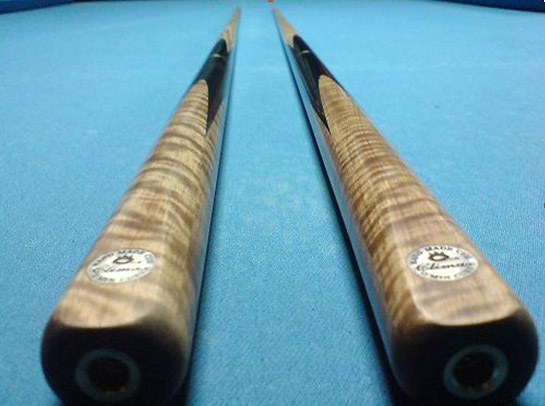
There are some sweet looking pool cues out there that go way beyond the ultra-cheapie starter you may have picked up or the heavily abused house cue at a pool hall. Those custom models feature gorgeous wood inlays, bands and other features that make your cue stand out from the crowd.

Of course, a custom cue carries with it a hefty price.  Most custom models start about $300 and can go into several thousands of dollars based on the features offered and the care of the maker.

But, if you are a woodworker and you want a custom cue, there’s nothing quite like building your own.  “By creating your own masterpiece, you can demonstrate your woodworking skills… even if your pool shooting skills aren’t up to snuff,” said Eric Poirier of Bell Forest Products. “We can certainly help you get off on the right foot when you are ready to build your own.”

For the past year or so, Bell Forest Products has been offering some very cool pool cue blanks for sale that just might inspire you to get into the shop.  They offer a line of full-spliced blanks made by master cuemaker Mark Bear. What makes them so special?  Bear makes his cue blanks with two different species of wood cut carefully to meet up a several ‘points’.  These long splice joints allow the wood to be held together by just glue, not the dowels and other joinery methods used in half-splice models.  The result?  Billiard players consistently rate the full spliced cues as easier to play with a superior feel.

These blanks are also made of some gorgeous combinations of wood. “We routinely carry cues featuring figured maples, bocote, purpleheart, bubinga and other exotic woods we sell.  The beauty of these contrasting and complimentary woods is pretty amazing.”

Since Bell started offering the cue blanks, business has been brisk. “We go to a large cuemaker convention to show off our offerings.  We get a lot of traffic at our booth from people who want to know just how we make such beautiful blanks.”

“Besides,” Eric continued, “many of our customers who build their own cues tell us that when they show up to play, they get plenty of compliments from the people they play against.  Not only does the cue demonstrate their artistic ability, but they say that using what they built gives them more confidence when they play.”

Nice shot!

A new product: Prazi Groove Center

I’ve been told by many people that I need to take up meditation.  No, not some kind of mystic zen-like kinda thing, but just a few minutes every day to sit quietly, relax and do some deep breathing in order to take the edge off.  The benefits are that my blood pressure would drop, I would sleep better and it would help me find my ‘center’ of calm.

Well, at my house, with a busy job, two sons and all the other stuff that goes with being a dad, husband and homeowner, time to relax is at a premium.

Fortunately, the folks at Prazi USA have found an easier way for me to find my center.

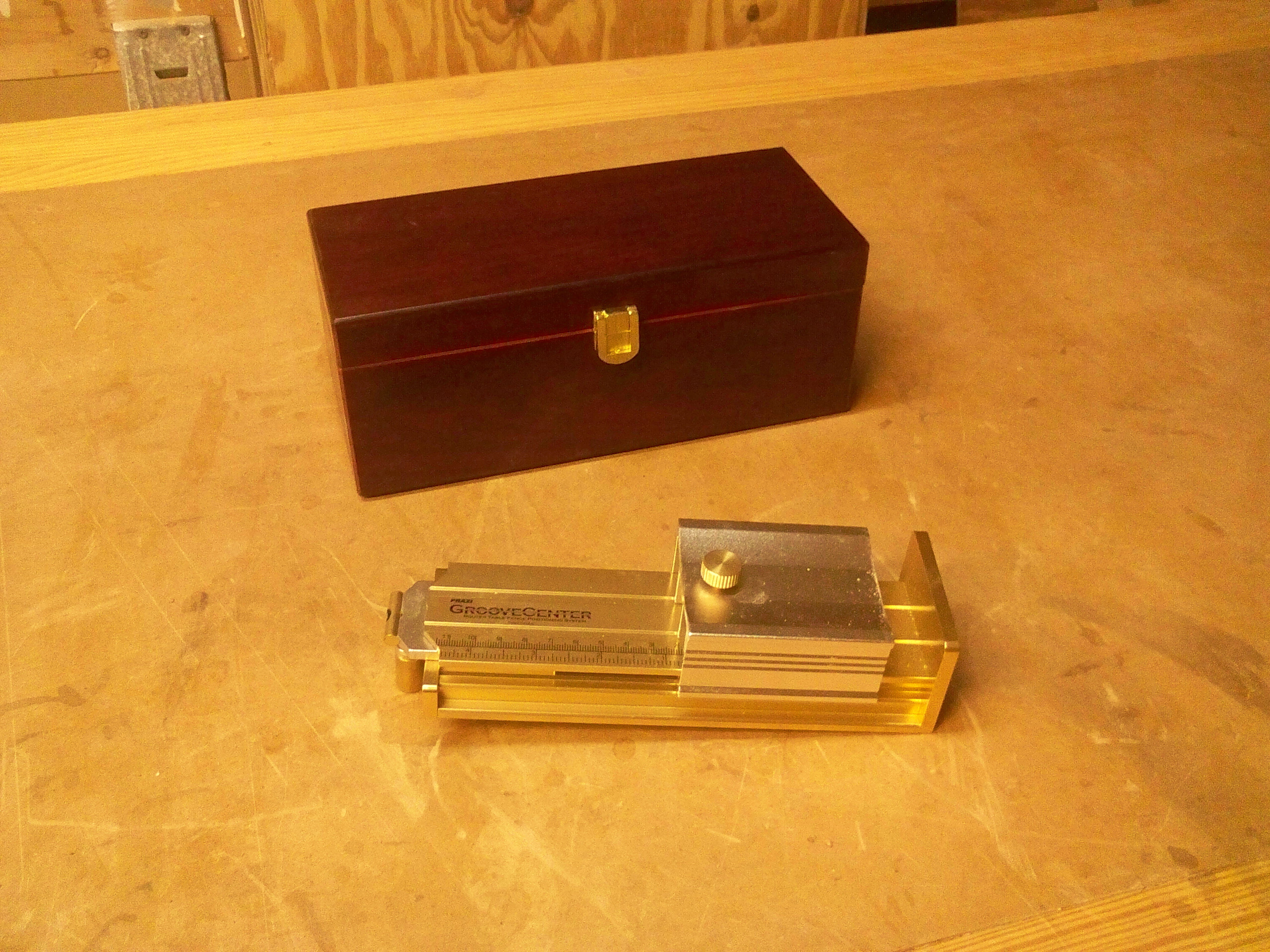
To be precise, they have created the Groove Center. This nifty device helps you find the middle of a board while routing grooves.  The first time.  Seriously.

What do you get?  Well, the tool comes packed in a beautiful box befitting a precisely-functioning tool. The tool its self is a gold anodized aluminum beauty. It consists of a flat base that allows the tool to sit securely on your router table, and a sliding ‘truck’  that rides in the slots of the base.  As you move the ‘truck’ along the base, you will notice the third piece which extends from the front of the piece.  You will notice that this piece moves exactly one half the distance you move the ‘truck’. This measuring tool is what allows you to set your router table’s fence perfectly the first time around.

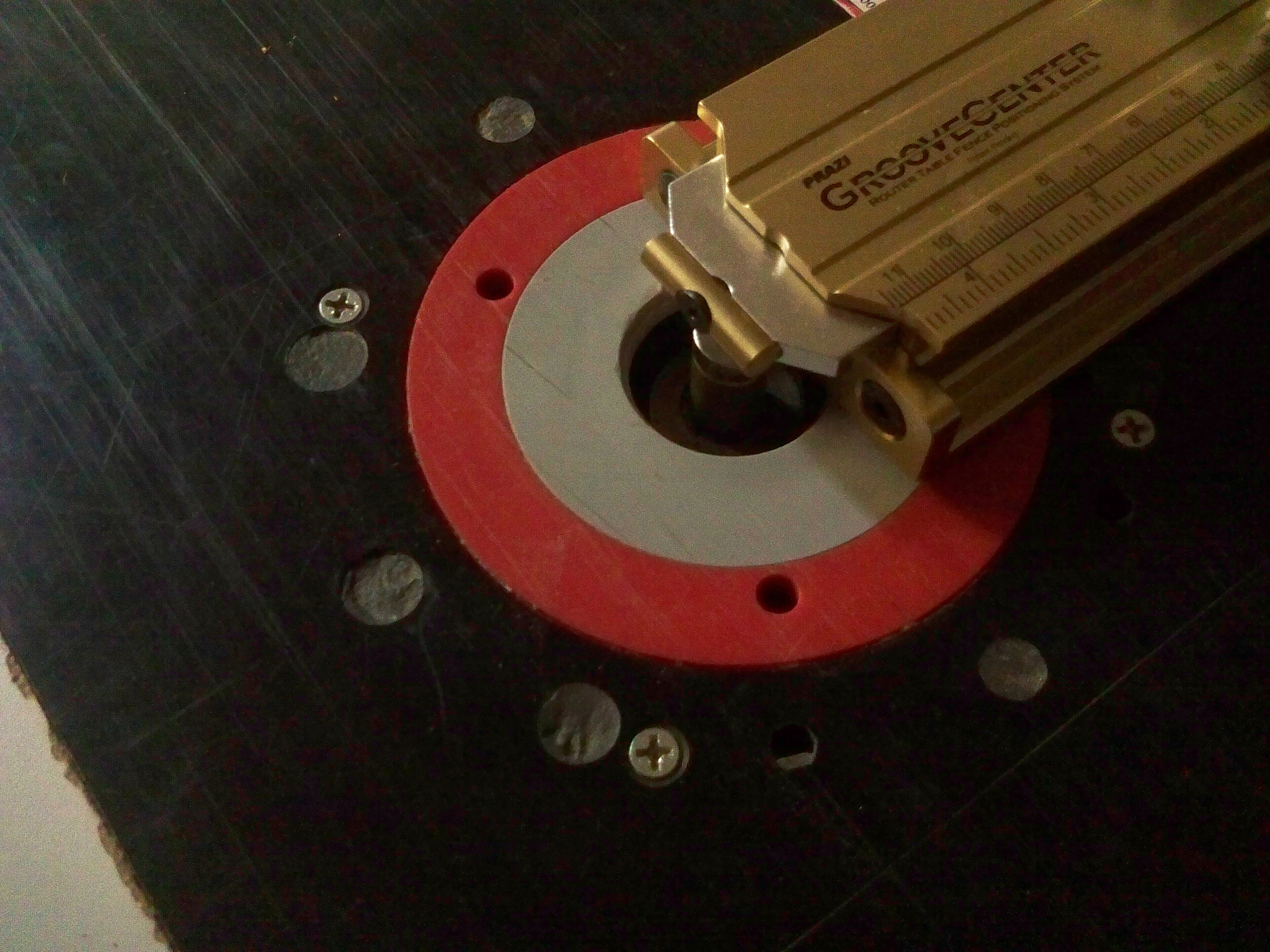
To set up the tool, first, you have to make sure the device is zeroed out, with the ‘truck’ far over to the stop at the back of the track. Push your router’s fence back away from the bit, jack your table-mounted router with the collet as far up as it will go.  There’s a 1/2″ diameter pin at the front of the jig that you slip into the collet (the 1/4″ pin is coming soon) and tighten so it grips the pin.  This is a very important step, since you are precisely measuring where to set your fence.

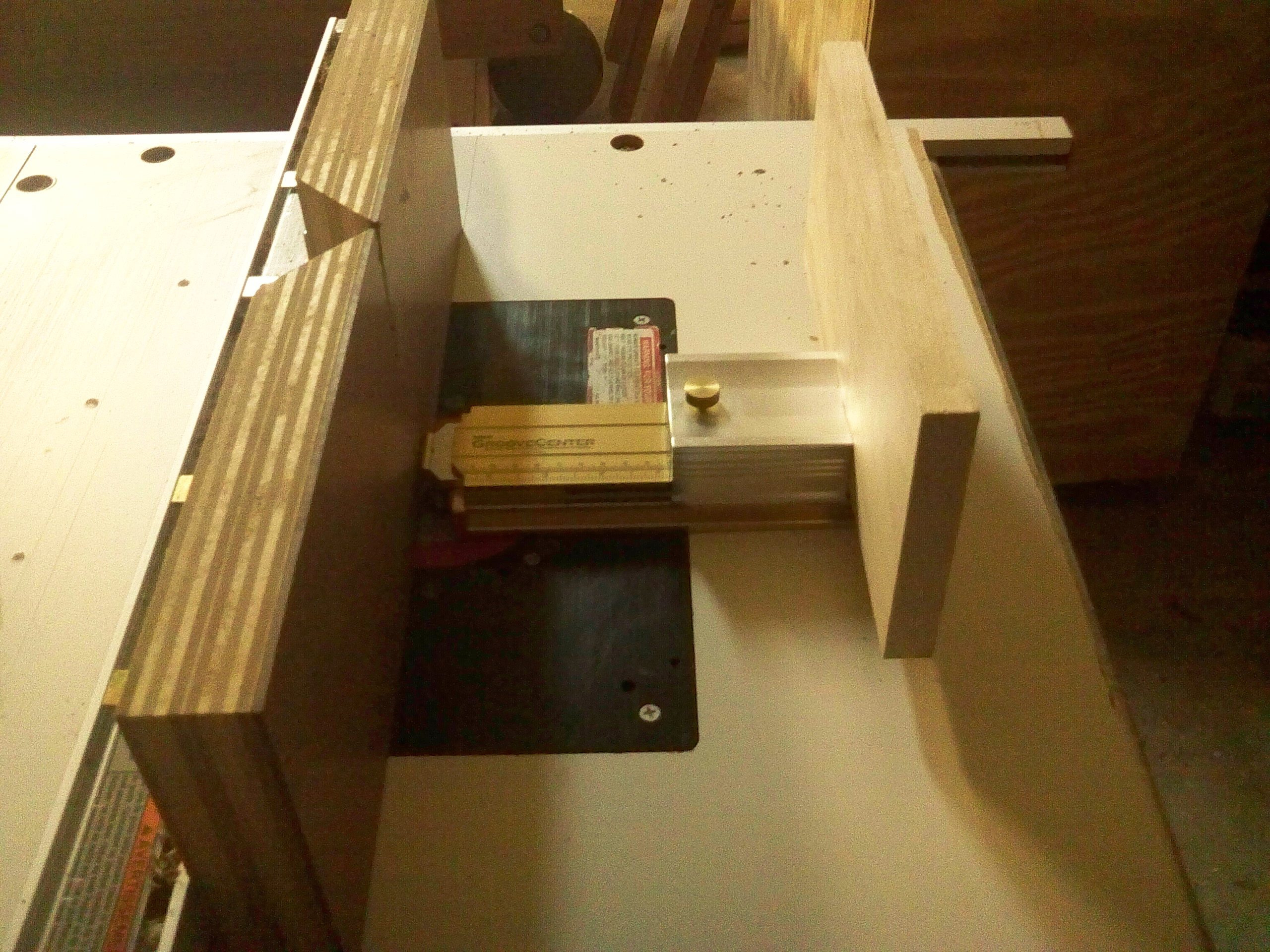
Next, push the ‘truck’ toward the front of the jig and slip a piece of the stock you will be routing into the opening and close the ‘truck’ to capture the piece.  Gently tighten the knob that locks everything into place, and voila, you will see that the nose of the jig has extended half the distance of the workpiece thickness.  Bring your router table fence over until it touches the nose and bingo, you are set up good to go.

Just don’t move the router fence.  It’s set perfectly.  If you have to move the fence in order to get to your router bit, you can clamp some wood to your table as a stop to allow you to get the fence back into the right position after you set the bit up.

Loosen the collet and remove the jig.  Insert your router bit and tighten it in place. If you had to move your fence, return it to its original position and you are good to go.  The groove is centered on the first run – no fuss, no muss.  And, it’s not just for grooves – cutting mortises on the router table is a snap once you know that everything is lined up perfectly.

Is this all the Groove Center does?  Absolutely not.  It has another trick up its sleeve – setting up the tricky-to-master lock miter bit.  But, that’s another post for another day.

Right now, I have a quick 15 minutes to spend meditating.  Gotta find my center, ya know.

FYI – here’s a video of the Groove Center in action…

Quick Poll

Using veneer in a project is a time-honored way to bring some interesting and unique looks to a project.

It also involves a little bit of know-how and some specialized tools to make it turn out right.

This week, let us know if you have ever used veneer in a project…

[poll id=”122″]

Link of the week

ProjectGuitar.com

Since I picked up the bass, I have been looking for plans on how to build my own guitar..

Ya know, just in case I want to do it myself.

ProjectGuitar.com is a great site offering links to resources necessary to build your own guitar, plans and a project gallery that will get the creative juices flowing.  A great link for the budding luthier.