All posts by Tom

I'm the guy who writes the blog...

Quick Poll

Let’s build on last week’s poll…

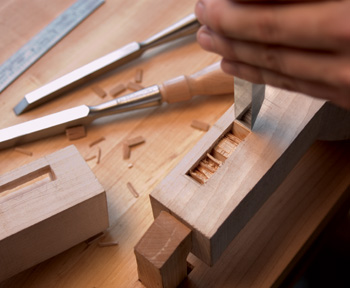
Salt and pepper. Laurel and Hardy. Macaroni and cheese. Some things are just natural partners. And, when it comes to woodworking, there are few partners as famous as the mortise and tenon.

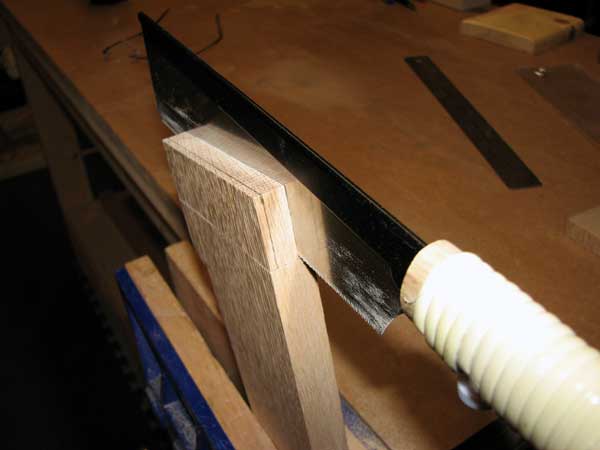
While cutting mortises presents its own challenges, cutting the tenon can be tricky as well. In this week’s poll – how do you cut your tenons?

Link of the week

Gorilla Glue

Hello again, everyone. It’s me, Iggy the Trained Shop Monkey.  I had to write today’s link of the week because Tom is ***STILL*** prancing around the shop bragging about how good of a job he did on that Monkey Stool. It’s a good thing, if I don’t let him celebrate his small victories, he’ll spend MORE time playing that bass of his (poorly).

That’s OK. Besides, if he was writing this, you wouldn’t get to hear about my new primate friends down at Gorilla Glue.


Yup, my bigger cousins make some seriously awesome glues. They have their signature polyurethane glue, their newer type II water resistant PVA offerings, epoxy, instant glues, duct tape… they have it all. They even sent me my own care package to help with my ongoing efforts to make Tom a better woodworker.

Now, all I have to do is keep the big galoot from getting his fingers stuck to the project!

The busted chair… y’all are good!

OK, so this morning, I’m wrestling with the reality that I have to bore some very accurate holes into some very thin turned spindles that are now missing their tenons. I thought about this while dropping my son off at school. I thought about it when I got my cup of coffee and turned on the computer. Heck, I thought about it during a brief meeting I had this morning.

That’s when inspiration hit me… in the form of a guy named Steve Sander who commented on my post over at my Google + account. His suggestion was so blindingly simple, I just had to come home and give it a whirl.

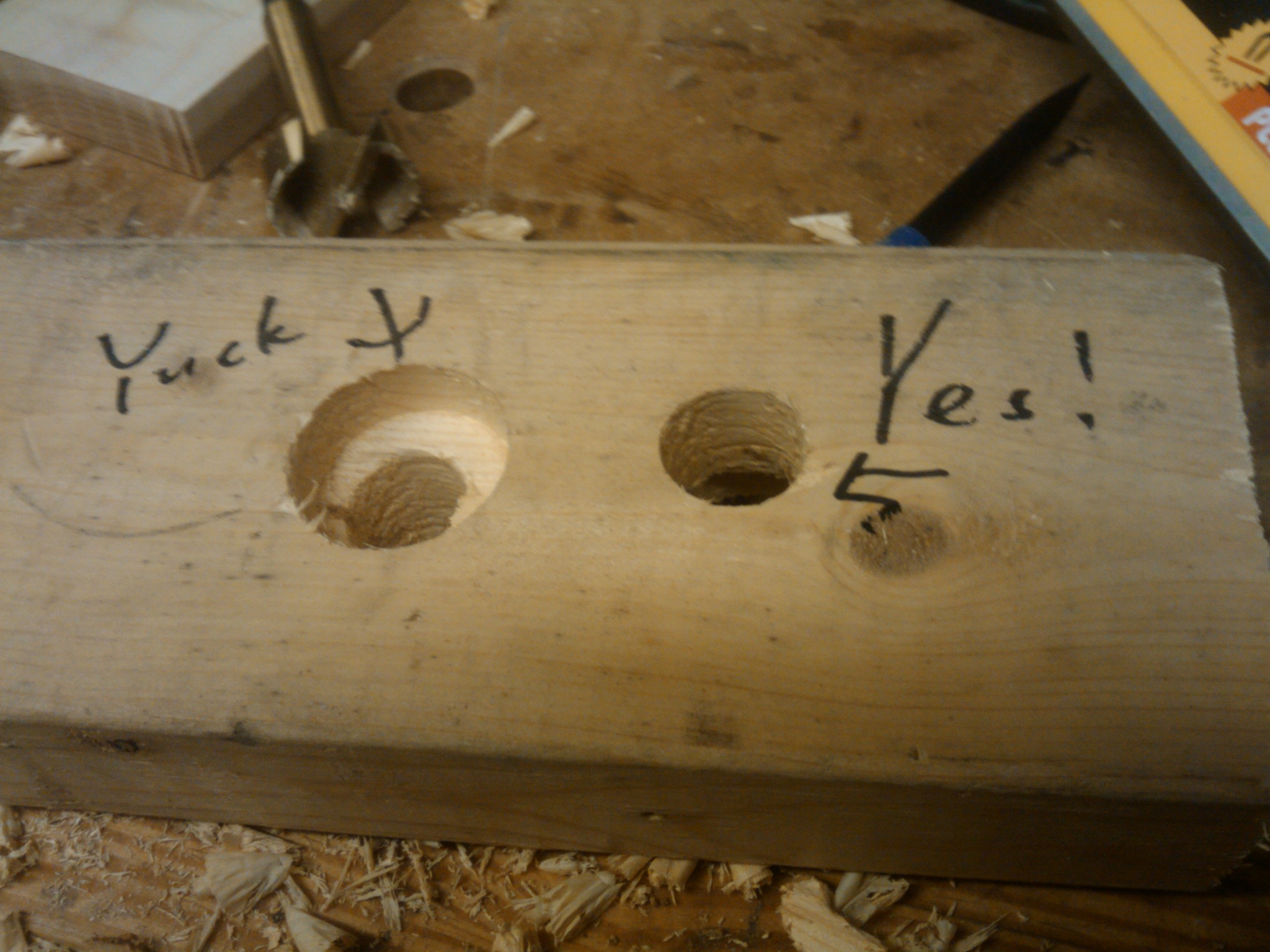
Steve is firmly in the KISS (Keep it simple, stupid) camp of woodworking. He recommended that I simply get a piece of 2 x lumber and bore a small hole all the way through from one side to the other. On the ‘bottom’ side, drill a hole the diameter of the spindle width. On the ‘top’ side, bore a 3/4″ hole through until it meets up with the one beneath. This means that the larger diameter will support the outer rim of the spindle, and the smaller hole will guide the bit.

As long as I do this carefully, using the small bore as a centering mark and keeping the bits perpendicular to the board’s faces, everything should come out fine. Of course, I blew it on the first attempt. But, that’s why I got me the longer board.

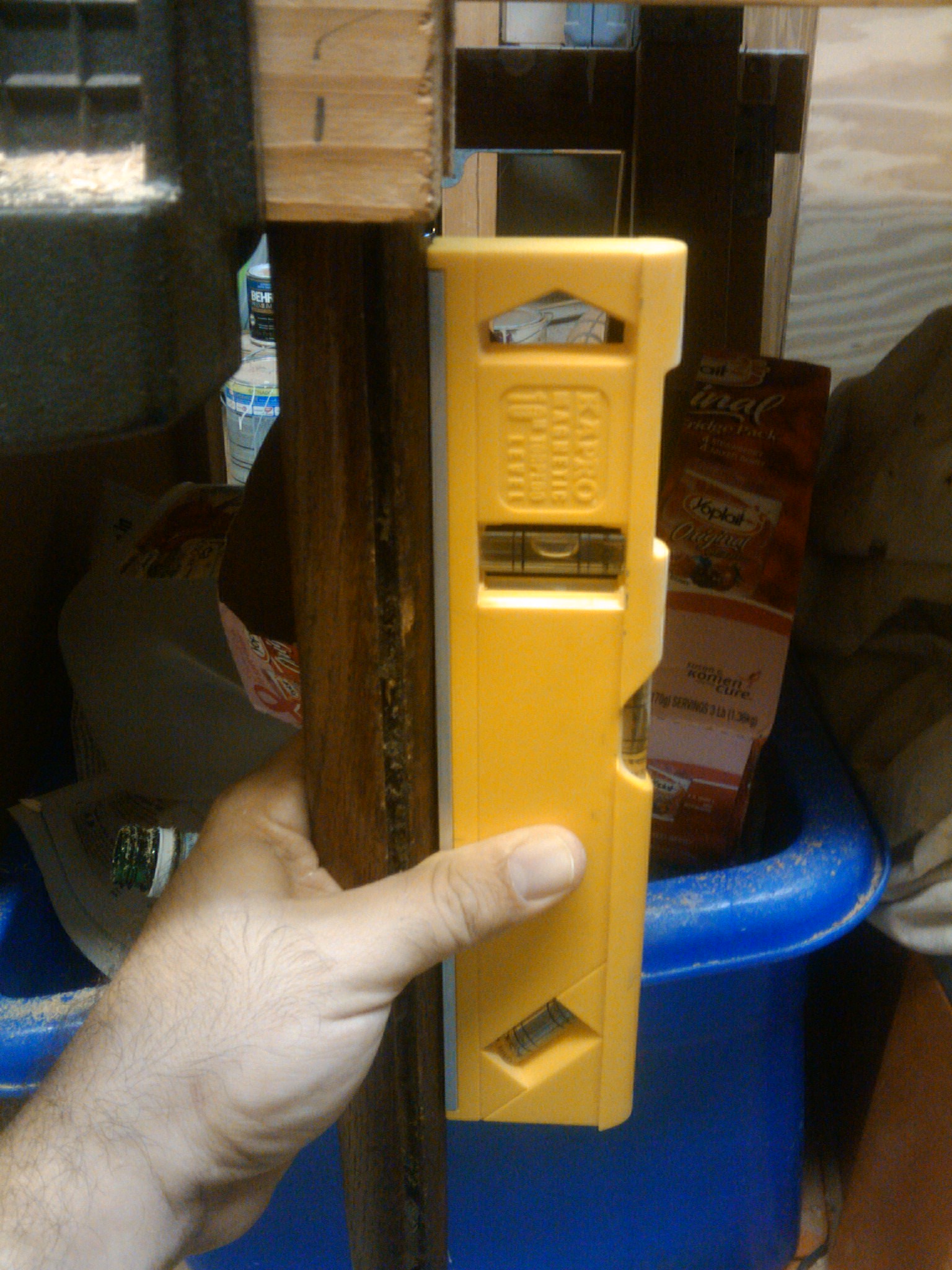
I put the spindle into my vise just high enough to ensure enough stuck up above to fit into the block. I also wanted to make sure the spindle was plumb, which greatly simplified my drilling. Just keep everything nice and plumb.. and we’re off to the races.

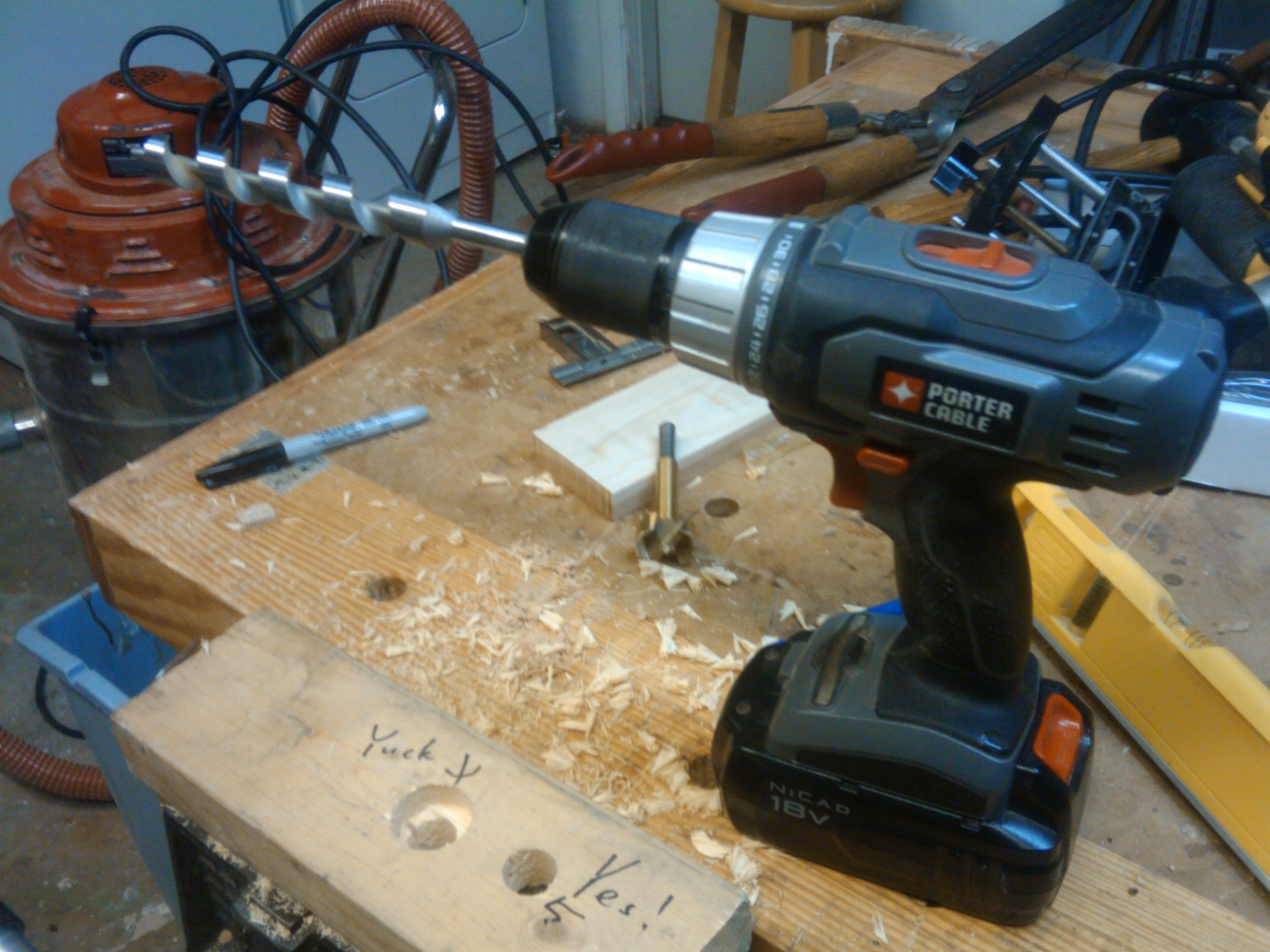
Next up, I chucked a 3/4″ auger bit into my cordless drill. I went cordless because I wanted to go on the slow setting used to drive screws… I just didn’t want to hit it with too much speed.

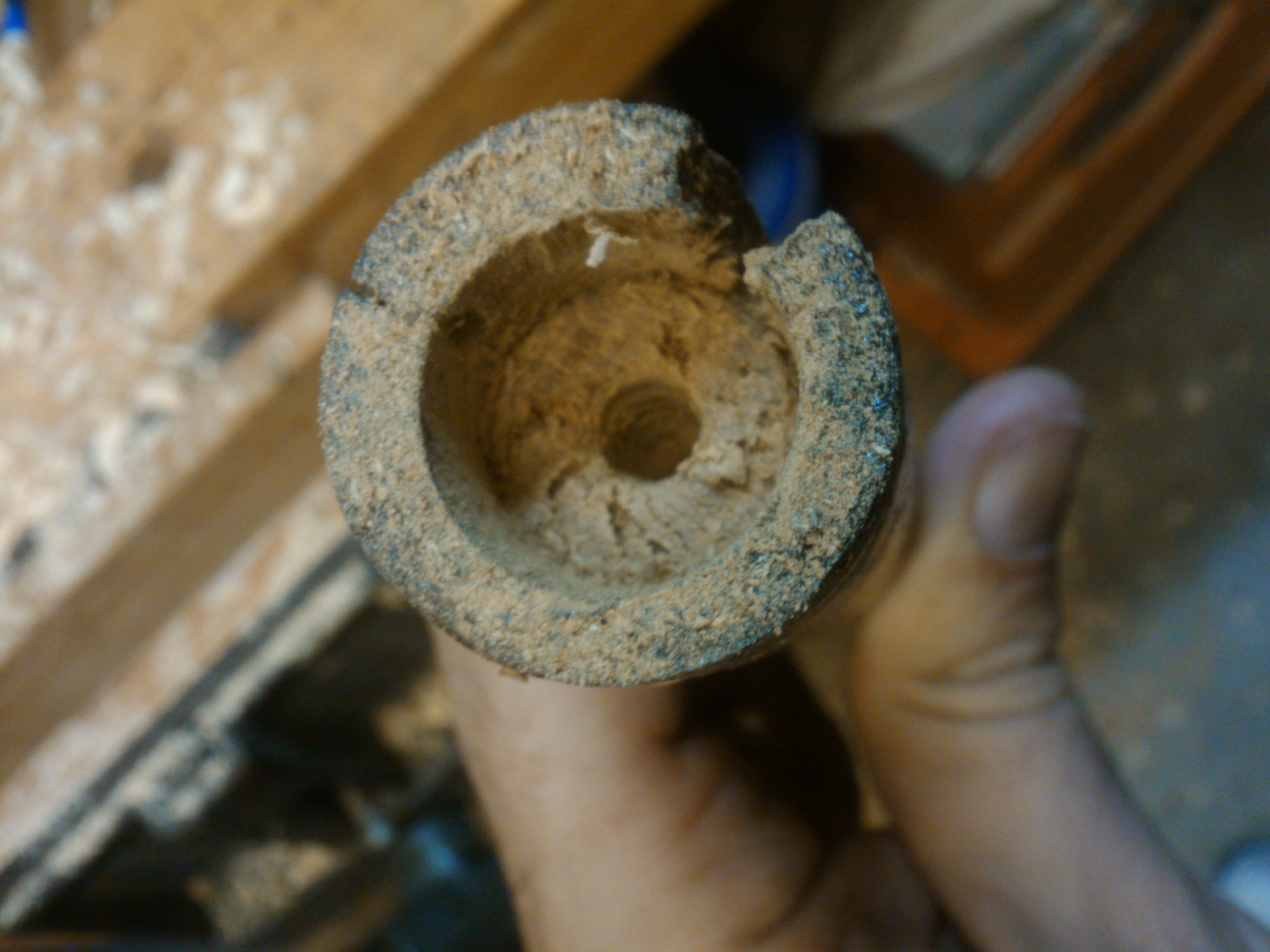
As Bob Ross used to say before he painted a huge tree, here was my bravery test. I put the auger bit into the guide hole, hit the trigger and let it roll. The bit at first brought up dust, but then it bit. And, boy, did it bite. It was bringing up nice slices of wood and spitting them out at the top of the hole. Since I hadn’t heard a crack or anything bad, I was hoping against all hope that things had gone well.

Heck, I don’t know if it was clean living (wait. We’re talking about me here. No way that’s in play) or what, but the dang thing actually WORKED!  I went to the band saw, cut some of my home improvement center dowels to size (they are long, I will trim them down to final size once the glue is dry) and glued them into place with hide glue.

Shoot… I’m already into a sweet bottle of red wine to reward myself… and – again – today’s success proves once again that Internet woodworking is very much alive and well…


The busted chair

I have this really good friend. She lives right down the street from us.  Our kids play together. Both families get together for picnics, dinners over and movie nights. Her husband is a Washington Redskins fan, but this New York Giants fan can still allow him into his house.

She also happens to be Swedish. Well, she used to be, but she became an American citizen a few years ago. Anyway, she still has family and friends over in the homeland, and she recently visited her brother to celebrate his 50th birthday. It was a total surprise.

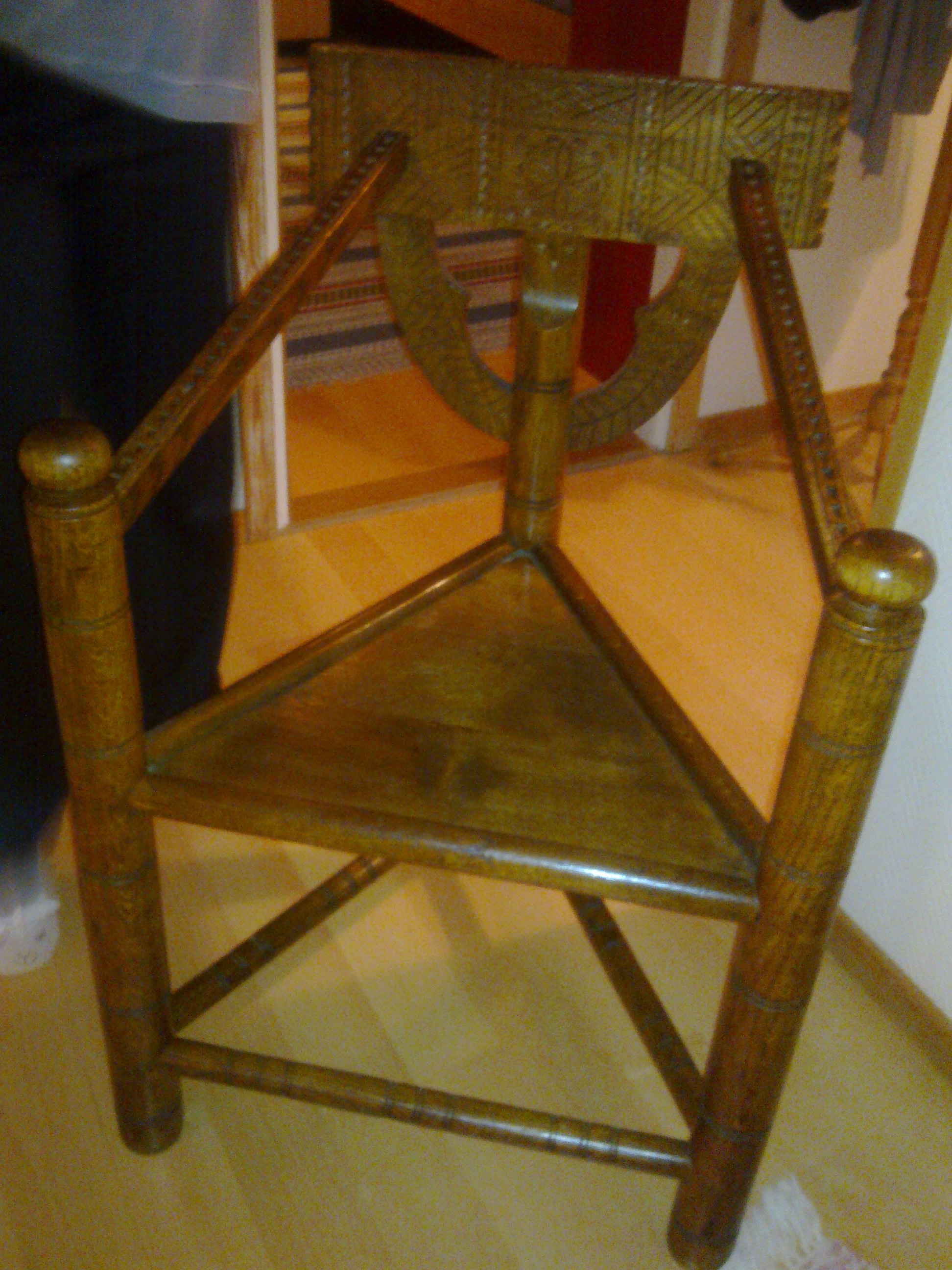
Before she made the return trip to Florida, her brother brought out a family heirloom. A piece of furniture she had always loved. It is a three-legged corner chair known as a Munkstol. What’s a Munkstol? Glad you asked. According to the Swedish Wikipedia and a bad translation from Google Translate:

A monk’s chair is a seating piece of furniture that was particularly popular during National Romanticism. Munk The chair is made of three straight, vertical poles, which constitutes both legs and holds up armrests. Between these there is a horizontal, triangle shaped seat with a tip pointing backwards. Munk chairs are often equipped with hand-woven, thin cushions of wool. They are quite uncomfortable to sit in.

And, as you can see, it’s a pretty sweet looking corner chair. My neighbor told me they were very popular after World War II. The three posts are turned beautifully, the crest rail is very ornately carved. The seat is an elegantly raised panel, with its edges held in a groove in each of the three turned seat stretchers. Quite the interesting looking project.

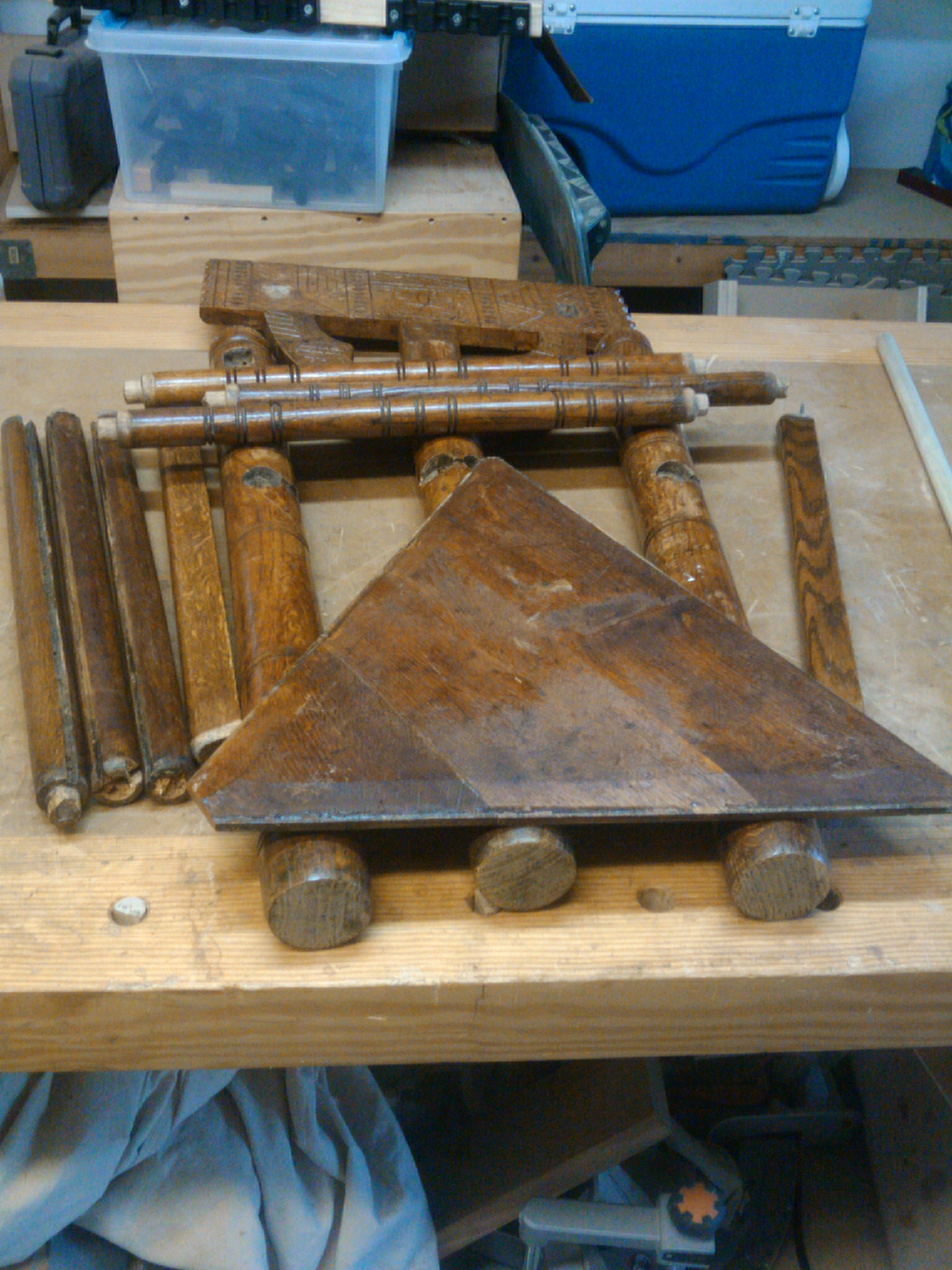
The only problem?  Well, her brother – in a totally kind effort to make it easier to carry back – basically beat the piece apart with a hammer.  So, these are the pieces…

Ehhh. This wouldn’t normally be an issue, but part of the plan when things were being busted apart was that my neighbor’s good woodworking friend – you know, the guy who likes to woodwork in the neighborhood – would be more than happy to put things back together…

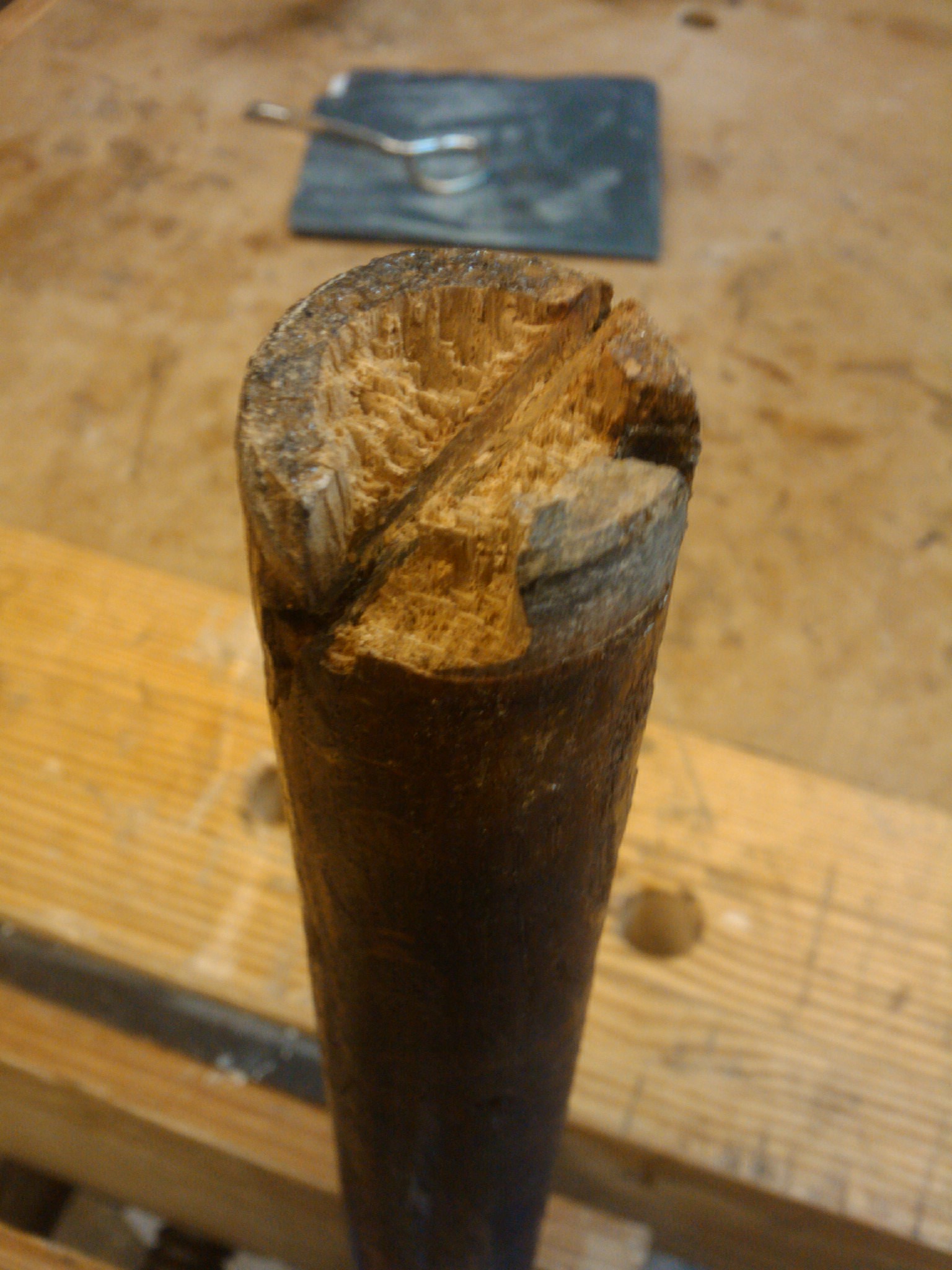
Gosh, it would have been easier had her brother – in his zeal to pack this baby up – not busted the piece up so roughly that he broke off the tenons on all of the turned seat spindles…

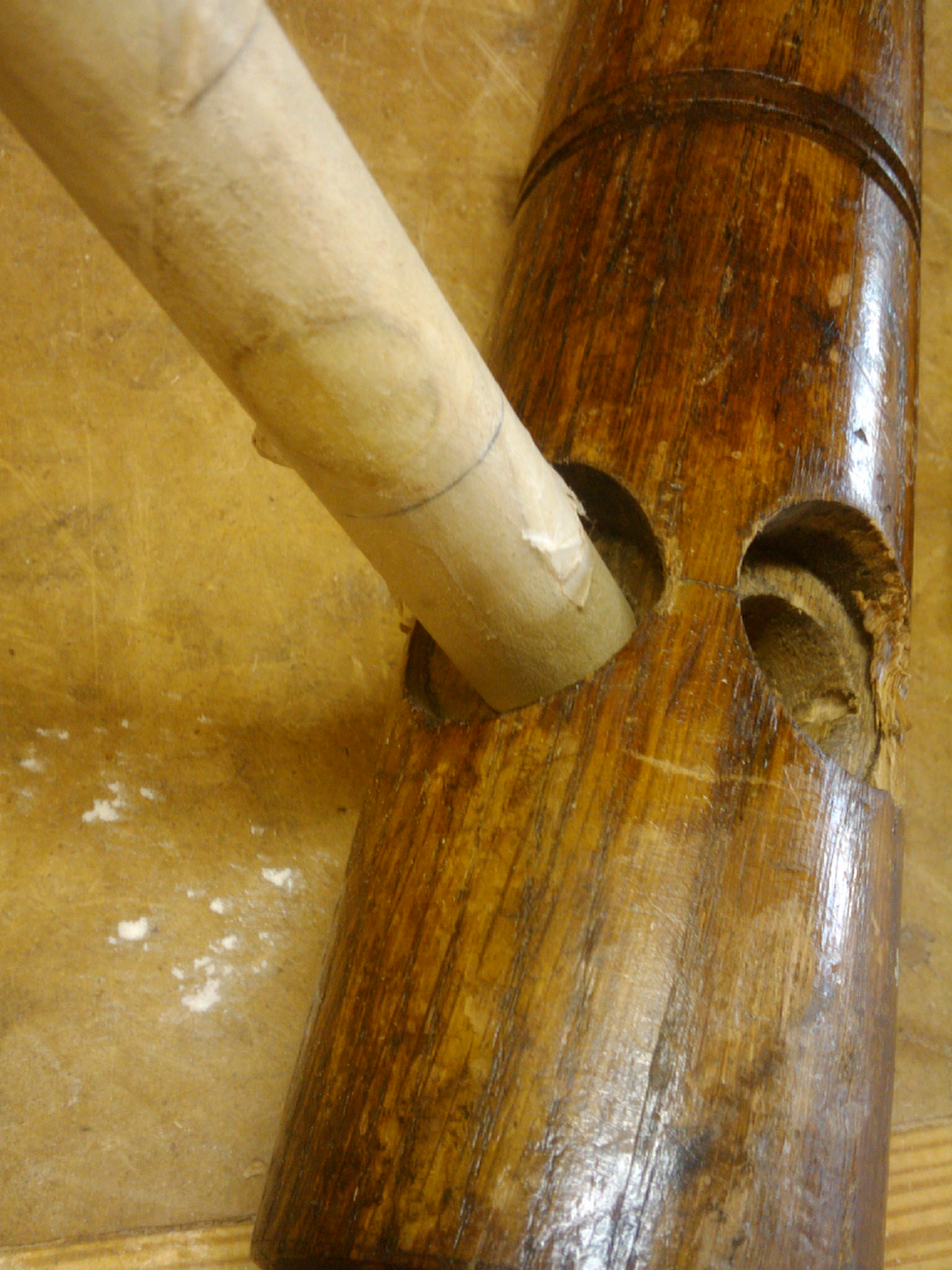
Fortunately, I was able to spend some time cleaning out the broken off tenons from the mortises (And pulling out the incredible number of cut nails that had been driven into the piece to keep the spindles from twisting), so they are ready to have new tenons prepared for them. And, I also discovered that a standard-issue 3/4″ hardwood dowel from the local home improvement center fits into the round mortises perfectly.

Now, I just need to figure out a way to bore a hole into the end grain of the  spindles, set the dowels into those spindles with some epoxy, and then epoxy them into the mortises without blowing out the sides of the spindles… This is going to be a real challenge.

The other one is to get the assembly put back together in the proper order. You can see from the finished piece that this is going to be one complicated build to get everything together….

Now, my neighbor’s husband is a professional sushi chef. So, I’m going to be plied with some prime Hawaiian tuna as a repayment for this job. So, with visions of some tasty Japanese treats dancing in my mind, I’m going to have to find the way to do this project soon… So I can enjoy  the sushi while admiring the completed, serviceable Monkstol.


Mudflapping

Last week, a computing pioneer passed away. Steve Jobs, co-founder of Apple Computer, succumbed to the pancreatic cancer he had battled so bravely for the past years. His vision helped to revolutionize computing, music, phones… a lot of what we take for granted today.

While he is being memorialized, many of his more famous quotes are being posted on the Internet. Some are inspirational. Some are snarky. Some are full-on competitive. And, then there’s this one, which seems aimed at the woodworking community.

When you’re a carpenter making a beautiful chest of drawers, you’re not going to use a piece of plywood on the back, even though it faces the wall and nobody will ever see it. You’ll know it’s there, so you’re going to use a beautiful piece of wood on the back. For you to sleep well at night, the aesthetic, the quality, has to be carried all the way through.

Of course, if Steve Jobs was going to build a piece of furniture, he would probably make an app for that.And, I get the point he was trying to make – that if you are going to invest the time and effort into building something beautiful, don’t use ‘inferior’ products and methods to finishing things off.  But, this quote did make me stop and think about the work I do in my shop.

No one is going to deny that nothing quite captures the beauty, depth and richness of solid wood other than solid wood itself. And, when it comes to building certain types of woodworking projects, there is nothing quite like solid wood. Small boxes that can be picked up and handled?  You bet. Pieces that will be opened and examined closely… sure.

And, I have no issues with the plywood that Jobs pointed to as substandard. The cabinet grade plywoods I use for higher-end cabinet projects costs upwards of $100 a sheet. In effect, it is stacked, glued up veneer instead of a crud-filled piece of sheathing. So, I would feel fine going with plywood on a project.

But, the spirit of his quote  – do you put the same level of care into the hidden parts of your projects as you do into those that are seen? You know, I don’t always. And, that’s something that was once referred to as Mudflapping.

If you have ever driven behind a truck, you will notice that some drivers love to embellish their rigs with fancy looking accessories. High end paint jobs. Fancy chrome. And, if you look down at the wheels, you will often see fancy mudflaps. Sometimes sporting the chrome silhouette of a nude reclining woman. While they make the rig look snappy, these flaps serve a utilitarian purpose – preventing the dirt on the road from being flung backward toward the cars behind the truck. So, as you can imagine, the inside of these snazzy looking flaps is just ugly and covered in mud.

When I know the piece I’m building is going to be permanently attached to the wall, I won’t do a darned thing to finish the piece. There’s simply just no reason to. The home office setup I built last year for my friend Paul was built from a series of boxes, and when they were secured to the wall, no one was going to see them. Ever. I guess maybe when they get ripped out 40 or 50 years from now, but no time soon. The unfinished backs were the perfect place for me to write notes about where they were going to be placed, what was going to be stored in there and if I had to do anything special to accommodate wires or other electronics.

For projects that are going to be seen ‘in the round’ – from all directions and angles – of course I take the time to carefully finish all sides. Everything gets sanded down to 180 grit, planed or scraped, sealed and finished. You never know where or how the piece is going to be used, so it’s best to go on the side of caution.

However, there is a case in which I need to more carefully consider my finishing regimen.  For the recently completed stair-stepped bookshelves, I carefully finished the ‘front’ side of the piece. I sanded it carefully, applied the gel stain, buffed it down with some 400 grit paper, applied the wipe on varnish, re-buffed and wiped on a coat of wax. It looked really nice.

The only problem was that I didn’t put the same level of care into finishing the back. I wasn’t quite as careful in the sanding, applying the stain or the finish. My thought was that the piece was going to be pushed against the wall, it wasn’t going to matter much.

What I hadn’t counted on was that the client was having her walls painted. So, she had the two shelves out in her living area. And she had to look at their backs until the painting was done.  So, she asked for the can of stain, and was going to apply it herself.

D’oh! Never something you want to hear about your work once it has been delivered. In this case, mudflapping was NOT the way to do things… And it provided me with a valuable lesson.  After all, if you are going to be following me on this blog, I can’t be flinging mud your way!

 

Quick Poll

Mortise and tenon joints are time-tested, can withstand a lot of abuse and they are the basis for so many other types of joints (dowels, biscuits, etc.). For many woodworkers, figuring out how to accurately cut the mortise can be a challenge.

This week, let us know how you cut mortises. Are you a hand tool kind of woodworker, or do power tools find their way into the process?


Link of the week

Woodgear’s dovetail joints on the bandsaw

So,  you love dovetail joints. And you can cut them pretty well by hand (I know you must not be talking about me). But, maybe you have a lot of them to cut. And, you don’t want to invest in a dovetail jig.

What can you do to speed the process along?

Why not turn to your bandsaw?

Yes, that’s right. The bandsaw is an effective way to do cut the pins and tails on your dovetails. With just a simple jig and a little bit of know how, you can get pretty darned good results in a fraction of the time.   This site shows you step by step – and even provides a video – on how the process works, and how you can get started.