
There are hundreds of ways to make woodworking joints. That’s part of the reason I love woodworking so much. Regardless of your skill level, amount of tooling or where you work, you can cut a joint that can far outlive the wood the project is made out of.
That being said, many of the joints to choose from out there are simple variations of a similar joinery methods. Pocket screws are simply screws driven from different directions. The Festool Domino is a variation of the venerable mortise and tenon.
One interesting joint that invites a number of variations is the dovetail. From the basic hand cut through-dovetail, a great number of variations have sprung up over the years. Half-blind dovetails, machine cut dovetails in a wide and growing variety of flavors – and my most recent discovery, a jig system that creates what is called tapered dovetail splines.

While traditional splines are typically cut with a sled on a router table, that method involves building an extremely precise sled first, then carefully marking and ensuring that the splines line up accurately – especially going from corner to corner. A tolerance of 1/32” is unacceptable because a gap even that small shows up like a pencil line you apply the finish. And of course you have the tedious and difficult operation of cutting the splines themselves . . .
While doing my interview with John Lucas, I stumbled across the Kehoe Jig, an innovative system that enables you to cut these joints faster, tighter and stronger.
 The “system” actually consists of three jigs. The main jig itself, which is used in tandem with a router to cut the spline grooves into the workpiece with a perfect one degree taper, and the Spline-making jig, used on the table saw to cut splines using whatever species of wood you choose. This jig also the matching one degree taper incorporated into it so that the splines will fit tightly into the grooves. The third jig is called the Corner Inlayer. It is also used with your router, and allows you to cut a perfect “mini-dado” of whatever width and depth you choose, but at an angle exactly perpendicular to the corner itself, versus from one of the flat sides of the workpiece. This jig is normally optional, but right now they are running an online special that includes this jig at no additional charge.
 The Kehoe Jig was invented by Larry Kehoe out of one part necessity, and one part frustration. According to Kevin Jaynes, owners of the company, ” . . . . while in the middle of building an oak desk, he was dreading hauling out his dovetail jig to build the drawers because he had never found a dovetail jig that was not slow and cumbersome, and he hated test cuts. As he was walking across the basement shop floor with the traditional dovetail jig in his hands, he had one of those “Flash Of Genius” moments where he actually saw the jig in his minds eye; the jig that would eventually become the Kehoe Dovetail Spline Jig. Larry told me he had seen it ‘in remarkable detail, especially the taper.”
From that first flash of inspiration, Larry perfected it over the first couple of years by tweaking the design. He made dozens of improvements, and even different types of jigs. In effect, the splines slip in loosely to start with, but quickly tighten as they are tapped home, creating a joint that’s beautiful as well as strong.
 While the joint is similar in many ways to traditional dovetails -and creates a strong joint – the beauty of it is that the Kehoe Jig can be used in boxes made of materials such as plywood – since the cutting of the spline grooves doesn’t expose the material’s end grain.
Another strength of the jig – as well as this technique in general is that you can add splines in contrasting woods that can serve as a design feature. According to Kevin, “It is not unusual to have your woodworking friends look at the work piece, turning it over and over in their hands and then accuse you of painting them on.”
Kevin is actually the co-owner of the company with his wife Terry. Mr. Kehoe passed away in 2007, “I got a call from Elizabeth (Mrs. Kehoe) one cool April day and she gave me the sad news that Larry had passed away. I had expressed an interest in the company a couple of times over the preceding years, in case they ever decided to retire. It was not so much a source of income for them as it was a hobby. Many others had also expressed the same interest over the years, but to make a long story short, she and Larry had decided I would be the best bet to ‘Keep Larry’s baby alive.’ We could never had gotten it back off the ground without Mrs. Kehoe’s knowledge and unselfish help. We consider it a privilege to be the caretakers of this business. ”
 Today, the Kehoe Jig continues to be a useful and interesting jig with an even brighter future. Kevin and Terry have already made three prototypes of variations of the jig, and are about a month away from releasing the first one. “It’s along the same lines, but cut’s smaller splines in a pattern closer together. Perfect for the smaller jewelry boxes, small drawers, and small humidors like many of our customers make. The current jig does this as well, but this one will just make it all the faster and easier. We also have a 28” coming right on the heels of that for larger projects.”
This may well be the first time you have heard of the jig, but if Kevin and Terry have their way it won’t be the last. “Larry was a genius tinkerer and inventor, but he hated marketing and selling. He hardly ever advertised it. What he enjoyed most was going to 2 or 3 wood shows a year and just taking orders. He liked meeting people and talking about his jig. We are trying to bring Larry’s ingenious invention to the world, and with the help of happy customers and woodworking sites, we are starting to make a dent.”
 Besides looking like an interesting jig to cut dovetails with, the story of Kevin and Terry has captured my attention. “We’re one of those rare American mom-n-pop shop manufacturers that are still making a go at it. We are making some dramatic improvements in the jig kit, and are also committed to keeping the manufacturing 100% within our borders. We are woodworkers ourselves and have dealt with many online suppliers over the years. It has been our experience overall, that most woodworking supply and tool companies have excellent customer satisfaction. Customer satisfaction is our first priority as well, because we believe that’s the foundation of any business.”
I think I’m going to have to give this jig a shot and tell you my impressions…
 Woodworking can be tough on your clothes. I can’t tell you how many times I have reached across a glue up to only to discover later the telltale streak of glue over a favorite tee shirt. Ruined forever! Or, after routing a series of dovetails, find that I have sawdust in ‘uncomfortable places’ in my clothing.
 If you are a woodworker and find yourself with your head spinning, this might be a good place to check out. Woodturning Online is a great place to start if you want to get into wood turning – or discover new tips and tricks.
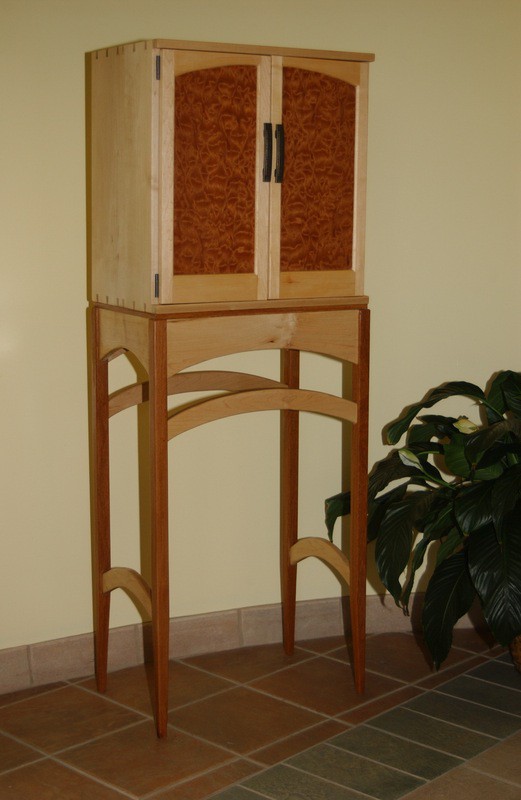 For those who follow along at the Wood Whisperer Blog, Marc Spagnuolo has featured one of my latest projects as his featured
 But, when you drag Ford, Chevy, Dodge, Nissan, Toyota and other manufacturers into the mix, people become defensive about their trucks. Boastful. Arrogant. “My Ford will tow your Chevy to the junk yard when it dies.” “My Dodge is a beast and will out perform both of your toy trucks.” This conversation can drag on for hours while people go back and forth essentially over what is a utility vehicle designed to carry a load of items.
 That’s where I’m getting stuck.
 No doubt Chris is imminently more qualified than I to write about all things woodworking. He’s worked with the best. He’s held some of the most expensive tools ever manufactured in his own hands. He’s perched in an enviable position from where he can monitor the latest developments in the craft. When he speaks, his voice carries with it a great deal of authority.
 He speaks about other designs – some of which he designed for Popular Woodworking – as if they are somehow beneath a serious woodworker. “Build it like that, and you’ll be terribly disappointed,” is a common refrain. Perfectly serviceable benches such as the
 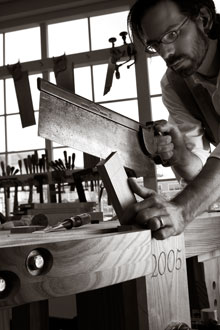 Chris describes his first exposure to the French-inspired Roubo workbench as a near religious experience – divine inspiration into the perfect form and function of what a bench could become. In some ways, I wish he would position himself as less of a Zealot when considering bench forms. Unfortunately, there will be many starting woodworkers who will walk away from this book thinking that any workbench – other than those recommended by Chris – would be a waste of time. Indeed, I can see many up-and-coming woodworkers stymied by the impression that they MUST build a Roubo before they dare touch a tool.
 Sure, you can’t plan for any eventuality. I could hit the lottery next week, quit my day job and woodwork full time. Of course, my kids could need glasses, braces and piano lessons too…
 Since its invention by Raymond DeWalt back in 1923, the radial arm saw has had quite an interesting history. Once held as the ultimate home woodworking machine, the saw could crosscut, rip, dado, cut joints and do other tasks with specialized attachments.
 As woodworkers, when it comes to cutting boards, if it’s not made out of wood, it’s not worth using.