Woodworkers Safety Day 2014

Oh boy! Oh boy! Oh boy! It’s Woodworkers Safety Day, and it’s like my birthday and a trip to the zoo all in one..
OK, I can’t whip up that much excitement when it comes to safety in the workshop. I mean, what is so exciting about safety? When you do woodworking well, you step out of your shop with a beautifully cut joint, a gently shaped curve or a finish that you will want to show off.

When you do safety well, you just walk out of the shop and do what you would normally do. Play with the kids. Make dinner. Watch TV. Go to the gym for a workout.

Hey, wait a second… those are fun things you can do, and, in many cases, you can’t do them if you are recovering from a nasty injury in the shop. I bet those stitches would burn if you went for a swim. I bet that eye injury might keep you from enjoying a movie with the ones you love.
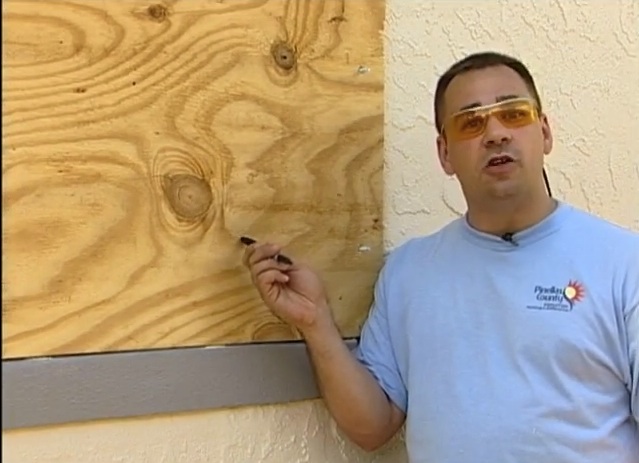
I shudder to think of those shutters

Just as with my day job – preparing people for disasters – safety is about keeping things as normal as possible for you. By shuttering your windows when a hurricane comes, your home is more likely to survive the storm, which means you are more likely to sleep in your own bed while waiting for repairs, instead of trying to complete the paperwork to get a FEMA trailer to spend the next six months in while your home is rebuilt.

In the same way, keeping safety top of mind – and making sure that you think safety through all steps in your woodworking process – means your routine is much less likely to be disrupted.
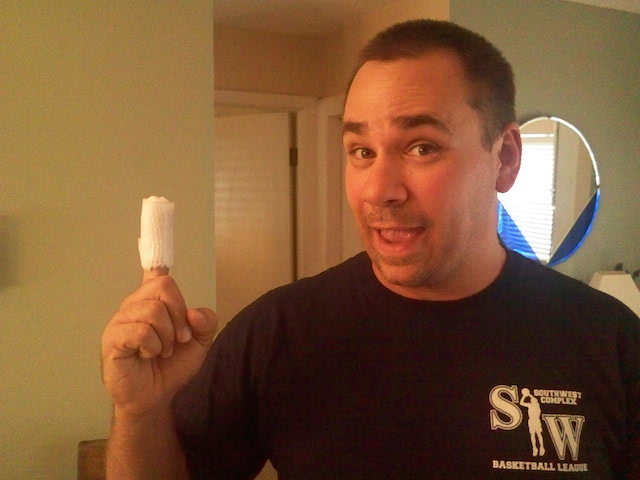
I'm number one!

Believe me, I have hurt myself in the shop, and that’s the kind of excitement I can do without. I can tell you from first hand experience that healing stinks. Staying healthy is where it’s at, because the very next day, you can be right out in the shop, spending your free time doing what you enjoy the most, whether it be woodworking or some other past time.

This year, we asked that some other bloggers submit their safety entries for the effort, and we got some great submissions. Here’s what came in…

Link of the week

Three essential tricks for recycling pallets

So, you want to try your hand at building a project from recycled pallet wood. That’s nice…

But, how do you go about ripping that pallet apart without breaking the boards, leaving buried nails in the pieces or losing your patience?

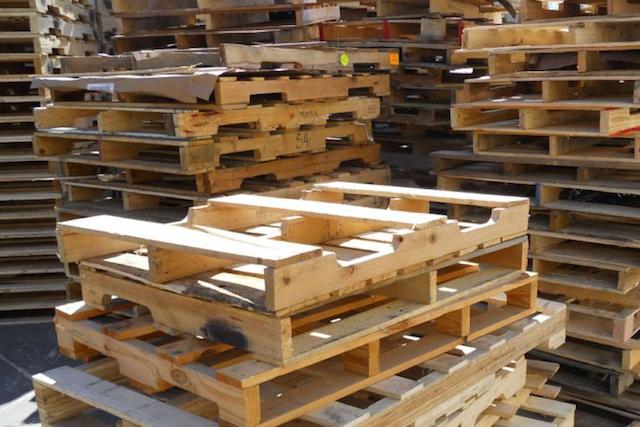
Pallets! Pallets! Pallets!

This page from a website called Cigar Box Guitar Parts (LOVE that name) gives the three most essential tricks on how to turn a shipping pallet into some prime lumber for projects in your shop.

Besides getting free (in many cases) lumber for your projects, upcycling pallets can help reduce the amount of stuff going into the refuse stream. Talk about going – and saving – some green!

‘Tis the season… to prepare

You’ll never guess where I am? Let me give you a few clues…

It’s mid May. My day job is as a public spokesperson for our county’s Emergency Management department. I live right on the Gulf of Mexico…

The 2014 Atlantic hurricane names

Yup.. hurricane season is coming up fast, and I am at the Governor’s Hurricane Conference helping to spread the word about preparedness and to take a few tips back home to help teach others.

That also means that the time has come again to talk about disaster preparedness and your shop. You would be surprised how vulnerable your shop can be to all kinds of disasters – hurricanes, fires, floods … the works.

Don’t think it can happen to you? That’s exactly what my friend Kyle Barton believed about his Galveston, Texas shop. That was until Hurricane Ike decided to pay a visit there, and do some tremendous damage to the shop. You can read Part One and Part Two here…

Kyle’s shop after Hurricane Ike

If a disaster did befall your shop, what would happen? After all, if you have a typical shop, you probably have a pretty significant investment of time and equipment out there. How can you replace that?

Here are a few quick tips:

  • Read your policy. Seriously. Get it out and take a look at it. What’s covered? You might be surprised with how much – or how little – coverage you have.
  • Do a shop inventory. Remember, you have to have a listing of what’s in your shop to provide an insurance adjuster after the incident is over. A list of your tools with model numbers is great.. and don’t forget to snap a few pictures. There are also tons of apps out there that can help you make this process a whole lot easier.
  • Identify the important stuff. Do you have a tool with great sentimental value? Maybe a plane that your grandfather used? How about a set of chisels you won in a contest? Small, meaningful items should be identified in advance so you won’t forget them, nor will you waste time hunting them down.
  • Can you ship some stuff out? If you have the ability to move some of your larger power tools to safer areas – such as a storage unit in a place that is less likely to flood – it might be a good idea to find out how much it would cost to move things there if you have advance warning – as with a hurricane. Some insurance companies may even pick up the cost of moving these items to a safer place – which costs them much less than replacing them.
  • It’s just stuff. Never – and I mean NEVER – fail to take appropriate life-saving action to protect your shop tools. Seriously. People have had entire shop losses and have been able to rebuild everything better after the fact … because they were safe when the incident happened.

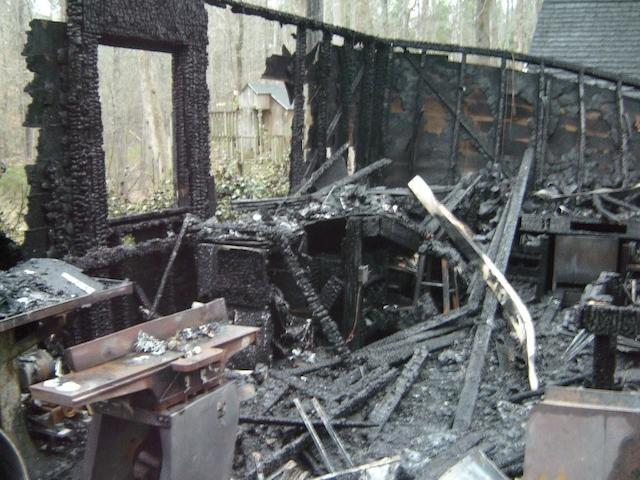
burned shop

Of course, should something happen in your shop, it will be a devastating blow. But, remember, you built your shop – in many cases – from nothing. Just take the steps to make the recovery a little easier. You may thank me one day.

Stars and Stripes … and a block?

It’s funny… the idea for the quick project I built this weekend came when I had my garage door opener installed. When the installer came in, he told me that the track that rail that opens the door shouldn’t be mounted directly to the concrete block in the wall, but instead to a wooden block that was mounted to the wall. He called it a shock block, and it supposedly prevented the concrete fasteners from rattling in the wall, expanding the size of the holes.

Well, I have this flagpole mount in front of the house that I mounted directly to the outside wall. And, over the years, the Florida breezes have moved the mount enough to loosen it. So, I wanted to put in a shock block… but I wanted it to look good.

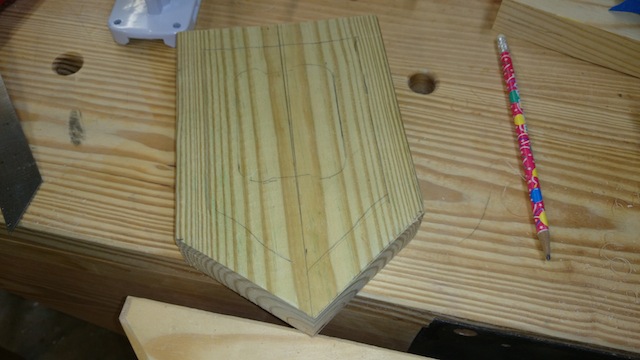
The shield shaped block

I had this piece of pressure treated southern yellow pine that was pretty clear. I had been holding on to it for the past year or so, and I thought it would make for a good block. I clipped an 8 inch piece from the board and trimmed the bottom to roughly match the shape of the bottom of a shield. I thought it would look pretty good. It was nice, but way too blocky. That’s when I moved to the bevel.

Cutting a bevel

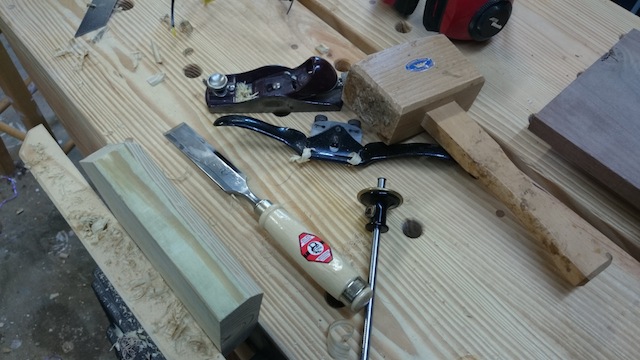
Using my mallet and a chisel, I was able to trim out a bevel across all five edges of the shield shape. Once I got it close to shape, I turned to a block plane, spoke shave and a sander to put in a nice, elegant bevel.

The bevel with the bracket centered

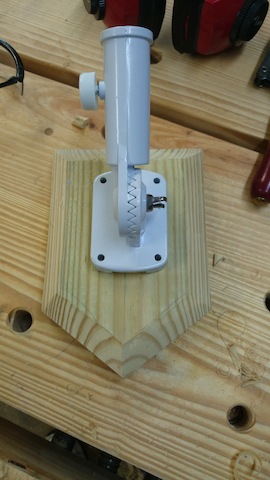
Once I had the block shaped, I placed the bracket that held the flagpole onto the block to get an idea of how large it would be. I traced the outside of the bracket, and carefully marked where I was going to drill some countersunk holes for the Tapcon fasteners that would hold it to the wall.

The boring part

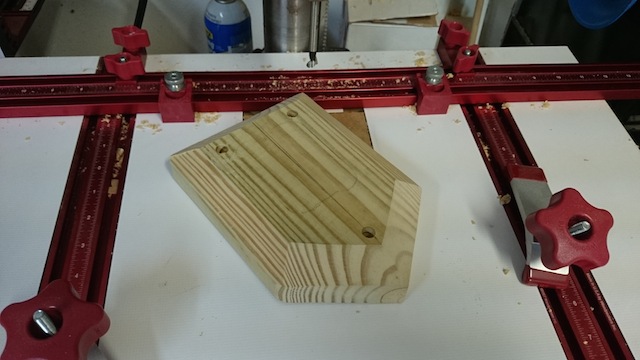
On the drill press table, I used a 5/16 inch forstner bit to bore some recesses that would be filled with plugs and through holes for the shanks. Once I got to this part, I put on a coat of primer and a coat of exterior paint that matched my home’s trim. I knew I had to protect it from the elements…

Mounted

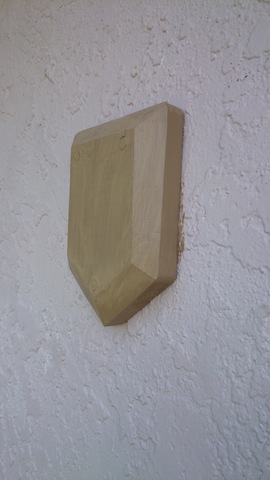
Now, I painted both the front and back of the piece to protect it, and I ran a bead of silicone caulk around the top and side edges to ensure that no water could get behind the piece. I did leave the bottom uncaulked, just in case water did get behind it.

Once I got the block mounted to the wall, I filled the countersinks with some short dowels I cut to size, and trimmed off the ends with a flush cutting saw. Another coat of paint on the front of the block helped to ensure that the block would look its best and be protected.

Hung with care

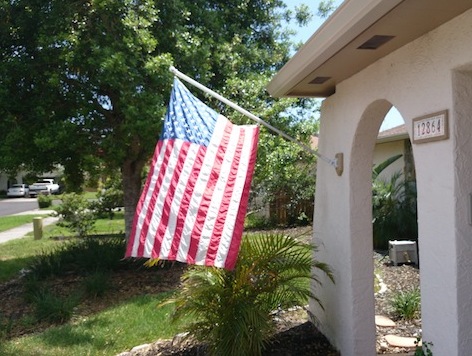
Once the block was in place, I carefully mounted the flag holding bracket with stainless steel screws to prevent rust, then put our American flag into the mount to see how Old Glory looked. Not too shabby.

With Memorial Day, Flag Day, Independence Day and Labor Day coming up, it feels good to have the flag properly mounted in front of the house. I hope my mounting system lasts for a few years.

The Weekly Plan

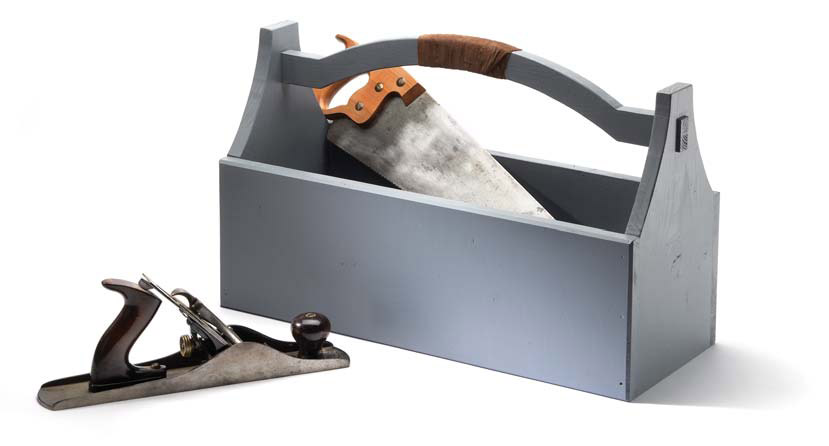
Popular Woodworking’s I Can Do That tool tote

The one thing about tools is that – well – you typically need more than one to do a particular task. And, it’s not easy to juggle a bunch of tools as you walk from place to place to do your work. There has to be an easier way.

The Tool Tote plan


Sure, there may be a million different easier ways. But, not all can be as stylish as this tool tote brought to you by our friends at Popular Woodworking. This free plan from their I Can Do That series was designed by Megan Fitzpatrick, and features some pretty snazzy looking joinery that can be mastered by even the newest woodworker.

Non-Link of the week

Woodworker’s Safety Day

It is a tradition started by Marc Spagnuolo over at the Wood Whisperer, and it is now being continued by the Modern Woodworkers Association. It’s Woodworkers Safety Day, and it’s a time for us to take some time out from our normal routines, and to think about staying safe in the shop.

MWA SAFETY DAY

How do we plan on celebrating this day on May 17? It’s easy…

If you are a blogger, take a little time out of your posting schedule and write a post about some aspect of woodworking safety. Maybe a jig you built that keeps your hands away from a spinning bit or blade. Maybe a piece of safety equipment that you can’t do without. Maybe even a story about a hard-learned lesson.

Be sure to send that link to me at tom@tomsworkbench.com, and we can post it for others to find.

Thanks for your help!

Measure once, cut twice

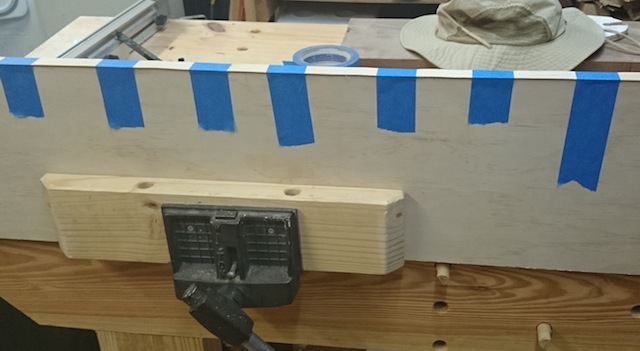
Oh, I love my friends at work. They are really a talented bunch of folks who make my time at the office a whole bunch of fun. But, there’s this one guy. The guy who asked me to build that new shelf for his kitchen pantry. Guess what I’m doing again? Rebuilding his shelf. Oy... You see, when he wrote down the dimensions of his shelf, he didn’t quite get it right. He wanted the shelf to be 33 5/8″ long, which is what I dutifully cut the shelf length down to after getting it all edged. I then went on to sand and finish the piece to make it all work out. Well, it turns out that my man Shan needed a shelf 36 5/8″ long, and when he went back to his house to put the shelf in place, it of course, didn’t fit. Taped up So, tonight, I am getting another lesson on how to cut an edge band for a plywood shelf. This time, I will get it roughly sanded  and give him the entire shelf at its current way-too-long measurement and ask him to remove one of the existing shelves from his pantry and take a direct measurement from its neighbor. After that, I can take it back and cut it to the final size before finishing it once and for all.

I guess I can’t laugh too much… if only he knew about all of the mess ups I made on my projects!

part of the Wood Talk Online community