So many things in life are subjective, aren’t they?
Do you think that was a good movie? Wasn’t that the best wine you ever tasted? Hot enough for ya?
As a hundred people the same question, and you will no doubt get 100 different answers. “That movie has plot holes so large, you could drive a truck through them.” “The wine reminded me of a subtle mix of mouthwash and pine tar.” “If you say another word about how hot it is, I’ll kick you in the shins.”
There are no right or wrong answers, just opinions.
 Then, why is it that when it comes to woodwork, there are so many ‘experts’ out there who claim to know exactly where the line between craft and art is drawn?
Sure, I can appreciate that the oak pantry I built for my kitchen is 100% utilitarian with just a little bit of decoration so it could pass as ‘furniture’. And, a famous painting, like the one of the dogs playing poker (I love that one) is art that you hang on the wall.
 The line does get blurry when considering other forms. Last year, I was taking a family trip to Washington D.C., and had a chance to walk through the National Art Museum’s Sculpture Garden. Some of these large-scale pieces were really eye-catching, showing a lot of originality and creativity.
Then, I came across this piece. It was ‘sculpted’ by Ellsworth Kelly in 1973, and it’s called Stele II. It is exactly what you would think it is… a one-inch thick piece of steel cut with rounded corners and allowed to weather naturally, thereby losing its shiny nature through the past three and a half decades.
No doubt, the artist did put a great deal of time, energy and thought into crafting this dramatic piece… about the same amount of time, effort and care you might find that a steel worker at a shipyard put into cutting an identical piece out of a larger plate. Yet, this qualifies as high art, and is ensconced in one of the nation’s premiere sculpture venues.
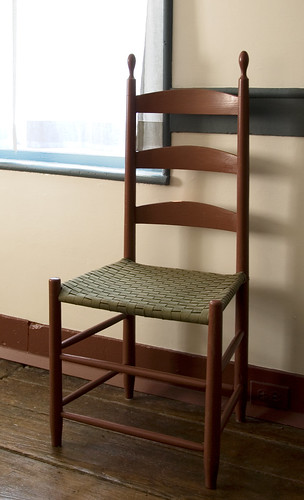 Now, take a look at a gorgeous piece of furniture, and there will be a different classification. Here’s a chair built by a Shaker brother sometime around 1850. Knowing about the Shakers and their practices, there’s a very good chance the wood was carefully selected for its strength and joint holding abilities. It was precisely split – not sawn – from the blank to provide even more ruggedness. Turnings were done by either a treadle or hand-cranked lathe. The joints were cut by an expert hand using keenly sharpened hand tools. Except for the turned finials at the top of the seat back, it is devoid of all ornamentation.
Yet, the chair is a work of sculpture in its own right. It looks like there is an impossibly small amount of wood to support a person’s weight, yet these antique chairs can support 250 pounds or more.
But, don’t expect to find piece like this in an art museum. No, you’ll find those pieces in a craft gallery. Not quite fully recognized as art, a piece like this is viewed in a completely different light.
Why would I bring up such an esoteric point? I’m glad you asked.
 At my job, this is the third year that the National Arts Program is holding an art contest for current and retired employees and their family members. As I have for the past two contests, I’m entering this year’s with a project that will spotlight my woodworking talents.
The past two years have been very successful for me. I took first place in the Intermediate Adult class for my Contemplation Bench and Pagoda Box. Both brought pretty hefty prize money, which I immediately put toward the purchase of new tools.
While I was enjoying my accolades last year, one of the artists who didn’t win came up to me and told me that I shouldn’t enter an art contest with a craft project. “It’s not fair to the true artists in the field.”
I chalked that comment up to being her opinion.
And, of course, it’s my opinion that I might have another winning project in the works.

 Lee Valley Tools has published an article I wrote about two easy ways to draw arcs on projects. Rather than rely on a bent piece of masonite or some other contraption, simple shop algebra or geometry (OK, stop laughing!) can ensure your arc will perfectly fit what you have in mind for your project.
 So, you want to try drawing your own woodworking plans, but you aren’t so good with the pencil and paper, and you can’t afford to buy an expensive CAD program.
 When it comes to woodworking, there are lots of plans out there. Plans to build new shops. Plans to squeeze the maximum amount of space out of your existing shop. Heck, there are even plans to clean your shop. But, those are usually put at the bottom of the to-do list.
 The next type of plan are shop-drawn ones made to reproduce an existing piece of furniture. Whether it’s from a drawing of a project you saw in a museum or a picture of an exquisite antique piece you wanted to bid on at an auction, these projects can be fun to plan and build. I find myself looking at pictures of projects from the modern masters –
  Draw the piece out to scale. Once you start cutting and shaping boards into component parts, you will want to know exactly how large that piece needs to be.
 The Freedom Pens Project was established by the members of the Sawmill Creek Woodworking Forum. They have established this non-profit 501 (c)(3) organization to make wooden pens for the American service men and women stationed overseas in combat areas.