Link of the week

Build a Classic Chessboard

Classic Chess BoardOne of the things my oldest son loves more than football, fighter planes and annoying the heck out of his younger brother is playing chess. He can’t get enough of it.

I once bought him an inexpensive set, but he didn’t want any part of that. Instead, we are using the set I got when I was a teenager while on a trip to Old Sturbridge Village in Massachusetts.

While that’s working out great, my son is eager to get his own set.  You know, so he can drag out his own set and beat me without mercy.

Rather than go out and buy a new board, I think we’re going to be building one of these first published in Popular Woodworking Magazine.  I once built a board using these techniques for a charity auction and it came out great.

The best part about this plan is that building the 64 square board is a piece of cake.  Instead of cutting the individual pieces and trying to glue them together, the technique employed by the plan’s designer increases the odds that the squares will come out evenly.  As an added bonus, the board also stores the pieces below, allowing you to keep the entire set together so you’ll be ready to play whenever you want to.

It’s a very simple plan that yields elegant results.  Now, I have to learn how to accept the fact that I will be humiliated by a ten year old…

Great Jigs: The Sawboard

Wanna turn your basic circular saw into a precision cutting machine?

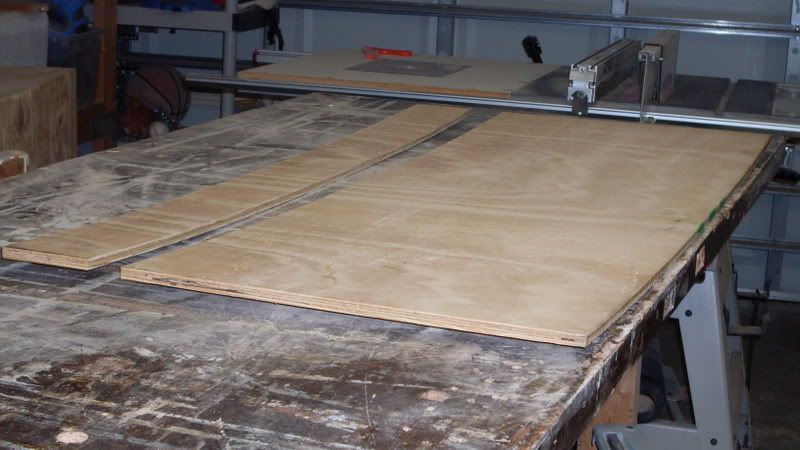
The sawboard piecesBelieve it or not, there is a way to get extreme precision with your circular saw for a small investment of some scrap sheet goods, screws and wood glue.  You can build one of these babies and use it to break down sheet goods with no hassle and minimal measurements.

So, how do you do it? (click on images for larger sized views)

Build yourself a Sawboard.  I found this plan on the Internet and decided I just had to build one for myself.  I have an 8 foot model, and wanted a shorter one for use on smaller pieces.  So, that’s what I built recently in my shop.

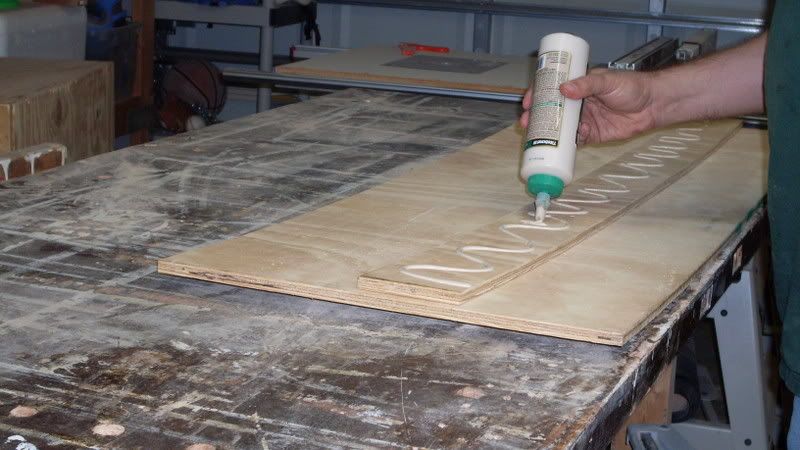
Gluing the piecesFirst of all, I took this scrap of B-C plywood lying around the shop.  It’s 4 feet long, and about 22 inches wide.  I ripped a 4 inch wide piece on my table saw and sanded the edges of what would become the top edge to prevent any splinters.

Next, if there is any bow in the pieces, put them so the bows cancel each other out and the sheets will lay flat once screwed together.  I put on a good bead of wood glue and used 3/4″ screws to hold the pieces together.  Now, you have to remember to keep this piece roughly centered on the bottom piece, and allow at least the distance from the edge of your circular saw base to the blade on both sides.  The precision comes from the next step.

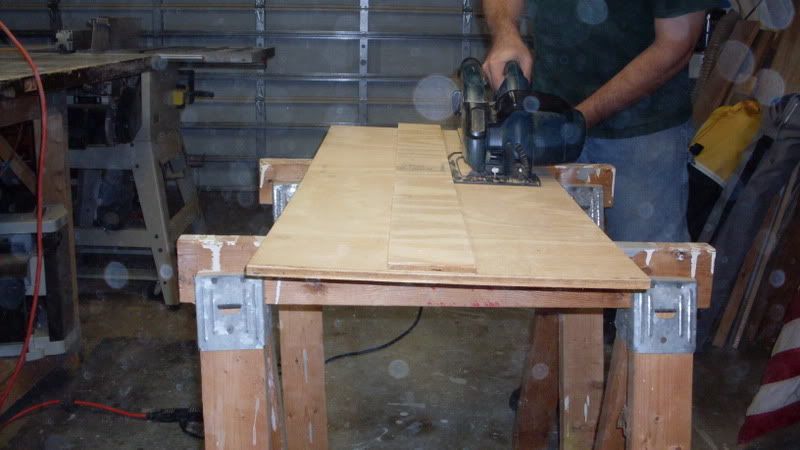
Cutting to sizeOnce you have the pieces screwed together, what you want to do is set the edge of your saw’s base against the fence and make a cut.  You will automatically have a guide that will be the exact distance between your saw’s base edge and the blade.  It’s genius!

To use the Sawboard, mark where you want the cut to begin and end on a peice of sheet stock.  It doesn’t matter if you want a straight cut or an angled one, because the saw will give you a perfect cut.  Clamp it down with the edge of the guide over the two marks and cut away.

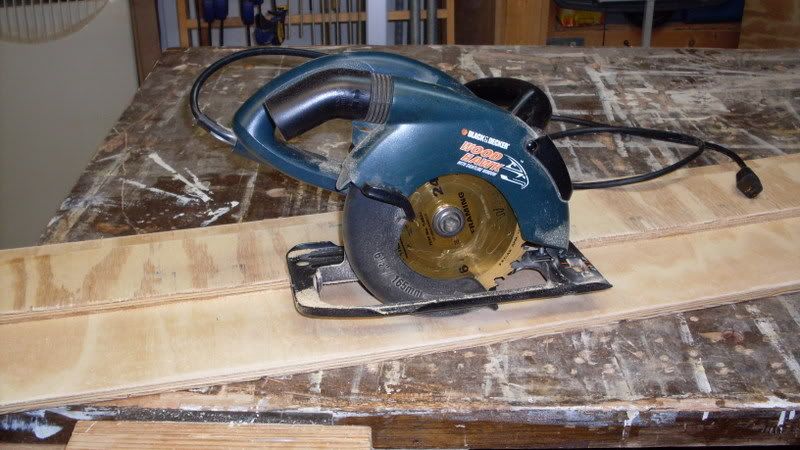
The Finished SawboardIf you clamp the Sawboard to the ‘keeper’ side of the cut, the jig actually presses down on the wood fibers, keeping them from lifting.  A pretty nifty idea.

To get the best out of the jig, just lay the piece you want to cut over a pair of wooden saw horses, and set the depth of the blade a little deeper than the thickness of the keeper and the jig so you barely score the top of the saw horses.

Simple and elegant.  I love it!

Step into my office…

So, you’re close to graduating high school, and you still haven’t decided what to do with your life?  I mean, I’m sure you are watching those Europeans fighting that war, and the Japanese Empire making trouble over in the Orient.  And, I know the economy has been terrible as of late.  But President Roosevelt says that the future looks bright for us.

I hear you are pretty good with your hands, and you have a good grasp of mathematics.  Since you are having trouble deciding what vocation you want to follow, I’ll thread this film into the projector and we can talk about what kind of job you want after you watch it.

Quick Poll

Plastic CasesThis one came from Duan Packard in Kerrville, Texas – and it’s a good one.  Thanks, Duan!

When you buy a tool, you know how it comes in one of those fancy blow-molded plastic cases, right?  It gives the tool manufacturer someplace to slap their logo, the product’s specs and the standard warnings about tool safety.

Inside, you’ll find each of the accessories for the tools placed into its own little custom-formed recess, almost like a modern version of a Studley Tool Chest.

After you unpack the tool and – ahem – read the directions, what do you do with the fancy blow-molded plastic case?

[poll id=”47″]

Link of the Week

Choosing and Using Hand Planes by This Old House Magazine

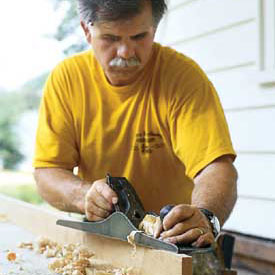
Tom Silva at the planeLeave it to the guys at the longest-running home improvement show to tackle the task of teaching their readers how to choose and use hand planes.

The show’s general contractor, Tom Silva,  shows the article’s readers the difference between the different kinds of planes (jointers, jacks, smoothers, blocks and specialty planes), how to sharpen the irons and how to tune the plane up to get the best results.

The accompanying pictures show Silva clearly demonstrating the proper planing techniques, including the right way hold the plane and how the curls should look as they come off the board.

Sure, this isn’t an in depth dissertation on the finer points of plane craft, but it’s an excellent way to get your feet wet in the wonderful world of hand planes.

Buying Lumber: The On-Line Experience

What hasn’t been revolutionized since the creation of the Internet?  Need a recipe?  Go out and search for it.  Wanna buy a new car?  Search for the best deal.  Is your love life in the toilet?  There are sites that can connect you with your future spouse.

Bell Forest Product's Logo

One area that has really benefited from the Internet is purchasing lumber. Now, no matter where you call home, finding exotic lumber or common hardwoods from anywhere across the country is just a mouse click away.

I recently had an opportunity to interview Eric Poirier of Bell Forest Products, who shared some interesting observations about how the Internet has affected the company’s business.   “We are located in the city of Ishpeming, Michigan with a population of only 6000-7000 people, so, as you can imagine, we are very grateful for the Internet.  The business was formed by Dennis Bell and his son Boone, who are both woodworkers.  Dennis was tired of not having a local hardwood supplier, so he decided to do something about it.  In 2002 he purchased a portable Woodmizer sawmill and built a dry kiln on his property.  He and Boone began purchasing Birdseye/Curly maple logs from local loggers and producing lumber.”

Bird's Eye Maple BlanksFrom those humble beginnings, Bell Forest Products has grown to a 37,000 square foot warehouse and full production sawmill.  While the majority of the wood they sell is locally grown bird’s eye and tiger maple boards, they have branched out to carry a tremendous variety of exotics.  At any one time, they have about 50-60,000 board feet in inventory.   They buy logs and saw them at the mill then closely supervise the kiln drying of the stock to ensure the highest quality possible.

And, it’s not just project boards that Bell deals in.  The site has offered turning stock for years, and recently started offering blanks for pool cue builders.

Bell Forest Product's MillWhile all of this sounds impressive, convincing woodworkers that they can trust the online wood buying experience was one of the most difficult issues that Bell Forest Products had to overcome.  “Oh, buying wood online can be a huge leap for some woodworkers.  A drawback to buying wood online is that they can’t fulfill that desire to pick up a piece of wood, to smell it, drool on it, taste it… you know.  Some folks just need that close connection with the wood before they decide to buy it.”

While Bell Forest Products – or any other online hardwood merchant – can’t let you taste the wood before you buy, there are certain things you do get instead.  First, Bell Forest Products has a neat feature where you can actually look – board by board – at the stock if you need a particular piece to make your next project shine.  “By finding the choice high-quality boards, we can make selecting the wood a much more pleasant process than digging through piles at some lumberyard.”

Another thing that Bell Forest Products prides itself on is how carefully the boards are packaged before shipping.  “We wrap each piece in cardboard to offer the best protection possible during shipping.  And, since hardwood is pretty hard stuff, and we have protected it very well, there’s a good chance that the board will damage OTHER items in the tractor trailer before it would even see a ding or a scratch.”

One other concern that shoppers might have is the cost of shipping. With the cost of diesel fuel, shipping has become a concern.  “First of all, we don’t charge a handling fee – we just add the shipping cost we are quoted to the order.  We recently added a shipping cost estimator to the site so shoppers can see what shipping will probably cost before even placing the order.  And, finally, we are always offering specials in our electronic newsletter that will certainly help defray the shipping costs.”

Having ordered two tiger maple boards from them recently, the quality of the woods Bell sells is very high.  Both pieces were wrapped securely and were better than advertised.  Those boards will make some interesting boxes when I get around to building with them.

While you might believe that running an online business might feel cold and distant, Eric was very excited when it came to describing his favorite part of working there.  “I really enjoy finding that perfect piece of wood for a customer.  When someone calls or emails and tells me they have this special project – I can ask them a few questions and usually find the perfect board.”  While helping the customer is fun, Eric added, “it is even more gratifying to get a photograph of the final project!”

Tools I Use – My Clamps

There are certain statements that are beyond refute.The sun rises in the east.  The only two things that are unavoidable are death and taxes.  Bread always lands butter-side down.

And, as most woodworkers will agree, you can never have too many clamps.

Here’s the arsenal that I work with on my shop-built rolling clamp rack. I have what I consider (especially given that I’ve seen other woodworker’s collections!) a pretty modest, yet fully functional setup.
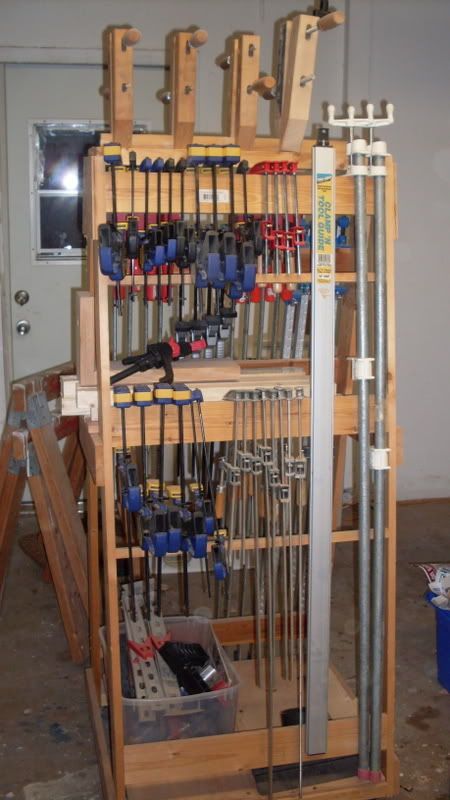
The short Side of the rack

This side I call the ‘short’ side of the rack – all of my frequently used short clamps are parked on this side.  From the top down, here’s what I have:

An assortment of handscrews.  Sure, they can be a pain in the rear to get aligned the right way, but these clamps will work when none other will do the job.  They can get a solid grip on angled pieces, and can also serve as a ‘kick stand’ for cabinet components when assembling them.

My 6″ Quick Grip clamps.  These babies are some of the most versitile ones in the shop.  Holding jigs, clamping small parts, breaking apart components (They switch to spreaders) and any one of dozens of other tasks.

Staying on that top rack, you’ll see some medium duty 4″ F-style clamps with the red heads.  Got them from Lee Valley and they are really nice little clamps when I need more pressure than the Quick Grips can offer.

Next, I have a clamp and edge guide.  I haven’t used this one much recently, but, when I need to cut or route a straight edge, that’s the one I look for.

Two 3/4″ pipe clamps.  I break these five footers out whenever I need a greater reach.  The pipes are threaded both ends, so I can use a coupler to get a 10 foot clamp if need be.  Also, these are great for squeezing an assembly square if it’s racked.

Down from there, I have my 12 inch Quick Grips, and a set of ultra-cheap discount F-style clamps.  None of the bars is straight, the heads slip and they don’t clamp all that well.  But, I can’t bring myself to throw them out, because they are the clamps I used when I started out.  Sentamental fool….
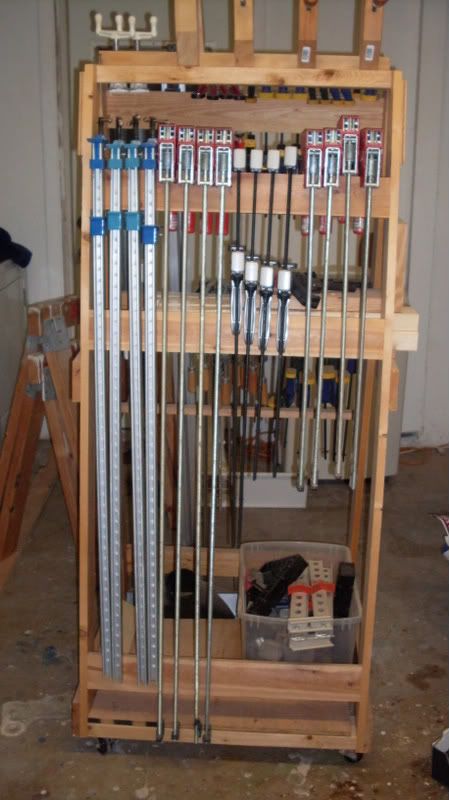
Clamp Rack - the long sideOn the flip side, this is where the bigger clamps call home.  This is where I go when I need the muscle to glue up big projects.

From left to right, I’ll start with my first serious clamps.  These 36″ aluminum channel clamps were the first ones I purhchased to glue up larger assemblies. I like these because they are lightweight, give me tremendous pressure and are easy to use.  If you had to buy longer clamps for the first time, these are the ones you should get.

From there, we go to the 50″ Bessey K-Bodies.  These clamps are BUTTER.  Large clamping faces, robust clamping bars… what can’t these babies do?  Really nice for large assemblies.  They have become my first go-to clamps.

The next clamps I’m not 100% sure I like yet.  These are the aluminum assembly clamps that Lee Valley recently sold.  I’ve only used them once and didn’t really like the way they worked.  I’m sure all I have to do is get more practice with them….

And, of course, four 25″ Besseys… nice for putting together smaller projects.

The bucket at the bottom contains an assortment of band clamps, Rockler right angle clamping jigs, spring clamps and other assorted odds and ends.  I use them, but not for every application.

Where the A-Frame meets, I decked the area in and store my eight 24″ clamping cauls I cut out of common 2×4’s.  They are great for holding panels flat while the glue dries…

And, yes during large glue ups, I find myself thinking, “Ya know, this job would go easier if I had more clamps…”

part of the Wood Talk Online community