The wood jumble

Before I start this article, I want to say that every woodworker I have ever met in real life or online could not be any more eager to help one of their own.  Who wouldn’t jump at the opportunity to help with a problem that needed to be addressed?

For example, take a look at this…
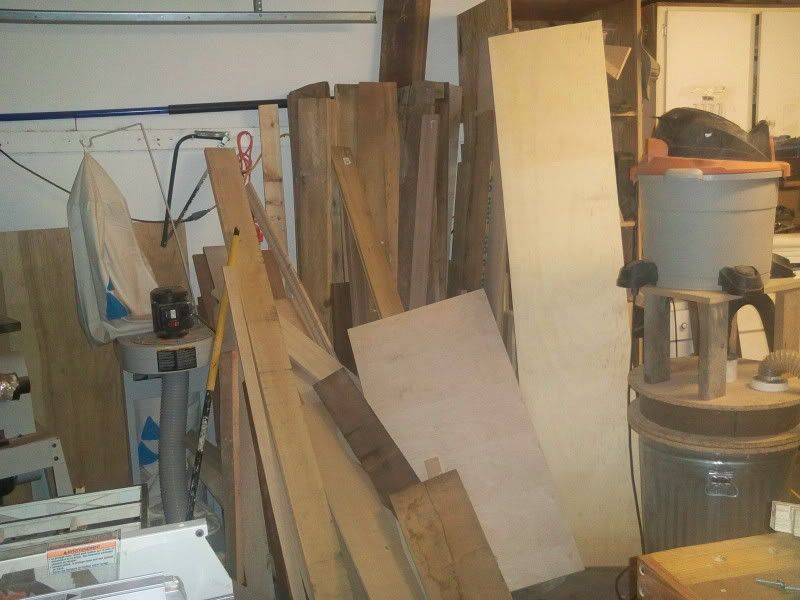
What is this jumble of boards all about?  Well, I’m ashamed to admit it, but that is my lumber stash.  All of those choice boards of oak, ash, maple, walnut and other species.  Some are big rough planks just waiting to be jointed and planed while others are smaller, more perfected pieces showing off their color, grain and figure for all to see.

There are boards with outstanding figure I just HAD to buy when I saw them at my hardwood supplier.  There are boards I got for free when a friend – out of the clear blue – sent me a coffin-sized box of stuff when he was clearing out an area of his professional shop.  There are even pieces in there I got as birthday gifts.

I have some nice pieces of cabinet grade ply in there from old projects.  Yup, there’s a big chunk of a piece of cherry veneer ply in there that cost me more than $120 per sheet here in Florida.

All of it is a mess.

Oh, this was a huge improvement over my old system…
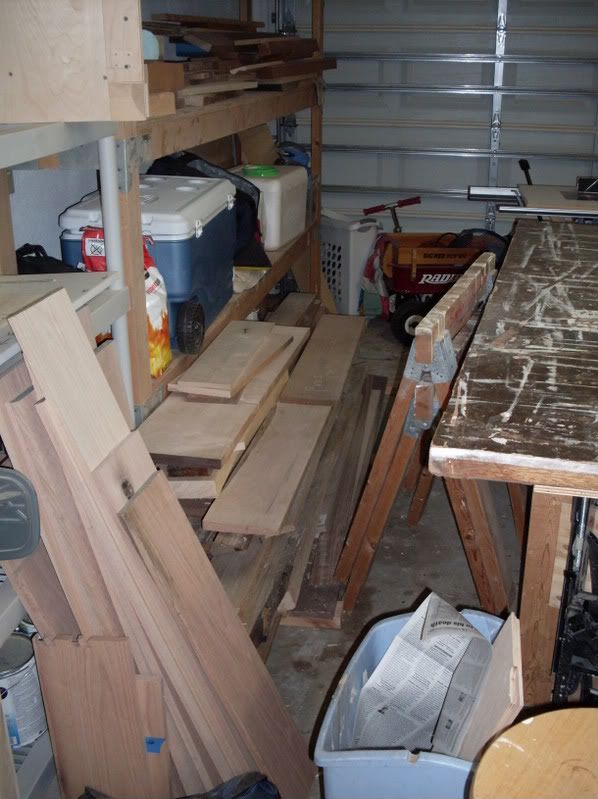
Yup, back in those days, all I did was build a stack behind my workbench.  It was all stacked back there, nearly impossible to find.  And, when the old washing machine started to leak… well, the boards all got a nice soaking.

I am indeed a candidate for building some type of lumber rentention system.  I will be spending some time over the next few weeks looking at lumber storage ideas to see how I can best transform my mess of a lumber pile into a clean, convenient, organized system to get at the boards.  Some of my design criteria include:

  • I really prefer vertical storage to horizontal.  I don’t have a great deal of area around the shop to dedicate to horizontal racks… Yes, I have an 8′ ceiling, but most of my stock is in the sub 8′ range anyway…
  • I have to have a way to store small stuff as well as big pieces.  Many prized little chunks and splinters are in that stack… I’d like to be able to get easy access to those babies.
  • The wall where the stack is now is masonry, and the space I have dedicated to lumber storage is about 8 feet.
  • I need it to be cheap.  Frugal. Cost-conscious. Penny-pinching.  Sure, I could just dial up a few companies and order their systems off the shelf, but what fun would that be?

In the meantime, I will finally HAVE to get off my butt and get out to the lumber pile to organize it before  it collapses, crushing small towns and leaving destruction in its wake.

Oh, and to all of my generous woodworking friends who would GLADLY take that wood and store it in their shops… No way, José… I could send it to you, but I’d never get it back!


Quick Poll

Everything in woodworking has a cost.  It costs to buy wood.  It costs to buy glue.  It costs to buy fasteners, jigs, electricity for the lights…

And, most importantly, it costs to buy tools.

Whether you have a massive, professional shop full of state-of-the-art monster tools or you have scoured the classified ads looking for ultra bargains, there is little doubt that you have made an outlay of cash to get what you need.

This week, I want to know what was the most you ever spent on ONE single tool.  Maybe it was that large cabinet saw, the hand-made infill plane you had commissioned or the large cyclone dust collector to keep your shop neat.  Just give us the price range you were operating in. Thanks for voting!

[For my international viewers, the values are in U.S. Dollars.  To convert your currency to USD, visit this Universal Currency Converter. Thanks!]

[poll id=”85″]

Link of the week

Utilikilts

So, you are looking for some tough, practical and stylish work wear to put on before you head out to the shop. Are you going to look in one of those big-box retailers for something to fill the bill?  Nah.  How about some clothing discount store?  No way.

Why not a utility kilt?

Utilikilts is an American company proudly making utility kilts for everyday wear. It may sound strange, but their version of this traditional Scottish garment comes equipped with all of the features you would expect to find on a premium pair of work pants or shorts.  Their workman model is made of heavy cotton duck with a key clasp, large cargo pockets and a hammer loop.

Since the only thing traditionally worn under a kilt are comfortable socks and sturdy boots, there is a modesty snap you could close before – say – climbing a ladder.  Ya know – just so you don’t give the ENTIRE neighborhood a peek.

Oh, and if you go out to celebrate finishing an important project, they even have a tuxedo version for those dressier places.

Is it failure… or opportunity?

My days back as a student at the University of Maryland were some I will never forget. Moving away from home for the first time.  Getting along in a large campus and being exposed to many new people holding diverse viewpoints.  And, a class schedule and structure that was very different than it was back in high school.

Basically, college was set up so you attended each of your classes about three hours total a week.  Sounds easy, right?

Well, that was all of the CLASS work you got… the homework, however, took many hours to accomplish.  And, if you didn’t keep up, you were lost in the weeds.

That’s exactly what happened to me the first semester of my Sophomore year.  Inexperience got the better of me.  I thought I had this college thing down pat.  I took a blow-off class everyone told me I could ace even if I didn’t show up.  And, as expected, I blew it off.

That class ended up being the only F I ever got in my entire academic career.   I had failed what is considered one of the easiest classes on campus.  And I was not happy with myself.

Why is it that some woodworkers will look equally hard at their failures? Could it be that they made their goof up on a prize piece of highly figured wood?  Is it that there is only so much time available for woodworking, and that time spend making mistakes is considered time wasted?  Or, is it that they expect that they will never make a mistake – ever?

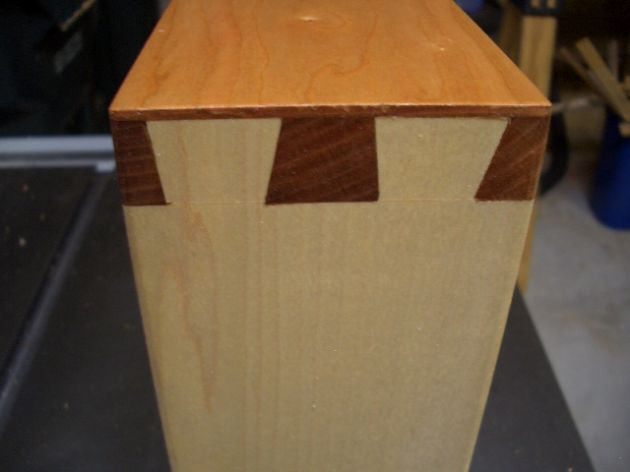
Certain skills in woodworking require a tremendous amount of practice and skill to execute properly.  One woodworker I know learned how to cut beautiful hand-cut dovetails on his own.  Sure, he watched the videos and read the books.  But, he gained the experience by setting up a stack of scrap wood blanks and cutting one or two sample dovetails a few times each week.

His first attempts looked as if they had been chewed by deranged beavers – gappy and uneven.  But, as he progressed over months of practice, he started to notice where he was making his mistakes.  Maybe he was not holding the saw properly.  Maybe he didn’t have his chisel perfectly perpendicular to the bench.  Maybe he wasn’t marking the cut lines properly.  Whatever the problem, he identified it and figured out a way to correct the issue.

Today, his dovetails are clean, tight and pretty as a picture.

Other woodworkers may be experiencing a fear of failure. Last weekend’s quick poll asked if you had ever bent wood for a project.  Nearly half of those who voted said they never have, but always wanted to.  For those who voted that way, why not?  Hey, I messed up my first attempt at bent lamination.  It’s in my scrap bucket right now, cut into multi-layered pieces waiting for the weather to cool down so it can be burnt in my fire pit.  Instead of saying, “I can’t do this,” I went back to the saw and planer and cut more strips to be laminated into bent pieces.  The results the second time around were much better… and now I’m working on the rest of the project.

What happened after I got that F?  I could have given up and felt sorry for myself, quit college and figured out what my next step was going to be.  Instead, I learned a very valuable lesson about life.  I sat down one afternoon and gave the direction of my college academic career a very stern looking over.  Was I committed to this or not?

I took the report card with the F on it and taped it to the surface of my desk where it stayed through the rest of my Sophomore, Junior and Senior years. Every time I sat down to do homework, I reminded myself what I had done, where I had failed and how I needed to correct my situation.  I studied harder, went to every class and sat in front. I budgeted my time carefully and made sure that I had my studies done before I knocked off for a cold one at the end of the day.

When I went to the mailbox to get my next report card, I just about fainted.  Four A’s and one B.  My best semester ever. I had taken my mistake, learned from it and became a much better student for it.

As woodworkers, I hope each of you takes the mistakes you make and learn from them.  Understand why things went bad, and seek out ways to improve your work.

I remember once reading the signature line of a fellow woodworker on one of the forums I follow – “It’s OK to make mistakes, but it’s to your credit if you don’t make the same ones over and over again.”

So, go make your mistakes boldly.  Learn from them.  You’ll be a much better woodworker for it.

Bow, Bow, Bow Your Wood…

Are you looking to add some flair to your next woodworking project?  Sure you are!  You are a woodworker, and after building lots of square things, you are ALWAYS looking to do something out of the ordinary to spice up the woodwork you are doing.

But, how can you do it?

Well, there is an easy way you can add graceful curves.  And, if yesterday’s link of the week is any indication, there are LOTS of people who want to give bending wood a go.

By no stretch of the imagination should you look to me as an ‘expert’ in wood bending.  In fact, I am building a table to hold a piece of custom pottery that a co-worker will be throwing, and this is the FIRST time that I have tried to bend wood.

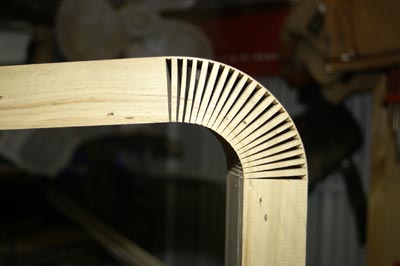
From all that I have read, there are three primary methods of bending wood.  The first is kerf bending, which involves cutting saw kerfs into the back side of a piece of wood in order to make it bendable.  It could work if I was building something where only one side was going to be visible, but that’s not what I am going for in this project.  So, that method is out.

The next method under consideration is steam bending. I went to school at the University of Maryland, so I have lots of experience with steaming – blue crabs – YUM!  The process is very similar – you have a container (a pot for crabs – a box for  wood) and you have a source of heat to boil water.  You place your lovelies into the container and put the spurs to the heat. After a set amount of time (20 minutes for crabs, a different calculation for wood), you can pull the lovelies out of the container and do what you have to with them (crabs = eat, wood= bend).  Some species of wood do exceptionally well with steam bending (Ash is the first that springs to mind), and it is a time-honored way to do this, but it was too involved for me.  Besides, the feels-like temperature in Florida right now is about 105 degrees F – definitely NOT steam bending weather.

The method I settled on is making a bent lamination.  I have seen this done before at a woodworking school I attended, and it looked like a neat trick.  Basically, you take wood and rip it down to several flexible pieces. I was using ash, which has legendary bending ability, and walnut… which I wasn’t so sure of.  I was going to alternate strips of ash and walnut to give the piece it’s own set of racing stripes.

For the pottery stand legs I am building, I aimed to have the wood rough sawn to 3/16″ thick. I then used an auxiliary planing bed at my planer to get the wood down to 1/8″ thick.  I understand that you can make the slices thinner if you have a more radical bend, but all I needed was the arc of a circle to for the legs.

Now, I had 9 strips of ash and six strips of walnut, and I had to get them glued up into a coherent shape.  My first thought was to use a form to bend them over.  This is the way it should be done.  I bought a sheet of particleboard and cut it into six 15″ wide by 48″ long blanks.  Then, I tried my best to make a fair curve nice and smooth in the stuff.

Perhaps I was a bit hasty or careless, but that form I built was terrible.  I couldn’t bend the wood to meet the form, and I wasn’t about to start cutting tissue-thin slats to showcase my bad cutting job.

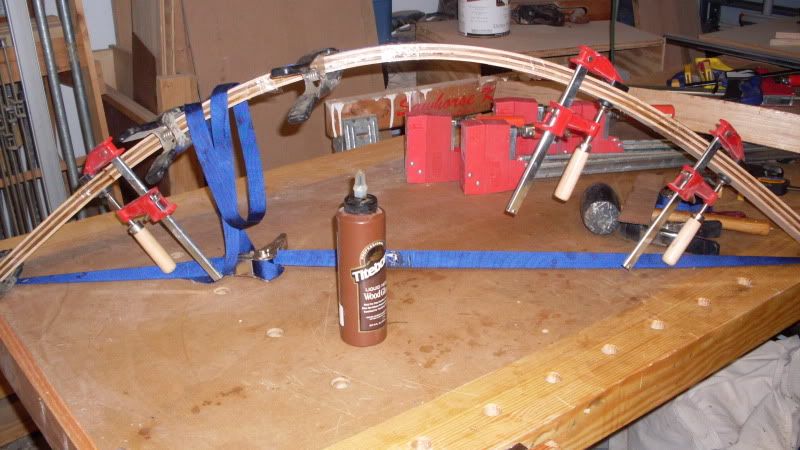
So, I struck on an interesting idea.  Grabbing my band clamps which see very little action, I made my stack of boards and slipped them into a loop.  From there, I pulled the strap tight while guiding the wood to flex in one direction.

The result kind of looked like a bow under tension.  I had a perfect arc for the pieces with little effort.  If you are planning on doing this, some ratcheting tie-down straps might be cheaper than buying outright band clamps.

I took the pressure off the stack, then I started to glue them up.  I have heard several times that yellow glue will ‘creep’ over time when tension is applied.  Since these legs will be under a considerable amount of tension, I decided to go with a traditional, less-toxic glue, bottled hide glue.  Hide glue gives a more rigid bond, and is very creep resistant.

This stuff is just like hot hide glue except it stays fluid at room temperature.  I spread a generous amount on both sides of each slat to be glued and made myself a sandwich of ash and walnut.  Then, I looped the band clamp around the stack again and tightened up the group until I had the amount of bend that looked good to me.  I took strips of packing tape and wrapped them around the stack at several places to serve as clamps, and – for good measure – I added more small clamps to the assembly to ensure everything held together well.

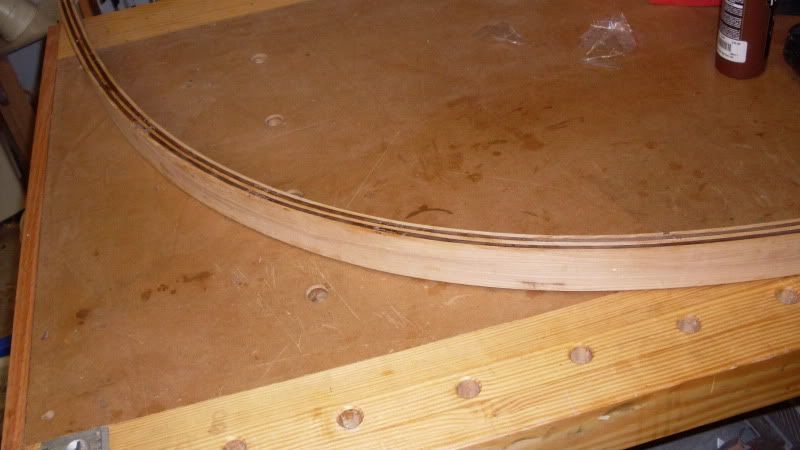
I gave the piece 48 hours in the clamp setup, then pulled them out.  They came out looking decent, with only a few separations of the plies on the edges.

Hmm….

I guess maybe next time, I’ll have to work more carefully to build better forms and try a different method or try a different glue.  But, with a little more glue and a few clamps, the big issues have been taken care of and the legs look as if they are ready to work with.

Will I ever bend wood again?  You bet I will.  Taking that first step of just doing it has gotten me off the straight and narrow path.

Quick Poll

When it comes to woodworking, woodworkers are always looking to get arrow straight boards, completely flat and true.

Yeah.  Right.

First, there are turners, who take nice straight stock and turn it round.  Then, there are carvers who – with chisels, gouges and other tools turn those pretty chunks of wood into works of art.

And, then there are the folks who like to bend wood to add flair and drama to their projects.

Bending wood is typically accomplished one of two ways.  The first is to steam the wood in a contraption for a certain amount of  time to loosen the lignin in the board, then taking it from the box and bending it quickly over a form.  The other method is to slice thin pieces from a larger board, then laminate them with glue and clamp them to a form.  Both give spectacular results.

So, this week, I want to know if you have ever bent pieces of wood for your projects, and if you have, how did you do it.

[poll id=”84″]

Link of the week

The Tattooed Woodworker

There is no such thing as a ‘typical’ woodworking blogger. Some are older, others younger.  Some love hand tools, others can’t get enough power.

One of the newest bloggers in the woodworking community is Robert Giovannetti a.k.a. The Tattooed Woodworker.  Rob may appear radical, but his love for traditional hand tools comes to the fore in his entries and videos.

Unfortunately, because of his skin art, he has gotten a lot of anonymous flack from some readers who think he has no business writing a blog.  It was so bad a week ago, he nearly pulled his blog off the web and sold his tools.

That would have certainly been a loss for all of us in the woodworking community.

Bloggers such as Rob, Marc Spagnuolo, Matt Vanderlist and scores of others put themselves out there for others to learn from. Folks who take of their time to help others learn the craft have earned my support and a great deal of respect.

If you would like to read the works of other talented and entertaining woodworking bloggers, you can also check out the members of the Wood Whisperer Network.

part of the Wood Talk Online community