Stuff I’ve Built: The Trestle Table Base

July 2005

Before our neighbors had their daughter and son, they had a very cool all-glass dining room table. A glass top and two pedestals each made of 12″ wide glass strips joined at a 90 degree angle with two screwed together brackets.  It was stylish. It was striking.

And, after they had kids, and those kids started to walk, they discovered just how unstable it was. In fact, after one energetic evening of their son and daughter running near the table, our neighbors ended up holding the heavy table top once a little one slid into one of the table bases.
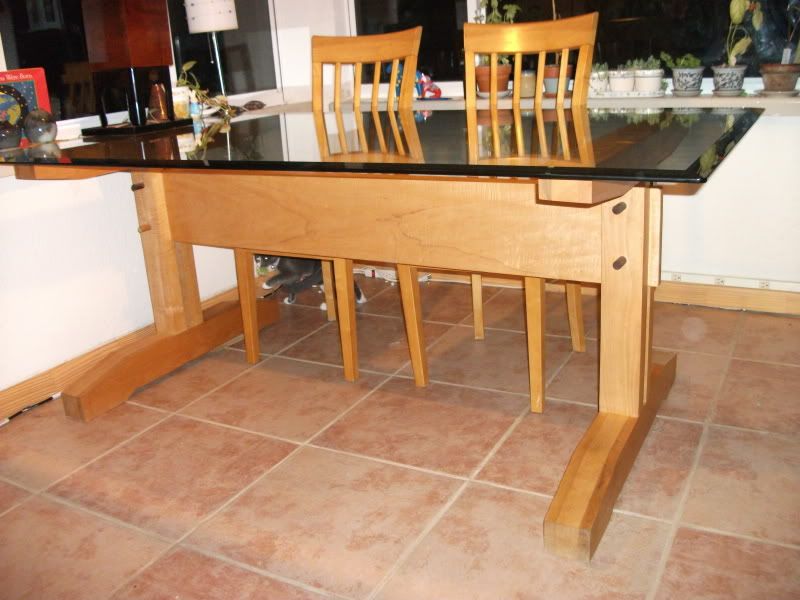
To help get the dining table issue under control, they asked if I could build a sturdy wooden base for the glass table top.  Something that would be a little heavier, a little wider and a whole lot more stable.

Since the husband of this couple was born in Japan, I thought I would go with an Asian-looking trestle table base. Something a little more graceful, something a little more muscular and something out of maple.

I built a pair of trestles starting with a massive base built up from three strips of  maple.  The middle strip was cut and glued into the sandwich allowing spaces to make ready-made mortises.  The same process was done for the top trestle.  Rather than build the upright support in the traditional manner, I glued two uprights into place, using the space between them as a mortise to receive the crosspiece. The uprights are glued and through doweled into the trestle base and bracket to ensure they don’t go anywhere.

And, what a crosspiece it is. A solid piece of maple – 8″ wide by 2″ thick.  Planed and sanded, the ends are tenoned to fit between the uprights. I drilled 1″ diameter holes in the uprights and drove dowels through the uprights and tenon to hold it in place.  I think it gives the piece a nice accent.

I sanded and scraped the piece smooth and finished it with a coat of 1# cut of dewaxed shellac sanded smooth with 600 grit paper.  Then I applied several coats of wipe-on poly to give a tough finish.

Today, their family has grown to also include a dog, two cats and their much older, bigger, faster and stronger children. And, the glass table top sits firmly on top of the table base, unmoved by the commotion and evening dinners.

Not bad for the strong silent type.

An Olympic moment

Thank you, Canada.

What a great 16 days of Winter Olympic games in Vancouver.  From the snow boarder jumping through the Olympic rings to kick off the opening ceremonies to the very classy selection of Neil Young singing Long May You Run as the flame was extinguished, it was one whale of a show.

My family would gather every night after dinner and watch the athletic drama.  The frenetic pace of short-track speed skating.  The grueling endurance of the cross country skiing. The confusion of curling…

It wasn’t just the competition that caught our imaginations.  The courage of the Georgian Olympic delegation pressing on after the loss of their fellow countryman Nodar Kumaritashvili during a practice luge run. The grace of bronze medal winning Canadian figure skater Joannie Rochette who took to the ice mere days after the passing of her mother. Gold medal winning bobsled driver Steven Holcomb who, just two years after an experimental eye operation to save his vision, piloted the United States four-man bobsled to its first gold medal since 1948 at the St. Moritz games.

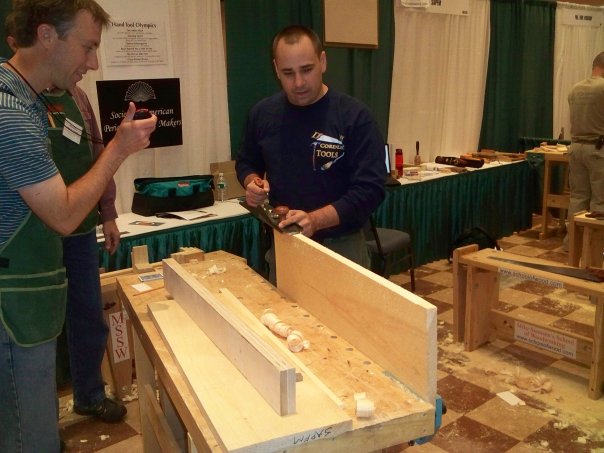
While the Vancouver games took place during the last two weeks of February, other Olympic competitions took place four months earlier in Valley Forge, Pennsylvania. No, IOC president Jacques Rogge didn’t stand at a podium and declare them open. However, the Hand Tool Olympics did take place at the Woodworking in America conference last October.

Mike Siemsen and a cast of volunteers conducted two solid days of competition, which included the one meter dash (rip cutting a three-foot-long board), Greco Roman tenons, boring, crosscutting, hand planing and – the toughest of them all – the two-tailed dovetail challenge.

Not only where contestants judged on their speed, but their accuracy as well. By stuffing a number of playing cards into the joints or under a straight edge, the accuracy judging was tough, with running commentary offered as part of the enjoyment.

Those were some tough and challenging games, and I really don’t want to go into how well (poorly) I did.

I understand that there’s a possibility that Mike might be bringing back the Hand Tool Olympics for this year’s WIA conference.  Maybe I can improve my Jamaican bobsled team performance and get a little closer to the podium this year…

Quick Poll

Woodworkers can find lots of knowledge about the craft by reading books, watching videos and browsing woodworking magazines.

However, when the goal is gaining wisdom, we often turn to other woodworkers for advice.  Believe me, I have asked question after question to anyone who with woodworking experience who would listen…

Later on, I noticed that woodworkers started asking me for advice.  Very strange.

This week, tell us if you have ever had the occasion to give woodworking advice… and if you took the opportunity.

[poll id=”113″]

Link of the week

Woodshop Demos

Earlier this week, I reported on the passing of woodworking jig genius Niki Avrahami. Since then, I have heard of the passing of another woodworking great – John Lucas.

John was an internet woodworking pioneer who established Woodshop Demos, a site rich with woodworking how-tos, tool reviews and wisdom.  John’s site stretches to nearly 4,000 pages, each loaded with at least one valuable nugget of information readers can apply in their shops immediately.

Fortunately, John left a legacy of his woodworking knowledge for others to benefit from. Take some time and review his site – you will be pleasantly surprised by the depth of knowledge and his home-spun charm.

I snapped a cap

I love my old hand planes.  One of the first I ever bought was an old Stanley Bailey No. 5 jack plane. It was one of the best purchases I had ever made.

The handle is solid and the sole is corrugated. I know those little parallel grooves probably do nothing, but man, they are cool.  Through the years, I have figured out the most effective way to use it when preparing a board for a project.   It has saved me a lot of time (over using a belt sander), space (no need for a jointer) and money (again with the jointer) for my prep work.

And then it happened.

I had been working with the old iron preparing some boards for the cutting board project I recently built. Things were going very well as I fell into the routine of board prep. Plane the boards with the jack, follow with the jointer and put the flattened side face down through the thickness planer.

While I was cleaning up between boards, I noticed a little accumulation of shavings in the mouth. No big deal. I levered open the cap iron, took out the iron assembly, blew out  the offending shavings and reassembled the plane.  I set the plane down on the bench and walked over to get the broom to sweep up the shavings at my feet.

Ping.

“What the heck was that?” I thought as I turned back to the bench.  It was worse than I had imagined. The cap iron had snapped… sheared right across the lower third.  DANG!

I’m not sure what happened.  Did I have the screw set too tightly?  Did I somehow knock the plane against something?  Or, did the cap iron just give way after more than 100 years of use?

I’m not sure what the deal was, but I know that now I have to start hunting around eBay and the local flea markets to find a replacement cap iron.

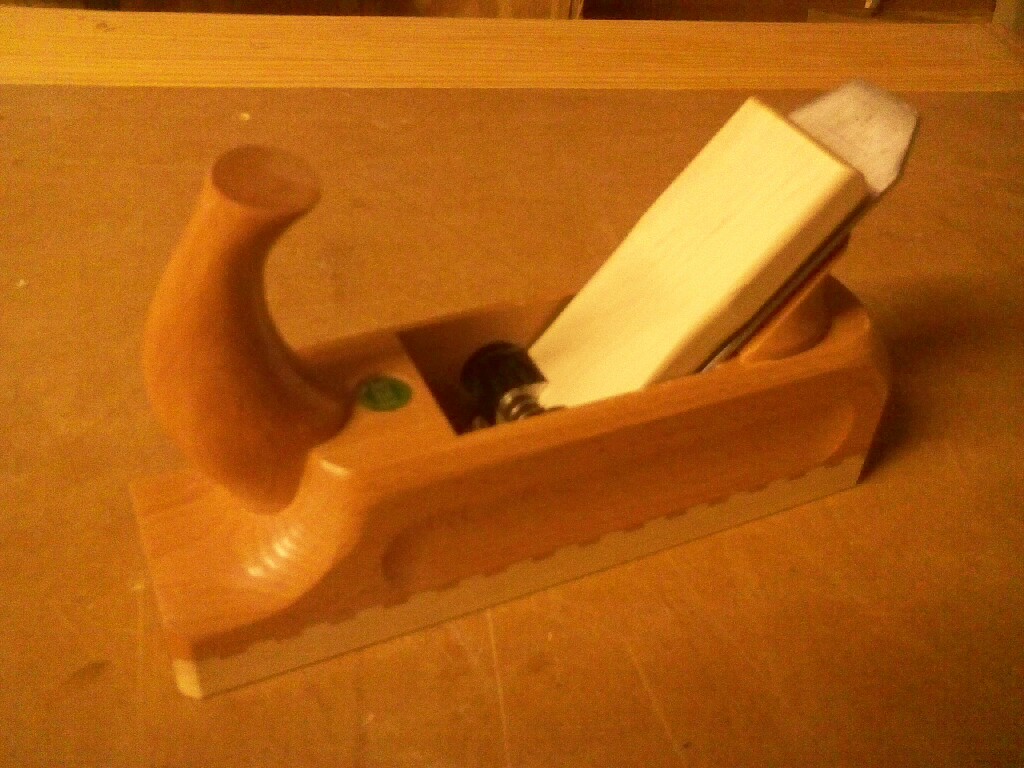
Oh, and while I’m looking, I guess there was nothing wrong with buying this, an ECE wooden bodied jack plane. This baby is sweet!  The only problem is the instructions for this plane were written in German, except the words ‘Made in Germany’ for some strange reason…

Pass it on

This past weekend, I found out that a woodworker had passed away.

No, it wasn’t met with the nationwide attention of the passing of Sam Maloof or James Krenov, but it marked the loss of a very talented woodworker.

Early on in my time writing Tom’s Workbench, I was thoroughly impressed by the posts on the Woodworkers Website Association by Niki Avrahami, a woodworker who lived in Poland. When faced with a woodworking problem, Niki would build a jig.  Not any kind of jig, but a jig that would just blow your mind when you saw it.

Elegant. Thoroughly thought out. Built with common materials. Bordering on genius.

Take this table saw sled Niki designed.  Just this one plan has 40 large annotated photos showing how to unpack and use the saw jig he had designed in an earlier post.  Clear, easy-to-follow instructions that anyone can follow.  They show from the first steps of setting it up, how it’s used, the results of the cutting and – as with all of the posts Niki wrote – a ‘Thank You.’

Niki’s work was so innovative, he submitted several plans to woodworking magazines – and many of those were awarded as top tips.  He posted his how-to’s on woodworking forums in Australia, Europe and North America. Thousands of woodworkers have been inspired by his creations.

While I interviewed Niki, I kept asking him, “Why don’t you write a book with these jig designs?  It would be a top seller.”

And, every time I asked him, he always responded, “If I wrote a book, who would do my woodworking?”

Fortunately for us, Niki had left his plans and designs scattered across the Internet for others to read, learn from and build. Unfortunately, this got me thinking that there are many other woodworkers who do pass on and don’t leave a legacy of their knowledge for anyone.  A few projects, some well worn tools and that’s it. All of the years of experience and know-how taken with them, removed from play forever.

In today’s world, many segments of knowledge are being lost to the ages. Master woodworker Toshio Odate spoke sadly about his friends who forge high-quality Japanese steel into chisels and plane irons.  These elderly gentlemen in generations past would have shared their trade secrets with their sons, continuing the line of knowledge.  Today, many of their children  and grandchildren go on to high-paying office jobs rather than sweat at the forge. When those old men go, that very well might mean the end of superior-quality hand-forged Japanese steel.

Thinking back on Niki’s passing this weekend, I think it’s critical that I ask each of you to do one favor for the entire woodworking community.  No, you don’t have to start a website or draft a manuscript for a woodworking book. What I would propose that each of us do is to seek out an up-and-coming woodworker.  A granddaughter or grandson.  A neighbor.  A Boy or Girl Scout troop.  Invite them into your shop to watch you work and learn from you.

You might be the one to inspire a future woodworker.. and to ensure that your hard-learned knowledge continues well beyond your years.

Rest in peace, Niki.

Quick Poll

Hobbies are fun.  They take you away from the everyday world and give us a chance to stretch our creative wings after doing the nine-to-five grind.

But, ask many hobbyists, and they’ll tell you that they have several past times… in the kitchen… in the garden… in the music studio… on the open water… in the garage… and on and on.

This week, tell us where woodworking falls on your list of hobbies.  Is it your one-and-only love, or do you spread time between several avocations?

[poll id=”110″]

part of the Wood Talk Online community