Back in the saddle again

The best tonic for a lousy day in the shop is to get right back out there, do things the right way and make some serious progress.

After my previous ‘issues’ in the shop – the ones that caused me to stop everything and start over from scratch – I knew I had to get back in there and get things back on track.  Get back into the flow. Get back in the saddle again.

And, that’s just what I did.  Last week, I went into the shop, cleaned stuff up and got ready for a busy Saturday.  I broke out the plans for the project again and started anew.

No, I didn’t do anything too exotic.  I started measuring, cutting and drilling for dowels just as I had done before – a straightforward rebuild of where I had already been. The real trick came in when I started to glue the outside frames up. That’s when I had the opportunity to rediscover some of the clamps and clamping devices I had already invested in. My two assembly squares were pressed into service on the square parts of the frames during the glue ups.  Simple to use, they not only allowed me to get the assemblies square where they needed to be, but they also clearly showed how quickly things could get out of square when the glue ups were taking place.

I found another set of specialty clamps living on my clamp rack.  A friend of mine had given me a pair of Shop Fox right angle clamps a few years ago, and I never had an opportunity to use them. Until now.  The sloped front braces were presenting a big challenge for me.  How was I going to get them to clamp up tight with conventional clamps?  Simply clamping the shorter top rail and the longer bottom rail didn’t help.  However, these babies were able to grab on to the uprights and pull the dowel joints tight with a few turns of the big handles.
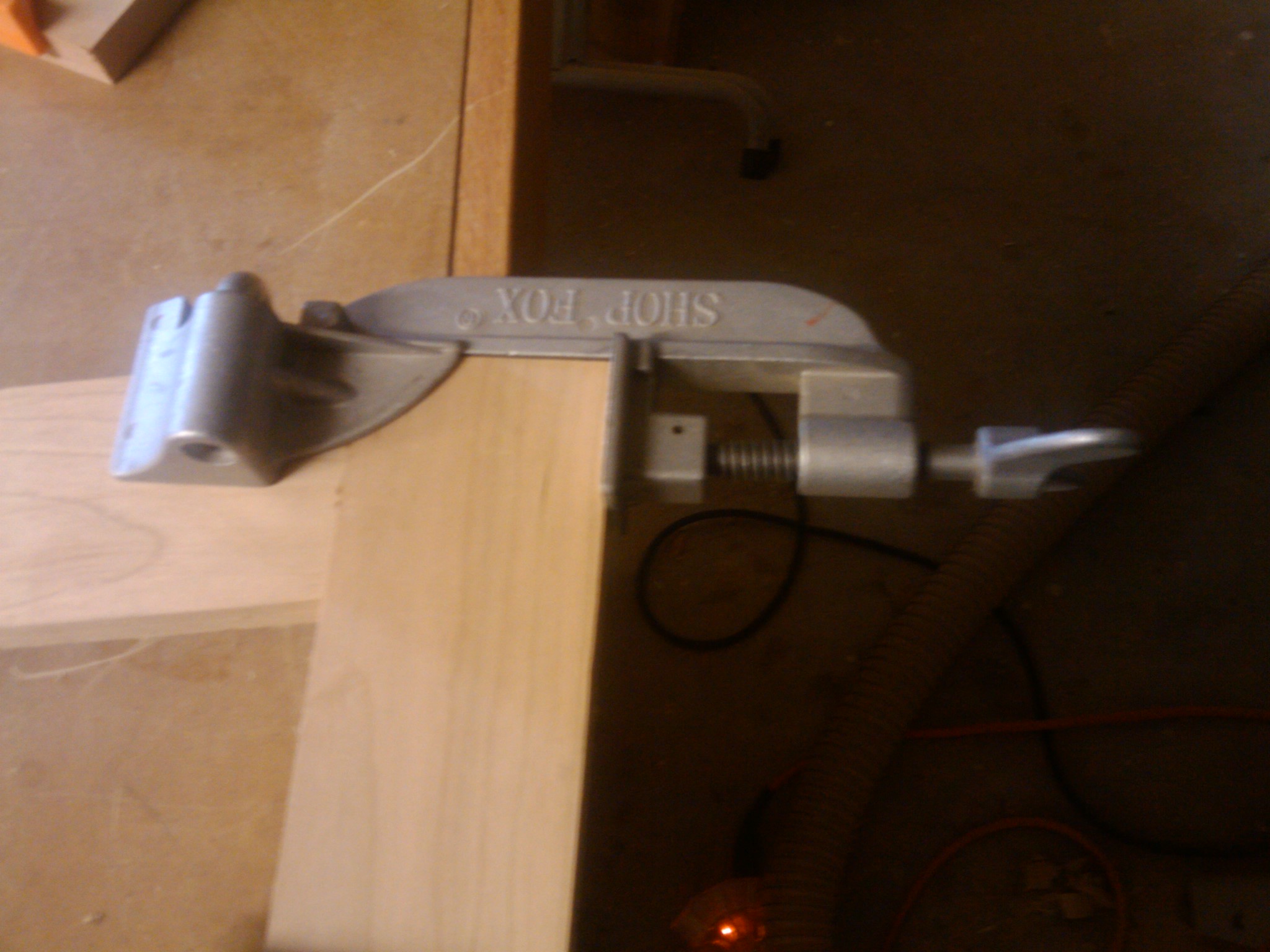
One word of caution… these clamps, while very tough, are not super heavy duty.  I cracked one over tightening it to close a stubborn joint.  The lesson learned there?  Use a mallet to seat the joint as tightly as possible and then get it super snug using the clamp at the end.

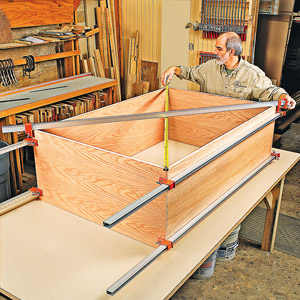
So, using a more careful approach gave me good results.  But, I wanted to see just how much things improved.  As you can see in this photo, the original frames were just way, Way, WAY out of square. The one in back is the offending one…
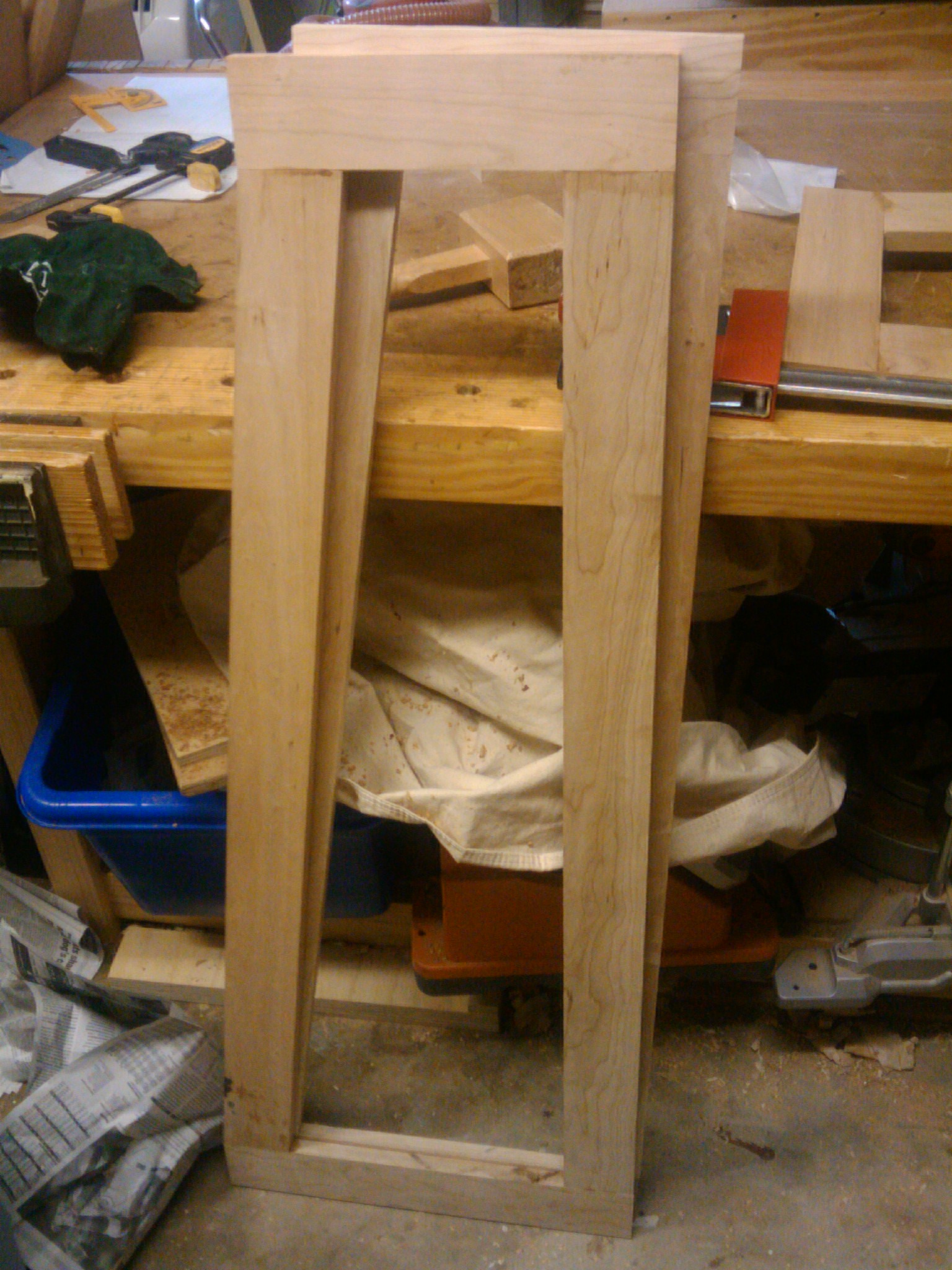
Slow is fast, fast is slow.  When I slow down and do things the right way, I’m going to be moving a lot more efficiently.

Now, it’s time to start making some progress on this project!
 

Quick Poll

For better or for worse, it’s widely considered that one of the signs of a talented woodworker is how he or she cuts hand-cut dovetails.  It’s easy to understand why… the joint is challenging and requires a tremendous amount of skill and concentration to pull off flawlessly.

This week, tell us just how good your hand cut dovetails are.  Are you an expert? Do you need some help?  Are they awful?


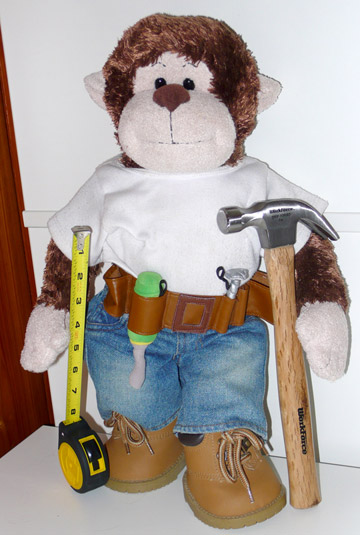
Gimme five with the Shop Monkey: Try the Ply

Eight…. Nine… Ten….

Whew.  Iggy’s been doing some weight training because he knows we have an upcoming plywood-based project on the schedule.  He needs to improve his upper body strength to heft those sheets!

While he sits and eats a banana between sets – good source of potassium, you know – he slipped me this week’s list.


The top five reasons why plywood is so cool to work with:

  1. Thicknessing?  Panel glue ups?  What are you talking about?  With plywood, cut it to size and get cracking!
  2. Plywood comes in a wide array of face veneer species. And, if you can’t find what you need at your supplier, you can use it as a substrate for a fancier veneer.
  3. You will give your classic AMC Gremlin a workout trying to shove a 4 foot by 8 foot sheet of ply through the hatchback when you carry it home from the supplier.
  4. Wood movement?  Come on… Plywood virtually eliminates it, allowing you to glue it in place in many projects, adding strength to the final assembly.
  5. Some sheets actually come straight from the factory pre-finished with a heavy-duty lacquer.  This is a huge time saver when working on cabinet projects, and eliminates that noxious finish smell inside the boxes.

Link of the week

About.com’s page on how to determine if an assembly is square

So, I didn’t use a square when assembling the sides of my ladder bookshelf project.  Is there a way I could have checked for square without breaking out my squares in the first place?

Turns out there’s not just one way – there are TWO easy ways to determine if a project is square using just a lowly tape measure. This site clearly describes the two procedures – the 3-4-5 triangle method, which uses the Pythagorean Theorem to determine if an angle is at 90 degrees.

The other method is very familiar to anyone who has ever watched the New Yankee Workshop.  By measuring the diagonals of a square or rectangular assembly, if the measurements are equal, the assembly is square.

Sure, some of this may seem like common sense.  However, you’d be surprised just how quickly that bit of common sense can be forgotten in the heat of an assembly!


It’s hip to be square

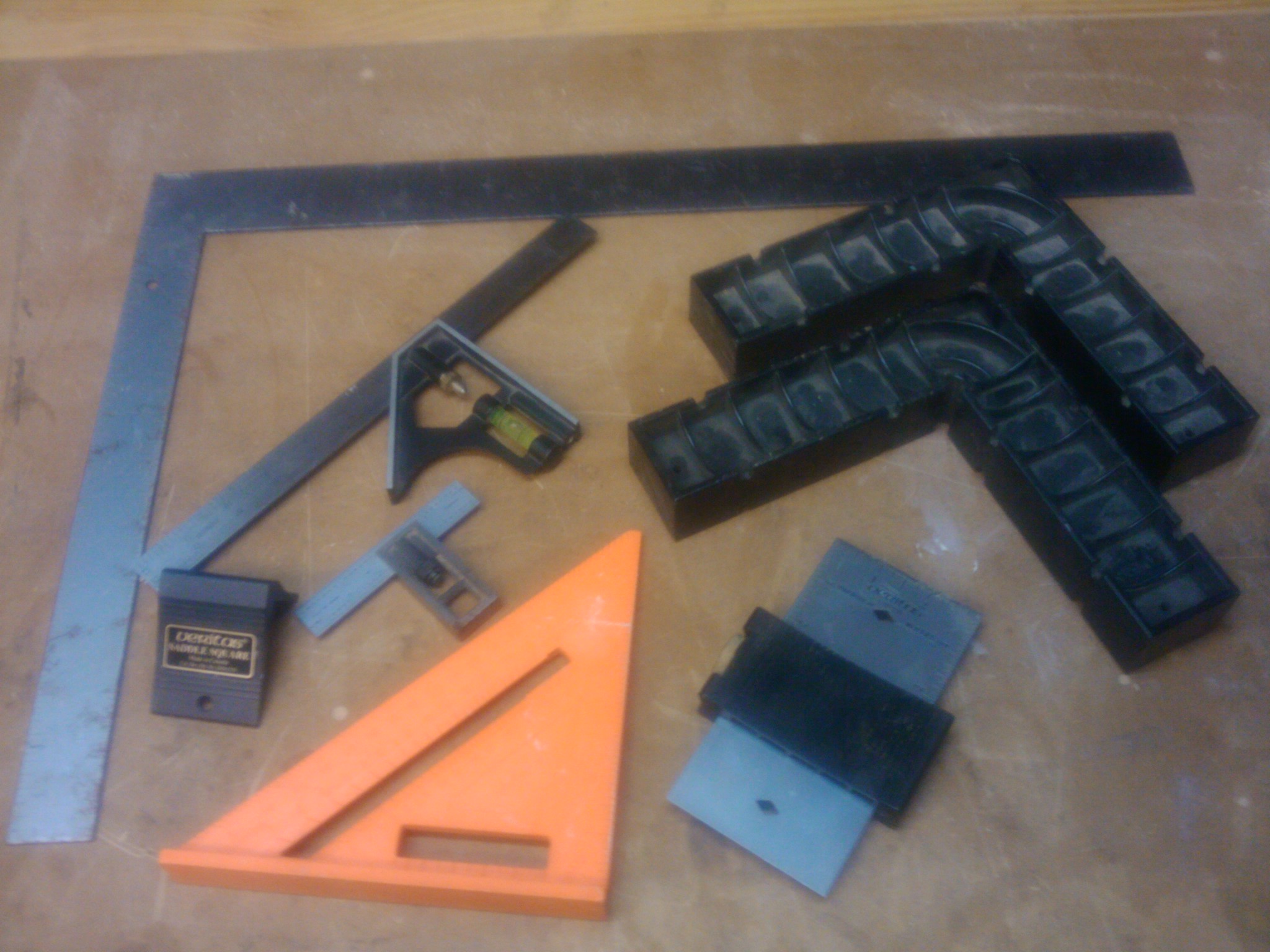
So, after this weekend’s fun and festivities in the shop, I decided to go out to the shop and take a look at the squares I have in my possession. No, none of these babies is a Starrett, but I can guaran-dang-tee if I had used one of them during the project assembly, I wouldn’t be in the mess that I am.  It’s not an unimpressive collection, and I guess if I use them on a more regular basis, well, maybe I could do a better job on my assembly.

First on the top I have top and left side is my carpenter’s square.  It’s a very useful tool. Besides measuring large cases for square, this baby also makes figuring out the rise and run of a slope a piece of cake…  There is so much more I can do with this, but that’s for more complicated carpentry projects, and I still have a lot to learn.

I have my combination square.  Got it on special at a local woodworking shop, and it came prepackaged with a center finding head and a protractor head as well.  This is a handy tool for drawing lines across a project, setting the depth of a blade or bit, and, yes, finding square.

To the right are a pair of assembly squares I picked up a few years ago.  These babies are dead-on 90 degrees, and are great for clamping into place to force an out-of-square assembly into square.  They also make gluing up miters a whole lot easier, since the points of the miter can nestle into place in the corner as you clamp the sides into place.

At the bottom of the combination square, you can see my saddle square.  While this won’t help you make an assembly square, it is totally awesome way to transfer marks dead one from a face to an edge.

Next to that is a handy little double square I use a lot when I edge plane a board.  I just press the beam against the face of the board and run the blade over the edge I just planed to ensure I’m getting a nice square edge on the board.  This one is small enough to put into a shop apron pocket… if I wore my shop apron.  Instead, I rest it on my bench.

The orange square is my speed square I picked up at the local home improvement center.  Again, another VERY handy carpentry square with ooodles of uses I would have to work as a carpenter to use, but simply using it as a square is an easy way to get that square assembly you are looking for.  It also doubles as a saw guide for circular saws… a sweet multi-tasker.

The last one is my sliding square… it’s a pretty cool tool for laying out square lines during design. Again, this can help in the marking and cutting, but not so much during assembly.  But, that’s OK…I’m down with that.

Do I need to buy new squares?  Nope. What I need to do is set up something around the bench where I can keep these squares a lot closer at hand.  I figure if I can see them, maybe I will be encouraged to get them when assembling my project. I’m gonna start doing that.

Oh, about the title of this blog post.  Once I wrote the title down, you KNOW this was the song going through my mind…

As a woodworker who came of age during the 1980’s, consider it my gift to you!


What the He%# am I doing?

So, I just walked in from the shop.  Still sweaty and covered with sawdust.  My wife is gonna kill me when she sees the mess I left.

I’m here at the computer about to launch into one of my patented stream-of-consciousness posts.  If you want to read, please continue. If you would rather look at pictures of gorgeous woodworking made by talented folks, check this out.

No, I’m here at the computer because I have to wonder just where the heck I am as a woodworker.  So, I’m working on those bookshelves, and I drag my posterior outside to the shop on a hot, sweaty day  after mowing the lawn. I just had lunch and about a quart of Gaorade, so I should be OK in the Florida heat.  Heck, I even turned on the A/C to get the shop down to a manageable temp.

I lay two of the sides of this piece side by side and get ready to start routing matching dadoes. Nothing is lining up.  Nada.  Hmmm…

Funny… when I laid out and cut the pieces, I used stops to ensure accuracy.  They should all be identical sizes… right?

For giggles, I laid a square against the back support and the bottom piece to see how square they were.

My next words can’t be typed on this – a semi family-friendly blog.

I was so far out of square, it wasn’t funny.  On ALL FOUR sides for both shelves.  Not off by a whisker off a gnat’s behind over four feet kinda out of square – more like you could drive a freakin’ Mack truck between the back member and the blade of the square. Somehow, during my dowel/mortise and tenon debate, I had failed to use my FREAKIN’ square to check to see if the pieces were going together 90 degrees to eachother.  Let me repeat that… I didn’t check to see if the pieces were FREAKIN’ square!

Woodworking 101.

I’m not sure what’s going on here.  But, it seems as if the more ‘advanced’ of a woodworker I am becoming, the more I’m forgetting to do the basics right.  I was watching Tommy Mac yesterday do some really cool veneer work on his walnut lazy susan thing.  “Gosh, that looks like it would be fun to do.”

But, gosh, getting to that point in a project to try something more advanced requires knowledge and application of skills previously learned.

There’s something more, though….

Yesterday, I was flipping through a photo album of some of my earlier pieces. There I was, grinning like a fool standing in front of what were some OK looking pieces.  Some were really eye-catching, while others were held together with bubble gum and spit.  The one thing that I do remember in common with all of those projects was how excited I was to be building them.  I can remember waking up before my wife and my at the time little kids and sneaking into the garage to check on that glue up I had put into the clamps in the wee hours of the morning.  I can remember that rush that I felt pulling a board off the table saw with a relatively straight and burn-free rip and thinking to myself that I was the master of all things xylem.

Now, I can literally go days – heck weeks – without even setting foot into the shop.   I don’t even bother cleaning up and arranging my tools for the next shop session’s work.  I don’t race home, wolf down dinner and see how many joints I can cut before I have to tuck the kids in their beds. Am I becoming the most talented tool collector on my street? The provider of the prettiest sawdust for my neighbor’s compost pile?

Could it be I’m not in love with woodworking like I used to be?

Probably not.  It could be that it’s 98 humid brutal degrees outside, that I’m in the busy part of my work year and I had a bad assembly on my project.  I’ll rip the piece down, salvage what I can (Maybe even turn some of those uprights into shelves or something like that) and get back in the saddle again.

Maybe I just need a vacation.. or to meet up with some other woodworkers to get that spirit back!


part of the Wood Talk Online community