Category Archives: Shop Talk

Come one… come all!

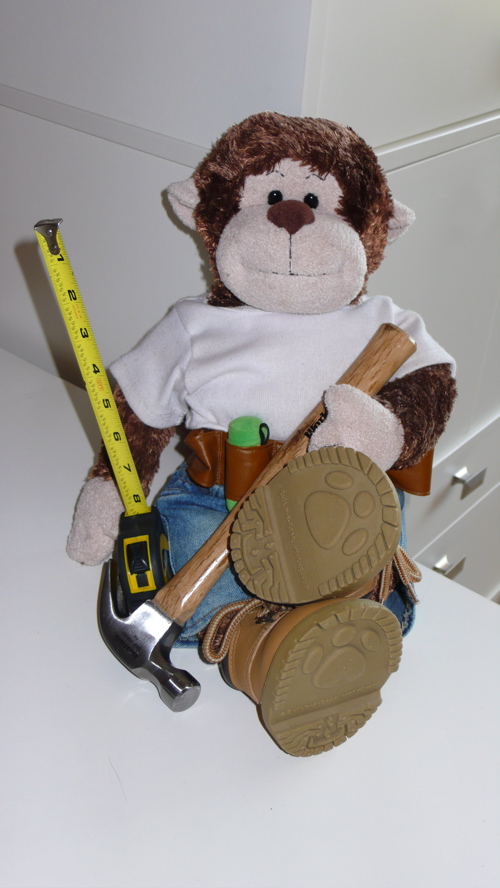
Hello, everyone, it’s me, Iggy the Trained Shop Monkey again. While Tom has been out bragging about his successes, I’ve been the guy in the background, rapping his knuckles with a wooden dowel Mr. Miyagi style when he fouls up. I have also been practicing my hand cut dovetails using nothing but a common frozen household herring.  I’m just about there…

But the real reason why I’m writing today is to let you know that I’ll be making an appearance at the upcoming Woodworking Show to be held this weekend at the Florida State Fairgrounds in Tampa.

If you have never been to a Woodworking Show, it’s definitely worth the trip. You get a chance to meet with vendors who have some incredible woodworking products for sale. You get to see some awesome projects in the show-off area. You get a chance to sit in on boffo woodworking classes on everything from slabbing timber to applying a lustrous finish. And, you get a chance to meet some exceptionally talented woodworkers…

Well, talented woodworkers other that Tom.

We’ll be working near Andy Chidwick’s booth on the expo hall.  Look for Tom and I all day Saturday – we plan on being there the entire day.  Well, if we aren’t at the table, either we’re eating, using the ‘facilities’ or drooling over tools.

While we’ll be doing the meet and greet thing, the one subject we are getting good with is blogging in the online woodworking community.  Swing on by, and we can talk about things… well, I’ll speak intelligently, and Tom will be doing his typical antics.

Remember, this will be the only stop for the Woodworking show in Florida… so, when they pull up stakes at on Sunday, that’s all, folks.  Don’t miss your chance to come out to the show!


My window on the world

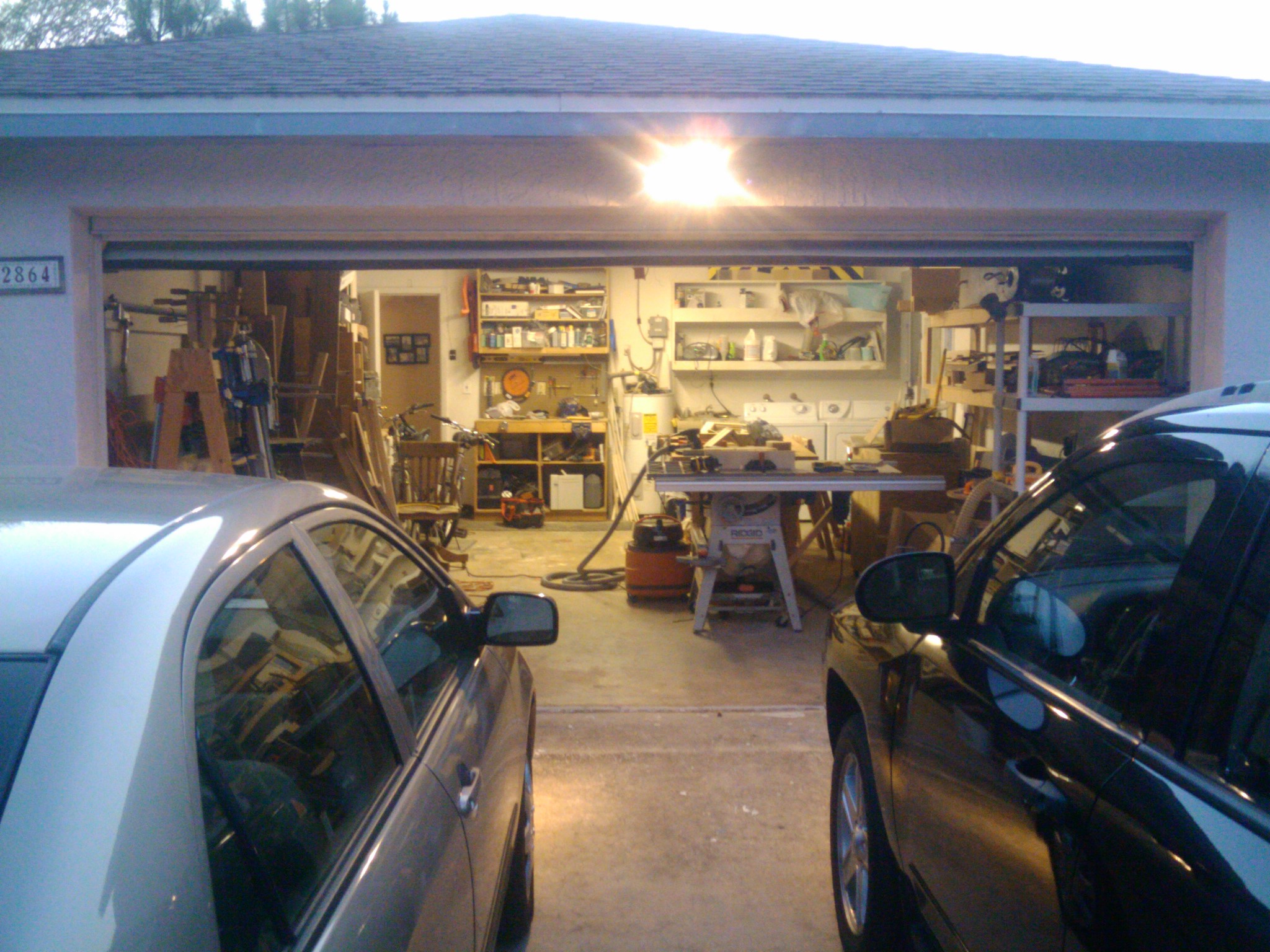
Basement woodworkers typically don’t have one of these. People who work in dedicated shops tend to have those structures behind their homes, separate from the goings-on of the neighborhood. I’m not even going to get into the folks who have their shops in attics, unused bedrooms or other tucked-out-of-the-way places.

No, we garage woodworkers have a chance to look out upon the world and see it pass by right from the comfort of our own benches. My shop’s front door is a two-wide segmented garage door that I can open up to get a full-blown 8 foot by 17 foot vista on the neighborhood. After the chilly winter weather but before the oppressive heat and humidity kick in, I get to enjoy beach weather while playing in the sand-paper box.

The advantages of working with such a huge opening are pretty obvious. Insanely easy access to bring materials in and finished projects out. I can move all of the tools and the bench out of the shop to give the entire place a thorough cleaning. There are no issues with fumes from finishes. Tons of natural raking light – making sanding and planing so much easier.

I can also attract a crowd when I’m in the middle of a project. I’ve had neighbors see me struggle to move thing on to or off of the bench, and they’ve stepped in to lend a hand. I’ve had neighbors come in to oooh and ahhh over the latest project on the bench. I’ve seen little kids being pulled in wagons by their parents become much larger bike-riding kids who still say ‘Hi, Mr. Tom,” as they ride past. One of my neighbors is a retired World War II era veteran, and he’s offered his services sanding projects for me.  Good thing he takes his payments in the form of a beer and some good conversation.  He’s so good, I could never afford his services!

Of course, with all of these advantages, having a garage shop has its problems as well. I’m reluctant to place tools near the garage door, so I lose a wall’s worth of space. My wife keeps asking just how much saw dust will blow onto the cars while they are parked in the driveway.

And, some of the passers-by tend to want to talk politics, personal relationships or want to know if I’m interested in buying some leftover steaks from an order they recently completed. I’ve also had my fill of people selling vacuum cleaners, magazine subscriptions or tree trimming service. And, when it’s election season, I just prefer to keep the garage door closed rather than deal with the folks swinging by to talk about the candidate they are stumping for.

With us getting ready to spring forward this weekend, I’m definitely looking forward to slipping out to the shop after dinner to enjoy a little more daylight.


There’s gold in them there ratios…

I have always hesitated to write articles about how to design projects.  Maybe it’s because I’ve built more than a few stinkers and want to forget about them. Or, is it that sometimes I design my projects as I go along… pencil in one hand and crying towel in the other?  I can’t keep the reasons straight anymore.

There is one convention that I have stumbled across while designing a few projects that has helped me out of more than a few jams along the way.  That is the Golden Ratio.

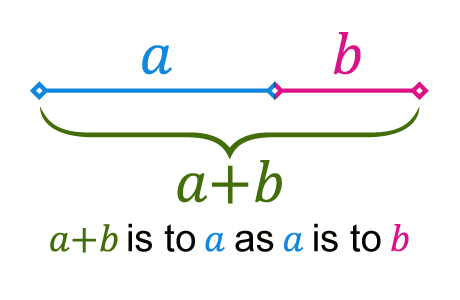
Just what the heck is it?  Well, it’s a classical design concept that has been in play for more than two millennia… Back in the days of ancient Greece, mathematicians such as Pythagoras and Euclid were noticing that in balanced shapes in construction, nature and geometry that there was this relationship between sizes of items that kept recurring. It was described as the extreme and mean ratio.  What does that mean?  Heck, I was an English major back in college… you do the math. However, it can be expressed quite eloquently in the following diagram:

The idea must have taken off, because many classical structures such as the Parthenon were built with this pleasing ratio in mind.

The golden ratio is also expressed as the Greek letter phi (φ) or as a number expressed as 1.618033…. This is known as an irrational number – kinda like my family’s checking balance after we pay all of our bills. “Honey, how did the account get so low? That’s just totally irrational!”

How does this help with woodworking? In many cases, it can be used to create a more balanced looking piece.  You can create the Golden Ratio by doing some complicated math, buy a special phi graded ruler or do what I do – look for a free online golden ratio calculator like this one.

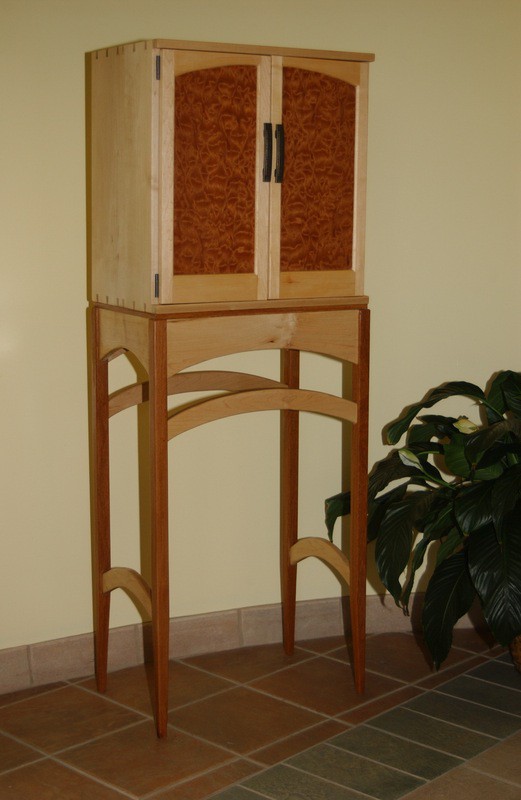
The best example of one of my projects using the golden ratio was the Fujiwhara Chest. I knew I wanted to build a cabinet about five feet (or 60 inches) tall, but how large should the cabinet section be versus the leg height?  I wanted the proportions to be nice to look at and convenient to access. So, I went online and plugged my numbers in.  I saw that the golden ratio of 60 inches is 23 and 37.  That’s when I drew up the plans for a 23 inch tall cabinet and a 37 inch tall base.

I also had to determine how deep to build the piece.  Should I just guess, or try to get it balanced? I plugged in 23 inches (the height of the cabinet) and figured the golden ratio for that – 14 inches deep. So, that’s how deep I built the piece.  The proportions came out pretty spot on, and one of the comments I got from the judges the year the Fujiwhara Chest showed was that it used proportions very well.

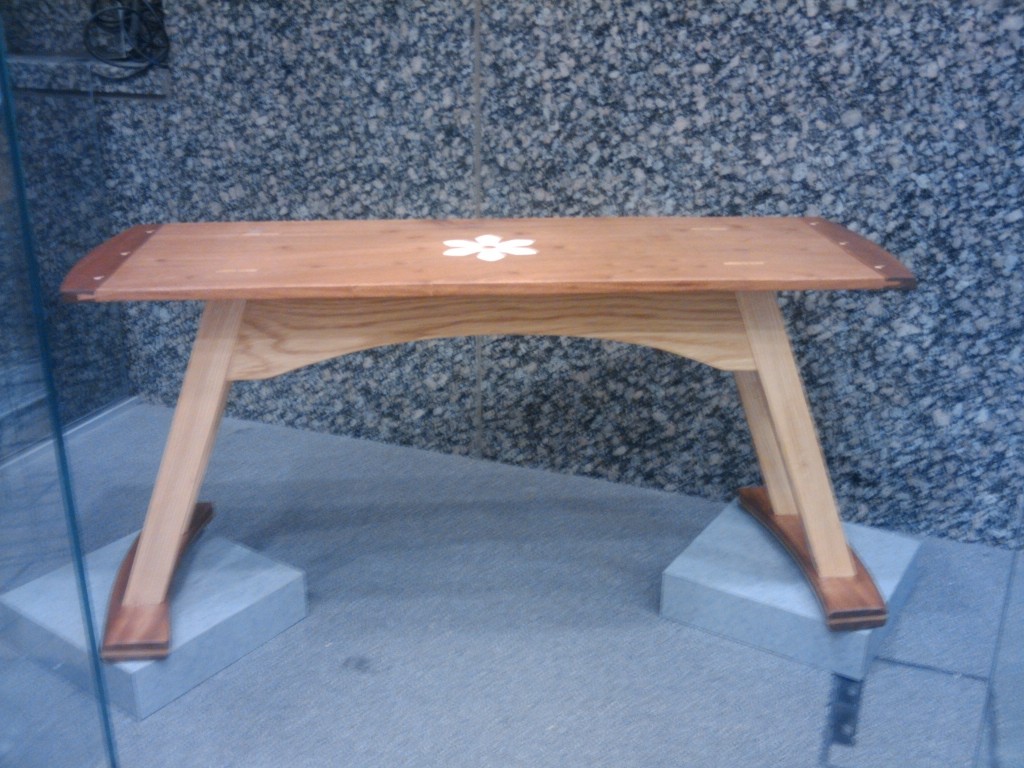
Another project I used the golden ratio on was Centered.  My plan was to come up with a unique looking table featuring a wide sapele board and angled legs. And, that’s exactly what I built.  And, when I showed the piece to some other folks, they all gave the same reaction.  “It looks nice, but something’s not right with it.” The project had no visual weight on the top, making it look too much like an ironing board.

OK, back to the shop it went for me to add some aprons to the piece.  How large should they be?  I plugged the total height of the table from floor to top – 17 inches into the calculator and saw that the numbers were going to be 7 inches and 12 inches.  This presented a few problems… I didn’t have a 7 inch wide ash board to use on the piece, and my band saw didn’t have that kind of resaw depth. Hmmm…

One other thing about the golden ratio is that you can continue to drill down, using the ratio numbers to make smaller dimensions.

So, since there is this relationship between numbers, I entered the  12 inch measurement into the calculator and came out with 5 and 7…   I figured why not try for 5?

Perfect. The apron looked balanced when I cut it to 5 inches tall. To help make it more graceful, I plugged the number 5 into the calculator and came up with 2 and 3.  I marked the center of the board two inches up from the bottom edge, connected a few points by a curve and cut it out to get a nice, graceful look.

Did I explain the golden ratio properly? Probably not. I’m pretty sure someone will weigh in to point out my complete lack of mathematical abilities or why the golden ratio should be avoided… but for a dunderhead like me, using this concept seems to help me in the design phase.

http://en.wikipedia.org/wiki/Parthenon

The sharpness quotient

A sharp looking paint job. A sharp-dressed man. A sharp wit.

We throw out the word “sharp” a lot during our daily routine. And, most of the time that we do so, we aren’t referring back to something that can cut anything but the mustard.

As woodworkers, though, isn’t “sharp” one of our primary concerns? Sharp tools cut wood better than dull ones, are safer to use and lead to much better results. But, what exactly is sharp, and how do you know when you’ve gotten there?

To get to the bottom of this, we return to Ron Hock of Hock Tools. “Sharp is simply a quality you get when two planes intersect at zero radius. The closer to zero radius the intersection is, the sharper the edge will be.”

Seems simple enough, but of course, that’s not the end of the story. Ron began by explaining to me that for something to have sharpness, those edges have got to meet at a 90 degree or more acute angle. “You can get sharp edges on a board you cut to 90 degrees. Take it off the jointer and feel the edge and you’ll learn quickly what a sharp corner feels like. But, if you cut the board at greater than 90 degrees, the edge may be clean and crisp, but it’s less likely to cut you.”

That makes the angle of the edge a critical component. “The rule is that the more acute the angle where the two planes meet, the finer the edge, but the more fragile it will be.” That’s why razor blades shave hair smoothly with their very acute angle edges, but they would stink as wood-cutting chisels.
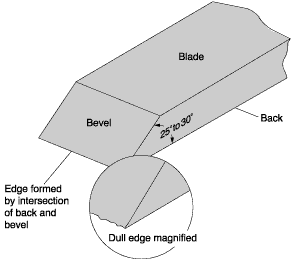
Interestingly, chisels are a very easy way to get a handle on this matter of sharpness. Paring chisels, used to carefully slice away wood for a joint, are usually ground with a 20 degree bevel. Mortising chisels, on the other hand, need to have their bevels ground at a wider angle – usually about 30 – 35 degrees – to withstand the chopping necessary to cut a mortise. Bevel-edge chisels – used in many cases for both applications – are ground to a 25 degree angle.

For many woodworking tools, sharpening is a relatively easy task. “Both plane irons and chisels are single bevel tools – they have a flat side and a bevel on the other. Since the bevel and the flat have to meet precisely, getting the flat side ground and polished is an essential first step.” When you purchase older chisels or plane irons, it’s a good idea to bring a straight edge along with you to see how far out of true these tools are on the back side. Even with the best tools, a careless owner may have done something to get the flat out of true. Most tools made in modern factories – especially high-end premium tools – are ground adequately flat at the factory.

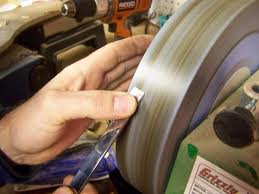
“With a flat back, the next step is to shape the bevel. If the tool is made and maintained properly, regrinding the bevel may be required only if you like to hollow grind on a grinding wheel, if you want to change the angle of the bevel or if there is damage to the edge that you need to grind away.” There are many ways to grind the bevel on a tool – with coarse stones, on a wheel or a platen grinder, with sandpaper, etc. The key to grinding is to keep the bevel consistent as you work, and don’t overheat the tool, which turns the steel blue and draws the temper from the tool, leaving the overheated areas softer.
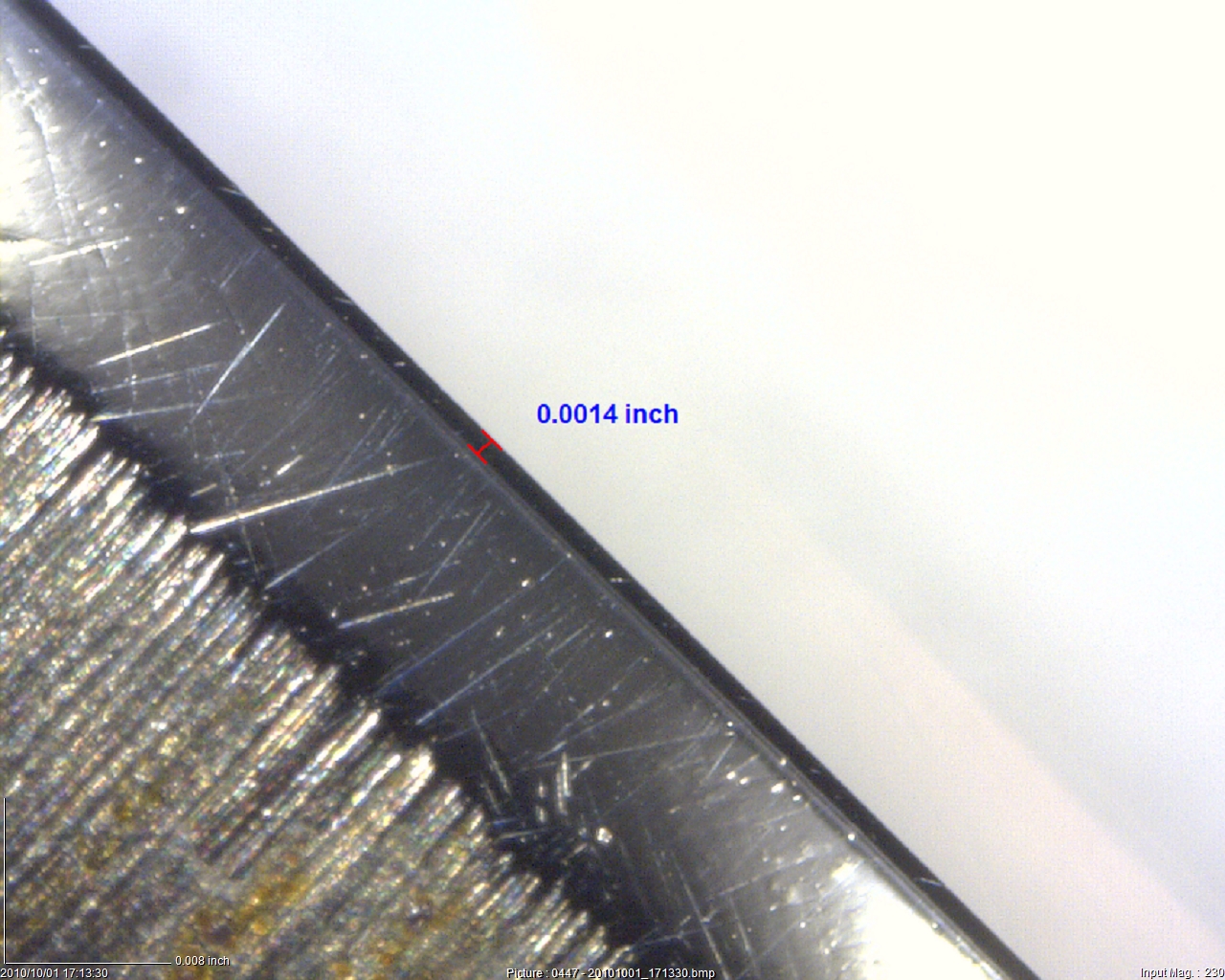
Once the bevels are ground, the next step is to hone the blade. “Again, there are a lot of different ways to hone a blade. Water stones, diamond stones, oil stones, honing film… What you are trying to do is to replace the coarse scratches in the blade with smaller ones as you progress through finer grits. This is going to make that edge where the two planes meet as fine as possible.” This is easy to see when looking at a blade’s edge through a microscope. Deep scratches from a coarse stone appear almost as rough saw teeth, and finer ones help refine the edge.
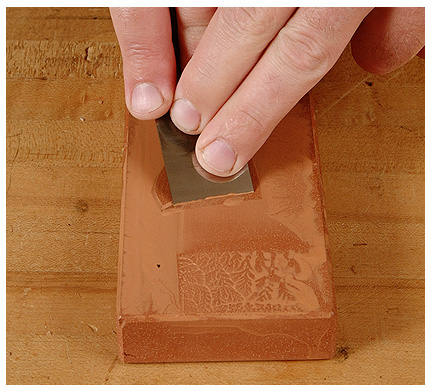
“For hand-held honing, I recommend a hollow ground bevel so the edge and the heel of the bevel can be used as a tactile honing guide. You can feel when the bevel is set properly on the stone. Some woodworkers also like to put a one or two degree microbevel on the cutting edge. You can save time this way because you’re only honing a thin stripe at the cutting edge. The larger angle of the microbevel strengthens the edge a bit, too. But if you hone hand-held, it’s difficult to maintain the angle of a microbevel.” Should everyone put a microbevel on their tools? “It’s all up to you – and your technique. I hear from both sides, frequently and adamantly. Microbevel or no, sharpening is a basic woodworking skill that requires practice like any other skill.”
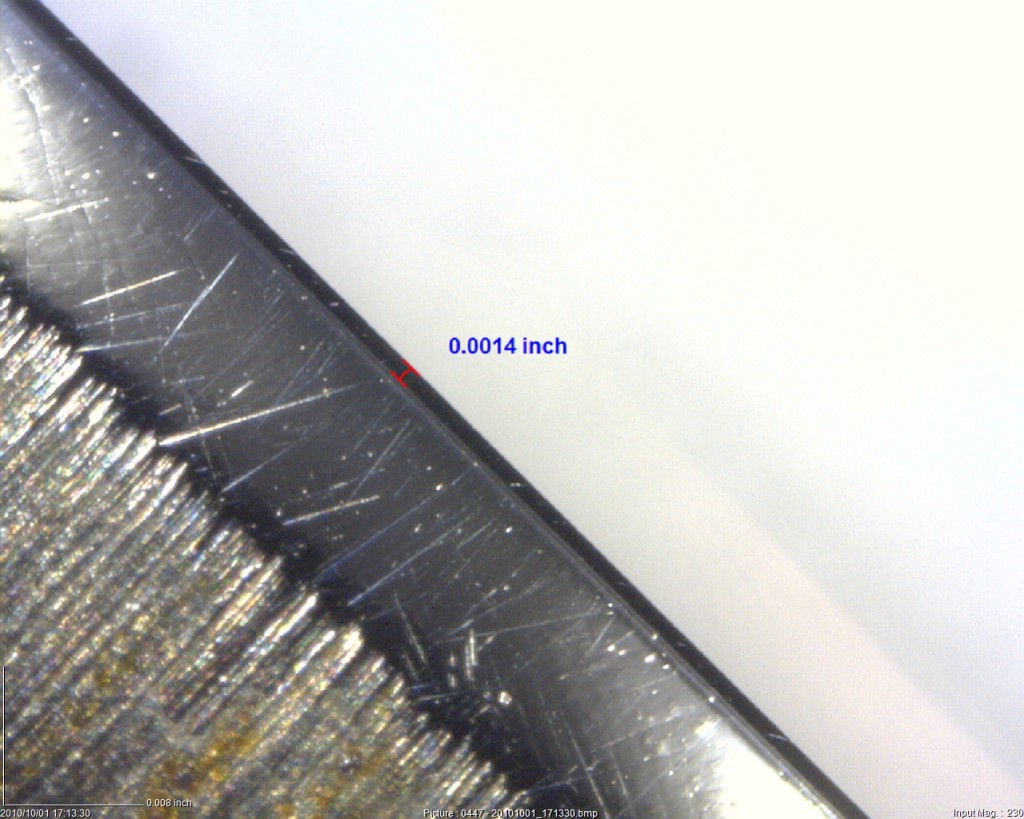
Double bevel tools such as knife blades require more care when sharpening. “Remember, you are grinding two bevels that have to meet at a particular edge as evenly as possible. Practice and consistency are keys here.”

But, how far should you sharpen your tool? “Polished edges do last longer but I’ve seen woodworkers obsess about getting to ultra-micro-fine abrasives to get the ‘perfect’ edge on their tools. I think 8000-grit is fine enough for most applications but woodworkers I know and respect insist on 12,000-grit or even finer for their blades (Here is an excellent chart to help you identify different grit sizes across a variety of honing media). Keep a block of wood, pine works well, in a vise nearby. When the tool can cleanly pare through the end grain with little effort, that’s where I’d stop. After all, you want to get back to woodworking as soon as possible, right?”

Spring out of the trap!

Check your calendars. Yup, THAT day is coming. Valentine’s Day.

V-Day is one of the biggest trap holidays of the year for couples as far as I’m concerned. Think about it – we have just completed the holiday season, complete with gifts, celebrations and even resolutions for the New Year. And, since the spring and summer are the two most popular seasons for weddings, the big anniversary celebrations are coming down the pike.

But, there Valentine’s Day sits, smack in the middle of winter for us in the northern hemisphere. The holiday bills are due, the snow and ice are out in force this year and good luck trying to make reservations for a fancy dinner at a restaurant. Faggetaboutit!

Add to the mix that my wife – as with many other spouses – has told me not to make a big deal out of the day. Hmmm, I’ve heard her say that before – only to find out that what it really means is to not make it look like it was a big deal…

Fortunately, we as woodworkers have an easy way out of this trap holiday – and it involves our favorite pastime of all – woodworking.

“Yeah, this is always a tough time of the year for us,” said Tim Walter of Eagle America. “That’s why we have a few ideas that can get you some shop time AND win some big points with your better half.”

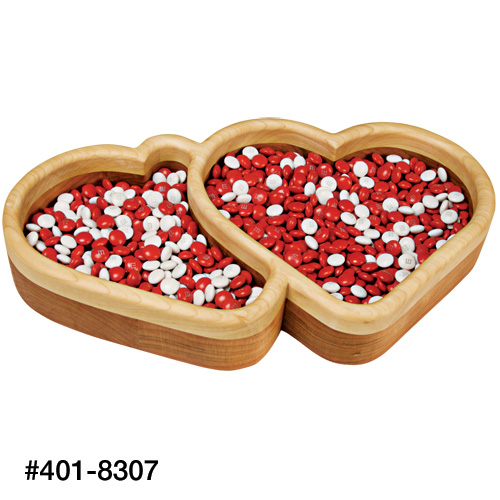
The first idea he shared with me was an appropriately-themed adaptation of Eagle’s wildly-popular tray routing system. “We have templates in the classic Valentine’s heart shape so you can show your significant other just how deep your love is. Heck, if you really want to get fancy, we even offer the double heart template so you can demonstrate just how both of your hearts are intertwined.” (I had no idea Tim was so poetic, but DANG, that would make a great line to put in the valentine card you send your sweetie, no?)

By using the template and special bowl-routing bit, you can easily make a serving tray out of one species or a glue up of several. Just don’t forget to include some nice chocolates with the gift…

If serving trays don’t make your heart go pitter-patter, there are other options to choose from as well. “A special keepsake box is a meaningful gift to give – especially to that special someone in your life.” The beauty about keepsake boxes is that they require such a small investment in wood, but allow you to be as creative as you would like to be. “Material selection, joinery choices for the sides, foot design, interior linings – the options are nearly endless. Imagine using wood harvested from where you first met or spent your honeymoon incorporated into the project. That would be a piece with special memories and show just how unique your relationship is.” (Tim should get a job with Hallmark! He’s that good!)

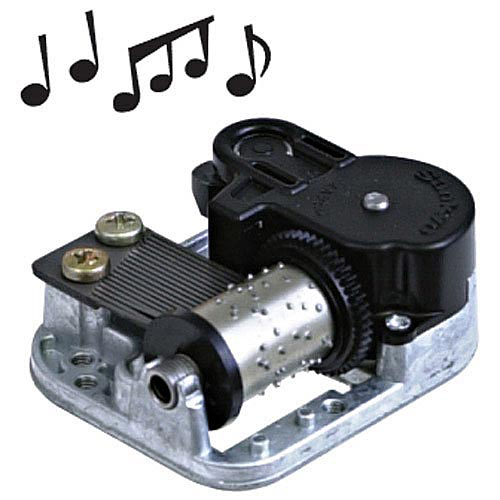
And, if you want that box to do more than just hold stuff, why not consider installing a musical movement? The choices sound like the playlist for a new couple at a wedding reception – Unchained Melody, Let Me Call You Sweetheart, Close to You… Heck, maybe one day they’ll offer a few selections from Barry White to make their collection complete!

While it may be a trap holiday, it’s best to play Cupid – not stupid – when it comes to getting ready for Valentine’s Day.

“That is one awesome axe…”

One of the things I enjoy most about woodworking is the wide variety of specialties you can drill into.

Do you like carving? You can do chip carving, power carving, relief carving, carving in the round…

Cabinetmaking? Build a set of kitchen cabinets, a freestanding pantry, an elegant home library…

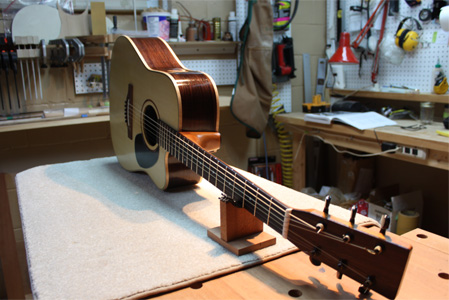
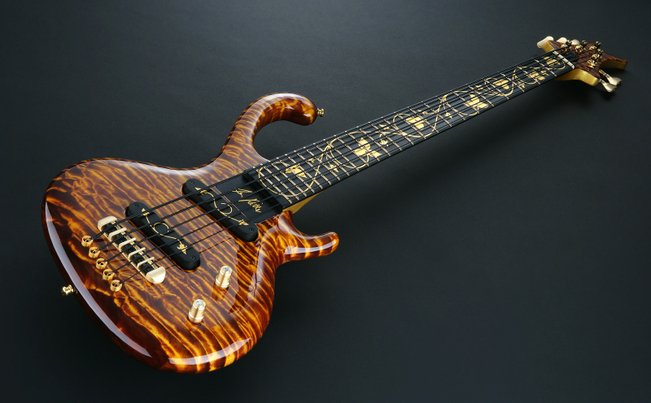
And, then you could become an instrument maker. While brass and woodwind instruments require metalworking know-how, luthiers can build some incredible pieces from wood.

No, luthier doesn’t mean that you are more luthy than someone else… A luthier is someone who builds stringed instruments. Guitars, ukuleles, violins… the works.

“We get lots of requests from luthiers of all levels of experience,” said Eric Poirier of Bell Forest Products. “You’ll see people just starting out who want to build a solid body electric guitar to those who craft playable works of art.”

While cellos, dulcimers and harps are interesting projects, nothing can compete with guitars for popularity. “Electric, acoustic, bass… so many woodworkers who are musicians – or know someone who is – want to build one of these iconic instruments.”

When it comes to building an instrument – especially a stringed instrument – many design and structural elements need to be taken into consideration. “A properly tuned guitar or bass guitar puts tremendous strain on the neck and the body of the instrument. When planning on building one, you need clear stock of significant strength to prevent warping and possible cracks down the road.” That’s why Bell offers guitar neck blanks of maple, mahogany or Indian rosewood. Equal parts beauty and strength, these neck blanks can make an awesome through-neck or bolt-on neck guitar.

On the face of the neck, luthiers frequently apply a fretboard to the instrument.  “The fretboard is another critical part of the instrument.  It has to hold the fret wire – if you are building a fretted instrument – and resist abrasion from the strings as they are held down to make notes.”  The fretboard offerings by bell come in a selection of beautifully sawn exotic and domestic species, ready to make a statement on the instrument.

And, when it comes to guitar body materials, just about anything goes. “Luthiers making solid body electric guitars and basses can let their imaginations run wild for the body.  For those making hollow body models, a strong, light wood that can be readily resawn into thinner strips for bending is the way to go.”

Ultimately, the skill of the luthier is what’s on show when an instrument is played. “Your first guitar will take you a whole lot longer than you realized because the work is exacting.  But, once you get the hang if it, you’ll get into the flow of things.” Eric added, “Besides, when you are learning how to play, everyone will forgive your fumble fingers and stare in amazement at your beautiful axe!”

I call monkeyshines….

If you are building holiday gifts, you might want to check out the latest edition of Wood Magazine.  In the December  2010/January 2011 edition, you’ll find the latest installment of the Shop Monkey column called “Living in the present.”


In it, you’ll find some of my tips for keeping your sanity when building woodworking projects during the crazy holiday season. Have you thought about how you’ll ship those things?  What will you do if you end up with a bad cold and have to play beat the clock?

If you want to read even more Shop Monkey input, why not check out my blog over at the Wood Magazine forum website?  Navigate the content and read the input from your favorite bloggers.

Yes, you can even read my content if you have nothing better to do …

Now, no more monkey business… back into the shop!