Earlier this month, Marc Spagnuolo over at the Wood Whisperer site led the annual Woodworkers Safety Week effort, where woodworking bloggers around the web write up articles on shop safety. From the simple tips such as cleaning up your workbench all the way through the gruesome stories (and photos) of shop sessions gone wrong.
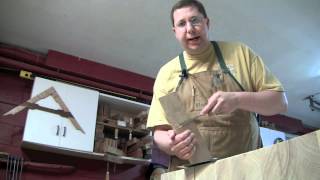
Click for Shannon Rogers' Shop Safety video
But, reader Jay Cox had an interesting question – just how long do these messages stay with you? Do you keep them top-of-mind throughout the year as you work, or are they forgotten shortly after you read them?
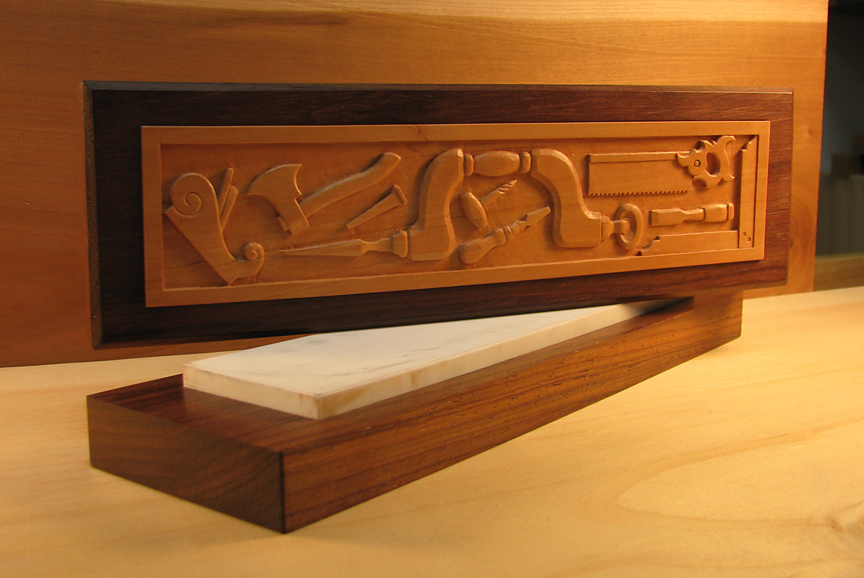
Since I joined the St. Petersburg Woodcrafters Guild, I have seen some incredible carvings up close and personal. Add to that seeing the impressive work of Kari Hultman and others and – boy – all I want to do now is carve. But, where on Earth to begin?
That’s why I’m happy this how-to page was created by the folks at Chipping Away. It gives a great primer on different types of carving styles (from delicate chip carving to carving in the round), an interesting perspective on how old someone should be before taking up the craft and links to tools to accomplish the different styles of carving.
It’s an interesting place to begin if you are interested in doing some carving on your own.
I can remember my dad’s old table saw blades. Those suckers were all high speed steel, with the teeth alternately set to clear a kerf in the wood. And, I can also recall my dad complaining that they were dull and had to be sharpened all the time. What would have fixed this problem was maybe something that could stay harder and sharper between sharpenings …
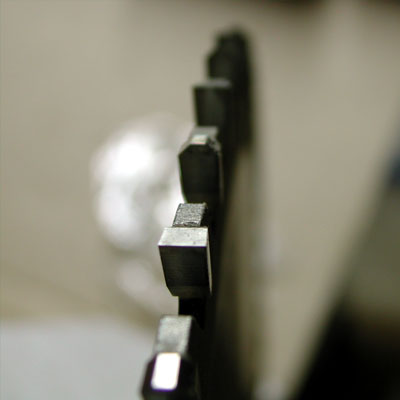
Enter carbide. These little bits of material are braised on to the teeth of these saws or the cutting edges of router bits help blades cut more cleanly while holding their cutting edge for a longer time. But, what the heck is carbide, and how can you tell what you are getting?
Carbide – more specifically tungsten carbide – is a combination of tungsten and carbon, arranged in an elemental structure that resembles common grains of salt. The substance starts out as a powder, but then is cast in a process known as sintering with a metallic binder to form the individual teeth or cutting edges. Under a microscope, these carbide cutters resemble concrete with the carbide serving as the aggregate and the metallic binder serving as the cement holding everything together.
Carbide cutting edges are exceptionally hard, and can only be sharpened with diamonds or other similar abrasives. So hard, in fact, that the United States Army uses tungsten carbide in certain circumstances as a tank armor penetrator instead of depleted uranium in their anti-tank rounds. That’s why you can’t simply use a water or oil stone to touch up your carbide cutting edges. The carbide would wear a track right through your stone. Diamond stones can be used to touch up an edge, but do so slowly… and just a few passes. For complex profiles on router bits or for teeth on a table saw blade, you might want to look at sending the blade off for some professional sharpening.
While all carbide is made of the same stuff, there are many different grades of carbides out there, and grade selection can make or break how well your tools perform. For instance, the C number of the carbide tells you just how hard the carbide matrix is. Something like C2 carbide isn’t quite as hard as C3 or C4 carbide. The harder stuff gives you a much better finish, but it’s far more brittle. So, while C2 may survive contact with a nail, C4 would be more likely to shatter.
The other think to keep in mind is that the size of the grain of the carbide which is sintered into the carbide cutter. The finer bits of carbide embedded in the matrix, the more finely the edges can be ground, giving a smoother cut. Larger, chunkier bits of carbide embedded into the matrix makes them less prone to handle impact with wood, so you could see the edges become dull faster.
Another thing to keep in mind – while all carbide is made of the same stuff, poor quality carbides will be sintered with a lot of bubbles in it. The more porous the carbide tips produced by using less expensive manufacturing processes fail to hold their sharp edges. That’s why premium carbide blades cost significantly more, but produce far superior results.
Just as important as carbide manufacturing is how the tips are attached to the blade or cutters. The process is known as brazing, in which a blend of metals are placed on the steel of the blade or bit body, heated and then the carbide is attached. David told me that the formula they use for their blades and bits not only hold the cutters to the blade or bit, it also serves as a form of a shock buffer, helping the teeth better withstand the impact of cutting into wood.
While carbide is very tough stuff, there are some simple things you can do to help prolong the life of your saw blades and bits:
First, be careful when handling your blades and bits. Because the carbide is just so hard, you can chip the teeth or cutters if you put them down roughly on a hard surface like your table saw top.
Keep your blades and bits clean. Pitch build up on the blades can block the sharp cutting edges of the carbides, forcing you to push the work harder and increasing the heat generated by friction, leading to more burning. You can use a number of different cleaning products, but stay away from caustic oven cleaners, which can affect the braising used to hold the teeth on the blade or bit.
And, finally, remember that carbide does dull. If you notice more friction and rougher cuts, or the edges of the cutters look chipped, bring the blade or bit in for a little TLC. Your effort will be rewarded.
While my dad’s old circular saw blades without the carbide inserts aren’t going to get a lot of time in my shop, they are awesome for the obligatory saw blade shop clock. That’s a pretty good use for them!
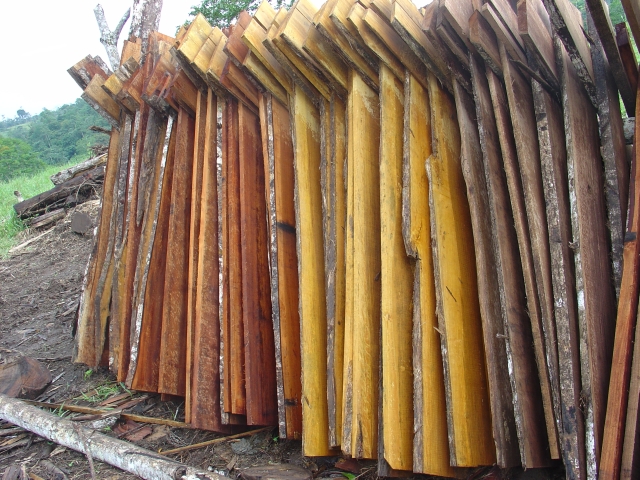
While local hardwoods can be a pleasure to work with and can leave you with a gorgeous project, tropical hardwoods can be eye-poppingly beautiful. Whether the vividly colored bloodwood or purpleheart from South America, the highly desirable bubinga or wenge from Africa or the hard wearing teak or rosewood from Asia, these boards from the planet’s tropical areas can be a woodworker’s dream, giving your projects a style all their own.
They do come with some drawbacks, however. First, they have different characteristics than the native wood you work with, leaving a splintery mess where a clean cut should normally be. They can also be very expensive, since they have to be harvested and shipped great distances to your supplier. And, the harvesting of these trees isn’t always done in a responsible manner, possibly being pulled from forests without consideration of their future health.
This week, let us know how you feel about using these tropical hardwoods.
Looking for personal protection equipment to wear in the shop? How about a new motor for that old table saw your grandfather left you? A new cordless drill?
Did you know there is a place you can go to find all this stuff? Grainger Industrial Supply has all of these parts – and millions more. I ran into one of their reps this week at the Governor’s Hurricane Conference, and he showed me the catalog of the stuff they offer… Boy, was that one thick book! They are worldwide, have locations all over the place and have all of those oddball pieces of hardware you can’t seem to find.
(Hey, folks, please take the opportunity to read my editorial statement at the head of Monday’s column. There are several points of clarification that need to be read.)
So, here I at the Governor’s Hurricane Conference and man – I’m keeping busy. I’ve been teaching a basic Public Information Officer class the past few days… my voice is shot! With hurricane season just a few weeks away, it’s time to get ready for what the season may bring. That’s what we’re here to do this week – learn from the experts.
As a hurricane public awareness spokesperson, it’s my job to pass information on to folks who may be in danger about the importance of having a disaster plan. While I normally talk to residents in all types of organizations and communities the county, I recently had an opportunity to speak with the St. Petersburg Woodcrafters Guild about the topic. In fact, I was the presenter that night (Great, I get to work for my dinner there as well!).
I had two topics to cover that night. The second one was veneering (that video will be next week, I promise!), but the first topic was about how to prepare your shop for the potential of a disaster.
Now, I know many of you won’t ever experience a hurricane in your lives (Unless, of course, you order one at the bar), but there are a number of other disasters that can befall your shop. Floods. Tornadoes. Wildfires. Theft.
In this roughly seven minute presentation, I covered many of the basics, especially when it comes to insuring your shop and tools so you can recover from a disaster.
(Shop Monkey Note: After discussion with the folks at Fine Woodworking, it has been determined that the title of the Shop Talk Live podcast applied to a segment later in the show and not to the online blogging community. That said, the folks at the magazine have admitted that they weren’t careful in how they expressed their concern toward the online woodworking community, and have issued an apology.)
It’s not often that I react to what other folks post, but this one couldn’t slide by the wayside. The folks at Fine Woodworking Magazine posted a shop talk live video podcast, their fifth, called “Perfect Storm of Stupidity.”
Nice title.
The podcast goes into a discussion about the online woodworking community… And, at first, the comments were pretty complimentary and tame. It’s a great way for people to share their experiences – to show what they are building and how they are growing in the craft.
Had the conversation ended at the five minute mark, It would have been a great topic to cover and things would have sat OK with me. Alas, they couldn’t leave well enough alone. In the next five minutes, I learned that the Internet is basically awash with a bunch of idiots claiming to be ‘experts’ on every topic, leading the poor beginning woodworker down the ‘wrong path’ to frustration and a lifetime of failure.
Woah. Hold the phone, fellas. I do get that some folks may or may not have a total grasp on the finer point of technique. But, I know a great number of woodworking bloggers, and I really have yet to run into one who claims to be an ‘expert’ on the topics they write about.
The claim was made that no one is vetting the level of expertise of these bloggers, and there is plenty of bad information floating around out there pretending to be the voice of authority. I have seen people cut joints that I’m not sure would be the best for the particular situation, but I have seen plenty of techniques that are plenty sound. Besides, if those techniques work for the particular woodworker, why not see how they are done?
The question of shop safety was also brought up. Some of the videos out there can be downright frightening to watch, with the one I posted here being example A. But, believe me, if someone goes out and puts up a post that’s not safety-conscious, the readers are going to be the ones who weigh in it. This was identified as crowd sourcing, and trust me, it works. Heck, I’ve had folks weigh in when I don’t have my safety glasses on while I hand plane.
Another point of emphasis is that the more stuff a woodworker builds, the better they are. Therefore, if someone build dozens of pieces of furniture of one style, they should be looked to as the expert in the field. I can see the logic in this, but it would be a stretch to say that this is a 100% guarantee that they are truly better. Think of it this way – if a person has been practicing the violin for 40 years and has perfect playing form, but can’t make the instrument sing, why would I want to listen to the performance? If someone has been playing for five years and can bring down the house, why would I not want to hear that? When I see younger woodworkers who have less than several decades of experience – David Marks, Rob Bois, Shannon Rodgers, Kari Hultman – cutting tight joinery and making it work -I am encouraged to see the new generation of woodworkers coming along to help pass the craft to my children and their kids.
The video hosts went on to say that only people vetted by the woodworking magazines or by well-known schools are the ones who really truly understand and can teach the proper methods. With their high level of expertise, they are the ones truly qualified to teach how to build. Nonsense. People who can woodwork are an awesome bunch of people, but it also takes an incredible amount of skill to be able to teach others about the craft. Communication, interpersonal skills and desire mean a lot. I had the honor of taking a class from Marc Spagnuolo when he was in his late 20’s… and his teaching skills were light years ahead of some of the other ‘more experienced’ instructors I have taken classes from.
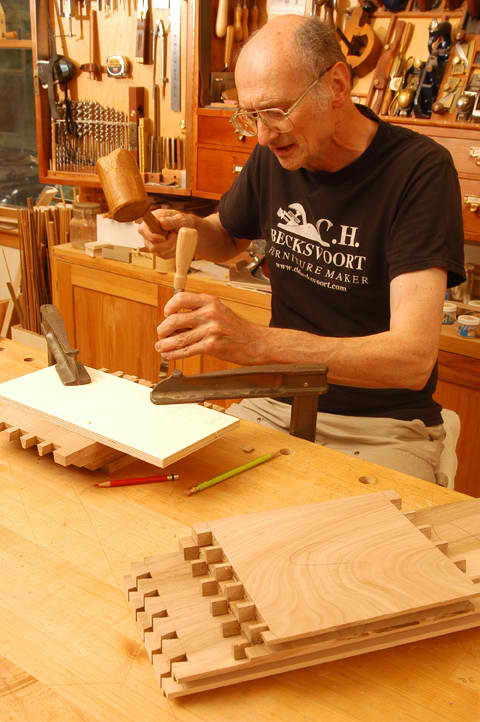
Another thing that struck me as odd … we know that all woodworkers have their own preferences on joinery. And, after years of doing things only one way, they tend to rely on those same joints and techniques for most – if not all – of their projects. I contest that it’s good to get a wider, more diverse vision of how things can be done. If I have said it a once, I’ve said it a million times – there are about a thousand ways to cut a particular joint, and they are all right if they make for tight joinery that can take the abuse. So, say, if Chris Becksvoort hand cuts his dovetail a certain way, does that mean that machine cut dovetails are inferior? How about box or finger joints? Splines? Should they not be considered valid because someone prefers another style of joinery?
And, while passing on the information is fine, what about the inspiration? David Life is a woodworker I have profiled before, and he does his work in spite of being legally blind. I find it fascinating to learn from David how his techniques have had to evolve as his eyesight faded. Hearing stories about woodworkers like David help make me a better woodworker. Just reading about or watching ‘established and vetted’ woodworkers leaves me flat. I need to see the stories of woodworkers like me – toiling away in their shops and turning out great work on the weekends and after hours – not just the ones who do it full-time for a magazine or at a woodworking school.
I contest that online woodworking is far from the perfect storm of stupidity. In fact, this online collaboration has done more to get new woodworkers off their behinds and into shops that many of the established woodworking sources care to admit. And, it offers exposure to a rich variety of techniques I may not have considered in my woodworking. Is it perfect? Nope, but either is the other option where only a few ‘masters’ control what content is released to the masses.
If you would like to hear about why I or other bloggers do what we do, check out our take on things on the fifth edition of the Modern Woodworkers Association’s online discussion.
Oh, and keep on blogging and building. I see the perfect setup the way things exist.