All posts by Tom

I'm the guy who writes the blog...

A woodworking pilgrimage

When woodworkers talk about places they HAVE to visit, some constantly come up in discussion. The Gamble House. The Hancock Shaker Village.  The USS Constitution.

And, then there is the cabinet shop at Williamsburg, Virginia.  Yes, the cabinet shop that Roy Underhill helped restore back in the 1970s. The one that was originally established in the early 1700s that uses period authentic tools to build period authentic furniture. That one comes up time and again as a place where woodworkers would love to go and spend some time completely immersed in the aura of the place.

Yes, it totally lives up to the expectations.

While walking in to the historic park, you have the opportunity to look at some very rough house-building carpentry. A group of three reenactors are out working on different aspects of creating shingles and clapboards for homes, barns and other outbuildings.
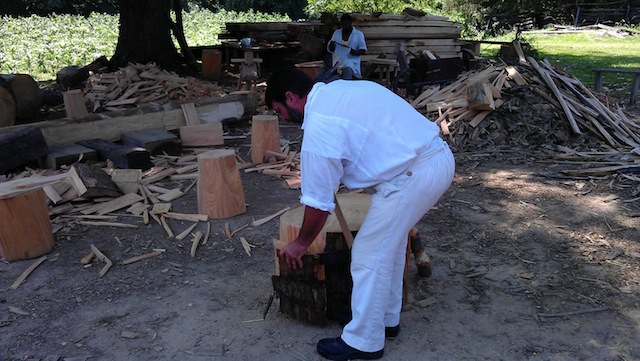
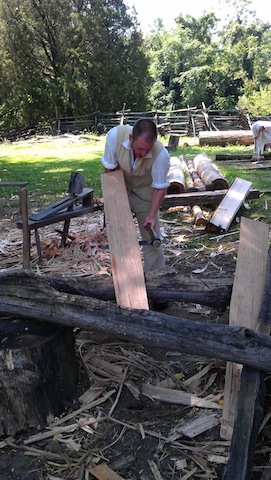
Splitting shingles from a large cypress log
Riving oak clapboards with a froe
Shaving split shingles with a drawknife at a shaving horse

Once past this fascinating demonstration, and much deeper into the historical park, is the little white house down a hill a ways that you just might pass by if you weren’t carefully looking for it. There lies the cabinet shop itself in all of its modest glory.

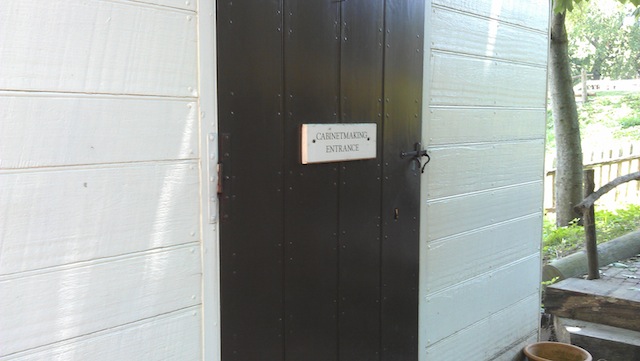
The cabinet shop down the hill
Come on in to the cabinet shop!

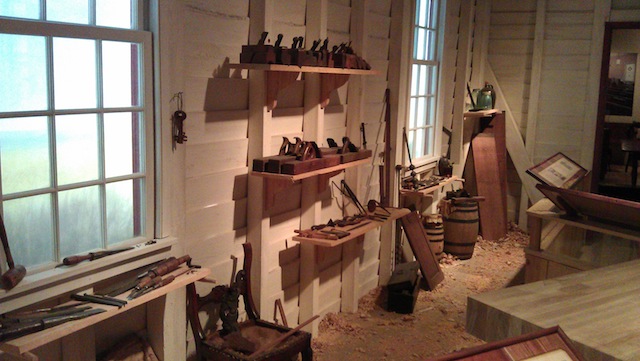
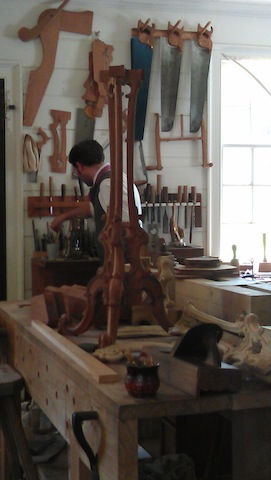
Once inside, you are indeed transported back in time to the 1780s. It’s a small, crowded shop that is well appointed with several workbenches, plenty of tools and several projects underway.
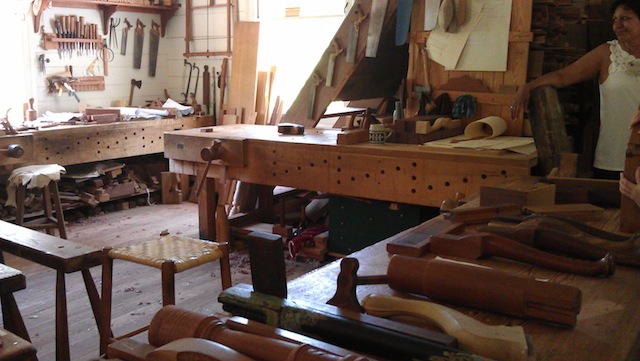
One of the English pattern workbenches found in the shop
A three-legged candlestand under construction
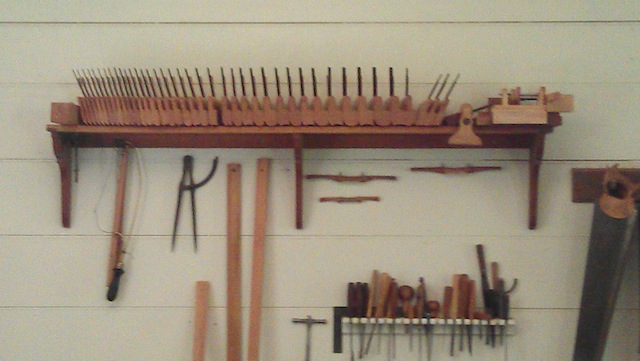
A rack of molding planes waits to be called into action
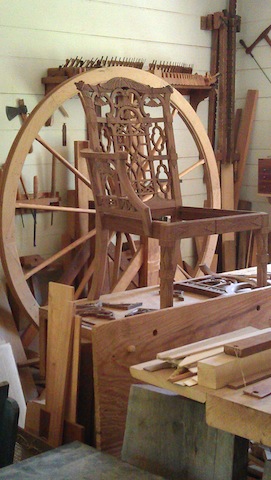
An ornate Chinese chair is under construction on one of the benches
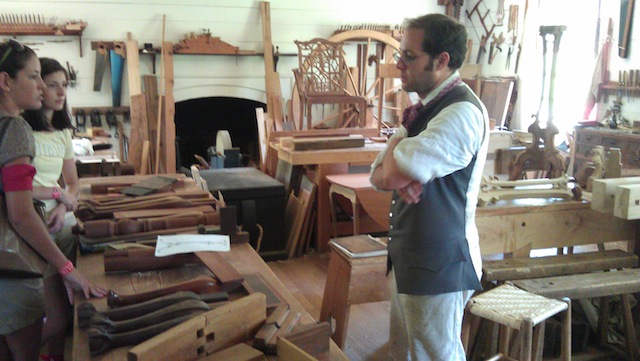
A docent talks about the shop to a group of visitors

Was it worth the trip? You had BETTER believe it. Just try not to plan your trip when the temperature is a steamy 104 degrees Fahrenheit…  That will make your trip just a little more enjoyable.

But, even if you do, they do have the cabinet shop totally air conditioned.  Not a bad reason to stay there the whole day.
 

Quick Poll

It’s hot. You are sweaty. The kids are driving you nuts because they are ALREADY bored with summer vacation. What to do?

If you are like many of the other millions out there on the highways this summer, you are out enjoying a family vacation. Away from work, home and all of those cares.

Yup, living out of a suitcase with limited access to laundry, bickering kids in the back seat and hotel shower heads that go from ultra-lame dribble to uber-powerful riot control with the twist of a dial.

While we are away, there are lots of things to see and do. The mountains. The sea shore. Museums and lakes. Cityscapes and peaceful countryside. Oh, and woodworking.

Yes, there are plenty of places where you can see some sweet woodworking. This week, tell us if you plan for woodworking on your family trips, if it just happens or if you steer clear altogether.


Link of the week

Beyond the Veneer: Thomas Day

You like woodworking, right? If that’s the case, book a trip to Raleigh, North Carolina. Visit the North Carolina Museum of History. Go to the third floor, and get yourself to the Beyond the veneer: Thomas Day exhibit.  Trust me, you will love it.

Day, a free person of color in North Carolina in the years before the American Civil War,  created furniture in popular 19th-century styles — from the very “neat” and “plain” to the ornate Rococo Revival — and infused many of the styles with his exuberant motifs. There are more than 70 pieces in the nearly 6,000 square foot exhibit, including some of the pieces he built for the newly-formed University of North Carolina.

The exhibit also includes a mock up of Day’s workshop, complete with a full-sized Roubo you can caress lovingly… At least until the security folks shoo you away.

Oh, and admission to the exhibit – and the rest of the museum –  is free, but, you might want to book that trip soon. The exhibit is slated to close in January of 2013.

A smart combination

I have trouble getting things square.

There. I said it. I don’t have the ‘eye’ to get things square on just the first crack. Or, sometimes the second. Or even the third.

But, eventually I get things right. And, that’s due primarily to a lot of measuring aids that I turn to. I have a number of clamping squares that help get things at right angles during assemblies. And, then there is my little double square  I like to pull out while I’m planing to ensure I’m not getting out of square while I true an edge.

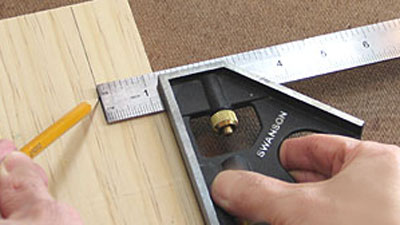
But, the real multi-tool of them all is the combination square. That sucker is a real workhorse in most shops. It typically comes with a 12 inch rule and a head that measures 45 and 90 degree angles. There are other heads that can increase that versatility, including protractor heads and center-finding heads. You can check assemblies for square, measure bit or blade height above a table, use them to scribe a cut line … well, they are a tried-and-true multitasker in the shop.

You can go uber-cheap with them, picking up the big-box home improvement version, or you can drop some serious coin on a Starrett model. But, for the average woodworker who needs a great, reliable tool AND would like to have some money left over to buy some wood, there are some options available.

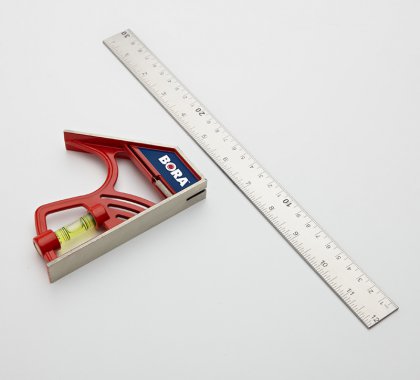
One that was sent to me by my new sponsor Bora Tools has an interesting feature I have never seen in a combination square. Most models use a ruler with a groove milled down the middle of one side. And, in the head, there is a nut that can be tightened down to lock the rule in place. The system works well, but if you ever pull the rule out to measure by itself, getting the parts all aligned can be a real pain in the posterior.

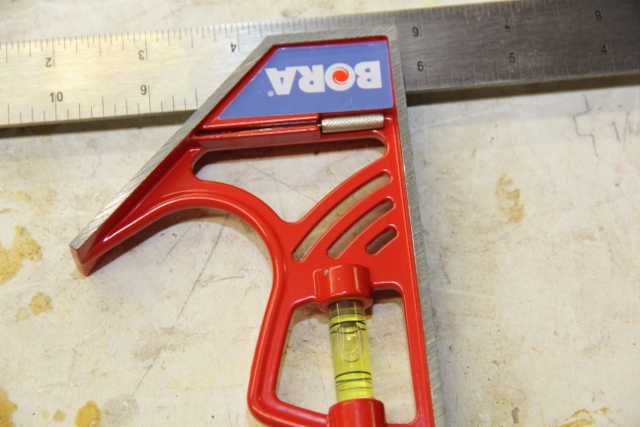
Bora’s combination square does away with all of that nonsense, relying instead on a set of rare-earth magnets to hold the rule in place. It holds securely enough to allow accurate measurements to be obtained, yet still allows for easy adjustment for changing measurements.

The rule that comes with this combination square is a substantial etched stainless model graduated coarsely on one side (in eighth-inch increments) and fine on the other (32nds). I have used this as a guide for my marking knife, and its thick edge is a sweet surface to reference the knife against.

The head of the tool is cast zinc, with all of the edges that contact the work surface milled well. It comes with a steel scribe for use when marking cut lines for joinery. And, it comes with the obligatory level vial to serve as a level or plumb reference.

When you throw in that Bora guarantees this tool for life, well, come on, what’s not to like?

Now, I just have to make sure I actually USE this thing when I woodwork, and stop trusting my poorly calibrated eyeballs.


From Tom’s workbench… with love…

With Tropical Storm Debby dumping tons of rain on us, and me called in to the Emergency Operations Center, my wife Rhonda has stepped to the plate and written a post for your enjoyment. She tried her hand in the shop … and here’s what she observed.  Enjoy!

First let me say that I am NOT one of those do-it-all women who know all the names of the power tools and which side is the sharp side.  I’m a busy mom, high school teacher, and wife.  Recently, after a frustrating search through Michael’s craft store, I couldn’t find any craft I could cling to.  So I decided to delve into my husband’s territory, with his permission, of course.  After all, I figured, here’s a quick route to “craft” satisfaction.  I could sand, finish, and maybe even veneer some of his furniture.  We could bond over birch, improve our communication skills while working side by sander, and share our dreams during demo.  That’s not exactly how things worked out.  But after you find out what happened, maybe you’ll be inspired to invite your wife or girlfriend into this sacred sanctuary called “the shop.”

Today’s task:  sand a stepstool.

In my first foray into the shop, I realized I would have to get used to a few things.

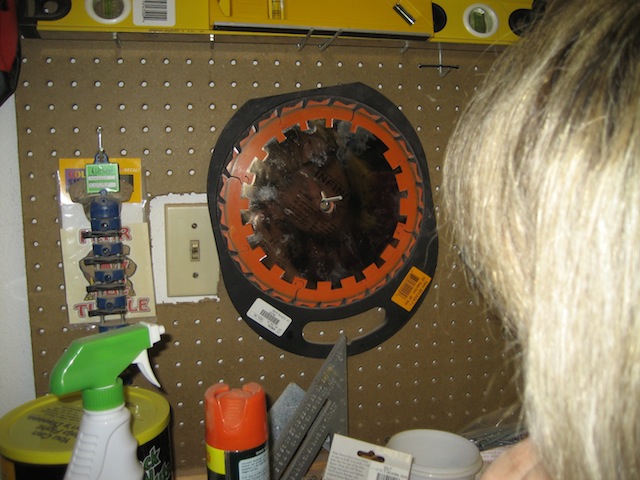
  1. No mirror.  Touching up in the shop is tough.  I found a way around it, though.  The infinity saw blade Tom had mounted on the wall.  Thanks, honey!
  2. No chit chat.  Once that sander turns on, you can’t carry on a conversation with anyone.  On the upside, I was able to recall all of the locales of the Real Housewives gals on Bravo.  (There are 5, I think.)
  3. No multitasking.  I LOVE doing more than one thing at once.  It’s supremely satisfying to make dinner in the oven while cleaning the fridge and quizzing your 11 year old on multiplication tables.  It must be in the genes.  You know what I mean, mom.

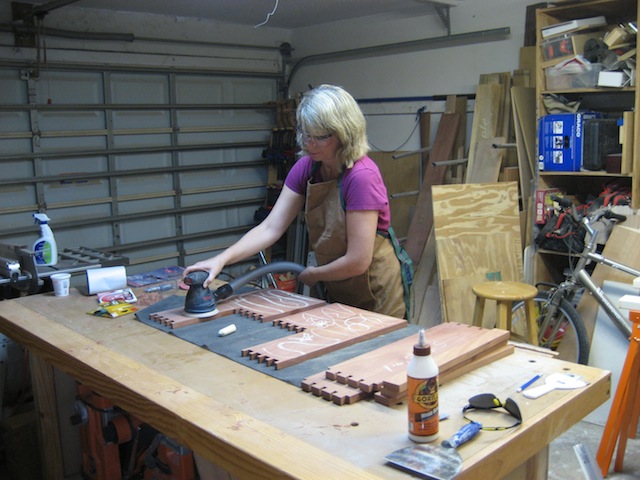
Now that you know what I’m up against, the actual reason I entered the shop was to sand my mother-in-law’s stepstool.  Tom had cut out the pieces with dovetails.

Santos Mahogany is a gorgeous wood.  Very … appealing.  OK – I have no idea how to describe it other than I like it.

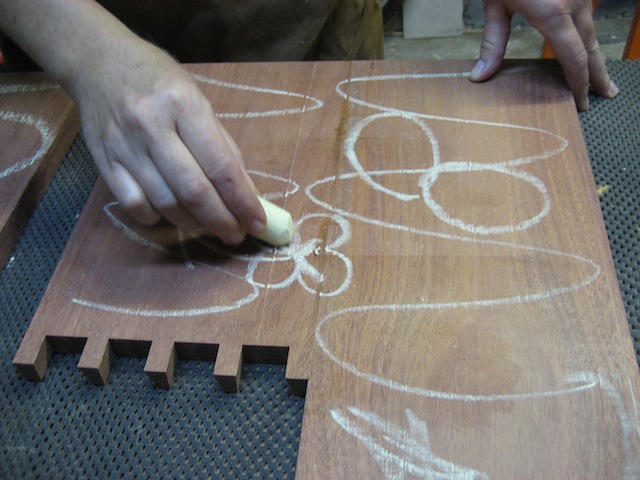
The first step was to get the right grit on the sander.  We used 120 for the first round.  I grabbed a piece of chalk and drew lines, and some flowers, so I’d know if I evenly sanded the wood.

Once I started up the sander, it was easy.  I just let the sander “do the work” as Tom instructed.  It took longer than I thought, though, and I had to resist that multitasking urge and just take my time.  After about 10 minutes, I flipped the pieces over to chalk and sand the other side.

By the time I was done, about 20 minutes later, I had a tingly sensation in my hands and just wanted to sit down.  But a refreshing sense of accomplishment came over me.  I had completed the task for today and looked forward to the next go-round with a lighter grit sandpaper tomorrow.  The step stool will essentially be made by both of us and I feel pride and ownership in that.

I see why you love this hobby, Tom!


Quick Poll

Hobby woodworking has undergone a tremendous change over the past fifteen years, and much is thanks to the Internet.

Once the only way to learn about woodworking was to take a lesson from a school or a knowledgeable neighbor, relative or friend,  read books and magazines or watch woodworking shows.

Today, woodworkers have access to a vast array of resources right from the comfort of their own living rooms.  Websites featuring new techniques, tool reviews and video build alongs have sprung up and can provide immediate access to what woodworkers want to know.

Of course, the Internet could be a huge time waster, taking away valuable time actually doing something in the shop.

This week, how important of a woodworking tool do you believe the Internet is for you?


Link of the week

Giant Cypress

A monk asked Zhaozhou, “What is the living meaning of Zen?”
Zhaozhou said, “The cypress tree in the yard.”

Wilbur Pan is a gifted woodworker. From his workshop in New Jersey, he creates tremendous  projects with a distinctly Asian flair.

Photo courtesy of Nik Brown – digitalwoodworker.com

His blog, Giant Cypress, is a great place to come for sound advice on his collection of Japanese tools, treatises on wood selection and working methods and links to a rich array of woodworking knowledge.

Wilbur also likes to link to a number of other sites that will make you stop and think, and he also posts many of his witty observations for readers.

In addition to running the site, he’s also one heck of a funny guy.  Visit his site, I’m sure you will be happy