All posts by Tom

I'm the guy who writes the blog...

Link of the Week

Going to Woodworking School

Ring the bell!  School’s back in session – especially for woodworker John Fleming.  He’s just started at the Palomar College Cabinetmaking and Furniture Technology Program in San Marcos, California.

Fortunately, he’s sharing his experience with us over at his new blog.  During this extensive program, John will be learning about furniture design, stock selection and preparation, joinery and finishing.  You can subscribe to John’s updates as he goes through this program and follow along on his woodworking journey.

Friends, Romans, Woodworkers….

Back when I was a student at the University of Maryland, I  had to study quite a bit of English Literature.  Makes sense, since I was majoring in English Literature and Language.

During my classes, I was exposed to many different writers of classic English and American novels, plays and essays. Some were just awful – wretched books that I had to force myself to read or risk failing. A few words of advice – if you ever have to make the choice of being compelled to read Humphry Clinker by Tobias Smollett or having your flesh ripped by wild weasels, you might want to give the weasels a chance…

However, other things I had to read were very engaging. Pleasant.  By the time I was ready to receive my Bachelor of Arts degree, I had developed a fondness for the works of William Shakespeare. The Bard of Avon – also known affectionately as Billy the Pen – had a way of setting a scene, bringing his characters to life and engrossing you in the story.  Romeo and Juliet, Richard III, King Lear… Shakespeare was able to churn out classic after classic.  The plots of his plays still appear in slightly different forms in movies, novels and even television shows.

My favorite play of all was Julius Caesar.  Talk about a play full of tragedy, majesty, deception and betrayal. Almost sounds like one of those reality shows on TV today.  What really makes the play for me is the oratory.  Both Julius Caesar’s assassin Brutus and the play’s protagonist Mark Antony make rousing speeches at the Roman Forum.  Mark Antony’s stirring words ultimately sway the crowd against Caesar’s assassin, setting up the eventual downfall of Brutus.

The whole forum concept was critical in Roman society. Forums were established in larger Roman cities for people to gather for commerce, for intellectual debate, religious worship and for justice to be dispensed.

So, it should come as no surprise when gathering areas were established on the Internet, they would come to be known as forums.  There are forums that appeal to many different interests – automotive repair, fashion, cooking, home improvement, business and technology.

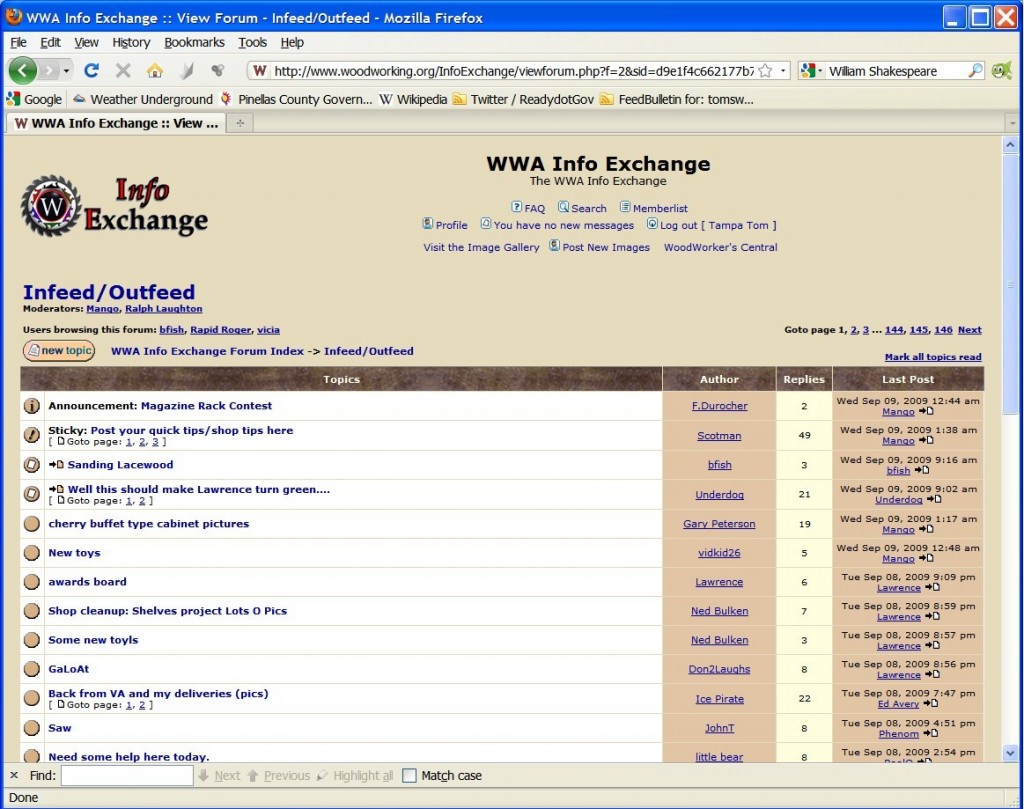
As woodworkers started gravitating to the Internet, many different woodworking forums began to spring up as well. At first, they were simple evolutions of ‘bulletin board’ services which had been around since the earliest days of what would eventually become the World Wide Web.  These forums have advanced tremendously over the years in sophistication, giving users access to a tremendous amount of information.

WWA

Some of the forums out there are tied to woodworking magazines.  These forums tend to attract their readers through their printed editions and focus primarily on topics covered by their contributors.

Others are run by tool manufacturers or vendors.  These are obviously focused more on the tools they sell, which gives users an excellent opportunity to get very tool specific answers to problems they may be experiencing.

Some are run by professional associations, woodworking schools or bloggers, which give a greater depth of information about current projects, trends or special offers to participants.

Finally, there are those which are just a little maverick.  In the early days of Internet forums, woodworkers kind of went their own way, establishing independent forums not beholden to an advertiser or other ‘parent’ entity.  Donations at this kind of site are usually greatly accepted!

These online forums are outstanding places to get your woodworking questions answered – sometimes in mere minutes.  However, you also have to understand that just as in the Roman forums, many people will be coming there to give you advice.  Each of the woodworkers who posts is coming from their own level of experience, set of tool preferences, methods of construction, etc.

While these boards are typically moderated for inappropriate behavior, don’t be surprised if  – say – your question on how to cut a mortise comes back with several different methods – and many vociferous supporters of each who  may seem a little strident in their support of their preferred method. “You fool!  You  MUST cut a mortise with a hollow chisel mortiser.  It’s the only way!”  “Forget what he said.  Develop your hand tool skills and chop them with a mortising chisel!”

Needless to say, when it comes to using these forums, it pays to have a bit of a thick skin and an eye to discern the level of expertise – and if they are trying to sell you something.

Oh, and it also pays to overlook some of the spelling and grammar mistakes on the posts.  Many are dashed off while glue is drying or on a quick lunch break.  Others are written by people with a firm grasp of woodworking techniques, but maybe not the best of writing skills.

But, hey, were you expecting Shakespeare to write a post?

A furniture theme park

I live in Florida.. home of white sandy beaches, unique opportunities to enjoy exotic wild lands and no shortage of theme parks.  You’d think there would be enough destinations to keep my family entertained and occupied on a long holiday weekend…

But, there was one place we hadn’t been yet… And I was excited to go.  This past May, the international furniture giant Ikea opened a massive showroom in Tampa. We also needed a new dresser for my youngest son to stash his clothes in.  Sure, I offered to build it, but my wife convinced me that we should at least go over to take a look at what they had to offer. We headed over this past Saturday to take in the experience.

The first thing that struck me most was the size of the building. Gargantuan.  It looked like you could easily get lost in there.. and I braced myself to take the plunge.  As I walked through the bank of automatic entrance doors, I have to admit that my emotions were mixed. Part of me was excited to see what ideas were there for me to copy in my projects…

The other part felt as if this Swedish chain store was flinging a gauntlet down at me, the home woodworker.  After all, how could I compete with the clean Scandinavian lines and cheap prices by building  at my shop?  I felt compelled to find every fault I could and point it out to my wife to show my superiority in all things wood.

As we got to the top of the escalator, I was pleasantly surprised. The first sets of furniture arrangements in the showroom were impressive. Tasteful. They looked good.

As we took the leisurely stroll through the showroom, the range of furniture offered was very impressive.  Living rooms with clever storage pieces and comfortable chairs and sofas.

Bathrooms that were stylish, yet full of intelligent design features.

Bedrooms that maximized every inch of storage space.

And kitchens like you wouldn’t believe.  No, they didn’t offer dovetailed drawer boxes, but they did have soft close drawers and doors, huge sliding pantries that pulled out revealing dozens of linear feet of storage and all of the amenities you would expect to find in a high-end kitchen.

There was a choice of styles of finishes offered on most furniture.  From traditional frame and panel doors to sleek, sexy modern European finishes, you certainly could modify your kitchen designs to fit your tastes… within reason.

That’s sort of where the Ikea aesthetic started to break down for me.  After a while, I noticed that the choices in finishes started to repeat themselves. You had white, light wood, medium wood and dark wood tones.
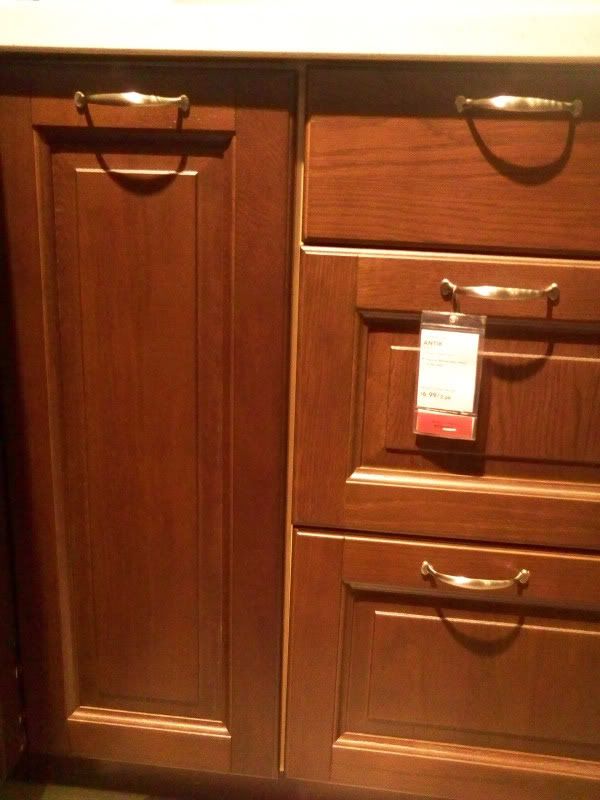
There were also some minor imperfections that began to stand out.  For instance, on one of their kitchen designs, the doors had a dark finish on them, but the cabinet insides had a light finish on them.  When the doors were closed, thin lines of light finished wood grain were peeking out from behind the dark doors, ruining the effect.

And, the molding options were limited to one style – a very narrow bull nosed piece across the top. Yes, that is part of the Scandinavian aesthetic, but it’s something that ultimately  limits the look of the pieces. Not every kitchen is going to look complete with such an austere molding detail.

Then, there is the material.  The company keeps costs down by relying solely upon particleboard in their casework pieces.  Granted, it’s not like the ultra cheap particleboard found on the ready to assemble furniture at the local mega mart, but it’s particleboard nonetheless. While the furniture may stand up to use in wet places such as bathrooms and kitchens, there’s a good chance that it may not.  After a few years, the possibility does exists that those sweet looking cabinets might swell if they face an errant water leak – something that good quality cabinet grade ply isn’t going to do.

As I sat in the Ikea cafe eating a plate of Swedish meatballs (It was a heck of a deal for lunch), I began to think about my shopping trip.  Even though there were some shortcomings in the design, the stuff did look to be very high quality.  I found myself less on the defensive and feeling more like there is a place in the universe for custom made furniture and the offerings found in Ikea.  I  can pick and choose what projects I want to build and custom make them out in the shop.

As my wife and I pushed the shopping cart with the flat-packed-dresser-in-a-box we bought for my son out to the van, I was at peace with my decision.  The four drawer dresser cost me only $99, went together in about an hour and a half and does its job admirably.  I doubt that I could build something similar in the same amount of time for about the same price.

Besides, that gave me more time to get into the shop and get working on the projects I have to get done on my honey-do list.

Like any good amusement park, Ikea did have its ups and downs and was quite a bit of fun. But, hey, who wants to live in an amusement park?

Quick Poll

Woodworkers can do what many other people can’t – when we want a piece of furniture, we can built it for ourselves.

Whether some custom cabinetry, a dining table for the family to gather around or a comfortable chair to relax on, we can transform a pile of lumber into a family heirloom – or an object of envy for friends and neighbors who will want one of their own.

There are, however, many furniture stores out there that sell products with different levels of craftsmanship, material choices and price points. And, while it may be tempting to go out and build a bedroom suite, there’s nothing quite as convenient as having all the furniture delivered the day after you purchase.

So, this week’s poll, let us know what you think about buying furniture. Is it something you do proudly, or do you avoid doing it at all costs?

[poll id=”89″]

Link of the Week

Kevin Brady’s Pen Making Page

Minneapolis, Minnesota based woodworker Kevin Brady likes to do his craft.  He also likes to offer clear and concise step-by-step instructions to other woodworkers about how to build projects.

His pen making page is one of the best instruction pages I have ever seen on pen making.  From wood selection to the final finish, Kevin takes his readers through the process, pointing out the tips and pitfalls of making a beautiful pen.

He also links to numerous sites offering pen kits, materials and know how, making this a complete site for the novice pen turner.

Book Review: Shop Class as Soulcraft

Shop Class as Soulcraft

by Matthew B. Crawford

ISBN-13: 978-1594202230

I recently called my old middle school – Walter T. Bergen in Bloomingdale, New Jersey – and had a chance to speak with the secretary who answered the phone.  All the memories started flooding back. How were my old teachers?  When did the town’s fifth graders start attending the school?

And, most importantly for me, what ever happened to the wood shop?

The place where I and hundreds of other kids took our first tentative steps into the craft was shut down maybe 15 years ago or so. The room sat dark for a long time, then the tools were shoved to one side and class was held on the other.  A few years ago, all of the tools were moved to the school district’s storage, and a partition was built.  Today, one half of the space is for special education, the other half is a health classroom.

What a total bummer.

Unfortunately, Water T. Bergen was not the only school to do this to their vocational education program.  Many other schools across the nation shuttered their shop classes through the ’80s and ’90s, seeing more value and less risk in using those facilities for other instructional purpose. Gearing their students up for academic excellence and a future in college.

That’s where Crawford’s book Shop Class as Soulcraft starts to engage the discussion and offer some interesting insights.

Crawford’s premise is simple – why has education and society marginalized the value of vocational education?  How does society look down on skilled tradespeople in comparison to the highly educated, yet has no problem coughing up $250 an hour for a plumber to fix an emergency sewer back up on a Sunday afternoon?

I only made it halfway through the book so far, but it has so thoroughly engaged me that I was moved to write about it. The points he made about the amount of knowledge and intuitive thinking a tradesperson needs to properly complete the job brought back memories of my family growing up.

My older brother wasn’t much into school as a high schooler. He struggled through the academics and was very happy once they were complete.  I frequently thought of him as someone who was never going to reach his potential because  he loved auto shop much more than – say – English Literature.

He really began to shine when he started taking classes at a local technical school. The instructors were awed by his ability to learn and apply what he was taught. He later went on to become ASE master certified in just about every single aspect of working on cars. My brother never lacked one bit for intelligence – his intelligence just lay in another area where he excelled.

I think I may owe my brother an apology.

Crawford also points out that this devaluation is also affecting the well educated.  While many can point to the cost-conscious approach of employing a moderately-skilled labor force in some foreign factory as an evolutionary step in the development of blue collar employees, the same process is occurring in white color work force, only at a more rapid pace. Think about it – a tech support question can be easily answered over the phone in India, Singapore or China, but it will still take a skilled tradesperson to properly construct and install a set of kitchen cabinets in your home or to fix your transmission.

Crawford’s book is a well-written argument for the return of vocational education to school systems.  Not every student is cut out for a four year college degree or higher education. As long as legislatures across the country and around the world try to impose a ‘college for all’ mind set, many students will be left behind, never achieving their true fulfillment.

And that would be a tragedy.