All posts by Tom

I'm the guy who writes the blog...

A Toot for Flutes

Woodworking projects can be embellished in so many different ways.

Pick out some sweet boards with impressive figure. Mix contrasting wood species. Lay in an awesome piece of veneer. Choose some outstanding hardware. Even a highly-polished finish can make a piece pop.

But, even the most basic woodworking projects made of the most common species of wood can be jazzed up with molded details. You can add a purchased molding to your work, rout a profile on the edge or, if you really want to get fancy, you can do some fluting.

No, I’m not writing about the tall, narrow glass you drink champagne from, nor the side-blown high-pitched instrument frequently used in marching bands and orchestras. Flutes are the shallow grooves that sometimes ornament the faces of columns and flat vertical moldings called pilasters. In stone and woodwork, they are usually in a parallel, evenly-spaced series vertically to a surface.

The flute is actually the groove itself. The area between the flutes is known as the fillet.

The first flutes  ever observed in architecture were carved into stone columns adorning buildings in ancient Greece and served as a visual design element. They can create dramatic shadow lines, and make the vertical elements of a piece seem taller. Surprisingly, Roman columns were typically smooth and polished unlike their Greek predecessors. And, yes, all of those flutes were painstakingly carved into the stone by hand. Hey, neither Rome – nor ancient Greece, it appears – was built in a day.

Today’s woodworker has more than a few options when it comes to adding flutes to pieces. Many lumber yards and hardwood suppliers have a stash of pre-milled fluted material on hand. While this is an easy way to go, it often limits your options. “Many of these pre-milled fluted moldings come in only a few common species, and you are limited on the size, spacing and number of flutes,” said Tim Walter of Eagle America. “You might be stuck with something that looks out of place – either too large, too small, or the wrong grain pattern going the pre-milled route.”

An option that gives the woodworker more flexibility is to mill your own fluted moldings. One way to do this is to set up a router table with a plunge bit (a core box, v-groove, etc) in your router and a router fence. If you route one flute, then flip the board end-for-end, you can route a groove with identical spacing on the opposite side. From there, you can cut the boards to length and apply them to the piece you are building. “That’s one option, but it might look a little choppy,” said Tim. “After all, you are just cutting the flutes at the end. You’ll have to find a way to cap the ends of the molding, and those flutes will end abruptly, leaving an pretty jarring transition.”

A better way to make the fluted profile look neater would be to create stopped flutes. This can be done by lowering a board onto a spinning router bit, running the board the desired length and then pulling the board up from the bit at the end. “That’s one way to do it, but it can be tricky to get all the grooves to start and end the same distance from the end of the board.”

Another, easier way would be to rout the grooves from the top of the board with a plunge router. “This way, you can plunge the bit into the board right on a pencil mark and run them the length of the board. You can get much better results because you can see where you are routing.”

The challenge with this method, however, is keeping the router on track as you make the grooves. On long pieces, a groove that jogs or slants one way or the other will stick out like the proverbial sore thumb. To ensure the router stays on track, many woodworkers turn to a dedicated edge guide. While that prevents movement in one lateral direction, there is the chance that just the briefest loss of concentration can allow the woodworker to pull the edge guide away from the board’s edge. “That’s one way to create custom, hand-crafted firewood in a hurry.”

To prevent this, many woodworkers rely on a jig that clamps the board between two fences, preventing any lateral movement across the face of the board. Tim showed me the jig they sell at Eagle America. It consists of a 3/8” polycarbonate base that mounts to your router’s sub base. The two edge guides are mounted to the main base plate with bolts and knobs that ride in two slots. “You can get infinite adjustments between the two edges that way, and you can rout pieces from 1” wide to 12” wide… more than adequate for the vast majority of woodworking operations.”

The added benefit of the jig lies in the shape of the edge guides. Not only can they be used on straight moldings, they can also be reversed and the smaller edge with ball bearings can be used against the work. This way, woodworkers can rout flutes into a curved or arched piece. “Imagine if you had to trim out the top of a Palladian window. This guide can allow you to make accurate flutes that match the curved profile of the molding. The results can be stunning.”

Eagle America is also throwing in a free round nose bit for woodworkers who order the jig. “We want to make sure that anyone who orders this jig will be ready to go as soon as it arrives at their shop. We don’t want them to have to wait longer to pick up the right bit to make it work.”

While flutes in your moldings won’t guarantee your work will be around 2,000 years from now like the stonework from ancient Greece, they can make your work a real piece of art.

Quick Poll

Ahhhh, Valentine’s day… one of the most stressful, nail-biting, “What do you mean you don’t have our dinner reservations?!?” “You ran out of roses? On Valentine’s Day?” kind of days…

Oh, wait, I meant to say one of the most romantic days of the year. A day to spend some quality time with the one you love and really turn on the romance.

Yes, there’s nothing like spending quality time with that special someone.  Maybe time taking a long walk in the park, enjoying an art exhibit or watching a movie. Perhaps even enjoying some time doing your favorite hobby.

So, today, on Valentine’s Day, what does your sweetie think about participating in your woodworking hobby?

[poll id=”112″]

Link of the week

Woodworker’s Workshop Heart-Shaped Keepsake Box

Uhh, guys and gals, you might want to check the calendar.  Go ahead.  Take a look.

Sunday is February 14th. You know… THE February 14th… Valentine’s day.

If you haven’t gotten anything for your honey yet, there’s time to head to the shop to build a little something-something for that someone special.  This plan for a heart-shaped keepsake box is a great way to build a sweet project while using up some of those pretty scrap pieces you are hoarding.

If you show up on Sunday bearing one of these babies, you will go from zero to hero in a heartbeat!

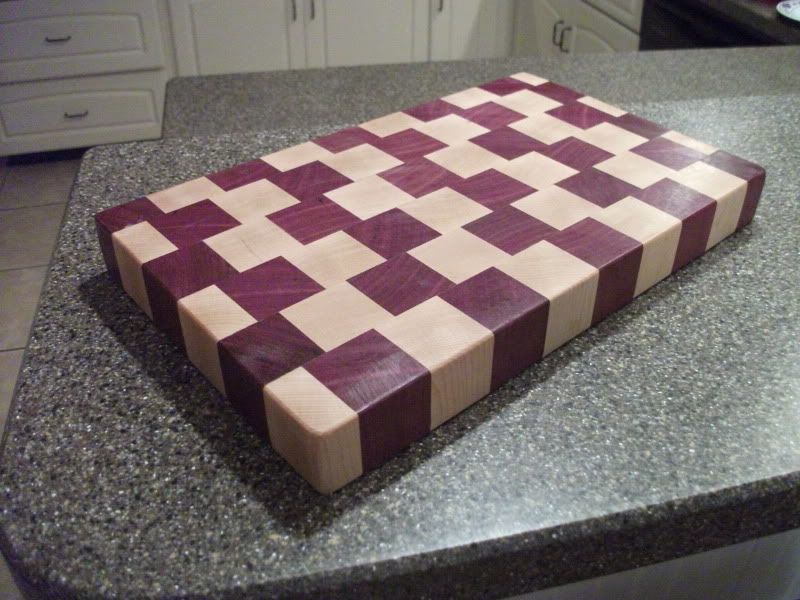
Stuff I’ve built: Purpleheart and Maple Cutting Board

February 2010

There’s nothing quite as simple – yet complicated – as an end-grain cutting board.

Sure, it’s just a flat, thick piece of wood you cut food on.  However, if you want it to be really durable, you want it oriented so that you are cutting on the end grain.  That’s the tough stuff..

Fortunately, there are many good plans for end-grain cutting boards out there.  Wood Magazine has a good one, as does the Wood Whisperer. Each of these plans offers step-by-step instructions on how to build them.

The wood for the board came from Bell Forest Products, and included a sweet piece of maple and another of purple heart.

I started by jointing and planing the boards flat and true, then ripping them into strips.  I glued the blank together with alternating strips.

Once dry, I took the boards out of the clamps and planed the assembly dead flat. Then, I crosscut the panel into 1.5″ thick strips, rotated them end for end and then stood them up with the end grain facing upward.  I shifted the pieces into a pleasing pattern and glued them into place.

While my glue up was pretty good, I still had to use a belt sander to get everything into perfect shape on the top.  First, 50 grit was used to get the pieces flush, then 80 and 120 to smooth things out.  Then, I hit it with my random orbit sander with 120 grit and 150 grit.  Since the top was going to see some abuse from knives, I didn’t want to make it too smooth.

I finished it with polyurethane thinned about 50% with mineral spirits, allowing the finish to soak all the way through the board and then wiped off the excess, as per Marc Spagnuolo’s instructions.  That seemed to do the trick.

Now, here comes the hard part.  I had originally built two boards, but I won’t be seeing them in my house.  I already gave one to a really nice couple who has us over their home  for gourmet dinners and really fine wine.  The other one?  Well, when my mom saw it, it became hers.

Oh, well… At least when I go to these homes, I’ll know the meals I’m eating were prepared on them!

You are virtually there

Video games have been around for quite a while. From the first game of Pong to the latest hack-and-slash Internet capable first person fantasy role playing game, there’s something out there for just about everyone.

One of the traditional genres for video games has been sports simulation games.  Those old football, baseball and basketball games were pretty weak at first, but they have become more sophisticated through the years. Now, you can assume the first person role of New York Yankee Derek Jeter, New Orleans Saints Reggie Bush or Cleveland Cavalier LeBron James and actually make game decisions that can affect the final outcome of the game. Sure, the majority of folks playing the games don’t have a shot of making a professional team, these games have been known to encourage a few players to get out and try their hand at picking up a new sport.

While these games are great… and getting more sophisticated every year, the gaming public wanted more. That’s when the Guitar Hero and Rock Band game series were created.  Now, gamers weren’t on a sunny ballfield facing down a determined opponent, they were thrust on stage as part of a rock and roll band, crushing fierce note streams in front of adoring fans.

This was an interesting shift in gaming. A totally new field of games had been opened to people who don’t want to necessarily play shoot ’em ups or sports.  The games come with guitars, drum kits and microphones, enough to get a group of players to believe they are on world tour.

And, as my sons and I have played Rock Band in our living room, I have warmed to the idea of picking up an instrument for the first time of my life.  The bass guitar.  I’m shopping around now, but hope to have one by Father’s Day.  Gotta save those pennies, ya know!

Now, with music conquered, video game designers have moved to an even more non-traditional game genre – cooking.  I been seeing ads for Cook or be Cooked, the first video game from the Food Network.  In this game, the players can hone their knife skills, expertly season the food they are preparing and bake, saute or stew their creations to a perfect level of doneness. There’s even a  tasting by judges to see if the dish is up to the high culinary standards expected.

I know that the shows on the Food Network have inspired me on several occasions to get into the kitchen to try a new recipe or two. Perhaps players of this game might be inspired to get off their butts, not call for take out and discover that lightly used room in their homes… the kitchen.

Now, I think the next step will be to make a woodworking video game.  No, seriously!  Imagine how it would work… you could have a selection of projects to choose from… a bookcase, a decorative box, a Maloof-inspired rocking chair and some other challenging and interesting ones.

Then, you can choose from a selection of tools… a virtual table saw, tenon saw, chisels, drills… the works.  A little cutting, a little shaping, a little gluing and sanding and you have a project. Then, you bring the final piece before a virtual Marc Spagnuolo or Norm Abram get judged on your work.  If you had some high-end tool manufacturers come on board… hey… we might be on to something here!

Sure, it may sound crazy, but with fewer schools offering shop class… virtual might not hurt to get new woodworkers into the craft…

Quick Poll

Congratulations to the New Orleans Saints, NFL Champions.  I bet there will be some partying on Bourbon Street tonight…

Well, today is Super Sunday, the day the NFL American Football championship is played.

The Indianapolis Colts come in with a rookie coach and arguably one of the best quarterbacks the game has ever seen.  The New Orleans Saints come in with spunk and fire five years after Hurricane Katrina devastated the city.

Both teams come in as the best in their conferences… this is truly a match up of the best teams from this season.

The past few Super Bowls were very exciting games, with last minute heroics to settle the game.  How will today’s matchup match up?

So, what are your thoughts on the game?

[poll id=”111″]

Link of the week

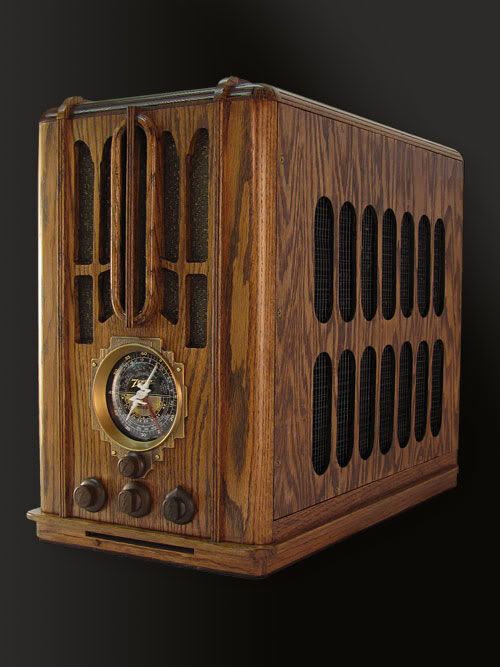
Voigt’s Classic Radio Build

Antique radios were lacking in the electronics department… but they were beautiful  pieces of furniture.  Today’s modern audio systems are powerful and extremely capable… but, plastic isn’t something you want to feature in your living room.

If you want the best of both worlds, you could do a whole lot worse than user Voigt at the Extreme Systems audio forum.  Starting in May of 2009, he started to build a wooden enclosure styled after a classic 1934-36 Zenith model 5-S-29 radio.  Inside, the system is all state of the art, with digital amplifiers and MP3 inputs.

Follow along through the process from Sketchup and component selection to the final product. There’s plenty for everyone in this thread – electronics, woodwork, metal and acrylic fabrication… it’s in there!