
The house I grew up at in New Jersey had a fireplace. I remember my dad and uncles building it late in the year – sometime around a Christmas in the early 1970s when I was just a little tyke. It quickly became the social center of our home. When my brothers and I were really young, my dad lit the fires on the cold winter nights. The job later fell to my older brother and then eventually to me.
Now that I live in Florida, the need for a genuine fireplace isn’t as urgent. Oh, sure, there are fireplaces in some homes in Florida. I have been in my share of them on a warm winter afternoon where the fire was lit and the air conditioner was on to offset the heat gain.
 In our home, my wife and I have discussed the possibility of adding an electric fireplace insert to give us the ‘ambiance’ of a fireplace without the hassle and expense of building a real one. This way, we can get the glow whenever we wanted, and could turn the heat on for just the chilliest January mornings. Whenever I see ads for these ‘realistic’ fireplace inserts, I stop and pay attention.
One ad I recently saw on TV was for an electric fireplace insert called the Heat Surge. What set this particular unit apart? It wasn’t the realistic flames – although they did look convincing. It wasn’t the extra heat it could provide for the room it was located in – although there were plenty of satisfied customers who touted that feature. It wasn’t even the fact that it could save money on your heating bill – even though there was a graphic which showed money flowing back into a typical homeowner’s pocket.
No, what sets this unit apart is the fact that the wooden case and mantle built around the electric fireplace unit is hand crafted by the Amish.
 For those of you who aren’t familiar with the Amish, their communities can be found scattered across Pennsylvania and the Midwest, with other communities in Canada. These devout people choose a simpler, more secluded life to prevent the influence of the ‘English’ world – mainstream America – from affecting their membership. Their dress, mannerisms and even their language – a Germanic dialect – make them easy to recognize when they are in the ‘mainstream’ world.
Since the Amish first established their communities, they have tried to remain as self-reliant as possible. Many homes are not connected to the power grid and have no phones. However, in today’s day and age, the Amish leaders in many communities realize that there is much benefit to be gained in interactions with the ‘English’ world. Amish agricultural products and crafts are eagerly sought out and recognized as high quality by consumers. As with the Shaker communities in the 19th and 20th centuries, the Amish view hard work as a form of worship, and one way they express their prayer and devotion is through producing understated high-quality goods.
Now, this isn’t to say that the Amish haven’t had to adapt their ways while interacting with the outside world. For instance, all Amish dairies are required by law to follow the same sanitary and production practices for their product as any other commercial dairy in their state. Foodborne illnesses are no laughing matter, and tracing an outbreak of salmonella back to an Amish community would inspire suspicion, anger and lawsuits. This may require the installation of generators to provide the necessary power to be in compliance with local laws and ordinances.
Their other practices have had to be modified some to meet the demands for their labor. Early one spring, I flew to see my mom who lived in a new subdivision in south east Pennsylvania. “Thomas,” she said, “you’ll never believe this. The craftsmen working on the homes in my neighborhood are Amish! You have to see them work…”
 So, very early one morning, I poured myself a cup of coffee and stepped outside, fully expecting to see a horse-drawn carriage arrive and discharge Amish craftsmen armed with hand saws, bit braces and other classic hand tools to craft the structure. Much to my surprise, the Amish workers arrived in a Chevy truck, took their power tools out and started working on the home.
On this infomercial for the Heat Surge, the hosts were standing inside a large barn-type structure. They were surrounded by the assembled units and were extolling their virtues. In the background, there were maybe a dozen or so Amish workers – both men and women – busily working on the wooden cases. I had seen this infomercial so many times, the activity just blended into the background.
Before I hit the remote control button to change the channel, something caught my eye. There, behind the female host was an Amish woman. She was holding something in her hand and moving it back and forth, sort of like you would expect to see a person use a clothes iron. She wasn’t holding an iron – she was holding a wooden jointer plane – maybe 24″ long with a solid looking tote and square cheeks. The tool looked immaculate and, I would imagine, be a pleasure to use.
As she moved this massive plane back and forth, I noticed that she was holding it with only one hand, there was no iron on the plane and there was nary a curl or shaving anywhere in sight. Looking even more closely, she was running the plane over a totally finished panel! Wow, that was very interesting…
Looking at the other workers in the background, other oddities really jumped to the fore. A worker holding a chisel up to a finished piece, pressing it into the underside of the top and placing it back down on the bench. There’s the guy checking the top of the unit with a level – not checking the assembly for square as is the norm with case goods. While the entire half-hour infomercial isn’t available online, if you look very carefully at the first few seconds of this abbreviated version, you’ll clearly see an Amish worker holding what appears to be a No. 4 or No. 5 bench plane at eye level, rubbing it over the top of a finished piece. Again, not a single curl or shaving is detectable.
Nobody uses a plane like that. Period. Especially someone who is familiar and experienced with one. It would be used with two hands at a bench about waist high to get maximum leverage and make the work easier and more accurate. He did rub his hand over the surface, but nothing is there to wipe away.
This little charade continued in the background every time the shot went back to the hosts in the barn. After a few minutes, I called my wife over and started pointing out everything that was out of the ordinary. Sort of like a game of “Where’s Waldo” for woodworkers.
The script writers, director and producers of this infomercial must have spent a tremendous amount of time staging this shot. I can see what the day on the set must have looked like. “OK, you over there, take that big wooden thing you push around and rub it over the board. You guys over there, pick up those chisels and look busy. You, ma’am, rub that finished top down with this rag to make it look like you are working. Remember – the viewers want to see ‘hand made’ – give it to ’em! Places, everybody! Let’s make video magic!”
Then, it hit me. There’s this old advertising slogan that rings true time and again – Sell the sizzle, not the steak.
In this commercial, the sizzle isn’t comfort, energy savings, quality of the electronics or ease of use… I’m positive that every electric fireplace insert on the market can trumpet those features for each of their models. Instead, it’s the fact that the Amish hand craft each surround and mantle. Even if back at the real shops they are using generator-powered table saws, routers, planers and jointers, the hand crafting with old fashioned hand tools by the Amish is the only thing that truly sets these units apart. Even if these pieces have never seen a hand tool…
And, that got me thinking. I’m sure the folks who make and market the Heat Surge spent a tremendous amount of time and money to research what consumers want, evaluated the strengths and weaknesses of the product and crafted a marketing plan.
What that tells me is that the hand-made aesthetic is worth quite a bit. I guess the upshot of this rambling post is that when you build something at your shop, understand that the simple fact that you have built the piece adds intrinsically to its value. Hey, you may never sell a single piece you build, but understand that people are (or will be when the world’s economic crisis turns around) looking for that in products they seek to buy.
Either that, or you can throw what you built into your fireplace and stay warm on a cold winter’s eve.
 Nails have been an important part of woodworking for centuries. Originally hand wrought one by one, they were so valuable that old structures needing to be demolished used to be burned to the ground and the ashes sifted thorough to recover every usable nail.
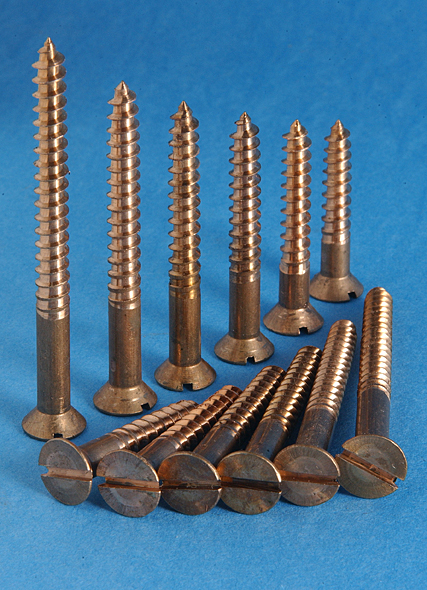 Screws play such a vital role in woodworking, it’s only fitting that they get some discussion. I mean, think about all of the different uses there are for screws in your shop. You might find that my experience alone might be typical…
 * Always predrill your holes. Sure, you can muscle your screws in with your drill, but you run the chance of splitting the pieces you are driving into. A combination drill/countersink and driver is an inexpensive way to handle the predrilling and countersinking in one step, and then driving the screw by simply flipping the tip of the tool around. These are sold at just about every home improvement or hardware store, and I have yet to see one cost more than $10.
 * Stop the wobble. Driving long screws with a power driver can really be frustrating. Watching the screw gyrate during driving while holding the drill with one hand and the work with the other is entertaining for observers, but can lead to some very choice words by the woodworker. I have found that inexpensive screw guides, which fit into your drill’s chuck and feature magnetic tips and a sleeve that helps hold the screw straight – are worth their weight in gold.
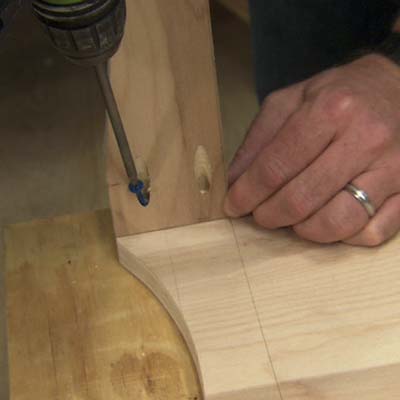 * Watch for bridging. Screws threaded along their entire shanks (from tip to head) have a nasty habit of forcing the two workpieces apart as they are driven home. That’s called bridging, and it can be a big issue. Three ways to counter this include tightly clamping the pieces you are screwing together, drilling a larger countersink hole in the top board so the threads won’t bite into the wood or using screws that aren’t threaded all the way to the head. This is a common feature found on premium wood screws.
 * Watch your material. Screws are made out of several different metals. While steel screws are definitely the easiest to find, brass and bronze screws are also available, and these more delicate materials need extra care while driving. I have had a great deal of success with driving brass screws if I drive an identically sized steel screw into the hole first to cut the threads. After removing the steel screw, the brass screw goes in with little hassle.
 If you haven’t been the parent of a newborn child in the past decade or so, wow, have you missed out on an interesting change in attitudes.
 Another area of concern is items that fold.
 It may seem like a strange reaction, but they are actually learning what things taste like and how things feel.
 Nearly all common wood finishes – after they are given sufficient time to cure properly – are non-toxic.
 For professional woodworkers, it’s the way they keep food on the table and a roof over their heads. For amateurs, it’s a sign that they have arrived as respected crafts person.
 The pocket screw has proven to be a fast and convenient way to build case construction. From face frames to box assembly, this system gives very good results in short order.