Tom’s Workbench

|

part of the wood whisperer network

Archive for January, 2008

Link of the Week

Thursday, January 31st, 2008

Wikipedia’s Woodworking Workbench Entry

Hard at work on the workbenchSure, some people laugh when you quote from Wikipedia – the Internet’s user-defined online encyclopedia.

However, you have got to check out this entry on woodworking workbenches.

This is one of the best written basic primers on workbench form, function and features.

Workbench materials are discussed at length, as are top and base construction. There’s even a section on proper bench placement which has me rethinking where my bench should be located. Sections on planing stops, vises, holdfasts round out this interesting entry.

As a major bonus, there are some pictures of workbenches that will inspire you to build your own – or leave you drooling uncontrollably.

Post to Twitter Post to Delicious Post to Digg Post to Facebook Post to StumbleUpon

It’s as plain as the nose on your face

Tuesday, January 29th, 2008

I love watching football. During the NFL season, I’ll wrap up work in the shop early on a Sunday afternoon, call the kids in from the backyard, pop some popcorn, heat up some hot wings and the three of us will sit and watch a solid ten hours of games. The live drama. The hard hits. The raw emotion and energy. We cheer our fool heads off and eat all the foods we know we can’t have during the week.

In football, as in all professional sports, you start to notice that there is a sort of unwritten rule that most players follow. For example, in an after game press conference, you might see one team’s star running back or linebacker who had a career day tell the reporters, “We played a hard game against a tough team. The win was great, but there are some things we have got to work on to improve our game.” It always amazes me that you’ll hear this coming from the mouths of players or coaches – even after an impressive win. Don’t they know they just crushed the opposing team? Why doesn’t anyone ever admit to playing a perfect game?

Many woodworkers do the same thing with their projects.

Under the magnifying glassI’ve done it. You’ve done it. We all have done it. Here’s an example that happens to me. After three or four months of planning, picking out lumber, cutting precision joints and buffing the final finish to a lustrous shine, my wife walks into the shop.

“Oh, my goodness!” she says. “That is one impressive piece!”

“Well, honey, let me point out all of the goof ups I made. Look at this miter that didn’t close all the way, and this rail that I misglued and had to live with and this glue smudge under the finish and…”

Soon, I find myself on my hands and knees pointing out a drop of dried glue under the bottom shelf that only the dust bunnies will ever see. That’s when my wife will say something like, “Well, I think this is a very nice piece,” turn around and go back into the house as I frantically search for more major snafus lurking in my work.

Why on Earth do we do this to ourselves? Do we gain some type of masochistic joy in beating ourselves up over the slightest goof?

If you worked in an office where your boss came in after every project – even projects that win universal acclaim – and verbally flogged you for the smallest mistake, like not formatting the page footer exactly as she would have, would you stay at that job? After a while, most folks would hit the bricks, and anyone who stayed would be hard pressed to find any joy in coming to work.

Then why would you do that to yourself? Remember, in this case, you have to live with your boss every stinkin’ day.

To help regain my sanity – if I had any to start with – I had to create a new process when it came time to show my work to someone. Even though I have a list of the boo boos in my head, I’ll invite my wife into the shop and have her take a look at the finished project. I have to FORCE myself to be quiet while she takes in the piece. When she gets close to where the foul up is, I have to fight the urge to blurt out what she should be looking for as she runs her hand over the finished wood. Sometimes, I have to grab the vise handle and squeeze it while she picks up the smaller pieces and gives them a thorough once over. I sweat as she opens the doors and drawers, wondering if they are going to fall off the hinges or runners.

“I like it. Good job” Then, she leaves the shop.

I exhale hard. The tension drains. Maybe my mistakes REALLY aren’t as bad as I thought they were at first. Maybe you really do need an electron microscope to see that not-too-gappy joint that looks as big as the Grand Canyon in my eyes.

That’s when I start doing my end zone touchdown dance!

Post to Twitter Post to Delicious Post to Digg Post to Facebook Post to StumbleUpon

Quick Poll – 1/27 results

Sunday, January 27th, 2008

Congratulations! A famous woodworker wants to come and visit your shop.

Who do you hope it will be?

View Results

Loading ... Loading ...

Post to Twitter Post to Delicious Post to Digg Post to Facebook Post to StumbleUpon

Woodworking Spotlight – Niki Avrahami

Friday, January 25th, 2008

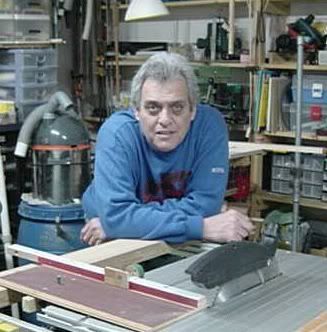
Niki in his shopLook in most woodworking shops, and, no doubt, you’ll find a pretty oddball collection of tools. Sure, there are the basics – a table saw, band saw, router, you know, the usual.

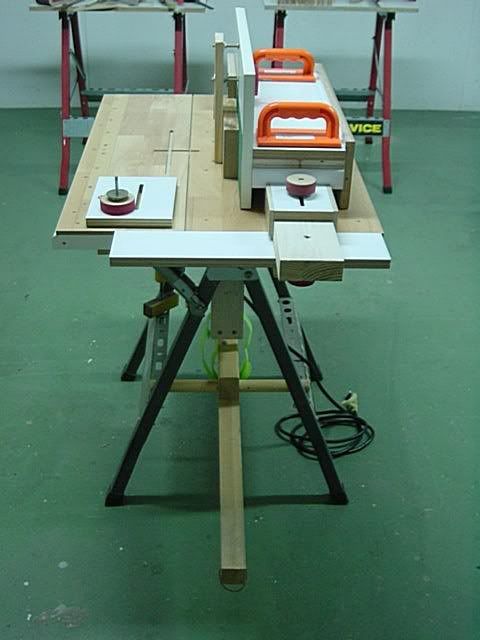
But, I’d wager you’d also find a number of tools designed to accomplish some very specific tasks –hollow chisel mortisers, specialized miter sleds, heavy metal tennoning jigs. There is no doubt that these tools are very good at what they do, but some can be quite expensive. And, in some cases, they get used only a few times a year at most.

That’s why woodworkers typically build jigs to meet these needs. There are some standard designs out there, and many of these jigs are cobbled together for one-time use and later collect dust on an out-of-the-way shelf.

But, that’s not the case for Niki Avrahami. If you have ever visited the Woodworker’s Website Association, WoodNet or many other woodworking message boards, you may have read about the ingenious array of jigs made by the woodworker from Poland.

Niki's Rolling Router Mortise JigFrom some very humble beginnings as a woodworker (his first project was a tissue box holder for his wife back in 1995), Niki has expanded his knowledge of the craft, and has taken his ingenuity to new heights.

Small parts cutting jigs. Fence stops. Router lifts. If there’s a need, Niki has built a jig to satisfy it.

His thought process is very simple and straightforward. “Usually, I think of a jig because of three reasons; accuracy, repeatability and, last but not least, safety. That, in my opinion, is very important to any woodworker.”

The jigs he builds look somewhat complicated at first blush, but they are pretty straightforward and are made of readily available materials. While a typical jig takes Niki about three hours to construct, his meticulous photographic documentation adds considerable time to the process. “For a jig, I’ll take 50 to 150 pictures. Later, I’ll select the best of all of those for posting.”

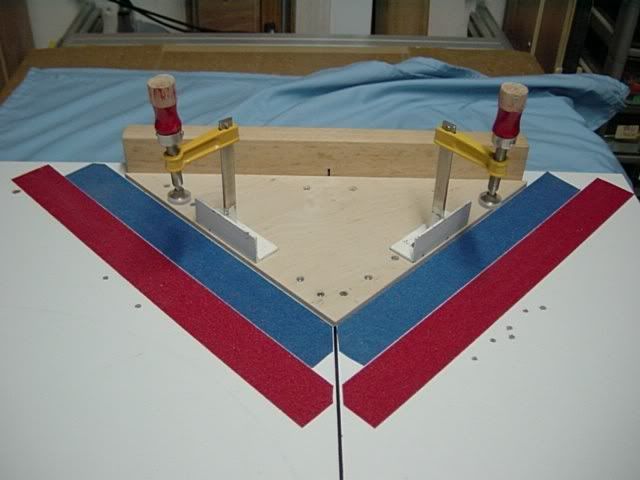
His work is starting to catch the attention of woodworking publications. Wood magazine recently featured his 45 degree mitering sled as the best shop tip of the month. Previous editions have also featured some of the creative ideas to come from his simple garage shop.

45 degree mitering sledJust as a proud parent won’t select a favorite child, Niki actually uses most of his jigs while building his projects. “What’s my favorite jig? That’s a difficult question. I think that I use all of them in almost every project because most of the steps are very repetitive. Wood preparation, cutting to dimensions, joinery, gluing etc. Because my machinery includes basic shop power tools, I think that every one of the jigs finds its place in a project.”

Just as with any typical woodworker, Niki always has his eyes on buying the newest and flashiest tools. Until he can afford them, Niki is making the most of what he has. “I’m happy with the tools that I have…the jigs are multiplying the possibilities of every tool.”

You can see a collection of Niki’s jigs at the following forums (Be sure to search for the poster name Niki):

Post to Twitter Post to Delicious Post to Digg Post to Facebook Post to StumbleUpon

Link of the week

Thursday, January 24th, 2008

Hand-Cut Dovetails After Fifty  

Hand-cutting dovetailsWow, if this week’s quick poll is any indication, it looks as if the majority of our readers prefer to hand cut their dovetails. That’s quite a surprise to me.

This site’s author Norman Havens proves you can teach an old dog new tricks. This site offers step-by-step instructions with clear photographic illustration of the hand-cut dovetail process – from the initial steps of marking out the pins to the final fitting of the completed joints.

The most valuable part of the site is that Havens not only describes the process, he also discusses the difficulties and mistakes he made along the way.  This way, the novice dovetailer can hopefully avoid some common pitfalls.

While there are many other processes to cut these complicated joints, this site will get the novice up and running with the basics.

Post to Twitter Post to Delicious Post to Digg Post to Facebook Post to StumbleUpon

The Roller Coaster ride of experience

Tuesday, January 22nd, 2008

Kumbaat Busch Gardens - WOW!I’ll remember it like the day it happened. I was standing in Busch Gardens, the Dark Continent in Tampa one steamy August afternoon. Looking up, my sight fell upon the aqua and red tracks of Kumba, the new enormous roller coaster the park had just opened. 143 feet tall. 114 foot vertical loop. Batwing maneuvers. Not one, but TWO inverted cobra rolls. This thing was a monster.

As the train whooshed by at 60 miles per hour, I could feel myself being knocked backward by the rush of air and deafened by the roar.

And, I was in line to take a ride on it.

I grew up in a family where my mom couldn’t stand to see her sons in peril. She cringed through six football seasons as my younger brother took to the gridiron. We grew up within short driving distance of a ski resort, but never went because it was too dangerous. Needless to say, whenever we went anywhere with a roller coaster, we were told just how perilous they were.

So, you could imagine my fear when I boarded the train – my first real roller coaster train – and it started to go up the lift hill.

Now, sure, it may not be as dramatic as that first rush down the hill in the coaster, but why do I sometimes feel the same apprehension before trying anything new when I woodwork?
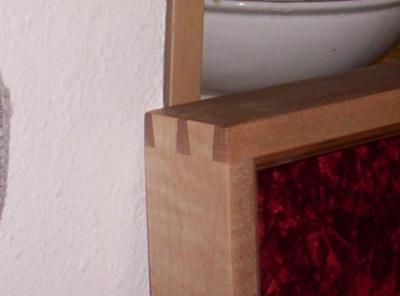
My first dovetailsFor instance, a few years ago, I was building a shadow box for my dad to house his military badges and medals. I found some choice maple that would be perfect when finished. I also found a nice scrap of cherry molding that would be just long enough to dress the piece up and serve as a glass stop. Everything was going to be perfect.

In order to make this piece extra special, I decided I was going to use dovetails. My first ones. Ever. Gulp.

No one could accuse me of not doing my homework. I read everything I could get my hands on about machine vs. hand cut. I visited every woodworking forum I could think of. I asked every woodworker I knew for their opinion.

Finally, after nearly two months of weighing my options, I went to my local Woodcraft, walking with the swagger of a seasoned woodworking veteran, and headed straight to the dovetail jigs. When I got there, I froze. The choices were staggering. Akeda. Leigh. Shop Fox. Stots Template Master. I had that blank look in my face when one of the employees walked up and asked me what I was looking for.

When I told him I was a complete novice and never had even seen a dovetail jig before, he recommended the Keller setup. I plunked down my hard earned dead presidents and headed to the car.

When I got home, there was no bravado or swagger left. I found myself staring at the manual, trying to make heads or tails of what I was reading. Tentatively, I assembled the jig and put the bit in the collet. I laid the router down, wood clamped to the jig, and walked inside.

Six days later, when I finally got the courage up to actually make a cut into the lumber I had lovingly jointed, planed and cut to length, I gingerly stepped into the shop and plugged the router in. The router whined to life and, after stopping six or seven times to ensure everything was the way it had to be, I touched bit to wood and stared cutting. Sawdust flew everywhere. Cut, cut, cut.

When I was done, I flipped the jig around and cut the pins. Cut, cut, cut.

Much to my amazement, the joint slipped together – perfectly – on the first try. I was so jacked, I took the pieces inside and showed my wife, who happened to be taking a nap on the family room sofa.

“Wha… Oh, that’s great.” She closed her eyes and lay back down to sleep.

I walked back to the shop, and proceeded to cut the rest of the joints. That afternoon, I had met dovetails, and I had kicked their butts.

When I stepped off Kumba after my first ride, I was pumping my fist in the air.

Now, THAT’S what I’m talking about!

After that, I looked at all roller coasters with a sense of anticipation. “Honey, when can we go to Sandusky, Ohio to ride the coasters up there?” I want a new challenge.

Funny how that first success can breed so much confidence…

Post to Twitter Post to Delicious Post to Digg Post to Facebook Post to StumbleUpon

Quick Poll – 1/20 Results

Sunday, January 20th, 2008

What's your preferred method of cutting dovetails?

View Results

Loading ... Loading ...

Wow!  Sharpen your chisels and break out your hand saws!  A large number of our readers prefer to cut their dovetails the old-fashioned way.

Post to Twitter Post to Delicious Post to Digg Post to Facebook Post to StumbleUpon