
Try the ply…

When my brothers and I were young, we got some tremendous thrills out of playing with our Hot Wheels and Matchbox cars.  Those race cars, army jeeps and tractor trailers had some tremendous adventures.  Some were involved in epic battles. Others were involved in rescuing people from tremendous disasters.  Still others met their ultimate fates at the end of a hammer or with a firework stuffed inside the plastic interior…

Hey, we were boys.

While rolling the cars over the carpet in the living room was fun, the scenery never really changed.  Sure, we could imagine that the carpet was a snow-covered tundra or a steaming jungle, but we wanted more realism.

That’s when I decided to grab a piece of plywood from the garage near my dad’s workbench.  I painted it up really well and glued cacti made of twisted up tissues to the board.  I even spray painted some cotton balls brown to give the impression of tumbleweeds.  In my mind, it would have made George Lucas blush…

That was until dad came home.  Apparently, I was using a piece of cherry veneer cabinet grade ply for my scenery, and dad wasn’t too amused.

That was my first experience with really sweet quality cabinet grade ply, and since then, I have come to appreciate its value.  Well made ply is stable, nearly ready to finish and beats the heck out of gluing up solid wood to make large panels for projects.

What is plywood? Basically, thin veneers of wood are sliced from a log and then glued to each other.  In the vast number of cases, each layer is glued perpendicular to the next, giving tremendous strength and rigidity to the panel.  Some plywood is glued with all of the layer parallel to each other, and this plywood can be used to build bent pieces of cabinets.

I did learn the hard way that not all plywood is made equally.  First, cabinet grade ply is not the same as construction grade ply – regardless of what the home improvement center signage tells you.  Sure, you can grab a piece of AC fir or southern yellow pine plywood and try to build something, but, if it’s going into fine furniture, you will be disappointed with the results.  That construction grade stuff is great for shop shelving and furniture, but it’s too rough for building bookshelves.

For that, you want to look for plywood with a larger number of plies which are more finely cut.  while construction grade material may have five plies for a 3/4″ piece, the cabinet grade stuff usually starts at nine.  The cabinet grade stuff also has a much more refined face than the construction grade stuff.  So, if you want to paint your piece, there’s a whole lot less prep work and you will get a superior finish with cabinet grade stuff.

The most commonly see ‘entry’ level cabinet grade panels are usually faced with birch, however I have seen some other kinds of woods.  Some are faced with a generic ‘tropical hardwood’, while others are faced with a South American hardwood called Gutambu.  These low-end panels are often hit or miss – some are beautifully built, others will have their glue fail and the layers separate if you look at them funny.  Buyer beware!

From there, you have scores of choices available to you.  Some, such as Baltic Birch or Russian Birch, is made of many very fine layers of wood veneer – maybe up to 15 or more – and is exceptionally stable – perfect for jigs and as a substrate for veneers.

Other sheets have similar cores as the birch plywood, but can be faced with veneers as plain as red oak or cherry to to as exotic as teak or zebrawood.  These pieces can be cut as impressive parts of a cabinet, table top or other project.  And, yes, the standard wood finishing regimens you use on solid wood will work on plywood veneers.  Lacquers, varnishes and oils all work well on the plywood surface.

While plywood is durable, strong and relatively easy to work with, there are some warnings which should be heeded.  First, plywood is very heavy stuff.  A sheet of 3/4″ cabinet grade ply can tip the scales at 60 pounds or more.  Sure, you could muscle the sheet around by yourself, but wow, you could end up with a serious backache – or worse!

Secondly, it’s very awkward.  Standard sheets of plywood are 4′ wide by 8′ long.  That’s taller and wider than most folks, so you have to be careful when handling.  Again, a friend is always appreciated when working with plywood.

The veneers which face the plywood are often beautiful, but they are also very thin.  Extreme care should be used when moving sheets (to avoid damage) and when sanding them (you run the risk of sanding right through the veneer into the core!).

This also means you have to be very careful when cutting plywood, so you don’t chip up the facing when you cut the sheets.  Some tried and true methods for reducing or even eliminating chipping include taping the cut line with masking tape, using a blade with the highest number of teeth available and scoring a line along the cut line with a utility knife.  The new track saws made by Makita, DeWalt and Festool also do an outstanding job of preventing chip out when they cut.  If you plan on working with a lot of  plywood, one of those saws might not be a bad investment…

Finally, when you cut plywood, you have the ugly exposed edge to deal with.  Edge tape, molding and setting the panels into frames or a rabbet are three ways to hide the unsightly edge from view.  Of course, if you like that kind of look, just refer to your pieces as post-industrial modernism and enjoy the compliments as they flood in.

While those days of playing with my toy cars are distant memories, I can look into my sons’ rooms and see the plywood bookshelves I built stuffed to the gills with toys and books.  What memories will those pieces of plywood will my sons bring with them into their adult lives?

Quick Poll

Finding time to woodworkIn the nearly two years I have been blogging, I have seen a great number of projects built by you, the readers of Tom’s Workbench.  Some are modern, others are traditional.  Some are elaborate, others have strong, clean lines.

But, the one thing I have always wondered is when these creations were built?

Some of us are early birds, grabbing shop time when the sun is on the rise.  Others are night owls, working well into the wee hours of the morning.  Your time preference may be dictated by work or family situations, when you can access your shop or just a personal preference.  Heck, you might enjoy using daylight to give you a consistent light source in a hand tool shop.

So, where do you fall?  What is your favorite time of the day to grab some shop time?

[poll id=”77″]

Link of the Week

The New Yankee Workshop

New Yankee Workshop's LogoWhen you think of woodworkers on TV, Norm Abram’s iconic image often comes to mind first.  From his signature plaid shirts to the well-worn tool belt around his waist, Norm is a woodworking legend.
The site for the New Yankee Workshop offers the entire collection of projects. From the medicine chest – the first plan built on the show back in 1988 – through the kitchen cabinet opus which aired last season, you can buy measured drawings and videos to accompany them.

The site also goes into greater detail, showcasing Norm-inspired projects built by other woodworkers, a question and answer section called shop notes and virtual tours of the famous workshop.

While Norm may not need the exposure, a visit to the New Yankee site can give you a little more background on this famous show.

The good booklets

I like to post on a few woodworking forums.  They are great places to connect with woodworkers from across the world.  You can ask questions, share your successes and get a few words of encouragement when things go wrong.

Oh, yes, things can go very wrong…

Beyond the terrifying tales of accidents and woeful recollections of projects gone bad, there are always a tremendous number of questions about tools.

Which are the best to buy?  Can I use this tool to complete that task?

And, quite frequently, there are questions about machine set ups and calibration.

Let me start of by saying that questions like these are very valuable.  Woodworkers with years of experience can weigh in with sage words of advice, pitfalls to avoid and shortcuts that can help ensure accuracy.

Unfortunately, what many of the original posters don’t realize is that they have the answers to many of their questions right at their fingertips – their owner manuals.

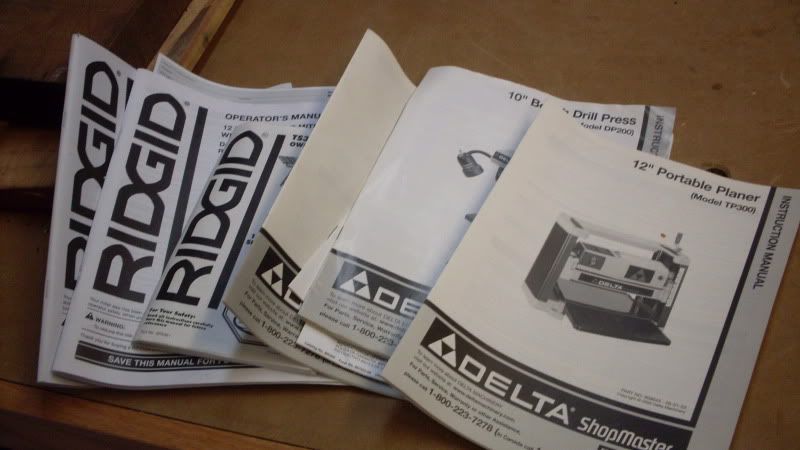
You remember what those are, right?  The usually black and white booklets proudling featuring a photo of the tool you are working with.  Believe it or not, those babies are a gold mine of information – if you know how to use them.

First of all, all manuals have valuable safety information printed in them.  Yes, do take the time to read through it at least once.  There may be some safety features on the tool you are using that aren’t intuitive and may require special care during set up.

Speaking of set up, the manuals also have step-by-step instructions on how to assemble the tool.  Again, it seems to be a no-brainer, but the instructions also give you important tips on when and how much to tighten screws and bolts.  Overtightening a table saw’s trunnion bolts can crack the cast iron casting… leaving you in the lurch.

Need help dialing in the accuracy?  Owner’s manuals give step-by-step instructions on how to tune your tool.  This way, you don’t have to rely on someone to give you the instructions on – say –  tuning your Jet table saw if he or she owns a Grizzly.

Finally, once you get the tool set up, that’s a great time to sit  down and review the manual one more time.  Believe it  or not, many manufacturers offer tips and tricks on how to make your tool more useful.  The  manual for my Ridgid table saw offers plans for cutting push sticks, feather boards and other useful shop jigs.

If you are the more organized type, it’s a great idea to staple the receipt for the tool and record the tool’s serial number in the manual, and tuck it away someplace safe yet accessible.  This way, you can get to it for warranty work and as evidence for the insurance company should something happen to your shop.

And, yes, I do break out my tool manuals to review them from time to time.  I’ve discovered that in the back of many manuals there is a troubleshooting section with frequently seen problems and ways to correct them.

This is great if you have a brand new tool, or you bought a used tool from someone who kept good records.  But, what if your tool is older, or the previous owner chucked the manual?

You are in luck!  Most manufacturers have their manuals online where you can download them.  To find the manuals for older tools, check  out the Old Woodworking Machines website.  Many of the manuals from older tools have been scanned and uploaded to this site for your review and can provide valuable assistance in restoring and tuning a classic tool.

Will reading the owers manuals for your tools make you a better woodworker?  Nah, only practice can do that.  However, for safer and more accurate tools, it’s hard to beat the manuals as a starting place.

What time is it?

For those why may remember the Howdy Doody show (no, I’m not that old, but I am hep on cultural icons), the only answer that could possibly work is “Howdy Doody Time!”

Unfortunately, that’s not the answer I am looking for.  We are saying ‘howdy’ though, it is the start of the Atlantic Hurricane Season.

Yes, I know those of you who live anywhere along the coast from Maine to Texas (or those of you who are fortunate enough to call Bermuda, the Bahamas or any of the Caribbean Islands home) know what this means. It’s that time of year to check that you have your hurricane shutters, get your survival kit together and remind yourself what your evacuation zone is.  I usually do that stuff, and then go have myself a Hurricane at one of the local drinking establishments to give me the courage to keep on planning…

June 1 also reminds me how important it is to check the tools I have in my shop.  Yes, I do a quick inventory to ensure that I have everything listed.  Names and model numbers of tools, manufacturer’s serial numbers, descriptions of tools that don’t have model numbers or serial numbers.  I try to cover it all on a list I keep on my computer.  It’s not too tough to maintain once you get it started, but it can be a bear to get started in the first place.

Why have the list?  Well, should the unimaginable happen, I want to make sure that when my insurance company comes calling, I can produce a list of what I own.  This way, it will be easier for them to value the tools I have in the shop and cut me a check to replace those items.

I also take the opportunity to snap a few photos of the collection.  This way, I can show the insurance claims adjustor what kind of tools I have.  Sure, I can’t just lie and tell them I have a brand new Delta Unisaw… but, hey, honesty is the best policy.

Do you need a separate rider on your insurance to cover your more valuable tools?  How about flood insurance?  What other kind of documentation do you need?  These are all great questions.  And, since I’m not an insurance agent, I’ll ask you to give yours a call.  Ask all of the questions now, and not after standing over the wrecked shell of your shop… it will save you some stress.

There is a great organization here in Florida called the Insurance Information Institute, and they have an outstanding page on how to conduct a home inventory.  Definitely worth a look.

Oh, by the way, if you don’t live in hurricane country, there are still earthquakes, ice storms, tornadoes, tsunamis, lightning strikes, flooding from heavy rains, fires, thefts… well, you get the idea.  Getting your tools covered properly will help you get back to the shop afterward.

Just think, only six months to go until the end of hurricane season…

Quick Poll

Applying a finishIt never fails.  You get through the final assembly of your project and it looks absolutely gorgeous.  Then, it hits you like a ton of bricks – how are you supposed to get your hand holding a piece of sandpaper inside those tiny and intricate openings to get a good smooth surface, and how are you expected to get a smooth finish in those nooks and crannies?
The ideal situation would be to have finish the pieces before you got to this point in the project, but how were you expected to quell your excitement during the assembly process?

And, then there’s the concern of getting finish on areas you need to glue up… will the glue stick to that kind of finish, or will the project fall apart?

This week, I want to know your thoughts on prefinishing project pieces before you get to the point of final assembly.  Is this a routine practice or not for you?

[poll id=”76″]

Link of the Week

Rick’s Workshop Electrolysis Rust Removal Page

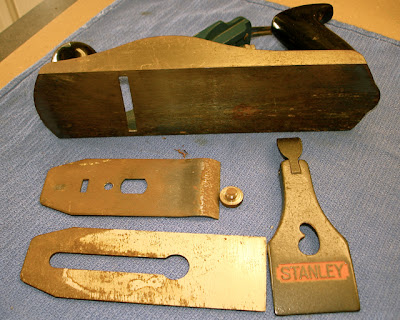
Rusty PlaneWhy is it that some of the best hand tools ever manufactured lie rusting in some basement before they are offered up for sale?

Are you intimidated to try to rehab a rusty old tool because you don’t know how to clean off the crust?

Well, Electrolysis is one very effective and scientific method you could try. Basically, you remove rust by immersing the plane in a solution of   baking soda and water and running a charge through it from a battery.

A woodworker named Rick  has given thorough step-by-step instructions on how the process works, and he claims that it’s a very easy thing to do that gives good results.

So, the next time you come across and old rusty and crusty flea market find, pay Rick’s site a visit and give the technique a whirl.

part of the Wood Talk Online community