We’re going bananas!

For all of you Wood Magazine subscribers (and those who may like to get the occasional copy at  the news stand), the Shop Monkey returns!

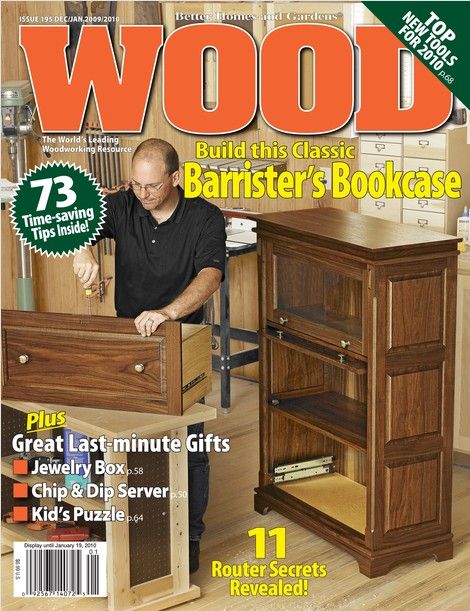
October 2009 Wood Magazine CoverYes, the editors of  Wood must be gluttons for punishment, because they had me back again for a new edition.

Be sure to check out page 16 of the December 2009/January 2010 edition (can you believe that we are now writing the numerals 2010?) .  There, I have a what I hope you consider an interesting discussion about the level of precision required in woodworking.  It’s named, appropriately enough, Precisely how Precise?

If you want to read even more Shop Monkey input, why not check out my blog over at the newly-revamped Wood Magazine forum website?  The new forum software makes it easier than ever to navigate the content and read the input from your favorite bloggers.

Yes, you can even read my content if you have nothing better to do…

The current schedule for the Shop Monkey right now is that the columns will appear in every other edition (the next one is scheduled to appear in the spring).

Now, no more monkey business… back into the shop!

Woodworking Spotlight: Lake Erie Toolworks

In so many things in life, bigger is better.

If you have a bigger hammer, you can drive large nails faster. If you have a bigger offensive line in football, you can block better and move the defense out of the way to score a touchdown. If you have a bigger truck, you can haul more wood home!
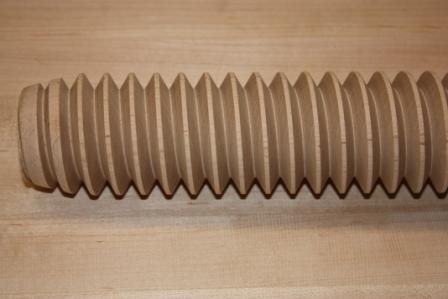
And, when it comes to workbenches, a bigger, more massive model gives you more stability when cutting, planing, routing and doing all manners of other woodworking.

Keeping with this theme, the folks up at Lake Erie Toolworks believe that bigger is better when it comes to vise screws. And, when I mean big, I really mean big!
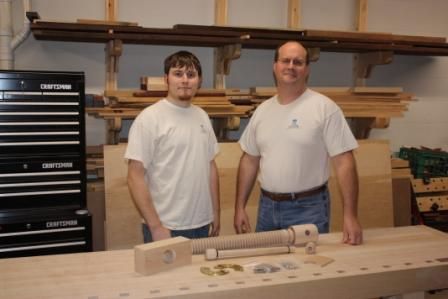
You see, Lake Erie Toolworks currently makes the largest wooden vise screw in the world. I had a chance to talk with Nick Dombrowski, owner of the company, to talk about his enormous vise screws. But first, Nick started with the basics. “First of all, a solid, well designed workbench make woodworking faster and more enjoyable. You don’t have to waste time and energy trying to work around the shortcomings of a table on sawhorses or even most of the commercially available benches out there. There is plenty that already has been said about solid workbenches, and we are working to make our vises an essential part of any solid workbench.”

Nick’s first experience with massive vise screws was when he worked at an organ building shop. “They all used vises with 2 1/2” maple screws, and they all worked great. Very smooth, quiet and fast acting.”

Nick later went on to build his own workbench with a steel screw vise. While the screw gave the vise plenty of muscle, it didn’t have the same ‘feel’ as the wooden models. That’s when Nick set out to make vise screws as good as – if not better – than the antiques he had already worked on.
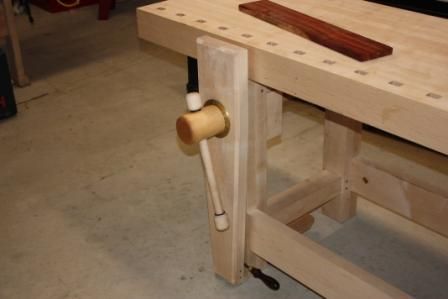
Now, it’s important to disclose the kind of vises you can build with these wood screws – twin screw vises, tail vises, face vises and even a cool vise design that had fallen out of favor for decades – the leg vise. It’s a traditional form that today’s woodworkers should look into building on their benches. “Leg vises have a lot more capacity than the fast-acting face vises. This gives you a lot more flexibility without getting your prized lumber close to guide bars.”

Currently, Lake Erie Toolworks is also working out the details for a shoulder vise screw to build the vise commonly seen on European benches. “Shoulder vises, while a little more complex, are totally worth doing if you like to dovetail.”

“Sure, there are no perfect vises out there; that’s why we encourage woodworkers to consider these other designs.”

Nick’s vise screws are made with a combination of CNC equipment, dedicated machines for internal threading purposes, lathe work and hand finishing. Hard Maple is the wood of choice. It has the highest shear strength of typical vise screw woods (beech, ash, etc), lessening the likelihood of having the long-grain fibers shearing off, or chipping, in use.
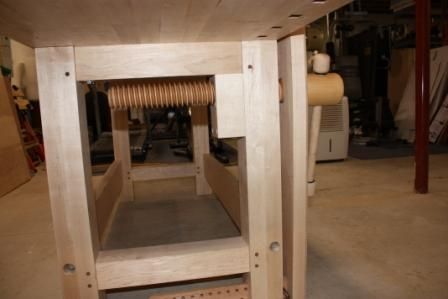
While you might suspect caring for a wooden screw vise would be challenging, it’s not as difficult as you would expect. “We recommend our customers use a penetrating finish on the screw and furniture wax to make sure things move smoothly. The beauty about this screw is that after a lot of use, you may not need wax anymore, as the action against the retaining nut will smooth the wood out on its own.”

Lake Erie Toolworks sells the screw with everything you will need to install on your bench. “You will have to provide your own ‘chop’ for the vise, but all of the running gear is included and is very easy to install.” Nick likened it to building a simple furniture project. The Lake Erie Toolworks site also offers detailed installation instructions, walking woodworkers step-by-step through the process of installing vise on their benches. And, woodworkers also have an option of how they would like to attach their bench screws. “We offer an external brass garter as well as an internal maple garter to hold the screw to the bench. Customers can make their own garter or even go with no garter at all. It’s all a matter of choice.”
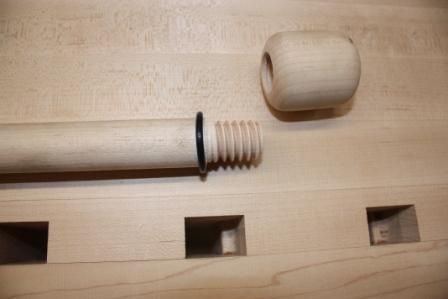
Nick has even gone to the trouble of threading both ends of the vise handle and providing a tapped cap for both ends. “It’s so much more sturdy and durable than trying to friction fit a cap on the end, an if you have to remove the handle, it’s a piece of cake, unlike a glued on cap.”

What does the future hold for Lake Erie Toolworks? “We are very responsive to the needs of our customers. In fact, we have a survey on our web site that lets customers tell us what products that they would want.”

What does Nick like the most about making these massive wood screws? “Tool building really is different than typical woodworking. You get the satisfaction of knowing that someone is using what you’ve made to make other things. Also, I have gotten the opportunity of learning a whole new skill set, that being machining. I’m finding that I like machining about as much as I like woodworking and building tools allows me to exercise both skills on a regular basis.”

Quick Poll

“Don’t touch that!  You don’t know where it’s been!”

If I had a dollar for every time my mom told me that… well, let’s just say I would have a really awesome cabinet saw in my shop!

Instead, I have a more modest model in my shop, and I’m still always looking for a good, budget conscious (read: Cheap)  source of wood.  So, imagine my surprise  when one of my friends told me he goes out on weekends to check the ‘pickin’s’ in the neighborhood dumpsters.

It seems that a lot of folks who don’t want furniture tend to throw it right out into the trash. From cheap particleboard and knotty pine to the occasional piece made of mahogany, oak or even TEAK(!), he’s found some pretty choice timbers nestled in the refuse.

This week’s question – have you ever gone trash picking wood out of the refuse stream.  And, yes, this includes everything… pallets, old furniture, etc.

[poll id=”98″]

Link of the Week

Goodwin Heart Pine

The one feature that struck European settlers when they arrived in the Americas was the abundance of enormous stands of virgin timber.  They thought that the supply was inexhaustible.

Well, it wasn’t.  The majority of today’s North American forests are considered second growth, and there is a difference in quality between these newer trees and the old giants.

While most of that old timber made it to the saw mill, some met a different fate.  While being floated down rivers to the mills, a percentage of the logs sank to the bottom, lost to woodworkers forever.

Or, were they?

Today, a number of firms are saving these ‘sinkers’ from the bottoms of riverbeds and turning them into gorgeous lumber for flooring, cabinets and furniture work.  Goodwin Heart Pine is one of many doing the task.  Their website describes the process of saving these logs and shows pictures of just how gorgeous this old growth timber truly is.

Tools I use: My shaping tools

Not all wood projects need to be square and flat.  In fact, curving edges and surfaces of a project adds drama, movement and a certain artistic flair that helps bring a project from ho-hum to WOW!

While many woodworkers may think first of routers and band saws when they consider adding curves to their projects, but unless you are very careful and use jigs or other hold down devices, your project can go from whoa to D’oh! in the blink of an eye.

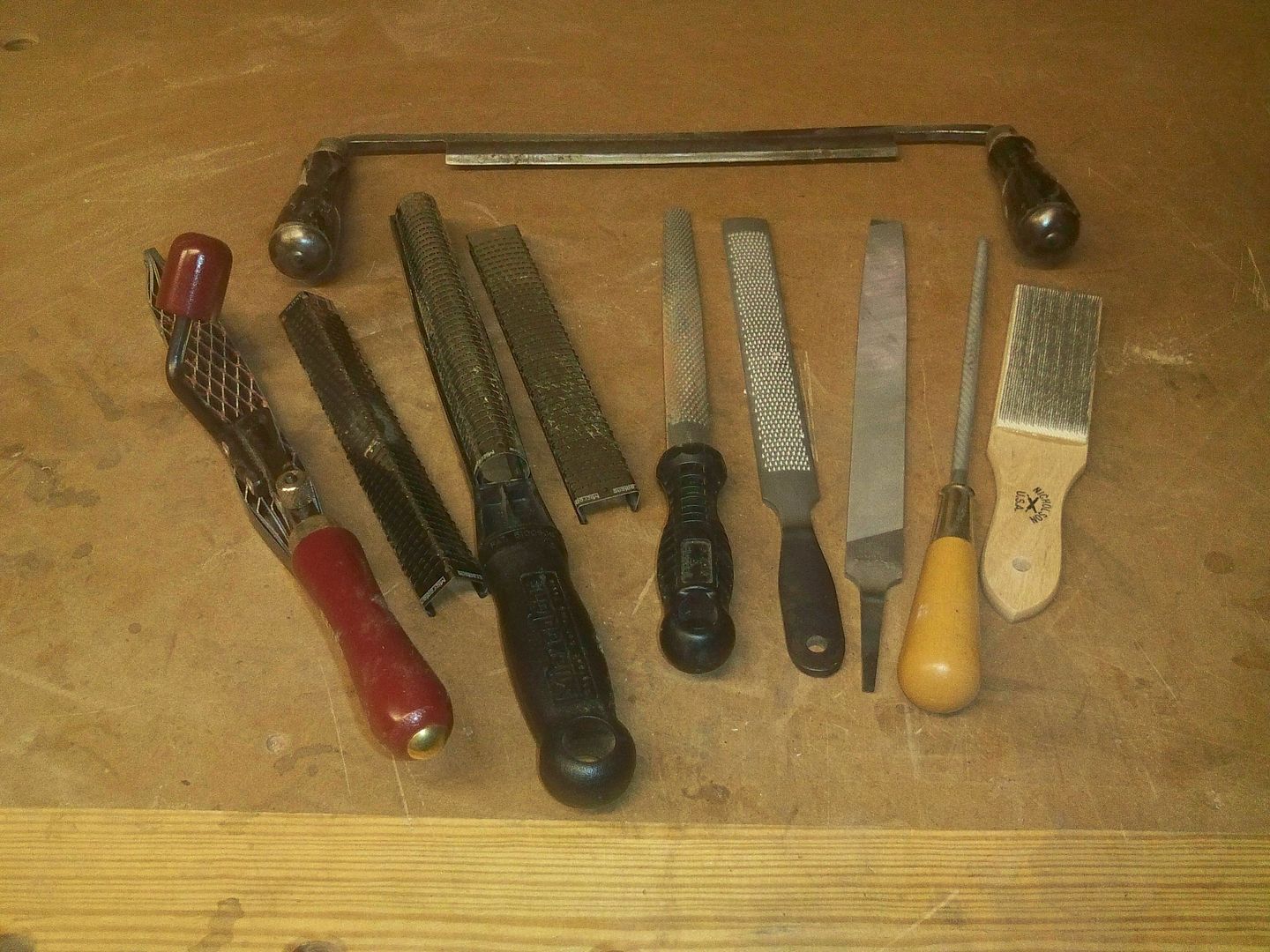
That’s why when I need to add delicate curves to a project, I will reach for some pretty scary looking tools.  Meet the shaping team.

From left to right, I have:

A Shinto rasp.  This is one of the newest tools to my collection, and I am growing to love it more every time I use it.  Basically, it is a series of what appears to be hacksaw blades bolted together to form a boat-like shape.  It has a coarse side and a fine side, and a comfortable handle that allows for a firm two-handed grip on the tool.  This sucker can remove waste wood like nobody’s business, yet allow for extremely fine passes and great control.  I like that I can also shape up to the edge of a leg or other obstacle on a  project because the sides of the tool are smooth.

A Microplane interchangeable rasp kit.  Now, we are talking.  This baby gets the most work in my shop.  Basically a plastic frame with three different interchangeable inserts, the Microplane tools shave the wood rather than tear it.  I can get a very heavy cut with firm pressure, yet get an exceptionally smooth cut with much more care.  The interchangeable inserts allow me to work on  a variety of different shapes with ease.

My rasps and files come next.  From left to right, I have a second cut cabinet rasp, a Nicholson rasp/file combo with an integral handle, a flat bastard cut file that is primarily for metal work, but can also do very fine work on wood and a round rat tail file.  Great for working on tight radii.  Of course, I also need my file card, the brush like device all the way to the right, to get the sawdust out of the teeth of these tools as I work.  I find I have incredible control with these tools, but they can be a little rough when shaping across the grain.  That’s why I find myself using the Microplane tools more.

At the top is my draw knife.  A pain in the butt to sharpen (I’m getting better at it) but a real joy to use.  The draw knife can take off mighty chunks of wood in certain circumstances, yet, when wielded with care and finesse can take off shavings as thin as you can with a smoothing plane.  Right now, I hold the work I’m working on in my bench vise when using this tool, but one day I will have to build a shave horse – or at least a little shave pony – for my shop to use this tool to its fullest potential.

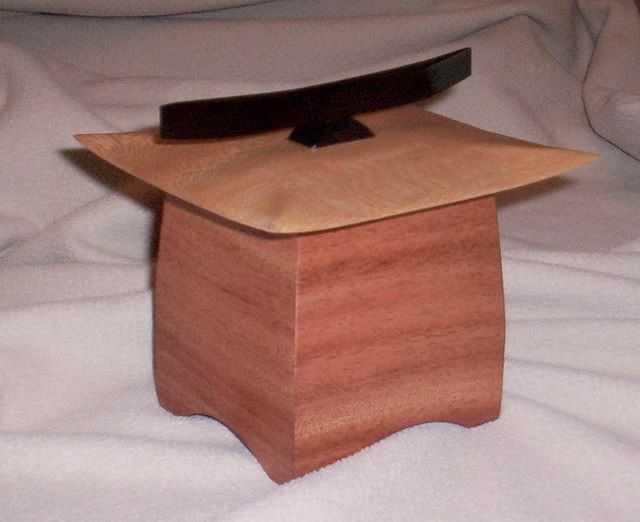
To give you an idea of what can be done with these tools, here is a pagoda style box with a gently sculpted lid.  While the original plans to built the lid involved a delicate balancing act on a band saw and drum sander, I found the task easy and immensely rewarding with just a rasp and a little bit of layout work.  The process is an enjoyable, quiet and much safer way to spend an hour or so.

What kind of care do these tools need?  They are pretty rugged, but will serve you a whole lot longer if you store them so they won’t bump up against each other.  Of course, I am always looking to upgrade my collection with some premium rasps and maybe a few exotic tools, but I have this feeling I have yet to truly tap the potential of the tools I already have in my collection.

But, hey, who wouldn’t like new tools?

Stuff I’ve Built: My Krenov-Style Plane

  • October 2009

Sometimes in life, you meet people who serve as a great source of  inspiration and motivation.  For some, it might be a parent, a friend or a co-worker.  For those who served in the military, it may have been their drill instructor in basic training.

For me, this project started with a meeting with Ron Hock.  At the recent Woodworking in America conference, Ron was there as a featured vendor.  At his table was a choice selection of his plane irons.  I told Ron I was considering purchasing a smoothing plane with a little more oomph than my Stanley No. 4.  Ron was quick to recommend that perhaps the best solution might be to build my own.

That’s when I laid out the money for a 2″ Hock iron and stared looking into plans for building a Krenov-inspired model.  With the plans from Popular Mechanics and some help from Bell Forest Products, I soon had a block of bubinga and instructions to work from.

Now, I’ll tell you I was terrified to start.  I mean, what if I had just wasted all that money on the iron and the wood? A few e-mails back to Ron brought more encouragement.  “Tom, look at it this way,” Ron wrote, “If you mess up badly, you are only out about a board foot or two of wood.  You can start over and do it again.”

The first part was easy… I had to edge and face joint the board to make everything nice and smooth.  Soon, the rough surface gave way to the lovely shade I had come to expect from bubinga.  Dead flat and four square.

The next step was easy as well…. Rip one cheek at one half inch, then the plane body at 2 1/16″ to accommodate the iron, then the other cheek.  I used a cabinetmaker’s triangle to ensure everything would stay oriented.

The directions then called for me to cut the plane body block at 45 degrees. At the table saw, this took only seconds, and the results were stunning.  Dead flat on the face and a true 90 degrees to the edge.

I put a 3/4″ router bit in my table mounted router in order to make a relief groove to accept the screw that holds the iron and the chipbreaker together.  Ron’s irons have a pretty beefy screw, but it was easy to center the bit on the block and make the cut.

By simply flipping the other body blank upside down, I formed the gullet of the plane.  The instructions said to file a flat spot at the miter point of the block that holds the iron, then space the two pieces 3/8″ apart to allow clearance for the iron.  I clamped both blocks to the cheeks and carefully marked where they had to be when I glued the plane together.

I took both cheeks and stacked them together, then drilled a 1/2″ hole through the cheeks at a mark in the gullet to receive the cross pin.  The plans called for me to create a complicated tennoned rotating pin to hold the wedge in place, but Ron advised me to just go with a fixed pin – it would save time and work just as well.  I took a length of 1/2″ oak dowel I had the shop and cut it a little longer than the plan called for so I would have excess I could trim.

Then came the glue up.  I lay one cheek flat on my bench and put glue on it – staying clear of the gullet area – then put the two body pieces in the places I had marked earlier.  Then, I put glue on the tops of the body halves and one end of the oak pin.  I slipped the oak pin into one of the cheeks and then put the other cheek on the top side of the assembly.

The next step I found to be critical.  Not only did I clamp the assembly together across the width, I also clamped it down to the bench to ensure things would line up.  Once I was satisfied, I went on to build the wedge.

After cutting an appropriate piece from the remaining bubinga, I put it into the vise and started to shape it with hand tools. I didn’t want to overshoot my thickness, so I worked carefully with a few rasps and a block plane to bring things down gradually.  Before long, I had the wedge to the right thickness and I was ready to work.

I took the plane out of the clamps, and started to shape it.  I cut the plane to length and then worked on rounding over the front and back edges.  I used the band saw, rasps and a belt sander – bubinga is tough stuff. Once I was happy, I flipped the plane over and ran the sander over the sole.  I wanted it dead flat, so I kept checking with a straight edge.  Once I had it nice and flat, I finished it off with a scraper to get the surface nice and smooth.

The came the moment of truth.  Would it even cut?  I put the iron in and tapped the wedge into place.  It took some fussing at first, but once I got the iron where I wanted it, it cut beautifully!  I do need to get my hands on a plane hammer – my carpenter’s mallet isn’t going to cut it adjusting the iron.  But, other than that, the plane works great.

The time invested was so small… one Sunday afternoon.  If I hadn’t stopped to watch football and tend to the laundry, it might have taken me about two hours. The results, however, were pretty spectacular.

Not a bad way to spend a weekend in the shop!

Quick Poll

I’m a big Stanley Kubrick fan. This world-renowned director produced several masterpiece films during his career.  Of his entire body of work, my favorite movie was 2001: A Space Odyssey.

One of the most pivotal moments in the entire film was when one troop of proto-humans is visited by the monolith, and shortly thereafter discovers the use of tools.  That gave them a key edge in the competition for survival.

As humans, our use of tools has allowed us to do many things.  Whether it’s a surgeon performing delicate open heart surgery, or construction crews building a massive bridge, tools make it possible.

And, in our workshops, we use tools to work with wood to create projects from the most basic and mundane to the most extreme piece of artwork.  That in itself is impressive, but there are also folks who go beyond and  build their own tools.

This week, let us know if you have ever built your own tool.  Power or hand, big or small, it doesn’t matter.  One key point of clarification… it has to be the tool you built.  A router jig or bench hook is a device that improves the existing tool, while a Krenov inspired plane or disc sander you made with a plywood platen powered by a washing machine motor is a tool in itself.

[poll id=”97″]

part of the Wood Talk Online community