Quick Poll

So, yesterday I got some woodworking done. Unfortunately, it wasn’t the kind of woodworking I could do at the workbench. Instead, it took the shape of helping to install about 150 feet of privacy fence in my yard and my neighbor’s yard.

After about five hours of digging post holes, lifting fence panels and screwing them into place, a neighbor noticed I had left a bit of a gap between panels and asked, “Gosh, Tom, as a woodworker, I expected you would be into absolute precision and making this perfect.”

This week’s question was a natural follow up to that… have you found that your skills and precision in building woodworking projects translating into improving your skills in other DIY applications such as carpentry?


Link of the week

Wood Magazine’s free shop organization plans

Woodworking is an awesome hobby. Until you realize what kind of disorganized mess you can create.  There are chisels and saws to keep from banging together, dulling their cutting edges.  Hardware to keep sorted by purpose and size. Specialty sawblades for your band, table, circular and other saws. Racks to store the lumber you are storing for that special project. Stands to hold the tools you aren’t using. Sandpaper storage. And, what’s up with all of those clamps? It’s enough to drive you crazy… if you don’t have a plan.

That’s exactly what Wood Magazine is offering at their shop organization plans page. Get a whole passel of free storage plans featured over the years in the magazine that can take your shop from a hot mess to a cool place to hang out and get work done. Not only can you safely store all your things, but you can find them easily, maximizing your shop time.

Less than a month away…

Can you believe it?  Get Woodworking week is now less than one month away!  I’m so excited, I can hardly contain myself…

Well, maybe I need to learn how to contain myself just a little bit. Anyway, I wanted to get you into the mood by listing a few resources you might want to check out for woodworkers just starting out.  At these sites, you will find all sorts of advice, plans, tool reviews and technique articles to get you motivated to get into the shop and try your hand at woodworking.

Wood Magazine’s Basic Built Series: This is is Wood Magazine’s initiative to provide simple, yet high-quality woodworking projects that can be completed with a minimum number of tools and skills. This site covers a wide array of topics – from how to find furniture worthy wood to where to find the best deals on tools. The inexpensive projects offered run the gamut from shop fixtures to tables, seating and casework.


Popular Woodworking’s I Can Do That: In every issue of Popular Woodworking Magazine, the “I Can Do That” column features projects that can be completed by any woodworker with a modest (but decent) kit of tools in less than two days of shop time, and using raw materials that are available at any home center. Be sure to download their .PDF manual first before you get a start on things.


New To Woodworking:  Marc Spagnuolo, the Wood Whisperer, understands that it’s OK to be a Noob. That’s why he put together this impressive site for the up and coming woodworker. He’s sorted through his site and found the best articles on shop set up, technique and projects with build-along videos.


NewWoodworker.com: Tom Hintz is no longer a new woodworker, but, believe me, his site will help steer any new woodworker in the right direction. Before you buy a new tool or select a spot for your shop, be sure to pay this site a visit and soak in the knowledge.

Now, this is by no means a complete list of sites. In fact, if you are aware of any others, be sure to list them in the comments below this article. This way, I can add them to this list to build a resource of sites geared toward the new woodworker.

Also, be sure to check the blogs listed to the right of this post. Each of those are the sites of bloggers I have been in touch with – either in person or online – who do some outstanding work.  I have asked for their help for the week, and most of them have said they are game. As they post articles on their sites, I will also link to them on a dedicated get woodworking page on my site.

The best part about Get Woodworking Week is that we’re going to make an active effort to get folks off the sideline and help them find the sawdust in their veins.  We’ll all be better off with new folks who get out there and show us what they’ve got.


Strop! In the name of love

I remember the first time I was able to get a hand plane to work properly. I had this nasty old Stanley No. 5 that I bought from eBay, and I had spent a lot of time cleaning rust and other crud off the body, freeing the adjusting screws and just cleaning the heck out of things. I also took the time to sharpen the iron, reading the instructions on how to do the deed at the bench while I worked on the edge. When everything was back together and the first curl popped off the board, I knew I was in love.
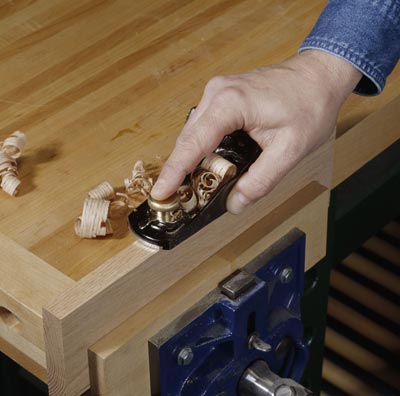
Unfortunately, I didn’t really like sharpening at the time, and the job I did was barely passable. And, after some serious use, I struggled to get things sharpened. After that experience, I shied away from hand planing because I didn’t ever want to go through the whole process.

Since those early days, things have certainly changed. I have improved my sharpening technique and, with the Tormek setup, I can get things done in very short order. The thing I did discover, though, was that while using my chisels and planes, the edges never really got totally dull. Not like a sit down and spend some serious time sharpening kind of dull, just a little difficult to push. That’s when I discovered the joy of stropping.

What exactly is stropping? Well, when you sharpen a blade, there are three phases of technique that you have to consider. First is grinding, which is working at the blade to recreate or reshape a bevel. If you get a beat up old plane, you may need to grind that edge into a usable shape. This is done with a coarse stone, a high speed grinder or some other contrivance.

Next up would be honing. This is when you have the shape of the bevel, but you are looking to start refining the edge. This is typically done by hand on finer stones to get a good polish on the bevel.
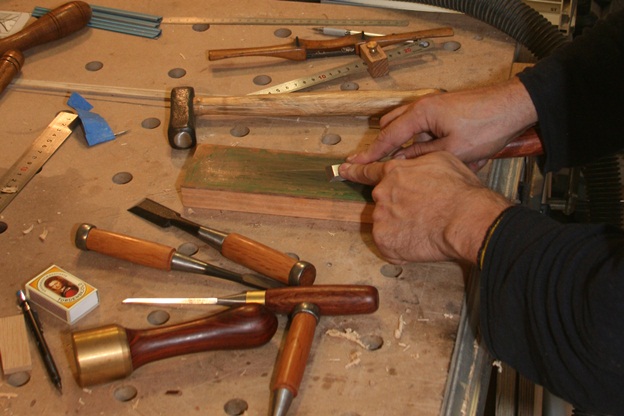
Stropping takes honing to the next level. Rather than use a hard surface like a water stone or sandpaper on a piece of float glass, you use something a little softer – typically a strip of leather. The leather itself doesn’t do the cutting – there is a compound that you would rub onto the strop. It contains very fine abrasives and really perfects the cutting edge. Just a few passes is enough to do the job.
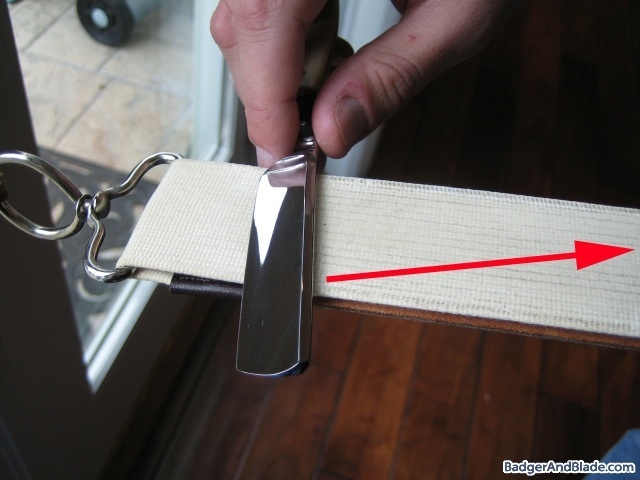
This is what barbers used to do to get ultra-fine edges on their straight razors. And, if you notice how a barber uses a strop, he or she never pushes the blade into the stroke, it is always pulled. This way, the sharp edge you are creating won’t slice into your strop, leaving a cut up mess.
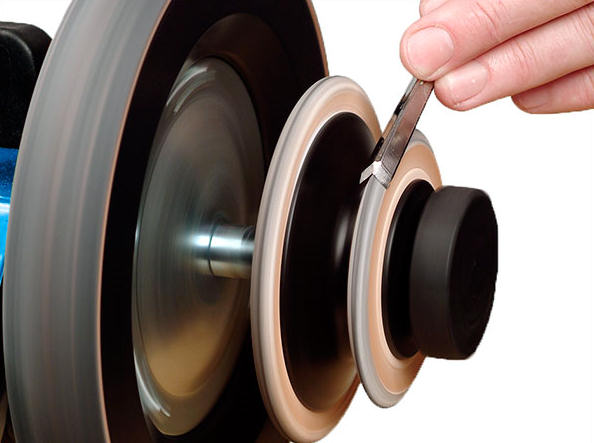
I have a hand held strop made of leather glued to a wooden handle. This worked well when I was doing all hand sharpening, and I still use it when stropping smaller tools. The Tormek also comes with a leather strop wheel which turns on the same arbor as the main sharpening stone. The set up comes with a tube of stropping compound, which gets rubbed into the wheel, allowing for a nice polished edge.

While stropping after sharpening is a great way to go, I also have a trick I use in the shop. When I’m working with a chisel or a plane, I will stop from time to time and bring the blade over to the stropping wheel at the Tormek. Just a couple of seconds on both sides of the bevel, and I’m back to work, cutting well again. Obviously, it’s not a full sharpening job, but just as a chef may use a steel to hone his knife during meal preparation, it gets my blades back to a ready-to-roll state quickly.


 

Quick Poll

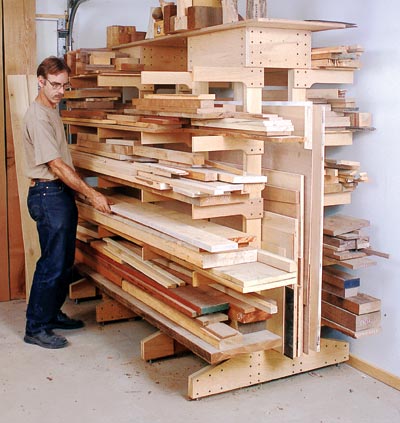
Over the years, I have accumulated some extra boards of project lumber. Some sweet walnut boards from a mill that was going out of business. Some awesome tiger maple boards my friends at Bell Forest Products sent me. A few extra cherry boards I bought because the mistakes I thought I was going to make didn’t happen.

While having extra wood on hand is awesome… you do have something you have to consider – how on earth will you store those extra boards?

This week, tell us how you store your extra boards… or, even if you have extra boards to begin with!

Well, that was awkward…

For those of you who signed on very early this morning, you saw the link of the week taking you to a different site.  Something about a dovetail jig review site.  In my zeal to provide you information about dovetail jigs, I grabbed that one and posted it today.

Boy, was I shamefaced when Stuart of Toolguyd.com wrote me a note pointing out something I should have seen all along… the site is – how shall I put this – less that reputable.

Basically, what the site’s author had done was to copy and paste a great deal of background information about dovetail joints from Wikipedia to the site, with a number of links his Amazon affiliate site. He also copied and pasted many of the user reviews from Amazon and listed them.  Of course, the big drive was to have unsuspecting woodworkers (like me) Google, check out the info and then click through to buy the jig, netting the site owner cash. Marc Spagnuolo of the Wood Whisperer’s site pointed out that these types of sites are commonly known as ‘link farms’, and with the amount of content he puts out, he has to watch the web carefully to ensure his material isn’t being used for this purpose.

It’s a very deceptive way for someone to set up a site, making money on the work of others without their knowledge or permission.

How can you tell if you are on one of these sites? Both Stuart and Marc told me to check  the site’s content against the Wikipedia entry – if it is lifted word for word, you know someone’s not doing their homework.

Also, look for an excessive number of affiliate links all over the page. On the page for one dovetail jig alone, there were eight links back to Amazon to that one product. On ONE page.

Was this the only site out there doing this?  Nope. There are many sites out there misappropriating online content for their shady dealings. I addressed similar sites in my Monkey Business article at Wood Magazine, and  Steve Ramsey did an awesome video about fighting online piracy at his Woodworking for Mere Mortals site.

The current link of the week takes you to the About.com site on dovetail basics – an awesome read.

As for me, I want to apologize for posting that first link today. This isn’t the first time I’ve made an ass of myself on my blog, but I’m hoping it will be the last.


Link of the week

About.com’s Dovetail Joint landing page

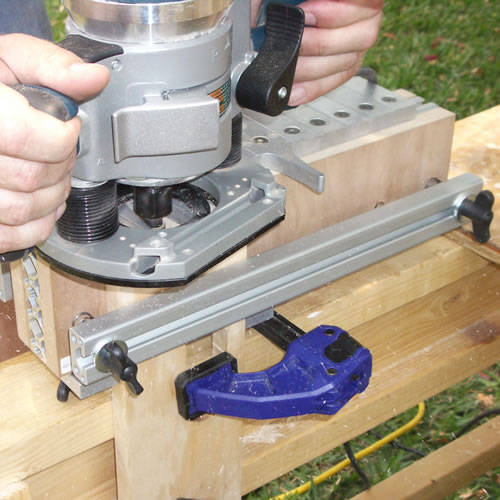
Full blind. Half blind. Through. Router cut. Hand cut. There are many different flavors of dovetail joints out there – but how is a woodworker supposed to know which is which?

One good place to start is at the About.com’s dovetail landing page. From this link, you can find a host of information about the different kinds of dovetail joints out there and the best way to cut them.  The site’s moderator has even put in links to show how box joints work – just in case you want to try those instead.

part of the Wood Talk Online community