Category Archives: Shop Talk

A Toot for Flutes

Woodworking projects can be embellished in so many different ways.

Pick out some sweet boards with impressive figure. Mix contrasting wood species. Lay in an awesome piece of veneer. Choose some outstanding hardware. Even a highly-polished finish can make a piece pop.

But, even the most basic woodworking projects made of the most common species of wood can be jazzed up with molded details. You can add a purchased molding to your work, rout a profile on the edge or, if you really want to get fancy, you can do some fluting.

No, I’m not writing about the tall, narrow glass you drink champagne from, nor the side-blown high-pitched instrument frequently used in marching bands and orchestras. Flutes are the shallow grooves that sometimes ornament the faces of columns and flat vertical moldings called pilasters. In stone and woodwork, they are usually in a parallel, evenly-spaced series vertically to a surface.

The flute is actually the groove itself. The area between the flutes is known as the fillet.

The first flutes  ever observed in architecture were carved into stone columns adorning buildings in ancient Greece and served as a visual design element. They can create dramatic shadow lines, and make the vertical elements of a piece seem taller. Surprisingly, Roman columns were typically smooth and polished unlike their Greek predecessors. And, yes, all of those flutes were painstakingly carved into the stone by hand. Hey, neither Rome – nor ancient Greece, it appears – was built in a day.

Today’s woodworker has more than a few options when it comes to adding flutes to pieces. Many lumber yards and hardwood suppliers have a stash of pre-milled fluted material on hand. While this is an easy way to go, it often limits your options. “Many of these pre-milled fluted moldings come in only a few common species, and you are limited on the size, spacing and number of flutes,” said Tim Walter of Eagle America. “You might be stuck with something that looks out of place – either too large, too small, or the wrong grain pattern going the pre-milled route.”

An option that gives the woodworker more flexibility is to mill your own fluted moldings. One way to do this is to set up a router table with a plunge bit (a core box, v-groove, etc) in your router and a router fence. If you route one flute, then flip the board end-for-end, you can route a groove with identical spacing on the opposite side. From there, you can cut the boards to length and apply them to the piece you are building. “That’s one option, but it might look a little choppy,” said Tim. “After all, you are just cutting the flutes at the end. You’ll have to find a way to cap the ends of the molding, and those flutes will end abruptly, leaving an pretty jarring transition.”

A better way to make the fluted profile look neater would be to create stopped flutes. This can be done by lowering a board onto a spinning router bit, running the board the desired length and then pulling the board up from the bit at the end. “That’s one way to do it, but it can be tricky to get all the grooves to start and end the same distance from the end of the board.”

Another, easier way would be to rout the grooves from the top of the board with a plunge router. “This way, you can plunge the bit into the board right on a pencil mark and run them the length of the board. You can get much better results because you can see where you are routing.”

The challenge with this method, however, is keeping the router on track as you make the grooves. On long pieces, a groove that jogs or slants one way or the other will stick out like the proverbial sore thumb. To ensure the router stays on track, many woodworkers turn to a dedicated edge guide. While that prevents movement in one lateral direction, there is the chance that just the briefest loss of concentration can allow the woodworker to pull the edge guide away from the board’s edge. “That’s one way to create custom, hand-crafted firewood in a hurry.”

To prevent this, many woodworkers rely on a jig that clamps the board between two fences, preventing any lateral movement across the face of the board. Tim showed me the jig they sell at Eagle America. It consists of a 3/8” polycarbonate base that mounts to your router’s sub base. The two edge guides are mounted to the main base plate with bolts and knobs that ride in two slots. “You can get infinite adjustments between the two edges that way, and you can rout pieces from 1” wide to 12” wide… more than adequate for the vast majority of woodworking operations.”

The added benefit of the jig lies in the shape of the edge guides. Not only can they be used on straight moldings, they can also be reversed and the smaller edge with ball bearings can be used against the work. This way, woodworkers can rout flutes into a curved or arched piece. “Imagine if you had to trim out the top of a Palladian window. This guide can allow you to make accurate flutes that match the curved profile of the molding. The results can be stunning.”

Eagle America is also throwing in a free round nose bit for woodworkers who order the jig. “We want to make sure that anyone who orders this jig will be ready to go as soon as it arrives at their shop. We don’t want them to have to wait longer to pick up the right bit to make it work.”

While flutes in your moldings won’t guarantee your work will be around 2,000 years from now like the stonework from ancient Greece, they can make your work a real piece of art.


“You are tough to buy for…”

My wife and I have a great relationship. We are a good pair of ‘parent partners’ when it comes to raising our boys. We share many of the same tastes in food, friends and keeping our home a pleasant place to live. There are times when we are right on the same wavelength, knowing when – say – it’s time to leave a party because someone thinks it would be cool to start dancing the Macarena.

The one time we seem to disconnect is when we are buying gifts for each other. I remember the time I bought her utility long underwear tops and bottoms – and gave them to her – on Christmas morning – in front of her parents – while we were just still dating.

I am an extreme dufus.

For many years, we would share the same lament whenever Mother’s Day or Father’s Day, our anniversary, the holidays or our birthdays would roll around. What am I going to get for my loving – and ever patient – spouse?

We got to the point where we now write down our gift ideas and slip them to each other. It’s been a good solution, and I’m currently working my way through her’s this holiday season. So far, so good.

But, it’s almost 2010! Pen and paper? So outdated. Besides, aren’t we all going paperless these days?

That’s why many retailers are getting savvy and putting together entire gift sites on their online stores. Every year, merchants are making it easier for those loved ones in your life to pick the right goodies for you.

EAGifts

“The whole reason we started our gift site,” said Tim Walter of Eagle America, “is that we know woodworkers throw themselves into their gift making this time of the year. We just wanted to make sure that you weren’t forgotten about, either.”

As with many other sites, the folks at Eagle America have combed through their entire catalog of offerings to select those handy, just-can’t-do-without items that woodworkers would love to see under the tree. “We put a focus on both essential items as well as some more fun woodworking accessories. After all, fun on Christmas morning shouldn’t just be for the kids, woodworkers deserve some too!”

The gift offerings are also broken into dollar range categories. “We understand that not everyone can afford to spend a lot this holiday season. That’s why we broke the categories down by amount. For instance, if you have kids and they are pooling their allowance to buy you something for the shop, we want to ensure they can find a high-quality tool well within their price range.”

And, for those who may have been extra-nice this year, “There are lots of fun ‘toys’ in there…you know what I mean, power tools! Who wouldn’t want a brand new Fein Multimaster under the tree?”

Of course, you can recommend your loved ones just browse by category, or you could select a few items and put them on your wish list. “Sometimes, you need a particular tool to help you develop your skills. Planting a few suggestions gives the gift-giver some guidance on what you are looking for and helps prevent them from giving you something that you may already have.”

While it may seem like it’s no longer a gift if you plant a few strong hints, remember, you may be helping your spouse, friends or relatives who might be sweating over choosing a gift for you this time of the year. “Besides,” asked Tim, “how many reindeer sweaters does one person REALLY need?”

Be a happy elf…

This past weekend proved to be one of the most productive I have ever experienced in the shop.  There’s nothing quite like getting holiday gifts built for loved ones.  You know they will appreciate the gesture and proudly exhibit the item you build for years to come.  Yes, as an elf at the North Pole, I was totally stoked!

Send your own ElfYourself eCards

Unfortunately, once word gets around that you are a skilled woodworker… well… the jig is up.  Requests start to come in.  “Oh, you don’t have to buy me anything… something from the shop would be awesome!”

This year, I have now moved up to building ten copies of a project I found in the pages of Wood Magazine.  I can’t show you what they look like all put together, because I don’t want to ruin the surprise for the recipients.

However, I can take you behind the scenes into Santa’s workshop to show you how those elves are busting butt to meet the production deadlines.

Let’s just say that power tools are the workhorses for these projects.  I could easily do the work with hand tools and bang out high quality pieces, but for accuracy, speed and repetition, power’s got it hands down.

OK, some quick math….  since I’m working on a factor of ten, the number of pieces I had to cut includes:

  • 40 uprights
  • 40 rails
  • 40 long rests
  • 20 feet

For joinery for these pieces, I then had to  cut:

  • 80 mortises
  • 80 tenons
  • 80 notches

Needless to say, all of these joinery cuts have to be very precise, since they should all be interchangeable between different assemblies.  I relied heavily on stops, jigs and sleds to get the right set ups for each operation.  Sure, it took some time to get set up to a high degree of accuracy, but once I was there, things sped along.

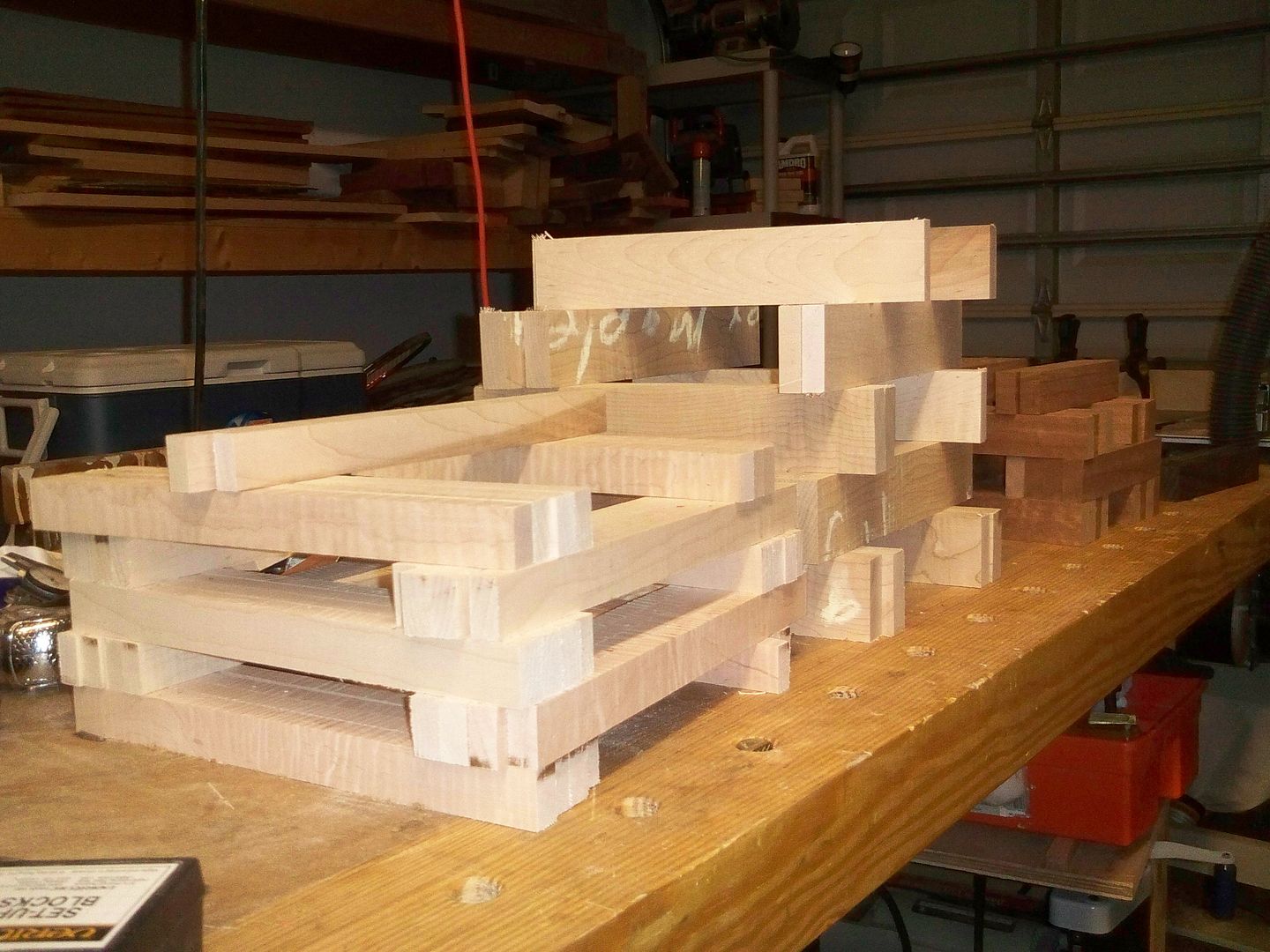
After about seven hours in the shop over two days this weekend, I managed to have all of the pieces cut to size, all of the joinery cut and the central frames glued up.  From here, there’s more shaping to do on other elements and the final assembly.  Perfecting the sanding will follow, and then the entire project will be capped off by a lovely finish.

I’m hoping that all of the pieces which have to ship to the family will be ready to fly by Thanksgiving week, and then I can get the shop back for a few fun projects that are coming along afterward.

Right now, however, Santa’s little elf has had it…  he’s beat and could use a nap to recover from a long stint in the shop.  Visions of sugar plums – and hitting the shipping deadlines – are dancing in his head for sure.

Holiday Gifts to Bowl them Over

It may be difficult to believe, but the end of October marks the beginning the crazy season.

You know exactly what season I’m talking about. The holiday season is now officially upon us.

You have to buy airline tickets for lots of family visits.  Tense negotiations between husbands and wives begin to decide which family gets each of the holidays. Who is going to cook?  Will you try to do the big Thanksgiving holiday dinner at two separate celebrations?

It’s almost enough to make you wish the holidays would already be over.

Woodworkers often look at this time of the year and get a little shaky as well. After all, now is put up or shut up time when it comes to the craft.  Sure, all year you were bragging about the cool projects you built. Maybe it was that dining room table in April, or that grandfather’s clock you finished in September.  Family members were taking note, and maybe they even suggested that perhaps they would like a little something from your workbench.

When it comes to building gifts for giving during the holidays, I’ve discovered a few immutable truths.  First, I always go small.  Sure, I could build an entertainment center for someone, but come on, there’s no way that would ever ship.  Some of the favorite projects have been keepsake boxes, clocks, desk organizer sets… things you can put into a box and send to those distant relatives. But, after giving them for a few years, well, how many clocks does your dad really need?

The past few years, I’ve also come to believe that the best way to go is to build items that get some frequent use.  Something like a cutting board is always a good choice, because it gets a whole lot of work through the year.

This year, however, Tim Walter of Eagle America brought my attention to a new project that really caught my eye.  They now offer bowl and tray kits that can be easily made using the most versatile tool in your shop, your router!

You know the kind of project I’m talking about… You go to a friend’s house for a get-together, and someone breaks out the potato chips and onion dip.  If your friends aren’t animals, they may offer a classy serving option – something like a tray that is sectioned for the chips and the dip, so they stay in their own cubbies, but they are easily accessible.  Imagine the pride you would feel serving up the chips and salsa to your friends in a wooden chip tray set you built yourself.

The kit comes with the acrylic templates to pattern to cut the sections, and the specialized router bit that removes the wood to form the cubbies leaving a rounded edge flat bottomed section in the tray.  “This is really an insanely simple project that has so much impact,” said Tim of the kit.  “With just a plunge router and some imagination in gluing up the blanks, you can have an impressive tray set to give that will amaze any recipient.  And, since they are so easy to build, you can knock out gifts for both sides of the family without any additional hassle. That makes it twice as easy!”

The basic kit offers the standard wedge-shaped pattern you expect to see on a round chip tray. For the holidays this year, Tim and his busy little elves have come up with a surprise for woodworkers.  “While the basic shape is great, we’ve gone a step beyond and developed some holiday-themed patterns – Christmas trees, snow men and a stocking.  Grab a handful of M&M’s, Hershey’s Kisses, cookies or roasted nuts out of those trays while Gene Autrey croons Frosty the Snowman on the radio, and you will be in the holiday spirit before you can say Jack Frost.”

While the patterns are new for this holiday season, the special bit is usable for every one of the patterns. “As with all of our bits, the Bowl and Tray bit is made of the highest quality materials and ground to a very fine edge.  Once your relatives see the first bowl or tray you make,I guarantee you’ll be very busy building more.” Besides, Tim said, “you never know when we may come out with templates in other holiday shapes… Stay tuned.”

A small, easy to build, easy to ship, ready to use gift that can be brought out at parties any time of the year?  It looks like Tim and the elves at Eagle America have been reading your holiday wish lists.

P.S. For some other easy to build ideas for holiday gifts, Eagle America also offers a few more helpful suggestions…

A Honing Beacon

My dad was fond of telling me to never discuss politics or religion with others.  I thought this odd advice, but, once I tried it at college, I knew exactly why he told me.  People tend to get very defensive if they feel their beliefs are attacked, and they will push like mad to have you think their way.

I guess my dad could have also added talking to people about their methods of sharpening.  Woodworkers tend to find a way to do something – especially as important as their techniques for putting a keen edge on their chisels and plane irons – and stick with it.

Now, let me make myself clear before I start to ramble on here.  Sharpening is a very broad term when it comes to edged tools.  There are actually two distinct steps in the sharpening process.  The first is grinding.  That involves the rapid removal of material to shape a bevel and remove any damage to a cutting edge.  There are many ways to do this, and you’ll see woodworkers rely on grinding wheels, very coarse abrasives and flat platen grinders to accomplish this task.  While getting the edge ready to be honed is important, it’s not what I am going to cover.

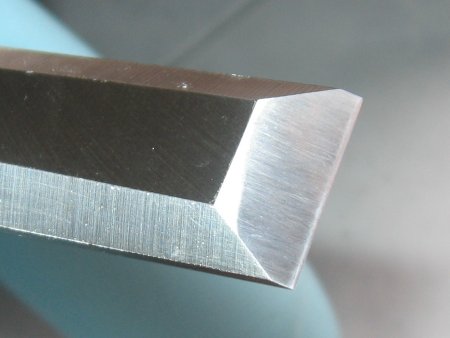
No, I’m talking about the act of honing… progressively removing small amounts of metal in order to achieve a fine cutting edge.  This act is typically performed by hand using careful amounts of pressure with very fine abrasive agents.  Here’s where the interesting discussions get started… and where you will see lots of folks start to take sides.

There are basically five different  kinds of media on which people will hone their edges – oil stones, water stones, sandpaper, diamond stones or ceramic stones.  Each has its boosters and each has its detractors.  Some people will make authoritative claims that one method is far superior over the others – even if they have never used the other methods in question before.  I’ve decided to at least give you a bit of a primer on the different methods and what I hear are the pros and cons of each.

Oil Stones: These stones are typically natural stones quarried from the Earth.  They typically bear the name of the region from which they were harvested – for instance, a hard Arkansas stone is found in a mining area that falls near the Arkansas and Oklahoma border.  There’s not a ‘grit measurement’ given for oil stones – their level of abrasive fineness is inferred from their descriptive name (Hard India, Translucent White Arkansas).  Exceptionally hard, most oil stones do not need to be flattened with another stone for years of use.  They use an oil-based lubricant to make sharpening easier and to clear the swarf – the metal shavings.

The agent that does the cutting for oil stones is novaculite, a silica based impurity that is found in these sedimentary rocks.

  • Pros: The stone stays true longer, giving the best sharpening job.  They have been used for thousands of years with great success.  The oil helps prevent rust on the blades being sharpened.  Lower cost compared to other methods.
  • Cons: The stones can glaze with metal cuttings, making sharpening difficult.  The hard stones sharpen slowly.  Oil makes a mess.

Water Stones: Japanese woodworkers have been using these stones for hundreds of years with great success, and now the stones are now in western shops. Naturally quarried water stones are becoming more rare, so many of today’s are manufactured. The water stones are softer, which means they abrade more quickly, exposing fresh cutting media as the sharpening progresses.  The water creates less of a mess to clean up and leaves no residue.  The stones – especially the manufactured ones – are advertised by their grit size – a 1,000 grit medium stone.  Because they do wear quickly, these stones do need to be flattened, or dressed, frequently to ensure blades and plane irons are sharpened squarely.

  • Pros: Fast cutting.  Only water is used with the stones. Easier to pick up the proper grit size. Most popular sharpening option, meaning more choices for buyers.
  • Cons: Creates a mess.  Water on steel – if not properly tended to – can lead to rust. The stones need extra care to ensure they remain flat. The price can get high for high-quality stones.

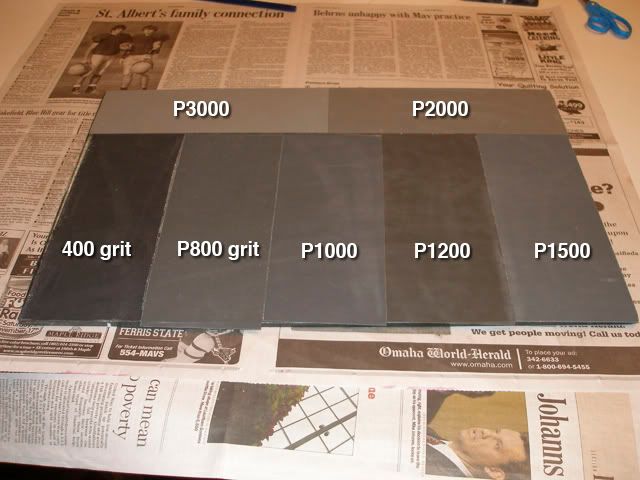
Scary Sharp (Sandpaper): At first, you may think this is some kind of joke.  Sandpaper as a medium to sharpen?  You bet… Different grits of sandpaper (400, 600, 800, 1,000) can take an abused edge from butt ugly to razor sharp.  The paper, which does the cutting, is typically adhered to a dead flat substrate, which means you you will always be working on a flat base.  You can use a few squirts of something like WD-40 to help the blade glide over the surface, but it’s totally optional.  Remember, you are sharpening on the sandpaper on top of the hard substrate… so there is the chance that your paper may move during sharpening, dubbing your edges.

  • Pros: Cost – it’s dirt cheap to get stared on. The sandpaper grits can be found at a home center or auto parts store. The paper cuts aggressively, even at higher grits.
  • Cons: Cost – you will be buying packages of sandpaper forever to keep sharpening, and the durability of the sandpaper is limited. You could dub your edges if not careful, meaning that you won’t have sharp edges.

Diamond Stones: Diamonds are a girl’s – and a woodworker’s – best friend. As the hardest substance known to science, industrial grade monocrystalline  (on premium stones) or polycrystalline diamonds (on cheaper stones) can abrade away metal very quickly.  The tiny diamonds are embedded on a flat metal plate with a nickle-based metallic binder, and many have ‘holes’ in the metal plate to allow the swarf a place to go.  Diamond stones are used with a squirt of water to allow for lubrication and swarf removal. These are some of the most expensive stones out there.

  • Pros: Diamond stones cut quickly.  They need no care other than an cleaning and drying after use. They come in a variety of grits to accomplish a number of tasks.  They are the only medium can can be used on carbide.
  • Cons: Price.  Conventional wisdom holds that the swarf generated by sharpening steel on a diamond stone will break the bond with the substrate. Cost.

Ceramic stones: The new kid on the block, ceramic stones are always manufactured.  Basically, a ceramic mixture is carefully mixed with sharp cutting agent embedded within before it is fired.  These stones can be used dry on blades, but they do need to be cleaned with a household abrasive cleaner.  These stones can be quite pricey, but their quality is quite high and they can become lifetime stones for your tools.  They are typically found only in finer grits, so if you do want to work an edge over, it could take some time to remove enough material.

  • Pros: Insanely flat. Can be worked without water or oil. Very hard, durable surface that can’t dish.
  • Cons: Cost.  Can become glazed and needs maintenance to keep cutting medium clear.

What does this mean for the average woodworker?  Well, each of these methods does provide outstanding results and can sharpen just about every tool in the woodworker’s arsenal. If you are using a method that gives you outstanding results, I say stick with it. In fact, if you are using several methods – say a diamond stone for coarser work and an oil stone for finer honing… there’s nothing wrong with that either.

However, I’m sure several readers will weigh in with their preferred method of sharpening. They will tell me that I am way off base and that their method is the only one that works – the others are just trash.

That’s what you get for talking politics, religion or honing!

Friends, Romans, Woodworkers….

Back when I was a student at the University of Maryland, I  had to study quite a bit of English Literature.  Makes sense, since I was majoring in English Literature and Language.

During my classes, I was exposed to many different writers of classic English and American novels, plays and essays. Some were just awful – wretched books that I had to force myself to read or risk failing. A few words of advice – if you ever have to make the choice of being compelled to read Humphry Clinker by Tobias Smollett or having your flesh ripped by wild weasels, you might want to give the weasels a chance…

However, other things I had to read were very engaging. Pleasant.  By the time I was ready to receive my Bachelor of Arts degree, I had developed a fondness for the works of William Shakespeare. The Bard of Avon – also known affectionately as Billy the Pen – had a way of setting a scene, bringing his characters to life and engrossing you in the story.  Romeo and Juliet, Richard III, King Lear… Shakespeare was able to churn out classic after classic.  The plots of his plays still appear in slightly different forms in movies, novels and even television shows.

My favorite play of all was Julius Caesar.  Talk about a play full of tragedy, majesty, deception and betrayal. Almost sounds like one of those reality shows on TV today.  What really makes the play for me is the oratory.  Both Julius Caesar’s assassin Brutus and the play’s protagonist Mark Antony make rousing speeches at the Roman Forum.  Mark Antony’s stirring words ultimately sway the crowd against Caesar’s assassin, setting up the eventual downfall of Brutus.

The whole forum concept was critical in Roman society. Forums were established in larger Roman cities for people to gather for commerce, for intellectual debate, religious worship and for justice to be dispensed.

So, it should come as no surprise when gathering areas were established on the Internet, they would come to be known as forums.  There are forums that appeal to many different interests – automotive repair, fashion, cooking, home improvement, business and technology.

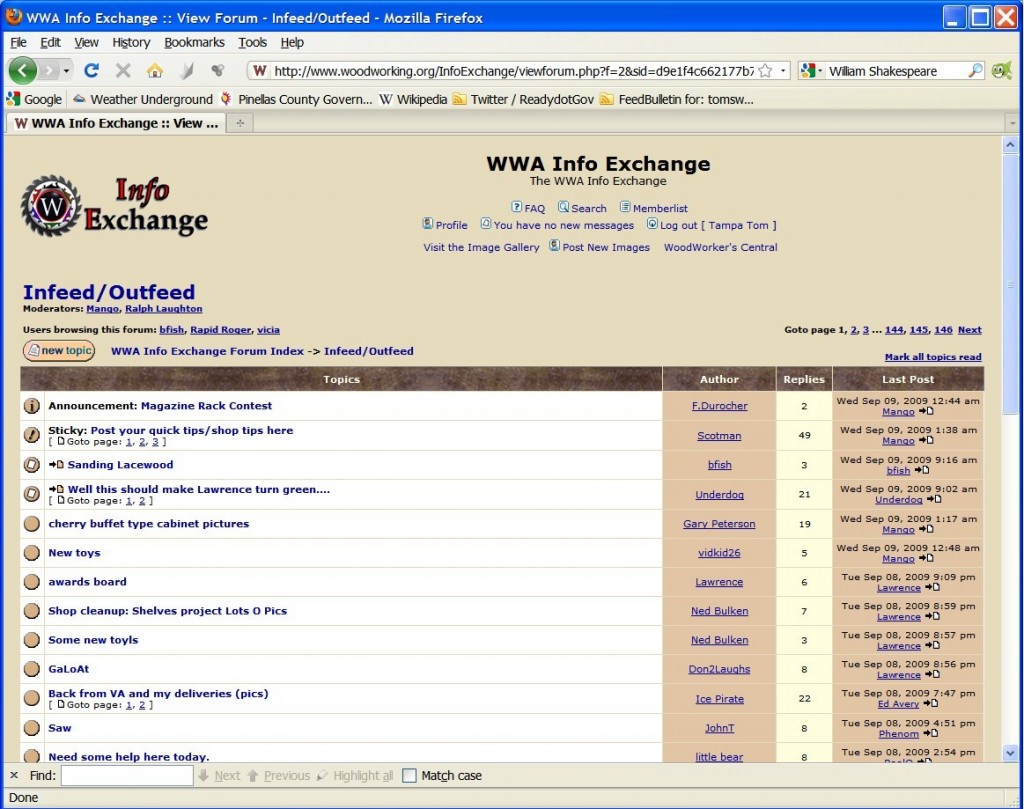
As woodworkers started gravitating to the Internet, many different woodworking forums began to spring up as well. At first, they were simple evolutions of ‘bulletin board’ services which had been around since the earliest days of what would eventually become the World Wide Web.  These forums have advanced tremendously over the years in sophistication, giving users access to a tremendous amount of information.

WWA

Some of the forums out there are tied to woodworking magazines.  These forums tend to attract their readers through their printed editions and focus primarily on topics covered by their contributors.

Others are run by tool manufacturers or vendors.  These are obviously focused more on the tools they sell, which gives users an excellent opportunity to get very tool specific answers to problems they may be experiencing.

Some are run by professional associations, woodworking schools or bloggers, which give a greater depth of information about current projects, trends or special offers to participants.

Finally, there are those which are just a little maverick.  In the early days of Internet forums, woodworkers kind of went their own way, establishing independent forums not beholden to an advertiser or other ‘parent’ entity.  Donations at this kind of site are usually greatly accepted!

These online forums are outstanding places to get your woodworking questions answered – sometimes in mere minutes.  However, you also have to understand that just as in the Roman forums, many people will be coming there to give you advice.  Each of the woodworkers who posts is coming from their own level of experience, set of tool preferences, methods of construction, etc.

While these boards are typically moderated for inappropriate behavior, don’t be surprised if  – say – your question on how to cut a mortise comes back with several different methods – and many vociferous supporters of each who  may seem a little strident in their support of their preferred method. “You fool!  You  MUST cut a mortise with a hollow chisel mortiser.  It’s the only way!”  “Forget what he said.  Develop your hand tool skills and chop them with a mortising chisel!”

Needless to say, when it comes to using these forums, it pays to have a bit of a thick skin and an eye to discern the level of expertise – and if they are trying to sell you something.

Oh, and it also pays to overlook some of the spelling and grammar mistakes on the posts.  Many are dashed off while glue is drying or on a quick lunch break.  Others are written by people with a firm grasp of woodworking techniques, but maybe not the best of writing skills.

But, hey, were you expecting Shakespeare to write a post?

Of work horses and show ponies…

I make no bones about it… I love old woodworking hand tools.

Give me a classic chisel, slick, plane, saw or other woodworking implement, and I’m as happy as a clam. My jack plane dates from the early 1910’s, my wooden fore plane from the 1880’s and my sash mortising chisel from approximately 1845.  Each of these classic tools sits ready to accomplish the task needed.

Since I have confessed my love for hand tools of bygone days, many  readers have asked  where I find the old iron.  I have gone to flea markets and I do cruise neighborhood garage sales, but the majority of my old tool scores have been found on eBay.  When I really need a tool to do something specific – such as my recent Scrub Plane purchase – I’ll go to this online flea market and find what I need there.

Recently, a reader named Charlie Morgan e-mailed me asking my opinion about a chisel that was up for auction.  It was a beautiful 1/4″ Lakeside socket mortising chisel with just a little bit of rust and an intact hardwood handle.  I wrote back to Charlie saying that it looked to be in very good condition and could serve as a great user tool.

The only problem was that Charlie had never heard the term ‘user’ before. And, that leads to an interesting discussion of why people collect old tools and what their intended purpose is.

When I hit the flea markets or eBay, I’m typically looking for a user. Those are tools which were the most frequently manufactured – and used – tools in carpentry and woodworking.  For instance, when it comes to hand planes, a Stanley Bailey No. 4 smoothing plane, a No. 5 jack plane and a No. 7 jointer plane are going to be the three most frequently seen of the bench planes.  They were made en masse and were the true workhorses of the day.  In fact, it was the rare carpenter or woodworker who didn’t have one of each – if not Stanley’s models, then perhaps ones from a competitor.

When you go to eBay, you will see plenty of these models out there.  Take a look in the buy/collectibles/tools, hardware & locks/tools/carpentry& woodworking section and see just how many are out there.  Knowing that there will be many of a particular model offered will prevent you from inadvertently  jumping into a bidding war over one offering when there may be dozens of others in similar condition.

And, when it comes to that condition, expect to see most of these user tools pretty well beat up.  Since they were used so frequently, they will have the black paint (Japanning) worn off of them.  Planes used in warmer climes may also have a lot of rust on them, a process accelerated by the salt content of their user’s sweat.  Old hand saws may be kinked, and old chisels may chips out of the edge. While they may look rusty and crusty, they can be brought back into usable shape in very short order.  With an upgraded iron for a plane or some regrinding for a chisel, they can work circles around many of the cheaply banged out offerings at the local home improvement store.

On the other hand, some tools have a greater collectible value.  Moving back to our example of the Stanley Bailey pattern planes, the No. 1 smoother jumps to mind.  This diminutive plane was not made in tremendous numbers during it’s production run, thus making it very scarce.  And, when specimens of this variety are offered for sale, they frequently fetch several hundred – if not one thousand plus dollars.

A plane such as that doesn’t belong in your shop.  Something with such a value should be displayed on the fireplace mantle, enclosed in Plexiglas to keep the wandering fingers of your jealous woodworking friends away from it.  In years to come, you may want to will this gem to your kids or grand kids.  Be sure they understand it’s value before they try to throw it away or sell it for a few bucks…

Unfortunately, in the old tool world, it’s always buyer beware.  Some sellers hear that old tools can become a gold mine and they may try to up their price for the unwary shopper.  Don’t fall into that trap.  You can always do a quick eBay search for that particular kind of plane model to get an idea of what it might really be worth.  From there, be prepared to haggle and to walk away if there is no flexibility in the pricing.

Can ‘user’ planes make ‘show pony’ status?  You bet they can.  If that old No. 4 plane was owned by your great grandfather and rode in his toolbox as he went off to work, then by all means, make it a showpiece.  But, also understand that if you do decide to hone that iron to see what it can do, don’t be surprised if it finds its way out to your shop on a full time basis.

That’s where these work horses like to gallop…