Category Archives: Experiences

Breaking free from solitude

I was just out in the shop applying another coat of poly on the stairstepped bookcases when it hit me.

Woodworking, for the most part, is a solitary hobby. Sure, if you work in a commercial woodworking shop, there are folks there, and if you go to a woodworking school, there are folks there as well. And, if you are blessed to have family members who share your interest in the craft… well… good for you!

But, more often than not, we are at our benches plying our craft. Planing boards. Cutting joints. Messing up, then hiding the evidence.
It’s not like golf, where you get at least a foursome together to hit the links. Plus, there are lots of tournaments to go to.

Fishing? It’s always best to drink a few beers with friends while you drown a few worms.

Running? I think there may be a 5K race every single temperate weekend within a 50 mile radius of your home.

But, woodworking can be a lonely pastime, even for those of us who are very active in the Internet woodworking community. No matter how many tweets, Facebook status updates or Google+ postings, we’re still out there in our shops plugging away all by ourselves.

That’s why I relish the opportunity to get together with other woodworkers. Every spring, the Woodworking Show comes to the Tampa Fairgrounds, and I always get a kick out of attending that. But, the Woodworking Show travels around the country, so I don’t see too many folks from outside the state of Florida when the show gets there. Florida woodworkers are awesome, but we share so many of the same challenges. For instance, there are only so many gosh-my-shop-is-sweltering-in-July stories you can swap before everyone nods their head in agreement.
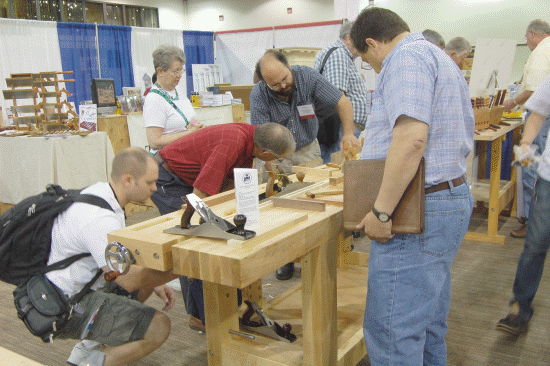
That’s why I look forward to the Woodworking in America conference each year. This year’s event is taking place in Covington, Kentucky, and it draws woodworkers from around the country.   As with the Woodworking Shows, there will be a vast array of woodworking tool manufacturers and dealers. Some slated to be in attendance include Lee Valley, Lie Nielsen, Benchcrafted… the works!

And, these aren’t just booths staffed by a disinterested temp employee – no sir. You have a question about a replacement iron for your classic hand plane? Just ask Ron Hock what you need to look for. He’ll be there. Joel Moscowitz from Tools for Working Wood can talk your ear off about hand saw sharpening.  Maybe Konrad Sauer can talk you into giving one of his hand planes a spin.
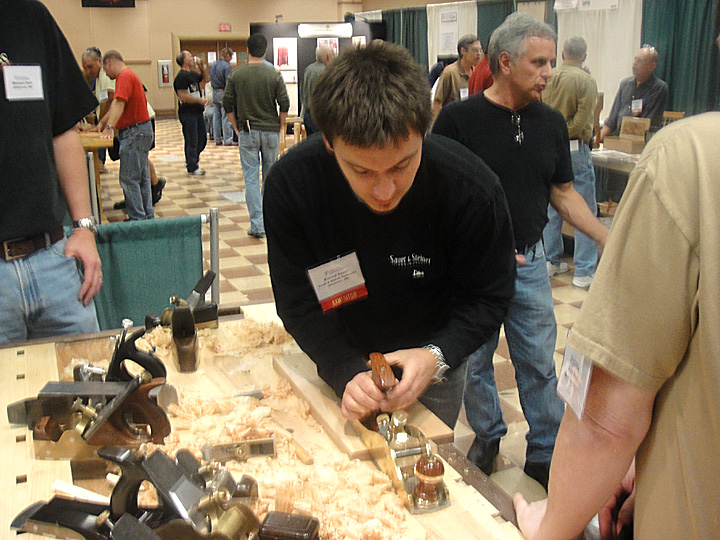
The thing I enjoy the most – of course – is the camaraderie with the other woodworkers and their experiences from around the country. Just think – Matt Gradwhol is coming all the way from Seattle to attend, and I’m coming up from the Tampa Bay area. You would be hard pressed to find two areas much farther apart in the continental United States, but we’ll be rubbing shoulders (and nibbling on Nuncake, I hope) there. The woodworkers come from big cities and small hamlets across the country. They come with expertise in power and hand tools. They come with all levels of experience and areas of specialty.

Oh,  yes, they come.

And we get to kick back and talk sawdust, eat good food and enjoy each others’ company. .
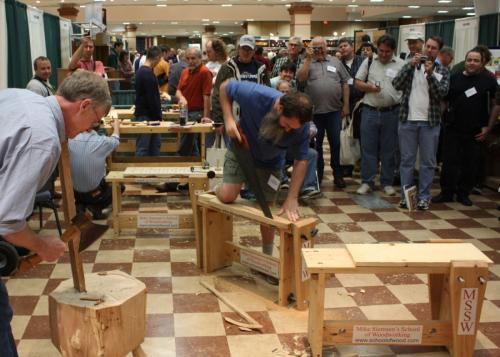
I plan on being in the marketplace on Friday and Saturday, helping Mike Siemsen with the Hand Tool Olympics and participating as well. I’ll be interviewing many of the folks there for future articles. I’ll be dropping my card off at a few booths – hopefully landing a few more sponsors for the old blog.

And, when I get back to my shop, I’ll be re energized and ready to build some more!

 

Bon Appetit!

So, with my recent illness, I spent a goodly portion of my holiday weekend lying on the couch watching TV. And, the only thing drifting through my mind most of that time was Bruce Springsteen’s  song from 1992’s Human Touch album entitled 57 Channels (and nothin’ on). (Yes, mom, I finally got a Bruce reference in for ya!)

Fortunately, I had a few other diversions to occupy my time. I read a book about the Apollo program, brushed up on a few tool manuals I had neglected to read and I surfed for online movies.  Yup, I was putting my Netflix subscription to the test!

Love ’em or hate ’em, Netflix is one of the largest players in the online DVD rental and streaming video world. And, as I glanced through the offerings, there was plenty of material to choose from. Action movies. Sci Fi. Comedies. Classics. While I was searching for movies, I came across one called Julie and Julia I had seen last summer. This 2009 movie told the story of Julia Child as she struggled to interpret archaic French recipes, and the story of Julie Powell, a blogger who set out to cook every recipe in Child’s classic work Mastering the Art of French Cooking.

Why did this movie stick out for me?  Well, as far as I can tell, it’s the only movie that is based around the struggles, trials and successes of a blogger.  The other part was the towering achievement Julia was able to make reality. The movie showed in great detail how this one time OSS operative (Yes, she was a spy!) during World War II had to struggle to merely be accepted as a student at the prestigious La Cordon Bleu culinary academy.   Her work in bringing these arcane cooking techniques to American kitchens was a seminal moment for home chefs and foodies. Yes, people who list cooking as a hobby owe much to Julia’s determination.

Why bring this up?  As you can imagine, there are many lessons that a woodworker can learn from Julia Child. For instance:

  • Method is essential. If you are going to make Hollandaise sauce (one of the five French mother sauces), should you melt the butter and pour it in to your egg yolk and lemon juice mixture? What if you put the butter in cold and stir off the heat?  How about using more lemon juice?  These may seem like trifling details, but they can mean the difference between a rich sauce that will make your Eggs Benedict the stuff of legends and bringing an oil slick to the dinner table. The same thing goes for woodworking – should you cut your dovetails before or after the final sanding of each component? What order  should you glue up that complicated project so you don’t get yourself into a sticky situation?  When you think your process through, you can save yourself a lot of headaches later.
  • Make the most of everything.  “Save the liver!” Oh, how I laughed when Dan Aykroyd lampooned Julia on Saturday Night Live. While it was a funny sketch, the lesson was profound. Chicken livers could be saved and made into pate. Bones from cuts of meat could later be boiled down to a rich stock – or, even better – a demi glace that can transform a ho-hum meal into a dish you would be proud to serve your guests. This one’s easy to take to the shop. If you leave a larger offcut, be sure to stash that sucker somewhere you can get to it later so you can build something smaller. Look at your tools as multi-taskers… how much more can you get out of your table saw or plunge router? if someone is throwing out an old piece of furniture that has seen much better days, maybe saving the classic pulls, knobs and hinges would help make your next project something special.
  • Nothing is insurmountable. Just imagine sitting down to learn all of the intricacies of French cooking.  Now, go beyond that and attempt to take these centuries old techniques and methods and translate them for the average American kitchen. When no one who is instructing you believes that 1) you can do it and 2) that it should even be done in the first place. So, when you balk at cutting your first mortise and tenon joint, making those dovetails or building your own doors for a project, why let something as simple as ‘I’ve never done it’ get in the way?  Just remember, someone had to go down to the water’s edge, grab a craggy looking stone-like animal with sharp edges from a reef, break it open, look at the glistening sliminess, scarf it down and say, “Hey, I think oysters taste delicious! Who’s going to invent Champagne?”
  • Enjoy the final product. During the production of The French Chef (one of the first cooking shows on television), Julia would whip up some exotic recipes from her masterpiece.  She did the show live to videotape (the woman had some serious guts to have attempted that), flubs and all – to show how to prepare those sumptuous dishes.  And, just before the credits would roll, she would turn to the camera, her face beaming with her trademark smile, and bid her viewers farewell with a cheerful “Bon Appetit!”.  I often find myself at the end of a project eager to get it out of the shop and off to the client. But, that’s just so anticlimactic.  One thing I’m going to start doing more is to take the time to appreciate that final piece. Take pictures of it.  Run my hands over the smooth surface one more time. Just notice what I have built and appreciate how happy it’s going to make the client.  That’s why I got into woodworking…

As for me? Well, I’m more of an Italian food guy myself.. but, I’m giving serious thought to changing the approach I take to my work. Ya know, that French chef really knew her stuff.


The only labor I’m doing today…

Is labored breathing.

What a total bummer on a holiday weekend here in the States. I mean, three days off from work, and the head cold I had last week came back with a vengeance as an upper respiratory infection.  Complete with antibiotics… Grrrr….

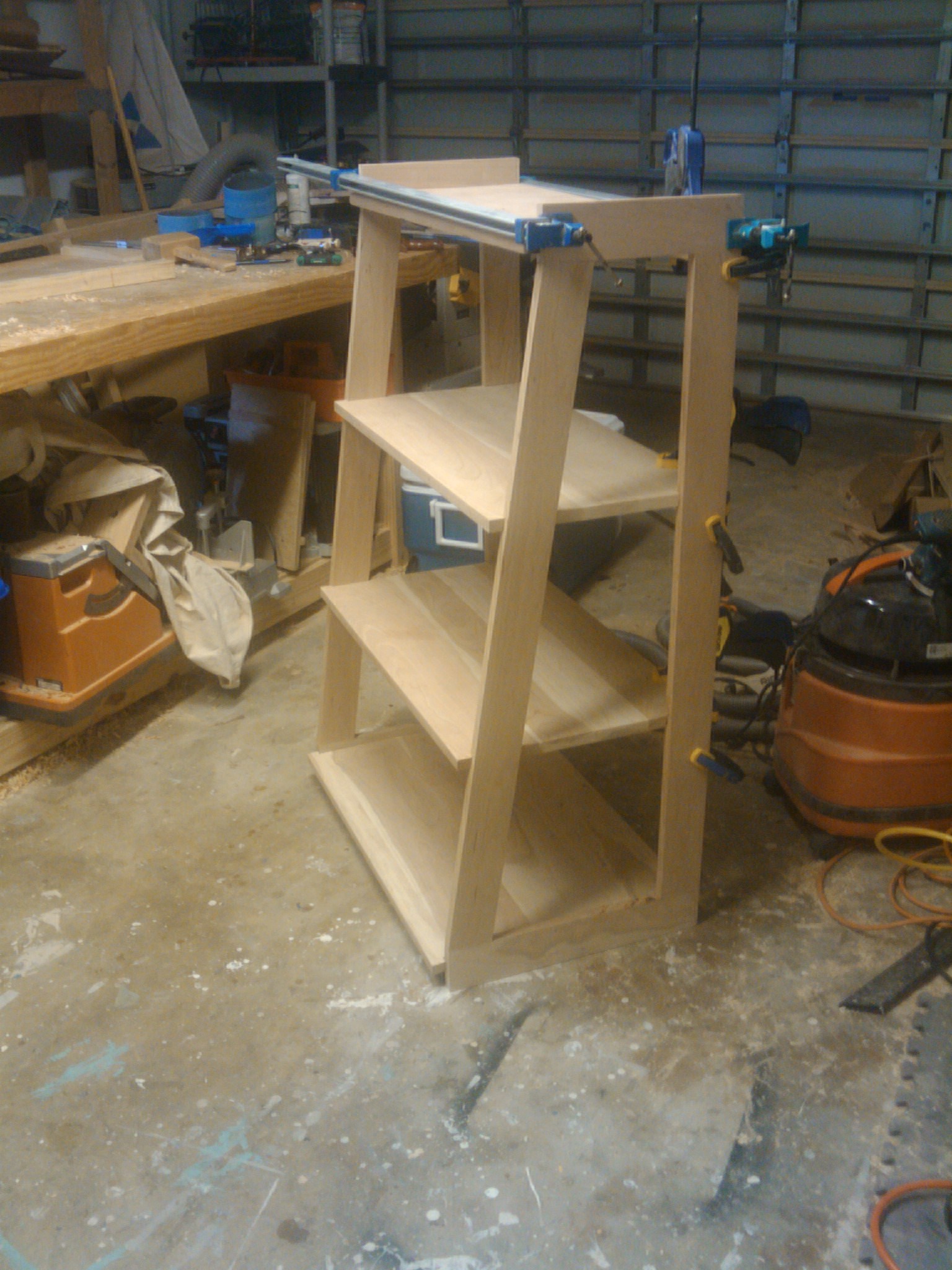
Before I was totally laid up, I did manage to get a little shop time in on Saturday morning. That bookshelf project that’s taking me forever to get done with it finally moving into the final phases. I took the opportunity to finish rabbeting the shelves and fit them into the notches I cut in the sides.  Here’s a look at the piece clamped up …

Now, I just have to cut some back pieces to be mounted across the back of the shelves that will prevent items from being pushed back too far and to provide some resistance to racking.  I hoped to have both units assembled this weekend, but hey, that’s the way life is.

I also discover that sharp tools start to lose their edge  while you are in mid project.  Rather than hook everything up to do a total resharpening, I ran those dulling blades over the strop wheel of the Tormek.  They were back slicing cleanly after just a minute or so of work.

The cherry that the guys over at Bell Forest Products sent is  something else! I’m really digging the way it works, and this project is going to look some kind of sweet when it’s done!

Now, if I can shake this bug, maybe I can squeeze in a little shop time this week!


“Where have you been all my life?”

Sure, it’s one of those questions people tend to ask themselves a lot. For me, I can remember asking my wife this question. I can remember thinking this after my first taste of a quality pinot noir.

I asked it again this past weekend using the Tormek.

OK, let me start off by saying that I love working with sharp tools. They need a lot less force to use. They give clean results. And, they are just so darned cool…

But, getting there has always been a hassle. I have a high-speed grinder. Used it once. Created a multi-faceted mess of a bevel on a chisel. I have a flat platen grinder. Works very slowly and leaves a mess. It also heats up the metal in the edge I’m working on, leaving a blued spot that I have to grind off.  I have two honing jigs. Three diamond stones of different grits. A hard Arkansas oilstone. Float glass with sandpaper glued to it. Yeah, you name it, I might have it.  And, so far, I have been able to get good edges with the diamond plates, but the effort I have to put out – especially in a steaming hot garage – well, let’s just say I don’t relish the sharpening chores in the summer.

The Tormek jig is going to revolutionize how I sharpen.

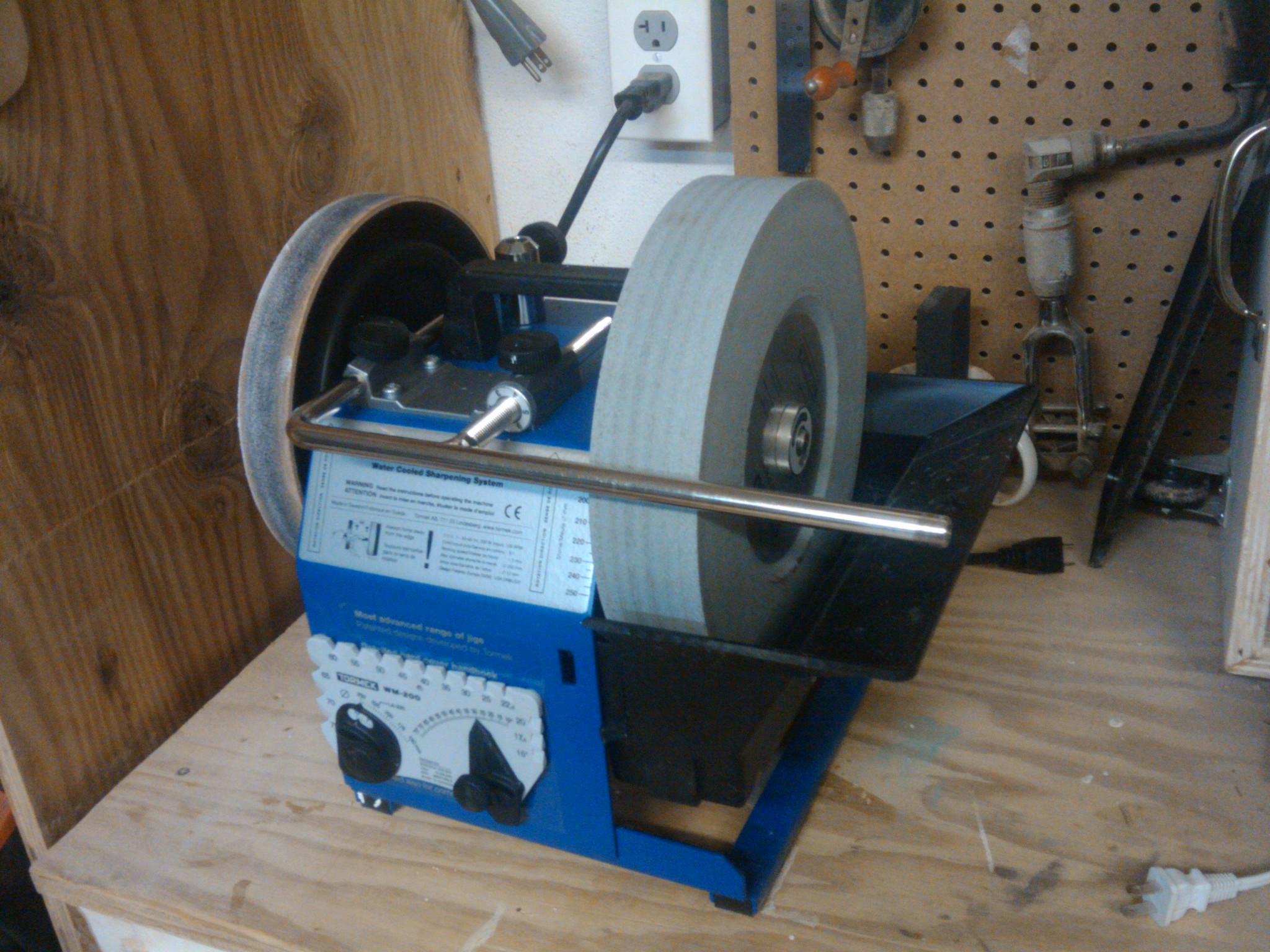
First, this thing is heavy.  I have the T–7 model in my shop, and it took a little bit of muscle to get the darned thing up to the workbench. The basic kit has everything you need to get going right out of the box.  The unit itself, which runs on a powerful yet quiet induction motor. The sharpening stone itself is a large affair that screws to the unit’s drive shaft with a stainless steel cap. There is a leather covered strop wheel that goes on the other half of the spindle. A universal guide bar can go from the front for sharpening ‘with’ the rotation of the stone or the top for sharpening ‘against’ the rotation.

A jig for sharpening straight-edged plane irons or chisels comes with the unit, and it fits easily on the guide bar, allowing the user excellent control and mechanical leverage over the sharpening operation. The jig is very well thought out, even storing  the stops that prevent the jig from slipping off the guide bar.

An ABS water trough slips under the sharpening wheel, holding about a pint and a half of water to clean the sharpening debris off the surface, cooling the tool and lubricating the cutting action.

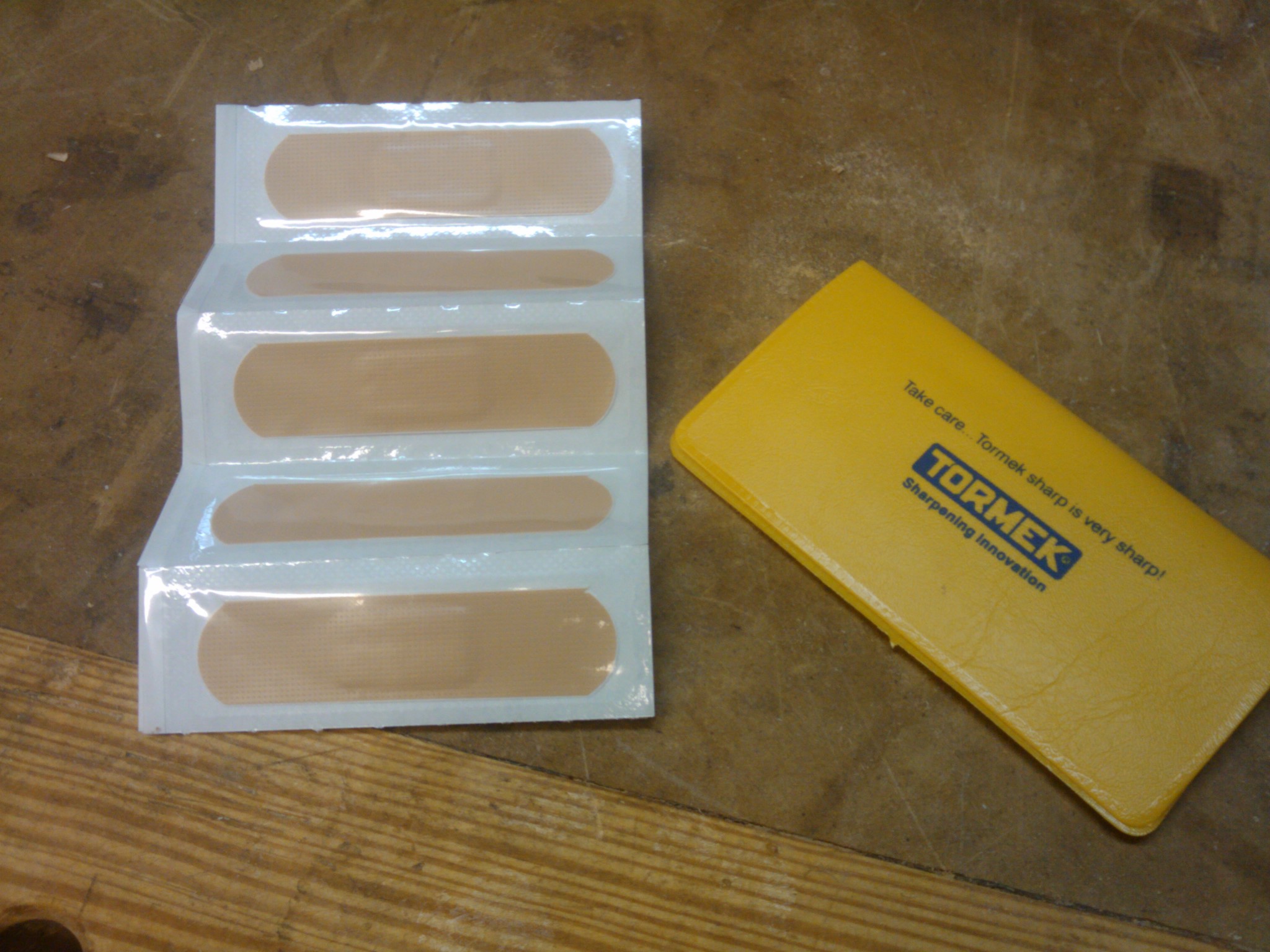
The folks at Tormek even included package of band aids in the kit, assuming that the first few times you try the jig, you might want to try the edge to see just how sharp it is.

I wanted to get a good idea of how well the sharpening system worked, so I put it to the test immediately.  Last Christmas, I bought a set of Hirsch firmer chisels for my shop, and had yet to truly hone them. I pulled out the 3/4″ model, and followed the instructions by the book.

The sharpening stone is kind of interesting – it can be graded with a grading stone to be rough for initial grinding and, by  using the fine edge of the grading stone, can put a mirror shine on the bevel.  Once I had graded the stone to the fine setting (the bevels were already in great shape from the factory), I measured the bevel on the tool’s bevel guide setting tool. This plastic gizmo takes the guesswork out of setting the sharpener, the jig and the guide bars. It allows you to set the bevel you want, and can make allowances for the stone’s size as it wears after numerous sharpenings. I followed the instructions to set the 30 degree bevel, and soon had everything read to grind.

The machine is quiet but powerful. I couldn’t press down hard enough to make the wheel stop. The effect was so cool, watching the the blade of the chisel slide over the face of the stone, with the cooling water just gliding out of its way.

After a minute of guiding the chisel’s bevel side to side across the face, I took it off the jig and held it  up to the light. It was a nice shiny bevel. I rubbed my finger over the flat back of the chisel and could feel the wire edge.  The instructions told me that the next step was to unmount the chisel from the jig and knock the burr off on the strop wheel. I had to charge the wheel with a little bit of oil first, and then put the supplied paste on the leather.  I flipped the machine on, applied chisel bevel and back to the strop, and bingo. That chisel was sharp enough to slice through paper.

It took me maybe ten to fifteen minutes, but most of that was due to the fact that I was reading the steps and ensuring I did everything the way I should have. I’m sure that number will drop considerably with a little bit of practice.

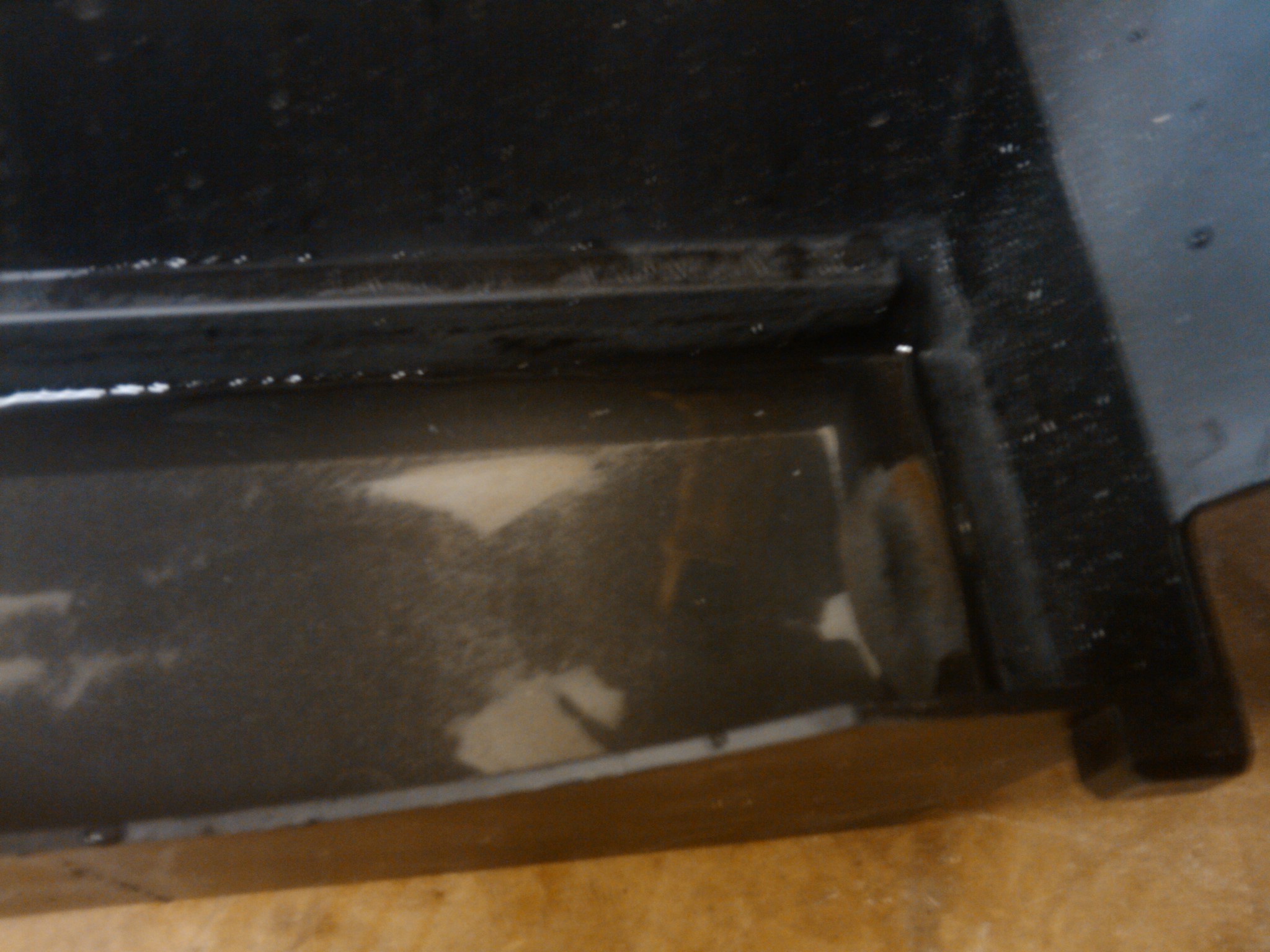
Clean up was just as easy. The plastic water basin unhooks to be dumped, and the instructions indicate that you should empty it at the end of every grinding session and not down the drain – the crud that the stone throws off sinks to the bottom and sets up like concrete. I had also read that there is a magnet built into the basin to catch the metal filings. Sure enough, a big clot of magnetized filings had grown amoeba-like around the magnet. I had to scrape that off with my fingers and throw it into the trash separately, but that was pretty darned cool.

Now, I know the Tormek is an investment.  There’s no doubt about that.  But, looking back at all of the money I had spent on the other gadgets, gee-gaws and gizmos to get sharp tools, if I had saved my pennies instead, I could have easily purchased one of  these babies – and saved myself countless hours of work trying to get sharp tools.

If  a lunkhead like me can set this up and use it quickly and effectively, I’d say it would be worth it!


There’s learning in woodworking

Today is the first day of school here in Pinellas County, Florida. We’ve bought all of the school supplies for the kids, they have new shoes and some new clothes, and I think we may have the school lunch business taken care of.  Of course, there are new car line patterns, bus routes and the works, but we’ll get the rest of the logistics taken care of over the next few days.

With the boys going to school, I’m sure there will be lots of math, English, science and other homework coming our way (though maybe not during the first week). But, there are many other lessons that need to be taught as well. One of them is at my oldest son’s school – technology.

Last year, I had a chance to teach at Michael Dority’s class during the Great American Teach In. I brought my tools, some wood, my video camera and proceeded to tell the kids a little about what I do in my shop.  Turns out, the kids in Mr. Dority’s class were already hard at work doing their own woodworking!

With the new school year, I had a chance to ask Mr. Dority a few questions about the upcoming school year and the class he teaches.

First, of all, even with cuts in vocational education, how did he get into teaching this newer program in the first place? “I was studying Elementary Education at St. Petersburg  college. When one of my professors noticed something in me and asked me to join this new program he was starting for the college, He really got me when he said robotics.  I was a shipboard electrician before college and I had to visit a lot of boat yards while in the military I always marveled at all the mechanical stuff running and moving these mammoths ships and containers around the docks with cranes and dry docking system I would really get excited, when the boat started lifting up out of the water onto the block system the yards used.  I wanted to share that excitement.  My trade background actually helps me understand the class even better than if  I had just  gone straight onto college.”

In Mr. Dority’s class, there is a focus on four key areas: multimedia communications (computers), safety and tools uses,  product design and laws of motion. As it turns out, one of the most effective ways he has to teach the kids about these areas is in woodworking.  That’s because it all stems from STEM: Science, Technology, Engineering and Measurement. “Math is covered throughout the measurement processes, Technology is covered by student using tools to cut, chisel, and plane or sand the wood to a desired shape.  Science is represented by; picking the material for use in a product, some woods will break and crack easily other woods are so durable that you can even twist and bend them.  Engineering is represented through the students’ designs to create a plan for cutting and design the wood into the desired product.”

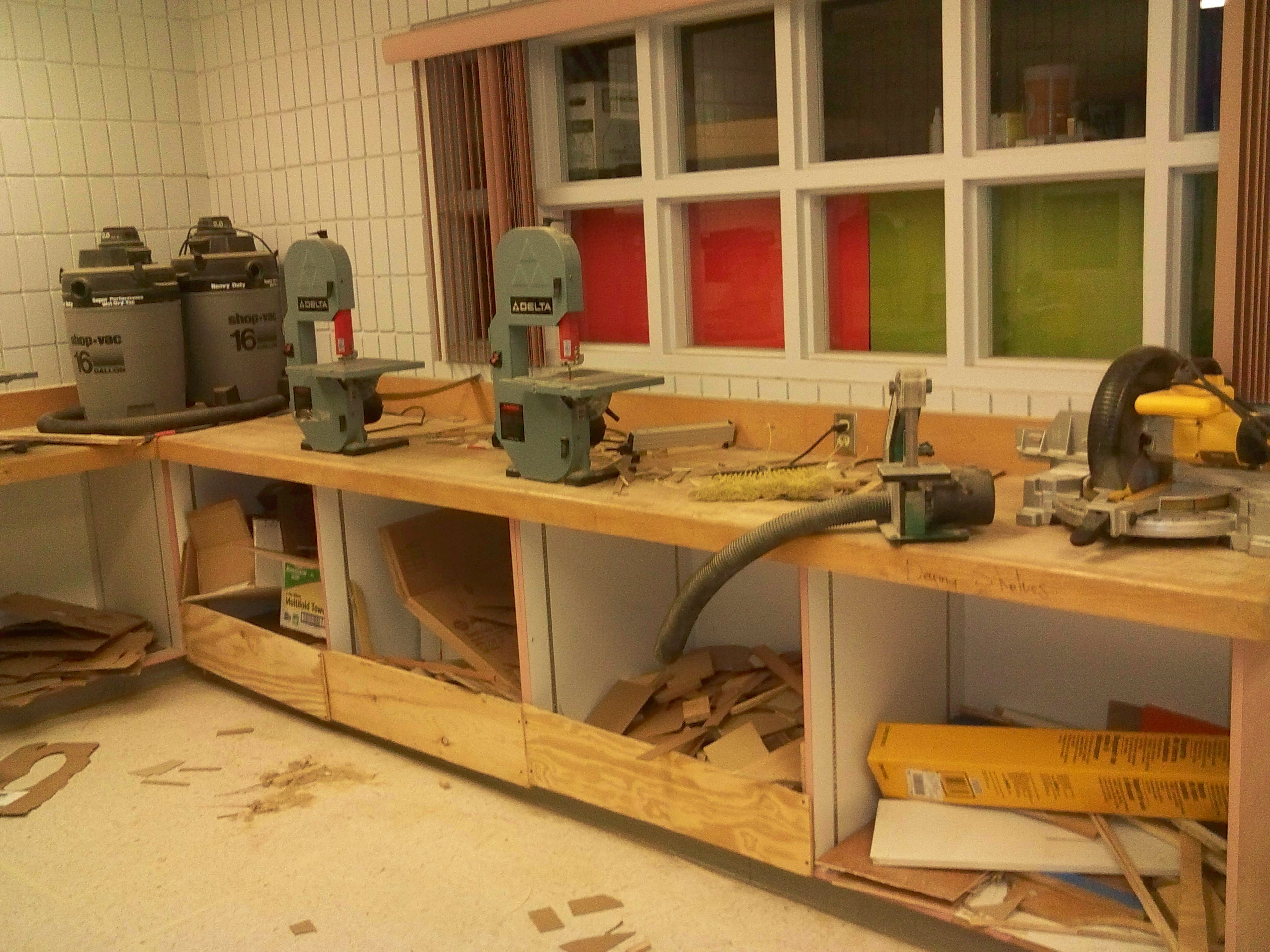
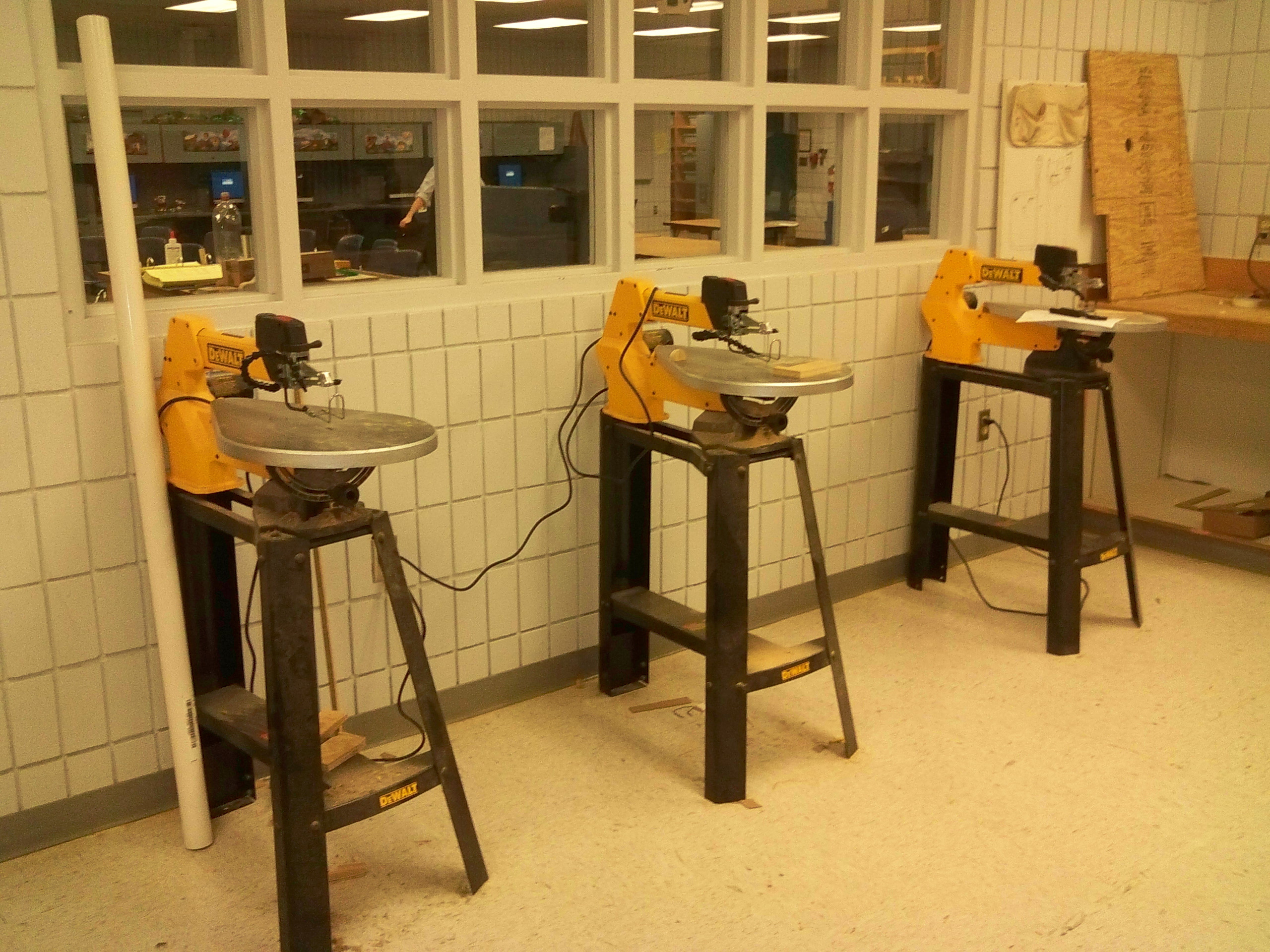
To make this happen, Mr. Dority has a fairly well appointed shop. “I love my shop because it is really set up for kids I have three DeWalt scrolls saws that have speed controls on them, and two 9 inch bench top Delta band saws, as well as one small drill press.”

While the tools are awesome, there is a very familiar first lesson that must be taught. “Safety is absolutely number one, there are tests and practical’s before anyone touches a machine by themselves and clothing restriction such as closed toed shoes and safety glasses are mandatory when in the shop area of my classroom.” And, as the kids start using the tools, there are some cues that Mr. Dority uses to gauge his students’ comfort level. “When many of the students first start cutting I try to be next them until they gain some experience on the tool they are using. One important rule I have though is if a student is afraid of a machine they do not have to actually use tools. The kids really enjoy this area of my room but because of the size of the shop I limit the amount of students inside of it at all times when machines are running.”

While Mr. Dority’s tech class may seem to be vocationally-minded at first, the skills he teaches reach way beyond the workbench – sometimes way beyond the workbench. “The main reason for tech is to get our student using their critical thinking skills to allow them to solve problems. It also provides our students practice in using their hands and their minds to solve problems, after all, even Doctors and Astronauts use tools and equipment everyday in their businesses.”

Mr. Dority even admits that much of his motivation is selfish. “I would love to hear the workshop and garages of our neighborhoods humming along with noise machinery instead of hearing that annoying buzzing sound coming from the computer and television sets.”

So, any parting words as we embark on a new year? “The most important thing though is if you know or see a kid that looks bored get  him or her out  in the shop. Start a project, keep it simple at first but many of my student surprise me all the time with their ability and skill.”


What the He%# am I doing?

So, I just walked in from the shop.  Still sweaty and covered with sawdust.  My wife is gonna kill me when she sees the mess I left.

I’m here at the computer about to launch into one of my patented stream-of-consciousness posts.  If you want to read, please continue. If you would rather look at pictures of gorgeous woodworking made by talented folks, check this out.

No, I’m here at the computer because I have to wonder just where the heck I am as a woodworker.  So, I’m working on those bookshelves, and I drag my posterior outside to the shop on a hot, sweaty day  after mowing the lawn. I just had lunch and about a quart of Gaorade, so I should be OK in the Florida heat.  Heck, I even turned on the A/C to get the shop down to a manageable temp.

I lay two of the sides of this piece side by side and get ready to start routing matching dadoes. Nothing is lining up.  Nada.  Hmmm…

Funny… when I laid out and cut the pieces, I used stops to ensure accuracy.  They should all be identical sizes… right?

For giggles, I laid a square against the back support and the bottom piece to see how square they were.

My next words can’t be typed on this – a semi family-friendly blog.

I was so far out of square, it wasn’t funny.  On ALL FOUR sides for both shelves.  Not off by a whisker off a gnat’s behind over four feet kinda out of square – more like you could drive a freakin’ Mack truck between the back member and the blade of the square. Somehow, during my dowel/mortise and tenon debate, I had failed to use my FREAKIN’ square to check to see if the pieces were going together 90 degrees to eachother.  Let me repeat that… I didn’t check to see if the pieces were FREAKIN’ square!

Woodworking 101.

I’m not sure what’s going on here.  But, it seems as if the more ‘advanced’ of a woodworker I am becoming, the more I’m forgetting to do the basics right.  I was watching Tommy Mac yesterday do some really cool veneer work on his walnut lazy susan thing.  “Gosh, that looks like it would be fun to do.”

But, gosh, getting to that point in a project to try something more advanced requires knowledge and application of skills previously learned.

There’s something more, though….

Yesterday, I was flipping through a photo album of some of my earlier pieces. There I was, grinning like a fool standing in front of what were some OK looking pieces.  Some were really eye-catching, while others were held together with bubble gum and spit.  The one thing that I do remember in common with all of those projects was how excited I was to be building them.  I can remember waking up before my wife and my at the time little kids and sneaking into the garage to check on that glue up I had put into the clamps in the wee hours of the morning.  I can remember that rush that I felt pulling a board off the table saw with a relatively straight and burn-free rip and thinking to myself that I was the master of all things xylem.

Now, I can literally go days – heck weeks – without even setting foot into the shop.   I don’t even bother cleaning up and arranging my tools for the next shop session’s work.  I don’t race home, wolf down dinner and see how many joints I can cut before I have to tuck the kids in their beds. Am I becoming the most talented tool collector on my street? The provider of the prettiest sawdust for my neighbor’s compost pile?

Could it be I’m not in love with woodworking like I used to be?

Probably not.  It could be that it’s 98 humid brutal degrees outside, that I’m in the busy part of my work year and I had a bad assembly on my project.  I’ll rip the piece down, salvage what I can (Maybe even turn some of those uprights into shelves or something like that) and get back in the saddle again.

Maybe I just need a vacation.. or to meet up with some other woodworkers to get that spirit back!


Amazing lobby woodwork

So, I have been in Atlanta at the National Hurricane Conference this week, and as always, the conference has been a great learning experience. I’ve moderated a number of panels and taught a few classes about public information and getting ready for the upcoming hurricane season.

But, no, that wasn’t the most surprising attraction.

Well, maybe it was the other tourist-based venues I had a chance to take in. The World of Coca Cola was a huge hit, and I enjoyed the nostalgic look back at one of the world’s most popular beverages.

But, no, that wasn’t the most surprising attraction in town, either.

No, I experienced that when I checked in.  This year’s conference is being held at the Hyatt Regency here on Peachtree Street in downtown Atlanta. The hotel, opened in 1967 was designed by John Portman.  It was the first in the world to be designed around a massive inner atrium, and features high-speed glass elevators rising to the 22 floors of rooms.  While is massive scale and architecture was impressive, it paled in comparison to the major improvements being undertaken in the lobby – including the lowly furniture.

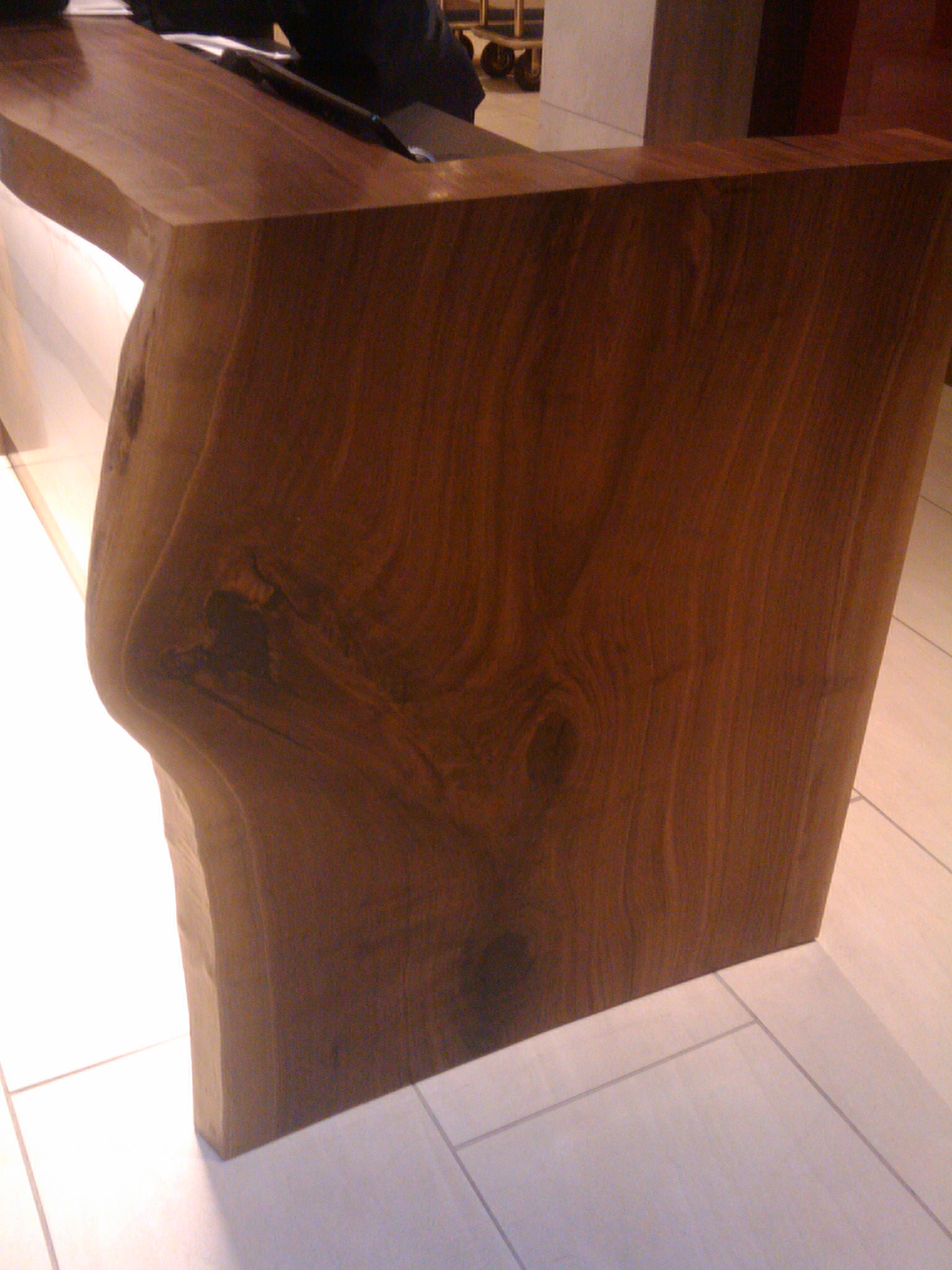
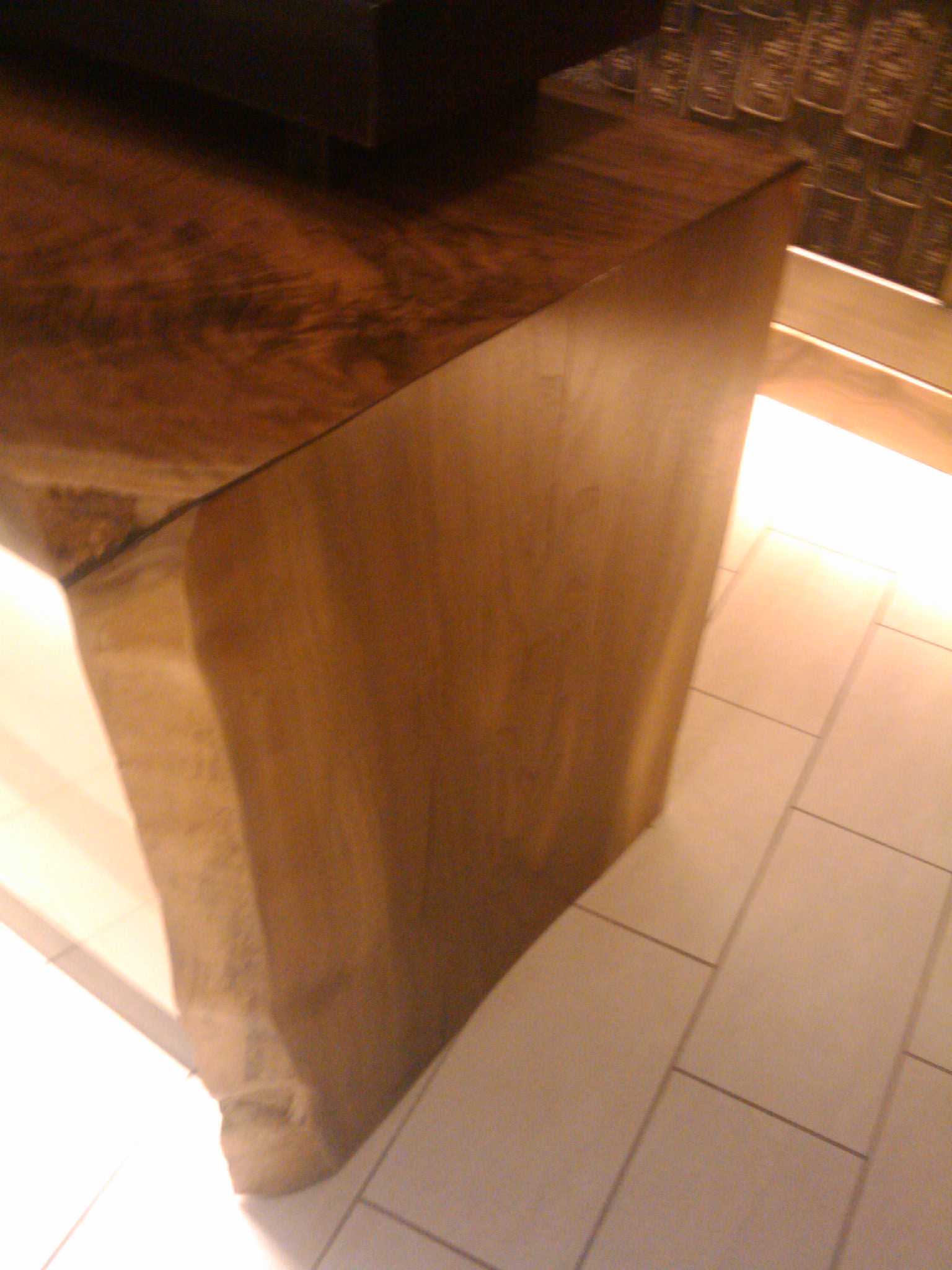
The bell and concierge desks as well as the valet stand – at first glance – looked like some interesting thick wooden laminate.  That was until I walked up to them and felt the live edges. It turns out that the folks planning the renovation of the lobby turned to woodworker John Houshmand to craft all of the desks out of large, live-edged slabs of black walnut.

Each is crafted of slabs nearly two inches thick and up to two feet wide.  They are mitered at the corners, eliminating the need to look at edge grain. The figure and grain pattern in these boards is awesome, and I have spent plenty of time in the open lobby standing at the check in desks snapping pictures like a fool.

While searching around on the internet, I came across a pair of videos about the project.

On the first video, Houshmand is interviewed about how he sourced the wood and how he built the projects.

This second video shows a representative of the Hyatt hotel chain talking about the renovations and what work is being done.

Here I was thinking that there would be no woodworking this weekend.. and look what I found!