
 When you think about woodworking tradition, thoughts often turn toward the masters who worked years ago with hand tools and an eye for the craft. One very talented woodworker who comes from that lineage is Bob Smalser, a frequent contributor to Fine Woodworking and Woodenboat magazines.
Bob’s upbringing in woodworking started with many of his male relatives. From a line of hard working Mennonite farmers and tradesmen, his dad was a shipwright, grandfather a farmer, sawyer and mason and uncles who also worked in the craft. “I worked for all of them as a kid just as soon as I could hold up a broom and later the end of a plank. Because of the Depression and World War II, I came along a bit late and these gents were all older than is typical today….I came to age at the end of their careers.”
While it may have been near the end of their careers, Bob’s relatives were exceptionally talented and willing to share their knowledge and trust this up- and-coming worker. “The notion that such skilled craftsmen were fussy about a kid messing with their tools was mistaken. These gentlemen were there to work, not romanticize. Once they trained me to sharpen and tweak they were perfectly happy not to have to do all that themselves at the end of the day.”
 The shops that Bob’s relatives worked in did have power tools – band saws, planers and jointers. But, the hand tools were – and still are – some of the most important tools in any boat builder’s arsenal. Bob has taken his years of working with these tools and can finely tune any chisel, plane or saw to do its best work. And, while premium tool makers such as Veritas have brought the quality of today’s tools to a new level, it’s the lack of basics that leave Bob puzzled. “I remain gobsmacked that sharpening tools the way their grandfathers did – without power tools or training wheels – is so difficult for so many to master. Don’t Cub Scouts learn to sharpen pen knives anymore? And looking at their work, it suffers for it. If you can’t look at the flat you made on the bevel with the stone and change your hold to move that flat where you want it on the blade, how do you ever expect to do the same thing with the cutting edge on wood? Sure, we can talk about coaches who can help guide us along, but in the end all of us are really self-taught by trial and error and practice. Do what’s necessary to acquire this most basic of skills, as it will positively effects every aspect of your woodworking.”
 Bob has worked very diligently through the years, and the variety of jobs he has held has helped to improve his woodworking skills. “I’ve restored antique furniture, reproduced it in various styles and restored antique firearms for museums. I can consult on forestry, land and habitat management, and I grow, harvest and mill my own wood. Custom sawyering alone could easily be a full-time job if I let it, and I often turn down work to maintain the variety of jobs I prefer.”
It’s true that Bob’s interests are wide ranging and varied, but his heart still belongs to the water and his passion – boat building. “I can’t think of anything I don’t enjoy about logging, sawyering and woodworking….even the sweeping. But I much prefer the sweeping curves and eyeball work required in boats. That’s where the craft truly shows itself.” Indeed, to see one of Bob’s creations is almost looking at a piece of sculpture – the way the fair lines come together in a sleek, durably built craft that can take to the water for many years, if properly maintained.
While many woodworkers won’t have the opportunity to come up through the ranks as Bob has, he insists that shouldn’t be an impediment to learning the skills to master the craft. “Go your own way. If forums set the tone, there is an amazing amount of snobbery out there without much of the merit I’d think would accompany it. Methods are hardly an end unto themselves. Learn your tools, study proportion to get the sizes and relationships sweet, learn to use sandpaper to get the tool marks out, learn power tools as well. One of the most important tools in my shop is the Porter Cable belt sander. Use the tool that makes the most sense for the job, and keep working. It’ll all come together soon enough.”
 Experience is the best teacher. After all, unless you actually get out and practice karate, fishing, kite flying, golf or some other activity, you can’t develop the skills to get better at your avocation.
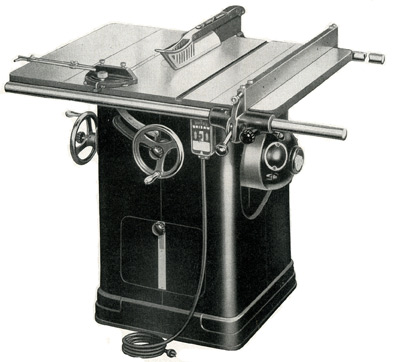 So, you scored an awesome 1950’s vintage Delta Unisaw from grandpa before he headed off on his around-the-world travel extravaganza. But, the saw didn’t come with a manual. And the fence is out of alignment. And, you’re not 100% sure how to align the trunnions…
 The “system” actually consists of three jigs. The main jig itself, which is used in tandem with a router to cut the spline grooves into the workpiece with a perfect one degree taper, and the Spline-making jig, used on the table saw to cut splines using whatever species of wood you choose. This jig also the matching one degree taper incorporated into it so that the splines will fit tightly into the grooves. The third jig is called the Corner Inlayer. It is also used with your router, and allows you to cut a perfect “mini-dado” of whatever width and depth you choose, but at an angle exactly perpendicular to the corner itself, versus from one of the flat sides of the workpiece. This jig is normally optional, but right now they are running an online special that includes this jig at no additional charge.
 The Kehoe Jig was invented by Larry Kehoe out of one part necessity, and one part frustration. According to Kevin Jaynes, owners of the company, ” . . . . while in the middle of building an oak desk, he was dreading hauling out his dovetail jig to build the drawers because he had never found a dovetail jig that was not slow and cumbersome, and he hated test cuts. As he was walking across the basement shop floor with the traditional dovetail jig in his hands, he had one of those “Flash Of Genius” moments where he actually saw the jig in his minds eye; the jig that would eventually become the Kehoe Dovetail Spline Jig. Larry told me he had seen it ‘in remarkable detail, especially the taper.”
 While the joint is similar in many ways to traditional dovetails -and creates a strong joint – the beauty of it is that the Kehoe Jig can be used in boxes made of materials such as plywood – since the cutting of the spline grooves doesn’t expose the material’s end grain.
 Today, the Kehoe Jig continues to be a useful and interesting jig with an even brighter future. Kevin and Terry have already made three prototypes of variations of the jig, and are about a month away from releasing the first one. “It’s along the same lines, but cut’s smaller splines in a pattern closer together. Perfect for the smaller jewelry boxes, small drawers, and small humidors like many of our customers make. The current jig does this as well, but this one will just make it all the faster and easier. We also have a 28” coming right on the heels of that for larger projects.”
 Besides looking like an interesting jig to cut dovetails with, the story of Kevin and Terry has captured my attention. “We’re one of those rare American mom-n-pop shop manufacturers that are still making a go at it. We are making some dramatic improvements in the jig kit, and are also committed to keeping the manufacturing 100% within our borders. We are woodworkers ourselves and have dealt with many online suppliers over the years. It has been our experience overall, that most woodworking supply and tool companies have excellent customer satisfaction. Customer satisfaction is our first priority as well, because we believe that’s the foundation of any business.”
 Woodworking can be tough on your clothes. I can’t tell you how many times I have reached across a glue up to only to discover later the telltale streak of glue over a favorite tee shirt. Ruined forever! Or, after routing a series of dovetails, find that I have sawdust in ‘uncomfortable places’ in my clothing.
 If you are a woodworker and find yourself with your head spinning, this might be a good place to check out. Woodturning Online is a great place to start if you want to get into wood turning – or discover new tips and tricks.