All posts by Tom

I'm the guy who writes the blog...

Link of the Week

The New Yankee Workshop

New Yankee Workshop's LogoWhen you think of woodworkers on TV, Norm Abram’s iconic image often comes to mind first.  From his signature plaid shirts to the well-worn tool belt around his waist, Norm is a woodworking legend.

The site for the New Yankee Workshop offers the entire collection of projects. From the medicine chest – the first plan built on the show back in 1988 – through the kitchen cabinet opus which aired last season, you can buy measured drawings and videos to accompany them.

The site also goes into greater detail, showcasing Norm-inspired projects built by other woodworkers, a question and answer section called shop notes and virtual tours of the famous workshop.

While Norm may not need the exposure, a visit to the New Yankee site can give you a little more background on this famous show.

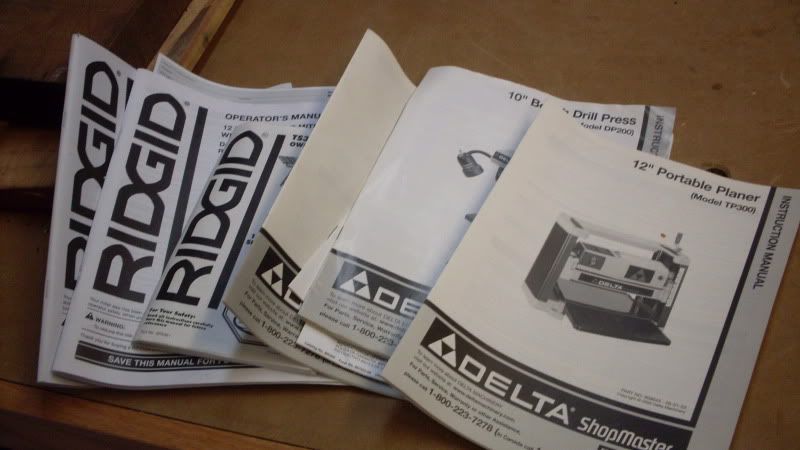
The good booklets

I like to post on a few woodworking forums.  They are great places to connect with woodworkers from across the world.  You can ask questions, share your successes and get a few words of encouragement when things go wrong.

Oh, yes, things can go very wrong…

Beyond the terrifying tales of accidents and woeful recollections of projects gone bad, there are always a tremendous number of questions about tools.

Which are the best to buy?  Can I use this tool to complete that task?

And, quite frequently, there are questions about machine set ups and calibration.

Let me start of by saying that questions like these are very valuable.  Woodworkers with years of experience can weigh in with sage words of advice, pitfalls to avoid and shortcuts that can help ensure accuracy.

Unfortunately, what many of the original posters don’t realize is that they have the answers to many of their questions right at their fingertips – their owner manuals.

You remember what those are, right?  The usually black and white booklets proudling featuring a photo of the tool you are working with.  Believe it or not, those babies are a gold mine of information – if you know how to use them.

First of all, all manuals have valuable safety information printed in them.  Yes, do take the time to read through it at least once.  There may be some safety features on the tool you are using that aren’t intuitive and may require special care during set up.

Speaking of set up, the manuals also have step-by-step instructions on how to assemble the tool.  Again, it seems to be a no-brainer, but the instructions also give you important tips on when and how much to tighten screws and bolts.  Overtightening a table saw’s trunnion bolts can crack the cast iron casting… leaving you in the lurch.

Need help dialing in the accuracy?  Owner’s manuals give step-by-step instructions on how to tune your tool.  This way, you don’t have to rely on someone to give you the instructions on – say –  tuning your Jet table saw if he or she owns a Grizzly.

Finally, once you get the tool set up, that’s a great time to sit  down and review the manual one more time.  Believe it  or not, many manufacturers offer tips and tricks on how to make your tool more useful.  The  manual for my Ridgid table saw offers plans for cutting push sticks, feather boards and other useful shop jigs.

If you are the more organized type, it’s a great idea to staple the receipt for the tool and record the tool’s serial number in the manual, and tuck it away someplace safe yet accessible.  This way, you can get to it for warranty work and as evidence for the insurance company should something happen to your shop.

And, yes, I do break out my tool manuals to review them from time to time.  I’ve discovered that in the back of many manuals there is a troubleshooting section with frequently seen problems and ways to correct them.

This is great if you have a brand new tool, or you bought a used tool from someone who kept good records.  But, what if your tool is older, or the previous owner chucked the manual?

You are in luck!  Most manufacturers have their manuals online where you can download them.  To find the manuals for older tools, check  out the Old Woodworking Machines website.  Many of the manuals from older tools have been scanned and uploaded to this site for your review and can provide valuable assistance in restoring and tuning a classic tool.

Will reading the owers manuals for your tools make you a better woodworker?  Nah, only practice can do that.  However, for safer and more accurate tools, it’s hard to beat the manuals as a starting place.

What time is it?

For those why may remember the Howdy Doody show (no, I’m not that old, but I am hep on cultural icons), the only answer that could possibly work is “Howdy Doody Time!”

Unfortunately, that’s not the answer I am looking for.  We are saying ‘howdy’ though, it is the start of the Atlantic Hurricane Season.

Yes, I know those of you who live anywhere along the coast from Maine to Texas (or those of you who are fortunate enough to call Bermuda, the Bahamas or any of the Caribbean Islands home) know what this means. It’s that time of year to check that you have your hurricane shutters, get your survival kit together and remind yourself what your evacuation zone is.  I usually do that stuff, and then go have myself a Hurricane at one of the local drinking establishments to give me the courage to keep on planning…

June 1 also reminds me how important it is to check the tools I have in my shop.  Yes, I do a quick inventory to ensure that I have everything listed.  Names and model numbers of tools, manufacturer’s serial numbers, descriptions of tools that don’t have model numbers or serial numbers.  I try to cover it all on a list I keep on my computer.  It’s not too tough to maintain once you get it started, but it can be a bear to get started in the first place.

Why have the list?  Well, should the unimaginable happen, I want to make sure that when my insurance company comes calling, I can produce a list of what I own.  This way, it will be easier for them to value the tools I have in the shop and cut me a check to replace those items.

I also take the opportunity to snap a few photos of the collection.  This way, I can show the insurance claims adjustor what kind of tools I have.  Sure, I can’t just lie and tell them I have a brand new Delta Unisaw… but, hey, honesty is the best policy.

Do you need a separate rider on your insurance to cover your more valuable tools?  How about flood insurance?  What other kind of documentation do you need?  These are all great questions.  And, since I’m not an insurance agent, I’ll ask you to give yours a call.  Ask all of the questions now, and not after standing over the wrecked shell of your shop… it will save you some stress.

There is a great organization here in Florida called the Insurance Information Institute, and they have an outstanding page on how to conduct a home inventory.  Definitely worth a look.

Oh, by the way, if you don’t live in hurricane country, there are still earthquakes, ice storms, tornadoes, tsunamis, lightning strikes, flooding from heavy rains, fires, thefts… well, you get the idea.  Getting your tools covered properly will help you get back to the shop afterward.

Just think, only six months to go until the end of hurricane season…

Quick Poll

Applying a finishIt never fails.  You get through the final assembly of your project and it looks absolutely gorgeous.  Then, it hits you like a ton of bricks – how are you supposed to get your hand holding a piece of sandpaper inside those tiny and intricate openings to get a good smooth surface, and how are you expected to get a smooth finish in those nooks and crannies?

The ideal situation would be to have finish the pieces before you got to this point in the project, but how were you expected to quell your excitement during the assembly process?

And, then there’s the concern of getting finish on areas you need to glue up… will the glue stick to that kind of finish, or will the project fall apart?

This week, I want to know your thoughts on prefinishing project pieces before you get to the point of final assembly.  Is this a routine practice or not for you?

[poll id=”76″]

Link of the Week

Rick’s Workshop Electrolysis Rust Removal Page

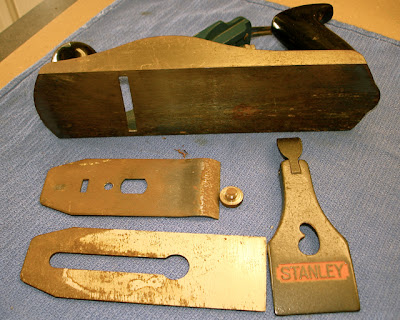
Rusty PlaneWhy is it that some of the best hand tools ever manufactured lie rusting in some basement before they are offered up for sale?

Are you intimidated to try to rehab a rusty old tool because you don’t know how to clean off the crust?

Well, Electrolysis is one very effective and scientific method you could try. Basically, you remove rust by immersing the plane in a solution of   baking soda and water and running a charge through it from a battery.

A woodworker named Rick  has given thorough step-by-step instructions on how the process works, and he claims that it’s a very easy thing to do that gives good results.

So, the next time you come across and old rusty and crusty flea market find, pay Rick’s site a visit and give the technique a whirl.

Bits ‘N Pieces

You can learn a lot about people when you are shopping for a home.  While it’s been about a dozen years since my wife and I bought our house, the memories of walking into people’s homes on our short list still live vividly in my mind.

There was the smell of the home of an avid cat lover, the sight of burnt orange and avocado appliances of people who chose not to update their 1970’s kitchens and the strange perceptions of being in a home where the owner had hung several overhead lights for decoration.  Yes, that’s right. Several of these light fixtures were just screwed to the ceiling, not even wired to the home’s power system.

The home we eventually bought was owned by an avid shot glass collector.  She had big shot glasses, small ones, ones printed with logos from big cities and small towns. Colleges.  Hospitals.  Even a sheriff’s office. She must have had three hundred, all on display around the home.  It was quite the impressive display.

I wonder when my wife and I eventually put our home up for sale if people will have an opinion about my router bit collection…

Routers are extremely versatile tools.  They can cut joinery or profiles.  They can help you joint a board’s edge or trim a shelf edging flush. They are useless paper weights without bits.

My mom gave me my first router for my birthday many years ago.  It was a fixed base Craftsman light duty model.  She asked me what I needed to go along with the tool, and I told her I needed some router bits.  She was stunned to see the vast array of bits available – and the variety of price points.  Eventually, she settled on a small starter kit that served me very well for the first few years.

A quick perusal through a woodworking catalog will show scores of profiles available for sale – from the plain straight bit to the most exotic multi-profile bit.  They are sold individually or in large all-encompassing sets. Do you need all of them to woodwork?

Hardly.  However, you do need some basics to get the ball rolling.  A set of straight cutting bits.  A flush trim bit with a follower bearing mounted at the bottom.  A chamfer bit.  A few different styles of round over bits.  Maybe an ogee profile to put a decorative edge.  That should get you started.

For me, I bought a set of 20 bits to start – the green ones in the wooden box.  Some conventional wisdom says that buying sets of bits is a waste of time.  You will use a few bits a lot and most of them very rarely.  My experience has been a little different.  The set I bought actually has several bits I love to use, and the entire kit does get a workout.

After I purchased my kit, you can see I got my hands on a few other individual models and sets.  I have two rabbeting sets – one does larger rabbets, the other smaller.  I have a set of slightly undersized plywood bits to cut slots to fit modern cabinet grade plywood.  Dovetail bits to work on different jigs.  Cope and stick bits to create frame and panel doors…

Wow, that’s quite a collection…  I had no idea I had added so many bits.

When you do buy your bits, look for carbide models.  Sure, you can modify your high speed steel bits’ profiles to make custom models, but carbide cuts so much more nicely without the need for frequent resharpening.  Also, don’t be afraid to pay some money for quality router bits.  Sure, you could go to eBay and buy a set of 100 bits for $39, but what are you getting for your money?  You will probably be disappointed with the results.

And, never be afraid to experiment with your router profiles.  You may have your eye on a fancy profile bit, but break the design down to more basic round overs, coves and chamfers, and you may discover you can use two or three bits you already own to make an exact match.

In order for me to keep my collection – and you to keep yours – in tip top shape, it always pays to follow the standard advice:

  • Don’t let the bits knock together.  Carbide is tough stuff, but it’s also very brittle.  Allowing the bits to knock together while in storage or on your workbench can cause the cutters to chip or shatter.
  • Keep ’em clean.  Just like saw blades, router bits can get gunk build up on them.  Your best bet to keep them clean is to first remove any bearings (if the bits are so equipped) and wipe them down with mineral spirits. You can use an old toothbrush to help scrub the stuff off, but nothing more abrasive than that.
  • Tighten them properly.  Your router’s collet does a great job grabbing the bits – when it’s properly torqued down.  To install a router bit properly, don’t let it bottom out in the collet – pull the bit up a fraction of an inch to keep the bottom of the bit off the router’s spindle.  Then, snug up the collet nut and gently twist it to make sure it sets firmly.  Don’t crank down on the wrench – you might damage the collet or make it nearly impossible to release.
  • Store them where you can see them.  If you don’t know which bits you have, how will you now they are available for you to use?  Store them out of harm’s way, but someplace where they are easy to get to and put them to use.

Have I bought my last router bit?  Not by a long shot.  I’m sure a new jig, a new application or a classic molding profile will be announced, and a new Uber-Bit  will be promoted which will be capable of joinery, decoration and establishing world peace.

And, when I do buy it, I’ll proudly add it to my collection.  It will become a new conversation piece in my living room.

A moving experience

Wood moves. As temperature and humidity levels change, wood’s cells will absorb and emit water to reach an equilibrium point. Sure, it can be slowed down by a wood finish, but it can’t be eliminated.

This is a universal truth that all woodworkers need to understand when they build a project.  All too often,  woodworkers need to learn this lesson at least once the hard way before it truly sinks in.

Sure, there are lots of tables and charts that will tell you exactly how much wood will move, but to get a real life idea, I’ve decided to set up a little experiment.  My shop is in the Tampa Bay area, and I’ve enlisted the help of two talented woodworkers who live in different areas of the country with wildly different weather conditions.

First is the Wood Whisperer himself, Marc Spagnuolo.  Marc lives in the greater Phoenix, Arizona area.  The other woodworker helping me out is Dave Campbell, deputy editor of Wood Magazine.  Dave calls the greater Des Moines, Iowa home.

While this is a wood-based article, it also gives me a chance to strut my weather geekiness in the name of woodworking. It’s obvious that changes in latitude will have a dramatic effect on the weather, but geography and location from the nearest large body of water will also play a part in the picture.

To help you understand the differences, I will reference the mean daily temperature and dew points for each city.  Why these two readings?  First, the mean temperature is an average temperature of the air as indicated by a properly exposed thermometer during a given time period, usually a day, month, or year. This way, we don’t have to wonder about abnormal cool snaps or heat waves – the data will be a little more smoothed out and better representative of a typical day.  In this case, we’ll look at the mean temperature of a given day – May 25 – for each of our cities.

The other reading is the dew point, which is the temperature at which the air becomes saturated and produces dew or – if it’s cold enough – frost.  Why not use relative humidity?  Well, relative humidity is – errr –  relative to the temperature, and will rise as the air cools off overnight and drop as the air warms.  The dew point produces a better apples-to-apples measurement for our purposes.

Here are some of the stats from the cities:

Tampa, Florida – May 25 mean temperature 79 degrees F, Dew Point 69 degrees.
Lying in the humid subtropical zone, Tampa’s prevailing winds pull hot, moist air off the Gulf of Mexico and the western Caribbean Sea and push it ashore.  This leads to exceptionally hot and humid conditions, with frequent thunderstorms throughout the late spring and summer.  Basically, you can take a shower and, unless you are in an air conditioned building, never truly dry off.

Des Moines, Iowa – May 25 mean temperature 65 degrees, Dew Point 55 degrees
While Des Moines is at a much higher latitude than Tampa, the prevailing summer winds will still push hot humid air from the Gulf of Mexico.  However, at this time of the year, both cooler and warmer air masses are still battling for possession of the region, which leads to variability in the conditions until the summer pattern truly sets in.

Phoenix, Arizona – May 25 mean temperature 84 degrees, Dew Point 30 degrees
Phoenix is in a very hot, arid climate,  It’s too far west to be affected by Gulf moisture, and the Rocky Mountain complex to the west cuts off Pacific moisture.  I’ve heard it described as standing in front of a giant hair dryer…  This is not to say that Phoenix doesn’t get rain.  In fact, by late July, a monsoonal flow will come off the Gulf of California, leading to a rise in humidity and thunderstorms.  So, we’re hitting Phoenix at an ideal time for this test.
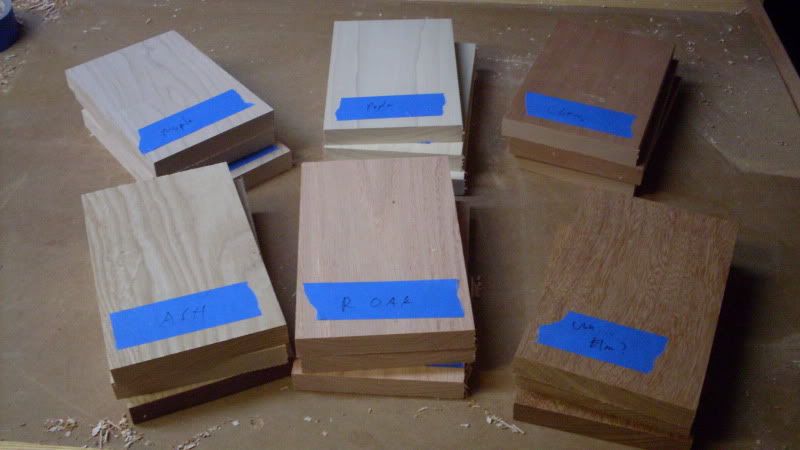
The wood samples for this test have been cut from plain old boards that have been acclimating in my shop for – I dunno – as long as five years.  I chose a series of samples from frequently used cabinet woods to give a good representation of what most woodworkers will use.  They include; maple, poplar, cherry, ash, red oak and a surprise board.

Yes, it’s a surprise to me, because I picked up what I thought was ash from my hardwood supplier. Got it for a steal – rough – at $1 a board foot. However, once I started planing it for this experiment, well, it’s not ash.  I’m going to guess from the photo that it’s red elm, but I could be way off base. Maybe one of my esteemed panelists will be able to put a better ID on it.  Hey, at least it’s a different species!

I planed, ripped and crosscut the boards to exactly 5” wide and 8” long.  I will be shipping the boards by US Postal Service tomorrow  (today is Memorial Day, an official federal holiday) to Marc and Dave with a copy of the steel ruler I used to measure the boards.  I took the time to ensure the measurements on each rule lined up to give as accurate a reading as possible.

I have asked both Marc and Dave to let the boards sit in their shops for two weeks, then measure the board samples on June 8 to see what kind of changes have occurred.  How will the boards react to the changes in temperature and humidity?

Stay tuned…