All posts by Tom

I'm the guy who writes the blog...

It starts with the word fun…

Ask people how they define the word ‘recreation’, and you are bound to get wildly differing answers.

For my wife, recreation means taking a folding chair and a sun umbrella down to the beach with a cooler full of cold water and a murder mystery.  She can spend hours just laying back and relaxing.

For me, well, I steer more toward the active. Case in point, I am currently coaching my son’s youth recreational basketball team.

Before I started woodworking eleven years ago, the local rec league was desperate for people to coach, so I stepped in to offer my services. That’s the last time I had coached, and our team did pretty well.  Now, with my son in the 11 – 12 age group and the hurricane speaking tasks slowing down for the season, I stepped up again to take the reins.

My ten-person roster is full of kids of differing motivations, skill sets and levels of experience.  My job is to whip them into a unified team.  But how?

I have been watching some of the other coaches in the league to see how they do their work.  I’ve seen coaches who just want to scrimmage during their practices, playing half their team against the other half.  Then, I’ve seen coaches focus intently on setting up designed plays.  Their players have to remember a bewildering number of play names and learn exactly what they have to do in each situation.

While both approaches have their merit, I have decided to focus heavily on the fundamental steps of playing the game.  After all, I could teach them set plays, but if they understand how to move without the ball, play solid defense and rebound correctly, they can use these skills later on down the road should they continue playing.

In much the same way, I have received a number of e-mails since I started working on Tom’s Workbench from woodworkers just starting out the craft.  “Tom, I’m looking to learn how to cut dovetails.  Can you tell me how to get started?”  “I’ve been trying to build a mission style lowboy for my wife.  I’m not sure how  to begin.”  “My finishing is just awful.  Where am I going wrong?”

I’m not going to claim that I am a woodworking expert – that I have all of the answers for every single problem or question.  In fact, there are still MANY different things that I need to learn myself, and there are still dozens – if not hundreds – of aspects of woodworking I have yet to even touch on.  I’ve only been doing this as a hobby for a little more than a decade.  There’s still much to learn.

One thing I have learned, however, is the method I am approaching my basketball coaching translates very well to working in the shop.  By taking the time to learn the proper fundamentals of different aspects of woodworking, you can more easily master the advanced techniques.
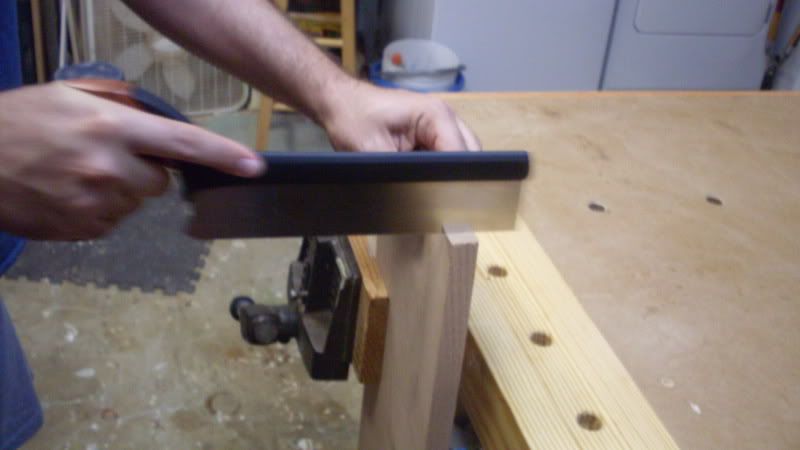
Think about it for a moment.  What do hand cutting tenons and dovetails have in common?  Besides the fact that it involves using a saw and not plugging in a tool, the main skills you must master are marking an accurate line and cutting exactly to it.  Yes, seriously.  That’s exactly what is required to make the joints sound.

So, how do you get that kind of experience?  The answer lies in the punchline to a classic joke tied to New York City.  A young lady gets into a taxi cab and asks the driver, “How do I get to Carnegie Hall?”  The cabbie looks over his shoulder and cracks back, “Practice, kid.”

To get that kind of practice, you should line up a few practice boards of some inexpensive material – poplar, alder, red oak or the like.  Mark a depth line and grab your saw.  See how many dead perpendicular lines you can cut across the width of the board.  When you fill one board’s width, cut that end off and start over.  Look at the results.  Focus on your grip and the flow of motion in your arm.  Look at the results and evaluate your progress.

Do this five or ten minutes every time you go into your shop, and you will hone those skills to the point where cutting advanced joinery will be a piece of cake.

The same can be done  for any number of other essential woodworking skills.  Learning how to use your planes.  Learning how to sharpen your blades. Learning how to properly work a router. Making high quality rip cuts.

Will it be fun?  Maybe not.  After all, our shop time is precious, and we want to spend all of that available time building projects.  But, just as the kids on my team may want to play like LeBron James or Michael Jordan and shoot the lights out, they have to start by learning to do the essential skills properly.  Once the are competent with those basics, the other stuff will start to come more naturally…

After that, hey, the sky is truly the limit.

Quick Poll

Power tools are awesome. They make so many tasks in the shop faster and easier.  From ripping boards to boring holes, there’s one to suit your needs.

However, they can cost quite a bit. There are off brands and cheaper models, but for high-end power tools, prepare to pry open your wallet to pay…

That is, of course, unless you buy a factory reconditioned tool.  These reconditioned tools are typically ones that are sold to a customer but returned because of some defect.  They are returned to the factory, rebuilt to specs and sold again.  You might be able to score a decent tool for a discount price.

However, there are some woodworkers who have had bad experiences with reconditioned tool.

This week, let us know if you have every bought a reconditioned tool and how it worked for you.

[poll id=”88″]

Link of the Week

The Appalachian Blacksmiths Association All About Nails page

Why are nails referred to by ‘penny’ size?  Why were homes burned to the ground to rescue common nails?  Just what does the term ‘Dead as a Doornail’ really mean?

Find the answers to these and many other questions at this outstanding page run by the Appalachian Blacksmiths Association.  This well-researched page tracks the evolution of the humble nail from the earliest of civilizations to today’s modern nail making factories which can spit them out by the millions.

While you may not give up your pneumatic nail gun after reading this page, it will at least provide you a glimpse of the fascinating history of this ubiquitous fastener.

Of work horses and show ponies…

I make no bones about it… I love old woodworking hand tools.

Give me a classic chisel, slick, plane, saw or other woodworking implement, and I’m as happy as a clam. My jack plane dates from the early 1910’s, my wooden fore plane from the 1880’s and my sash mortising chisel from approximately 1845.  Each of these classic tools sits ready to accomplish the task needed.

Since I have confessed my love for hand tools of bygone days, many  readers have asked  where I find the old iron.  I have gone to flea markets and I do cruise neighborhood garage sales, but the majority of my old tool scores have been found on eBay.  When I really need a tool to do something specific – such as my recent Scrub Plane purchase – I’ll go to this online flea market and find what I need there.

Recently, a reader named Charlie Morgan e-mailed me asking my opinion about a chisel that was up for auction.  It was a beautiful 1/4″ Lakeside socket mortising chisel with just a little bit of rust and an intact hardwood handle.  I wrote back to Charlie saying that it looked to be in very good condition and could serve as a great user tool.

The only problem was that Charlie had never heard the term ‘user’ before. And, that leads to an interesting discussion of why people collect old tools and what their intended purpose is.

When I hit the flea markets or eBay, I’m typically looking for a user. Those are tools which were the most frequently manufactured – and used – tools in carpentry and woodworking.  For instance, when it comes to hand planes, a Stanley Bailey No. 4 smoothing plane, a No. 5 jack plane and a No. 7 jointer plane are going to be the three most frequently seen of the bench planes.  They were made en masse and were the true workhorses of the day.  In fact, it was the rare carpenter or woodworker who didn’t have one of each – if not Stanley’s models, then perhaps ones from a competitor.

When you go to eBay, you will see plenty of these models out there.  Take a look in the buy/collectibles/tools, hardware & locks/tools/carpentry& woodworking section and see just how many are out there.  Knowing that there will be many of a particular model offered will prevent you from inadvertently  jumping into a bidding war over one offering when there may be dozens of others in similar condition.

And, when it comes to that condition, expect to see most of these user tools pretty well beat up.  Since they were used so frequently, they will have the black paint (Japanning) worn off of them.  Planes used in warmer climes may also have a lot of rust on them, a process accelerated by the salt content of their user’s sweat.  Old hand saws may be kinked, and old chisels may chips out of the edge. While they may look rusty and crusty, they can be brought back into usable shape in very short order.  With an upgraded iron for a plane or some regrinding for a chisel, they can work circles around many of the cheaply banged out offerings at the local home improvement store.

On the other hand, some tools have a greater collectible value.  Moving back to our example of the Stanley Bailey pattern planes, the No. 1 smoother jumps to mind.  This diminutive plane was not made in tremendous numbers during it’s production run, thus making it very scarce.  And, when specimens of this variety are offered for sale, they frequently fetch several hundred – if not one thousand plus dollars.

A plane such as that doesn’t belong in your shop.  Something with such a value should be displayed on the fireplace mantle, enclosed in Plexiglas to keep the wandering fingers of your jealous woodworking friends away from it.  In years to come, you may want to will this gem to your kids or grand kids.  Be sure they understand it’s value before they try to throw it away or sell it for a few bucks…

Unfortunately, in the old tool world, it’s always buyer beware.  Some sellers hear that old tools can become a gold mine and they may try to up their price for the unwary shopper.  Don’t fall into that trap.  You can always do a quick eBay search for that particular kind of plane model to get an idea of what it might really be worth.  From there, be prepared to haggle and to walk away if there is no flexibility in the pricing.

Can ‘user’ planes make ‘show pony’ status?  You bet they can.  If that old No. 4 plane was owned by your great grandfather and rode in his toolbox as he went off to work, then by all means, make it a showpiece.  But, also understand that if you do decide to hone that iron to see what it can do, don’t be surprised if it finds its way out to your shop on a full time basis.

That’s where these work horses like to gallop…

A Panel Discussion

Cabinet doors. Chest sides. Drawer fronts.

Look around at the furniture you come in contact with every day, and you’ll see them there.  Some have transitions in their profiles that add shadow lines, yet others are soft and rounded, easy on the eyes. Raised panels just staring at you, adding visual dimension to plain, everyday items.
If you have never cut raised panels for a project, you might be intimidated to try, or believe that they require advanced tooling that would break your woodworking budget.  Not so.  In fact, there are several ways the average home woodworker can tackle these panels, making their projects that much sweeter.

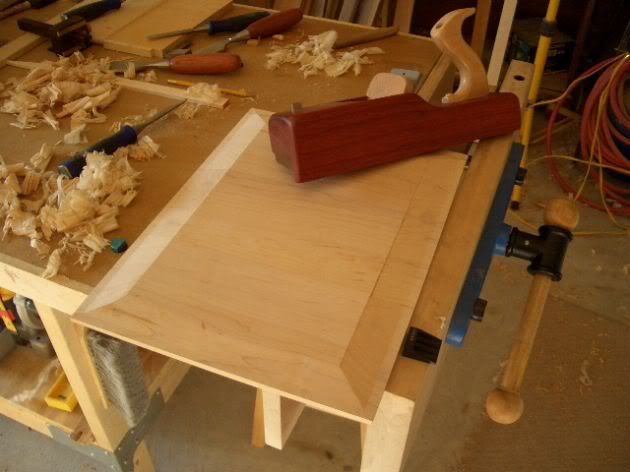
The first method is a throwback to the days before power tools were common… or even invented.  Hand planes can raise a panel for you in a jiffy.  Back in April 2008, I wrote an article about planing a bevel on a workpiece.  Using just a jack plane and a marking gauge, I got very good results with a minimum of fuss and effort.

You could take the route my friend Craig Andrews went.  He had a custom-made panel raising plane made for his shop.  It’s a gorgeous piece of tooling, and it produces a very crisp bevel with some embellishment. Unfortunately, this kind of tool requires a considerable investment up front, but if you can swing it, the results are spectacular.

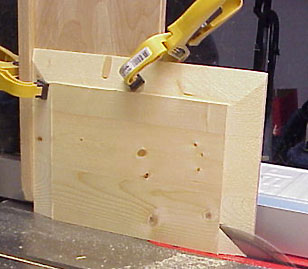
If hand work sounds  like too much work, there are other options.  How about your table saw? It may not seem like it would be a good choice at first, but the table saw can cut very crisp panels by simply beveling the blade and using a smart jig or two.  Tom Hintz of New Woodworker.com offers his take on this process here.

The late Danny Proulx also offers plans on how to cut a coved raised panel profile on the table saw. His method does use an unprotected saw blade and is best executed with the kind of push blocks used at a jointer to provide control and protection.

If you decide to go the router route, there are several options there as well. Eric Reed, the product manager for Eagle America, gave me a quick rundown on the different kind of router bits available with their strengths and weaknesses.

Vertical panel raising bits are generally the least expensive option. They require less steel and therefore weight less. This means they can run in less powerful routers that are at least over 2 HP. This does require more than one pass – usually three. The downside is that they are more difficult to set up in a vertical position because there is less surface material riding on the table to support the panel as you are feeding it through. However, they work great with a flat bed horizontal router table where the router is perpendicular to the router table top and the face of the door panel is supported by the table.

Horizontal bits are generally a little more expensive than vertical bits. They require more steel and therefore weigh more. This requires a more powerful router, at least 3 HP. They still require at least 3 passes to achieve your full depth of cut. The upside to this style of bit is that it is ready to work in just about any router table with no modification or special equipment. The panel lays face-down on the table and is fully supported during the cut. Another bit of advice is to check your router’s speed control. Larger diameter bits do require a slower speed of rotation, so adjust your router accordingly.

If properly setup, both bit styles will produce high quality cuts. Ultimately, it comes down to personal preference and what you are comfortable working with.

Regardless of the method you use to cut your raised panels, you may want to consider cutting a rabbet on the back side of the panel.  This relief cut will help prevent the pane’s face extending above the rails and stiles.  If you don’t mind the panel being raised out like that, then it’s OK to go.  But, a shallow rabbet on the back of the panel – say 1/8 to 1/4 of an inch – can keep your panels from riding proud.

If all of this panel raising sounds complicated, it’s really not.  However, another option available to you would be to cut a groove in the stiles and rails of your door and use a plywood panel in the door.  Or, you could use some MDF which can be painted or veneered…

You know, there are lots of ways to get this accomplished. Think of the possibilities you can try in your shop!

Quick Poll

While doing the recent Finding Those Roots articles, a number of the responses were quite interesting.  Some who participated can remember their first days back at a very young person working side-by-side with their dad in a workshop. Others could vividly recall their high school shop class instructor lighting their woodworking fire many years ago.

Whether you were a little one or considerably older, there was that moment in your life when you chose to become a woodworker. That’s usually considered the time you started laying money down for tools, establishing some kind of work area and spending Saturday mornings hard at work. In this week’s poll, I’d like for you to look back into your past and remember just how old you were when you started woodworking.

Now, remember, I’m looking to see when you got into the craft seriously, not when you were first exposed to it. For instance,  I had a wood shop class in middle school when I was 12, but I didn’t get seriously involved in the craft until I was in my late 20’s.  So, I would vote in the 25 – 30 range…

[poll id=”87″]

Link of the week

Building a Box Joint Jig

The late Danny Proulx was an excellent writer and instructor of woodworking.  His books such as Build your Own Kitchen Cabinets and Cabinet Doors and Drawers are outstanding resources for the home woodworker.

At his website, Danny also offered several free tips, and this one has easy-to-follow instructions on how to build and use a box joint jig. Built from a few scraps of plywood and solid stock, this jig can be built in minutes and allows you to cut crisp, decorative joints for drawers, boxes, chests and other woodworking projects without a large outlay of cash.