All posts by Tom

I'm the guy who writes the blog...

Sledding to safety

Yes, it’s true.  I had a kickback on my table saw last week.

Even after all of the safety posts I have written, it still happened. It wasn’t serious enough to require me to go to the hospital or seek other emergency medical help.  Thank goodness.

I got a bad bruise to the tip of my left index finger and a gash on the inside of my forearm about four inches down from my elbow.  I’m nearly recovered from this mishap.

However, it did serve as a gigantic wake-up call for me to review my attitude about safely operating the table saw. Here’s a list of what contributed to the accident.

  • It was the proverbial ‘last cut of the night’
  • I was feeling tired
  • I was frustrated because I was following a plan that gave incorrect dimensions for a part… I had to saw, edge and thickness another piece of wood to work with a larger blank – and it was curly maple…  not something I want to waste.
  • I thought the thin material (1/4″ thick) wouldn’t hurt if it did kick back
  • I was crosscutting a board about 3″ wide by 12″ long using the rip fence to gauge the distance… believing it would be more ‘ accurate’ and ‘easier’ to deploy.
  • My wife had just walked in to talk to me, so I took my eyes off the work.

As you can see, there were quite a few contributing factors to this accident.  For me to ensure my safety, I am going to have to help set the tone in my shop.

Of course, I’m going to have to start to recognize when I do get feeling tired, frustrated or distracted and learn to walk away from the power tool.  It’s better to do something mundane like sharpening a plane iron than packing my fingers in an ice-filled Ziplock bag for a trip to the hospital.

But, I have to also use the proper jig to help ensure my safety. Crosscutting using the rip fence is dumb.  It’s stupid.  It’s something I know better than to do.  However, I did it anyway, even though I have a $159 Osborne EB-3 miter gauge and a large panel cutting jig maybe a dozen steps away from the saw.

Why didn’t I use them?

The sled is just too heavy.  It’s a monster jig I built to crosscut up to 18″ wide panels.  Great for that application, too much to heft to the saw for small cuts.

The Osborne is sweet, but for small work, it gets kind of awkward, trying to balance a small piece against it. Besides, it doesn’t allow me the option of clamping the work down to the table so I can move my hands out of the way.

So, I set my mind to build a small, maneuverable crosscutting sled that is lightweight, accurate and allows for clamping.  The problem I ran into when looking for one on the Internet is that the plans fall into one of two camps.

There are those that are just too darned simple.  A runner for the miter slot, a back or front fence and a sheet of plywood.  These, like the famous one found in Norm Abram’s shop, are great for cutting square edges on larger panels, but fall down on the job when cutting smaller stock. Besides, these typically just ride on one side of the blade, leaving the ‘offcut’ side unsupported.  I needed something that will bridge the saw blade, keeping the workpiece securely supported on both sides.

Others  look like wooden Swiss Army Knives.  They can miter, tenon, crosscut, slice, dice, julienne and make mountains of cole slaw based on how they are set up.  Crisscrossed with feet of T-Track, hold down knobs and other devices, they are only slightly more complicated than the entire Apollo Moon Landing program, and can take several nights of detailed construction to become reality.  This, of course, brings us back to the weight problem.  If they are too heavy, I can see myself at a later date wondering if I really need to get the sled off the shelf…
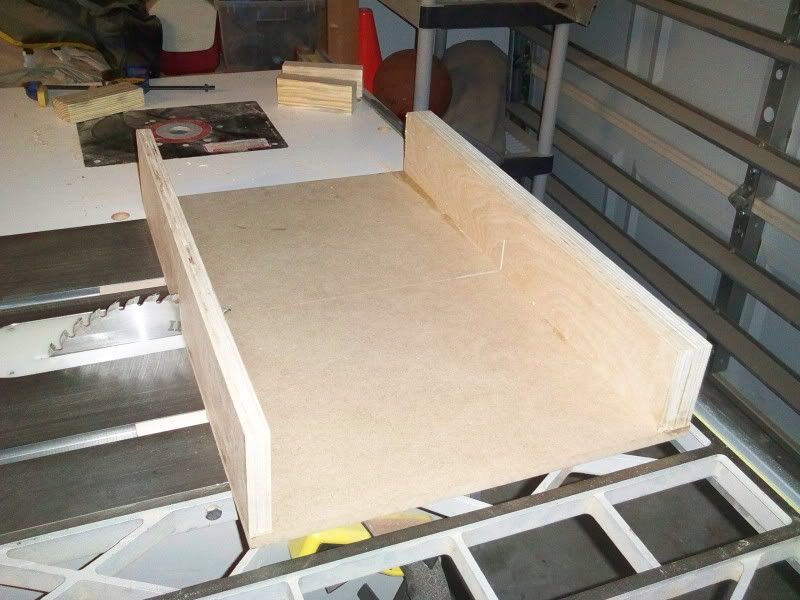
This is what I came up with. It’s rather simple to build and it offers me a lightweight jig with excellent accuracy. As with most crosscut sleds, the heart of the system rests with the miter slot runners.  I milled these out of a straight clear piece of maple.  One in each slot, and they fit perfectly.

The base of the sled is a piece of 1/2″ MDF 16″ wide by 24″ long.  No, may not suffice for large workpieces, but that’s not the purpose – this baby is set up to handle small work.   I cut it square on the table saw, butted it against the rip fence and laid it on top of the glued runners.  A few brads held it the assembly in place until I could flip the board over to mount screws.

The front fence is a 3 1/2″ tall piece of 3/4″ cabinet grade ply.  It’s that high so the blade won’t cut through it, leaving me with two sleds.. something I’m not looking for.  It was glued and screwed to the piece from underneath.  Once I did that, I pushed the sled through the blade until it was close to the back of the MDF sheet – not all the way through.

The back fence is two pieces of 3 1/2″ tall cabinet grade ply glued and bradded together to give me a piece 1 1/2″ thick.  My initial plans were to install a T-Track to serve as a base for a hold-down clamp, but I held off for now. That will be a later edition if I want the convenience.  Once I got the back fence squared to the blade, I glued and screwed  it into place and pushed the sled through the blade.

I also dug through the scrap bucket and came up with a few scraps of southern yellow pine to serve as hold downs. Now, when I want to cut a small piece, I can set it in place, using the saw kerf to accurately mark where the blade will cut.  I can then clamp one of these scrap SYP pieces directly down on the board to be cut right at the kerf line.  This way, I can ensure the wood won’t move, and I can keep my hands safely away from the blade.

My first couple of cuts with the sled were dead-on at 90 degrees.  The pieces didn’t move, and I was very happy to have my fingers safely out of the way.

Improved accuracy AND safety?  For the handful of scraps and screws I used, it was well  worth the cost.

Quick Poll

It’s no secret – woodworkers love woodworking.

However, everyone has a breaking point – some point at which they could be convinced to give up something – even their beloved woodworking.

Imagine if you will, a multi-gazillionaire were to come to your town to make you an offer to give up the craft.  Cold turkey. A truck and a group of workmen would be dispatched to clear your shop of all of your tools and prized timbers, and, once completed, you would get a  briefcase full of cash to use as you wish.  With one caveat.

The terms of this agreement  would be severe –  absolutely no woodworking at all.  If you were to even read a woodworking magazine, participate in an online woodworking forum, even touch a piece of wood that you intended to cut, shape, drill or do other acts of mayhem on – you would have to surrender the money and everything you bought with it.

Would you do it, and for how much?

[poll id=”91″]

Link of the Week

About.com’s Top 12 Table Saw Safety Tips

Well, it happened to me Wednesday night.  I was trying to make the proverbial ‘last cut’ of the night, was feeling tired, using the saw incorrectly and I got distracted when WHAM… I had a kickback.

I’m OK, just a few cuts up my arm where the board flew up and a bruised left index finger… but it could have been much worse.

That’s why it’s a great time to review the basic table saw safety tips.  Read through this list and honestly assess what you do when you work at the saw.  It just might save a finger or two…

Woodworking Spotlight: Dawn Lindgren

Do you remember your first few days as a woodworker? Maybe it was the time you set foot in a shop class at the start of a new school year. Perhaps it was the time when your dad took you into his shop on a sunny Saturday morning to build something.

Regardless of when or where it took place, many of us recall that moment very vividly, almost as if we are living through it all over again. The sights, the smells, the feel of the tools in your hand.

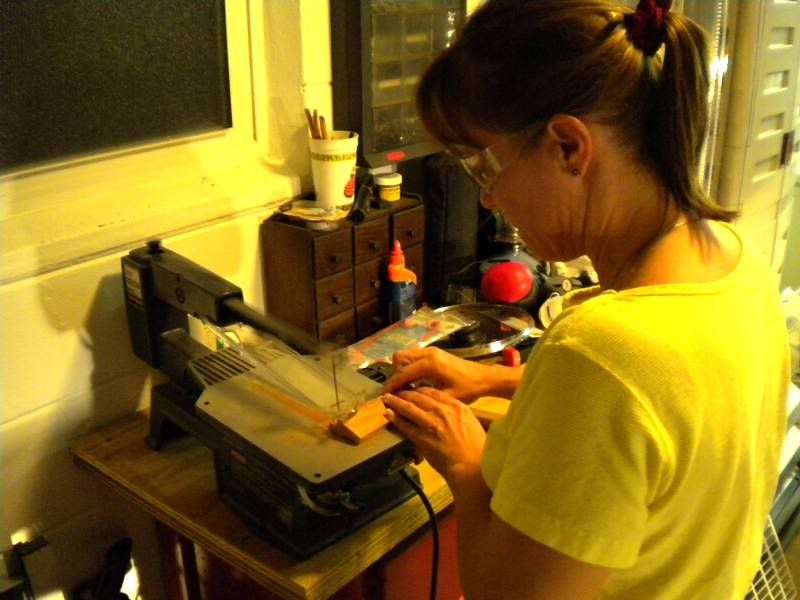
For some woodworkers, they are living those first few moments today. One of my co-workers for Pinellas County is just starting on her woodworking journey. It’s not too often that we get a chance to see folks just at the budding beginning of their woodworking adventures, so I graciously asked her if she would agree to be interviewed.

Dawn may be new to woodworking herself, but her memories of woodworking stretch back to her childhood. “My great grandfather was a pattern maker and I have many of his antique tools.  He made a beautiful tool box out of Birdseye maple, teak, and mahogany.  Both of my grandfathers also did woodworking and I enjoyed watching them build things.  I still have quite a few items that they built and were handed down to me or were gifts.”

While the thoughts of those sawdust-covered relatives were running around in her head for years, she faced one of the greatest obstacles which confronts just about every woodworker – a lack of time. “I have wanted to do woodworking for a long time. I just didn’t make the time – there was always something else which pulled me in another direction. Now, it’s time to try something different in my life. I have made the time to learn and see if I have the ability.”

While a beginner, it’s not as if Dawn is entering woodworking with absolutely nothing. She has amassed a number of tools through the years as she tackled different home improvement tasks. These include a table saw, a compound miter saw, some chisels, other power saws and the various assorted pliers, screwdrivers and other small hand tools. “Originally, all the tools were purchased for home improvement projects with the hope that someday my house projects would be done and that I could also use them create wood working projects. You know things like bookshelves, custom benches… or what ever else I could build.”

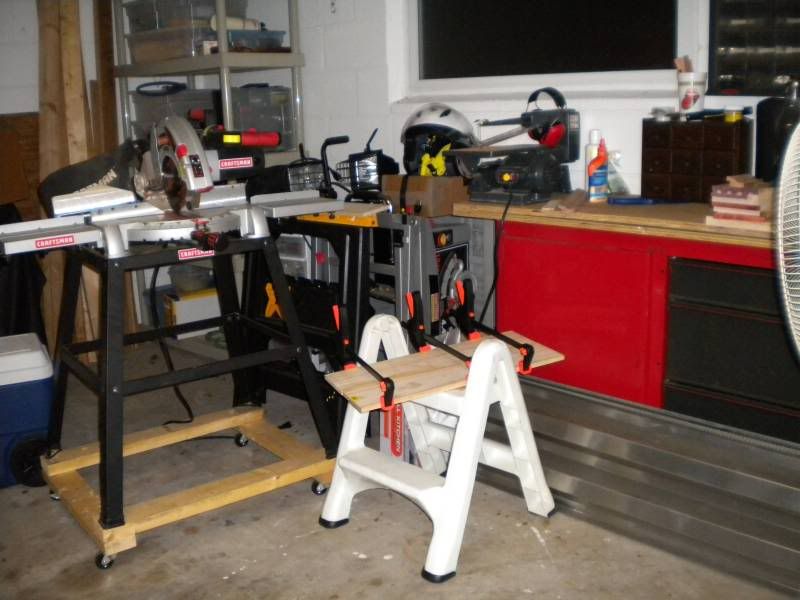
As far as shop space is concerned, Dawn is experiencing those growing pains all new woodworkers seem to face. “I have a two car garage and a large driveway that I plan to use for my shop for now.  Most of my larger pieces are on wheels and I move them around as needed. I have added several electrical boxes in the garage over the years, so power shouldn’t be a concern, and I have a faucet just outside the door if I need to clean things up.”

With the gentle coaxing of her new husband Greg, Dawn has taken some first steps into fine woodworking. Recently, she completed a class at a local Woodcraft on box making. “There were three of us in the class and we each made a box using our own dimensions and selecting what type of wood we wanted to use.  I selected maple for the box, cedar for the liner and lacewood for the veneer top.” The first day was an exercise in cutting joinery and assembling a nice cube. “I couldn’t understand how that cube was going to become a box. How was I going to get it open?”

Dawn learned on day two just how it was going to happen. “It really freaked me out when the instructor told us we would be cutting the lid off on the table saw.  I had visions of the entire box falling apart. As I cut my lid off, I was pleasantly surprised that it did not collapse or fall apart.  The cut was even all the way around and the lid came apart easily with a utility knife cutting though the last bit.” The final box is something to behold – the first piece of advanced woodworking she was able to complete from scratch.

While Dawn is just in those early stages now, she does have a vision of where she would like to be in the future. “In five years, I would hope to be fairly proficient.  Not an expert woodworker, but certainly proficient at making those things that I currently want to make.  I expect to be beyond the rookie mistake stage and working on more detailed projects.” And, that’s just the start. “At that time I hope to be looking at retiring in the next several years and beginning to design a better shop that is dedicated to woodworking, not sharing the space with a car. I would think by then I would have built my bench, bookcase and even a wine rack or two.  I hope that I come up with some other inspiration along the way.”

“Prepare to Lay Siege, Centurion!”

Elementary school was so much fun for my oldest son Dominic.  He got to cut shapes out of construction paper and glue them together. He got to finger paint.  He got to color with crayons.

All of these were essential skills for the up-and-coming youngster to master.  They improved his creativity, fine motor coordination and showed us how well he was able to follow directions.

Now that he’s in middle school, things are getting more complicated.  Higher level math (I can no longer help him with his homework!), advanced science and world history classes have taken him to the next level.  Not only is the work harder, the homework assignments have become a lot more challenging.

That’s what we were working on this past weekend.  Dominic’s technology teacher (yes, he has one of them) assigned his students a difficult yet interesting homework assignment – build a catapult. You know, a siege engine used by the Roman Legions as they laid waste to opposing cities around the Mediterranean. Other than that, the assignment was wide open – no restrictions on size, materials or methods of powering the device.

Dominic sat as his desk for a while, sketching out ideas on a notepad.  Some of his designs seemed pretty far-fetched (one involved a battery operated motor), while others were very plain and uninspired.  The more he worked, the more frustrated he became.  Finally, he asked if we could look around the Internet to see if there was any inspiration – and we came away inspired.

There was a site called Storm the Castle that had plans and pictures of different catapult designs.  From large models to hurl pumpkins and potatoes to desktop models that shoot wadded up pieces of paper, the plans varied tremendously in scale and complexity.

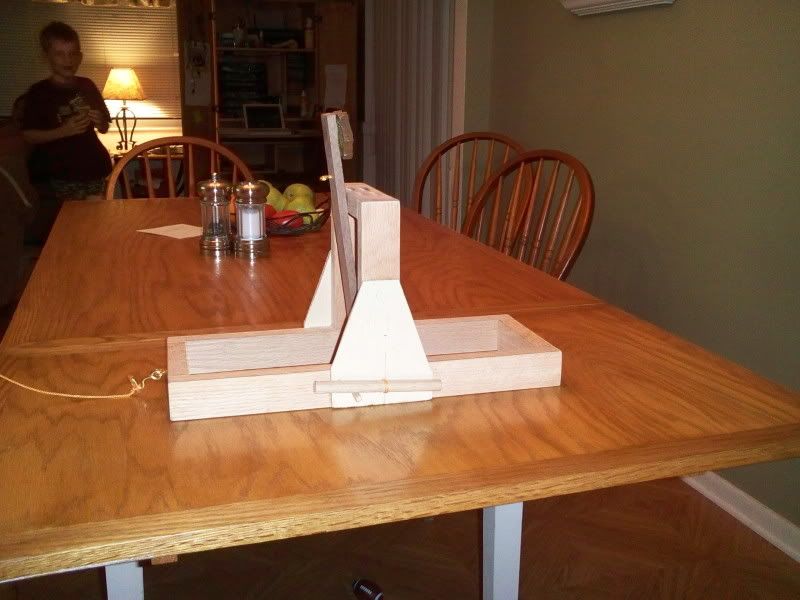
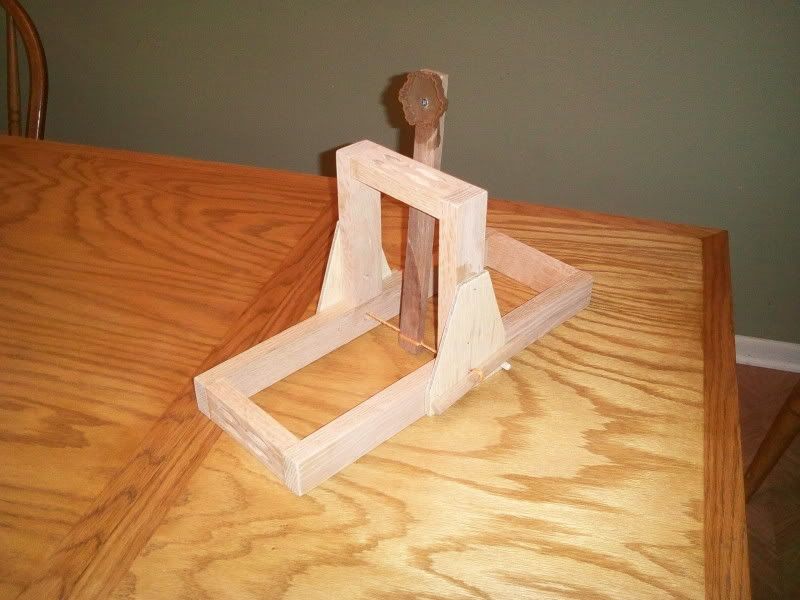
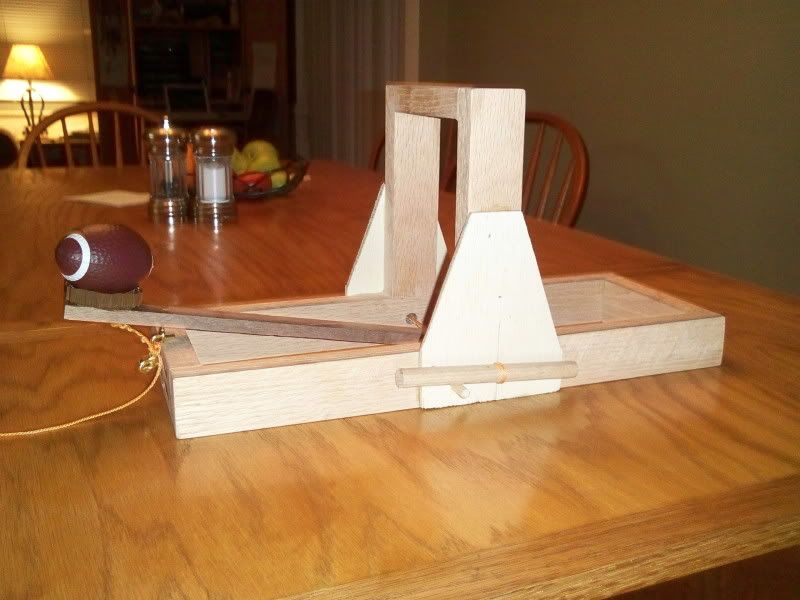
We went back to the drawing board and came up with this design. Built of 1 1/2″ by 3/4″ sticks of red oak. Every joint was reinforced by two pocket screws and glue.  The unit itself is 18″ long by 6″ wide, with the top of the cross beam set at 8″ above the table.  I cut the pieces to size on the table saw and let my son drill the holes, glue and screw the pieces together.  We added two plywood gussets to the outside of the uprights to reinforce the piece, giving tremendous stability.

The arm was made of a 3/8″ thick by 3/4″ wide piece of mahogany. We fashioned a basket from a plastic piece from a game my son didn’t use any more and epoxied and screwed it to the throw arm.

The other end of the throw arm is ensnared in a wound nylon mason’s string that spans the base.  I tied it into a loop and wrapped the ends around a pair of dowels protruding from the side.  We really cranked down on them to add plenty of tension to the skein, and my son drilled dowels into each side to work as a catch to prevent the string from unwinding.  Catapults using this sort of propulsion method were known back in Roman times as an onager – the local name for a wild donkey with a mean kick.  Believe me, even in miniature, this thing lives up to the image.

The final touch was to add a hook and eye catch to the base and the throw arm, and tie a length of string to the hook.  Once the projectile is loaded, a quick tug on the string is all it takes to trigger the mechanism.

To test how effective our siege engine was, we searched the house and found an appropriate missile to commemorate the opening weekend of the NFL season.  A countdown – 3…2…1… – and FIRE!  The catapult lobbed the miniature foam football a good five feet, with a maximum height of about two feet over the ground.  A perfect long pass to an open receiver down field!

My son is bringing the onager to school to be graded, but he promised that he would return home as any conquering hero would to Rome – with the prized siege engine at the head of his victory column.

I told him that when he comes home, he has to use the famous quote from Julius Caesar – Vini, Vidi, Vici… I came, I saw, I conquered.

Quick Poll

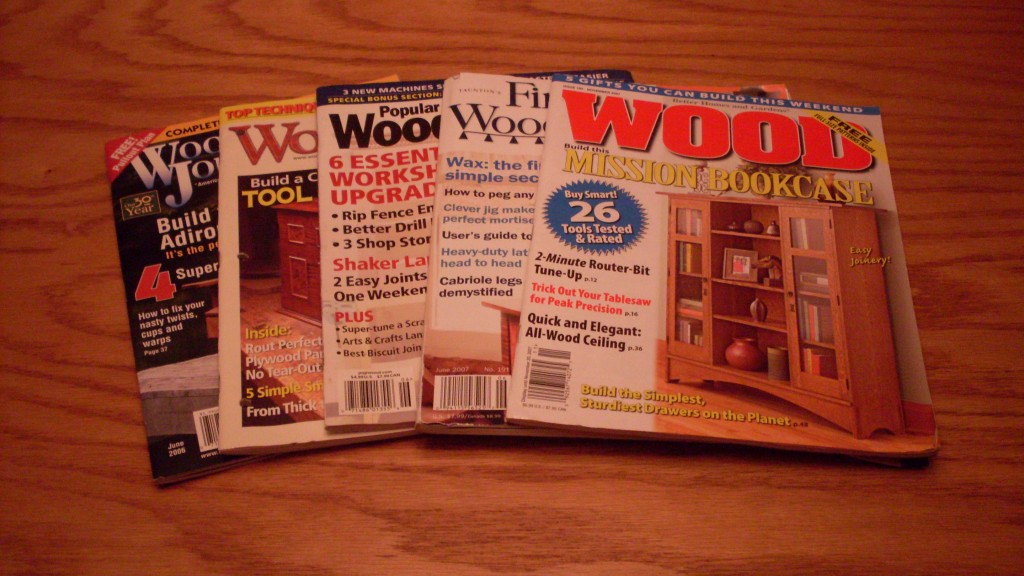
There are few sources of woodworking know-how as rich as the many woodworking magazines published around the world.  From magazines that appeal to a wide woodworking audience to specialized titles that focus on one aspect of the craft, there’s something to suit every one’s woodworking needs.

SDC10742

Each edition is loaded with shop tips, projects, background articles and plans for easy-to-build jigs.  The writers and editors have a great opportunity to strut their stuff and provide valuable information for their target audience.  If you subscribe, this wisdom comes right to your mailbox as each edition rolls off the presses.  Month after month.

Their strength – frequency of issue – can also be a weakness. After all, by the time you get a chance to read through the magazine, scheme in your mind what you would like to build and find the time to do it, the next edition is just about ready to ship.  And, the process begins all over again.

This week, we want to know approximately how much do you build and incorporate from each edition of woodworking magazine you receive.  Do you build everything you possibly can from each issue, or do  you find yourself just trying to keep pace?

[poll id=”90″]