It was 20 years ago today…

And, no, Sgt. Pepper had absolutely nothing to do with today’s post. I just thought it was a cool title for what I am writing.

Sgt. Pepper's Lonely Hearts Club BandYou see, it was 20 years ago today – at 11:30 a.m. – that Rhonda and I said, “I do” at a little old Catholic chapel in Bowie, Maryland.

Shortly after the big moment on the big day

Sometimes, I feel so sorry for her. Back on that day, did she know when we took our vows that she was going to one day be a workshop widow?  A blog widow? A woodworking show or woodworking store widow?

Did she know she was going to be a sounding board for woodworking designs? A trusted adviser, expected to know the benefits of a dual-base router vs. a pair of dedicated fixed and plunge base routers? A progress evaluator as I would hold up semi-complete sub assemblies of projects and ask for her unabashed enthusiasm?

Did she know that one day she was going to be angry at me for tracking sawdust into the house?  That she would be yelling at me to stop running the power tools after 10 p.m. so she could get some sleep on a work night? That she was going to be holding ice on a kickback injury or gauze on a nasty cut I suffered in the shop?

Did she know that she was going to hold back some snickers while I showed her my first few pathetic projects? That I was going to present those projects to her family as holiday presents and she was going to hope that they liked them? That she would be biting her fingernails in anxiety as she wondered if the finish would cure in time for them to be given as presents?

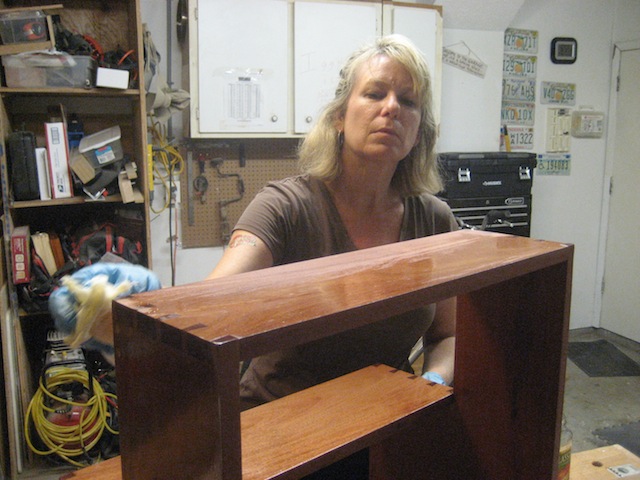
Rhonda taking to the shop

Did she know that her future sons were going to get snagged and sent out into the shop to help with the grunt work? That she was going to be out in the shop one day herself?

I bet she didn’t, but I am also willing to bet that even with all of the struggles, miscommunications and successes, that she wouldn’t trade the experience for anything.

Rhonda, thank you for being my supporter, my cheerleader and my biggest fan for the past 13 years as a woodworker. And, happy anniversary to you!


Shankapotomus

Summertime, and the living is easy. Everyone is headed outside to take in some glorious sunshine and enjoy the outdoor activities we look forward to. A trip to the mountains. Sand between your toes on the beach. Picnics in the park.

Getting into the swing

Oh, and some folks like to go out and enjoy a round or two of golf. While I have only ever played golf once (no, you don’t want to know what my handicap is), there are lots of people who play a whole lot more frequently. From what I understand, it’s a great way to get outdoors, be social, and spend hours looking for a tiny white ball you just smacked with a club.

Every player is looking for the perfect shot, but I’m pretty sure I have never hit one. My mantra on that warm spring day was that if it went left, it was a hook; if it went right, it was a slice; and if it went straight, it was a miracle. The other shot I made a lot was the shank.

Shank happens

I’m not sure why it was called a shank, but it didn’t look anything like the shanks I see on my router bits. Now, those babies are sweet looking – precision ground, perfectly round and made of sturdy steel. Sure, the cutters of the bit get all the glory, but the shank is equally as important to the health and well being of your router bit, and deserves a little bit of love from time to time.
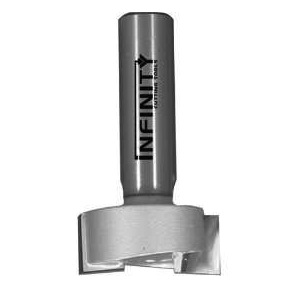
A router shank

That’s what Kurt Raschke – the craftsman in residence at Infinity Cutting Tools – told me at a recent router basics class. The key thing to remember is that the shank is precision milled to hit an exact dimension. Yes, a 1/2″ shank is 1/2″ diameter, and a 1/4″ is a 1/4″.

The reason they have to be so precise is that the sit in a collet, not a chuck, as you would see in a drill press. The collet can be smaller and lighter than a geared chuck, has tremendous holding power and is automatically self-centering. The downside is – of course – the collet can’t really adjust to different sized bit shanks. Keeping those tolerances tight is critical to getting a good fit.
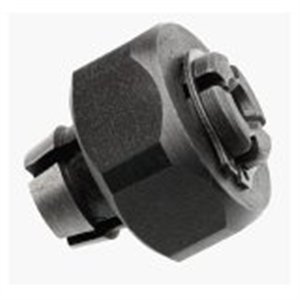
A router collet

Fortunately, keeping router shanks – and collets – in good shape is a simple matter of maintenance. First of all, every so often, you should inspect your bits. Is there any sign of wear? Burrs and grooves worn into router shanks could be a sign that the collet on your router may need to be replaced. Try not to sand them out, because that will affect the dimension of your shank, which can lead to pretty disastrous results. Can you say ‘bit slippage’?

You may want to wipe down the shanks from time to time with whatever you are using to clean pitch build up off the cutters to ensure debris or residues are cleaned off the shanks. Be sure to avoid using anything slippery on the bit, for obvious reasons.

It’s also a good idea to check your collet from time to time. After numerous bit changes, metal fatigue can begin to settle in, making it more difficult to tighten down your collet on the bit. Your first reaction will be to crank down heavily on the collet to get things snug, but that just compounds the problem you had in the first place. Spare collets for popular router brands can be found easily online. Some less-expensive routers may have a permanently attached collet on their models. In this case, a new router may be in your future.
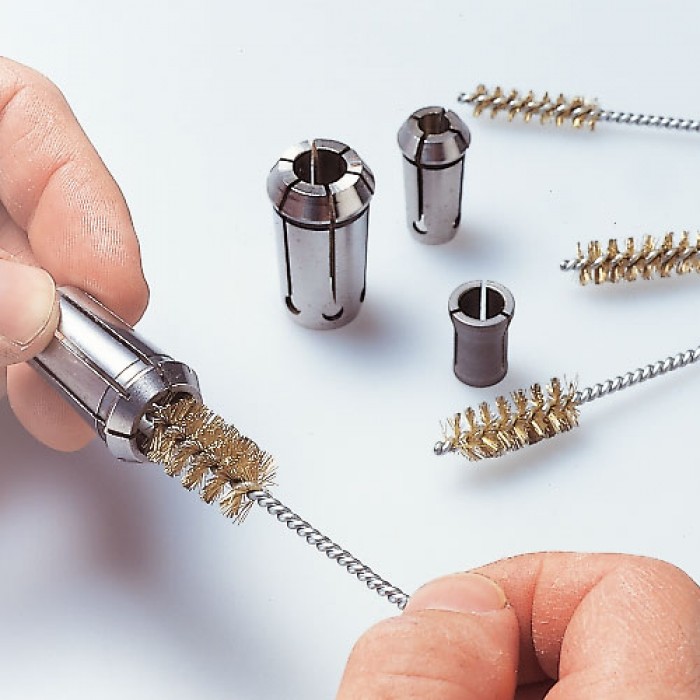
brushing out a collet

Also, be sure to give the collet a good wipe out on occasion. This helps remove any residue that gets in there, extending the life of the collet a bit. A great tool to clean out the bits can be found at a gun shop. Pick up a .25 brush for your quarter inch collets and a .50 for your half inch ones. The soft metal of the brush is designed to be gentle on the rifling of a weapon, and it will also do a good job on a collet.

When you insert the bit into the collet, push it in until at least 2/3 of the shank is inside, or push the shank until it bottoms out, and then pull it up a fraction of an inch – maybe 1/16 or 1/8, to give the bit some room to move as the collet is tightened. You don’t want to leave the bit bottomed out as you tighten things up, because the tightening action will pull the bit closer to the router.
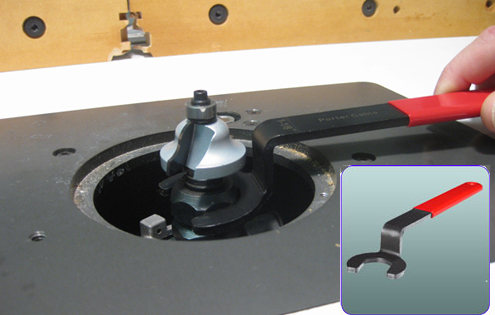
tighten that bit

Also, just be sure to snug the bit up until it’s hand tight. If you have to crank down on the collet to get it to tighten up, you are looking at a replacement,, and you are making bit removal a nightmare later.

While they aren’t the prettiest or highest-tech part of the router bit, treating their shanks with some respect will keep your cuts true things of beauty.


 

Quick Poll

In most shops, there are remote corners of your shop where little takes place. You know, you might chuck a few seldom-used tools there, or pile your lumber into there that you are reserving for future projects.

Me at my old workbench

That’s nice to have. But, there is also that one area that is just mission-critical to your woodworking. Maybe it’s your workbench. Maybe a table saw or a band saw.  Maybe a multi-function router table.  Whatever it is, it’s the area frequently referred to as the heart of the shop.

In this week’s poll, let us know what that area is in your shop.


Link of the week

The Toolstore Blog

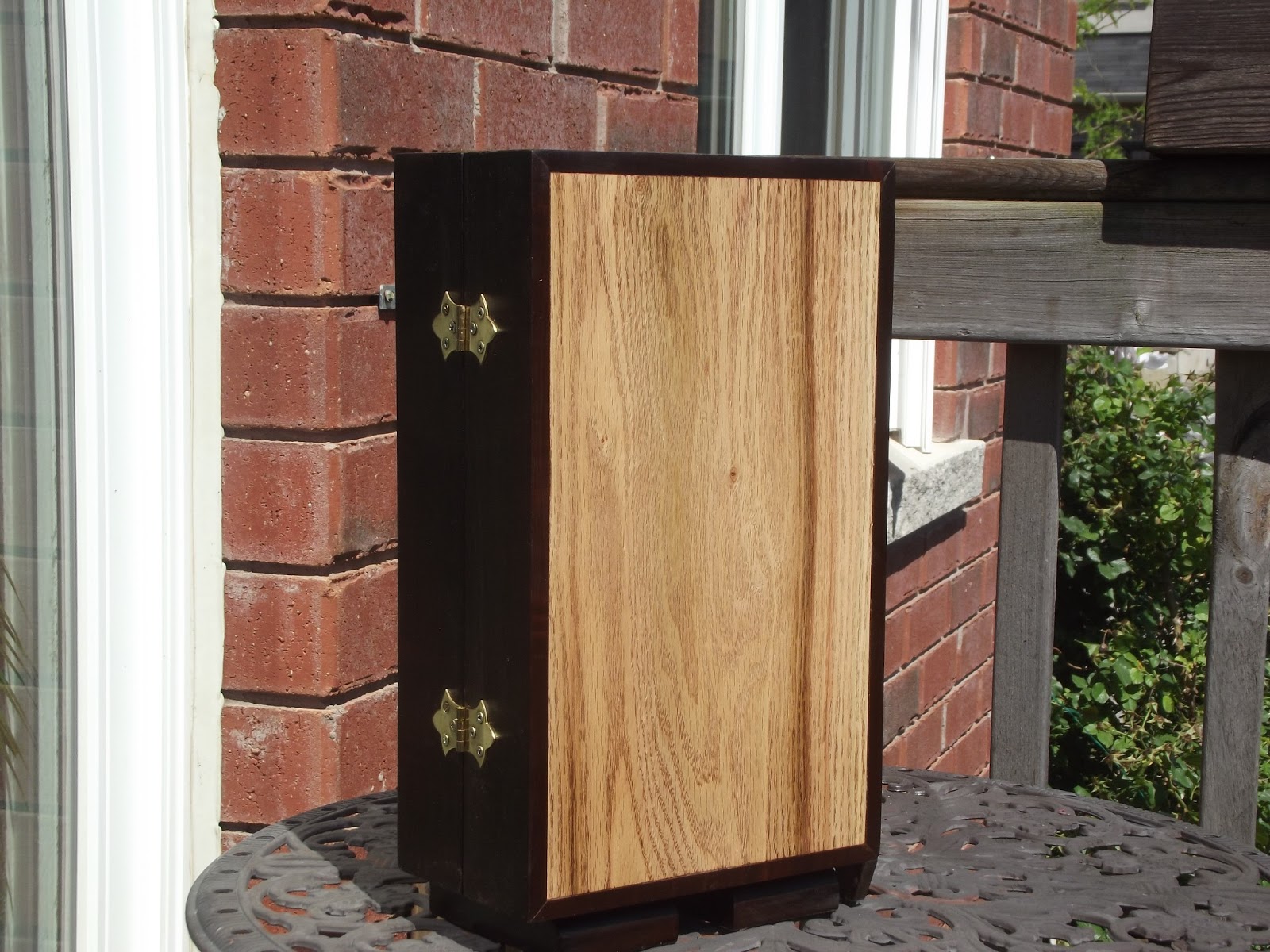
North of the Canadian/U.S. border, Ian Waltenberry is running a blog attached to the Tool Store of Canada.  While he does reviews of the tools offered on the site, the strength of his blog is the incredible number and the skill of the projects he’s building.

A jewelry box

The blog is a nice balance of projects, reviews and techniques – a great place to spend a few hours and get some ideas for your shop.


Back where we started

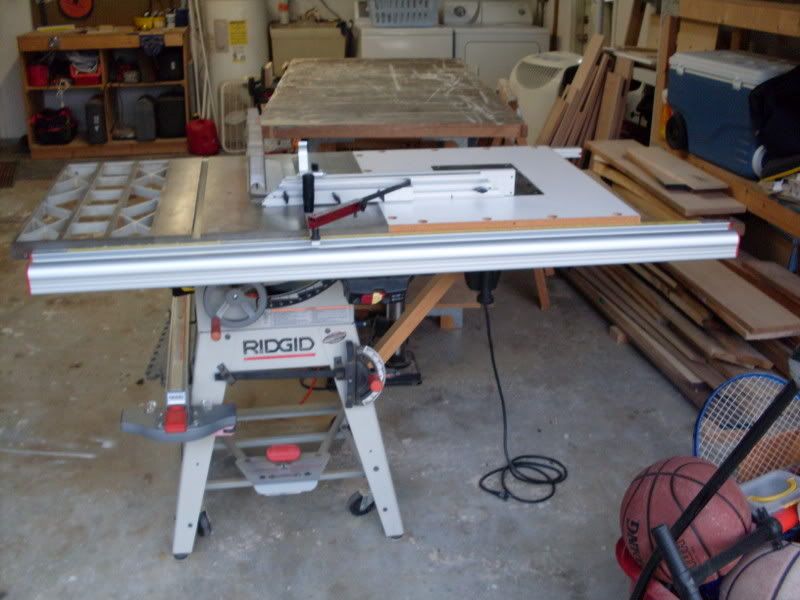
I bought my current table saw back in 2001 – April, I believe. When I got my hands on it, wow, it was just love at first flip of the switch. The thing surged to life – a whole lot more quietly than the universal drive benchtop table saw I used to have. That baby was a dream.

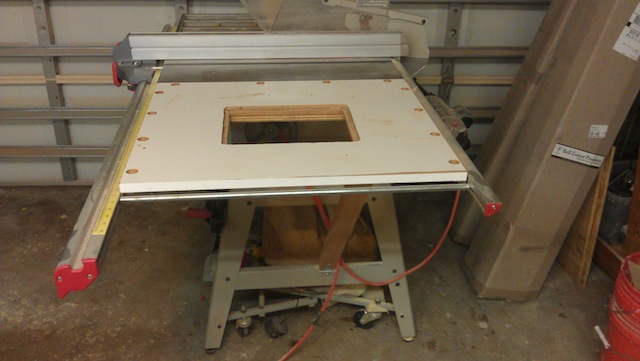
The table saw with the wing mounted router table

And, after a short while, I had heard that I could add a router table to one of the wings of the saw to open up some space in the shop. I was sold!  So, I cobbled together a little something – a sheet of melamine covered particle board, some bolts, a little bit of aluminum angle and I had myself a plan. So, I took out the right most extension wing and put my shop-made model in there. And it was good.

That’s when the one shortfall of this plan hit me. If I had to use both the router and the table saw – for something like shaping some molding on an oversized piece of wood and cutting the molding free – I had to move the rip fence between acts. Which meant I was never going to get my measurements exactly right. And, once the folks at Infinity Cutting Tools set me up with a new router table, well, this wing-mounted router table was unnecessary.

Fortunately, I had saved the original cast iron wing (even though I hadn’t saved the original bolts…), so all I had to do was break out the owner’s manual, buy some new bolts, washers and lock nuts and hook everything up again.

IMAG0318

Getting to the table was going to be easy. The saw rolls nicely on the caster system, so I was able to spin it around to get lots of well-lit working space.  As you can see, it fits between the front and back rails, and has a diagonal brace to help support the weight of the router, table and work on it. The brace was going to have to go first.

The support

Since I had no earthly idea how I was going to get a diagonal brace into the space, I mounted it with a pair of T-hinges between the stand and a support block I had glued to the bottom side of the table with epoxy. Sure, it’s probably not the best idea, but it worked for nearly a decade.  That was just a simple matter of unbolting it from the stand and unscrewing from the bottom of the support block.

The steel bar glints beside the table

From there, I had to remove a round steel spreader bar that adds support to the rails. This was easy to do with an allen wrench. I was very careful to not lose the clips that held the bar in the tracks of the front and back fences.  Then, it was a simple job to unbolt the carriage bolts that held the table to the rails and the table to the saw, and slide the whole assembly off the rails. It took a little jiggling, but it worked.

While I was in there, I took the opportunity to replace a broken wire tie that allowed the power and motor cables to hang loose in the back of the saw. A wire zip tie was all that was required.  I also gave the retaining screws on the two hand wheels a quick turn to tighten them while I was there. I then installed the bolts into the wing and slid the assembly into the rails until it was snug to the saw’s body.

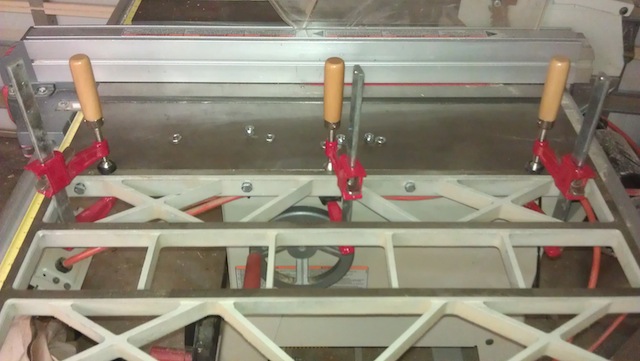
Clamped into place

The instructions in the manual said to use a set of clamps to hold the wing flush to the saw table, which I did. I put the lock nuts on the back of the bolts and tightened everything into place. This was much easier than I had imagined. I slid the steel spreader bar into place and put the end caps back on the front and back rail. There, good as new…

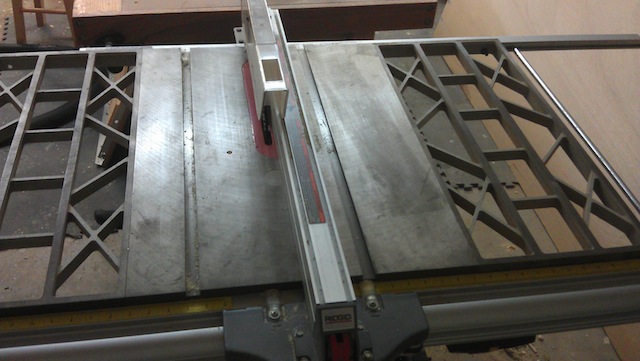
The wing, back like before

While I was down there, I noticed that the velcro strip for the  canvas dust collector bag I had put on the saw failed to hold in the dusty environment. I am thinking about finding a new way to hold that bag onto the saw to help contain the dust it generates. But, that’s another post for an other day…


Quick Poll

Regrets. I’ve had a few, but then again, too few to mention…

Francis Albert Sinatra...

Right. You can tell that Sinatra was not a woodworker. I know, because I have a bunch of tools in my shop that I regret buying. Whether it was the spring-loaded corner chisel thingamabob that Norm used all the time, or the Freud router with the proprietary base that I can’t use standard guide bushings on, I have my share of mutts out the shop that should have never gotten there in the first place.

For today’s poll, give us an idea of how many tool purchases you have regretted over the years. Maybe you are batting 1.000 and have never picked up a dog, or you should start consulting with more seasoned tool purchasers to ensure you get usable items, we want to know. And, if you have a great story about some tool that you regret with your entire being, be sure to put that into the comments. We would love to commiserate with you…


Link of the week

Chief Woodworking’s wood movement page

As I had written on Wednesday, I am building a trophy case for a friend’s daughter. They live in parched Yuma, Arizona, while my shop is here in soggy Tampa, Florida.  So, how much will the boards in my project shrink when it arrives at its new environment?

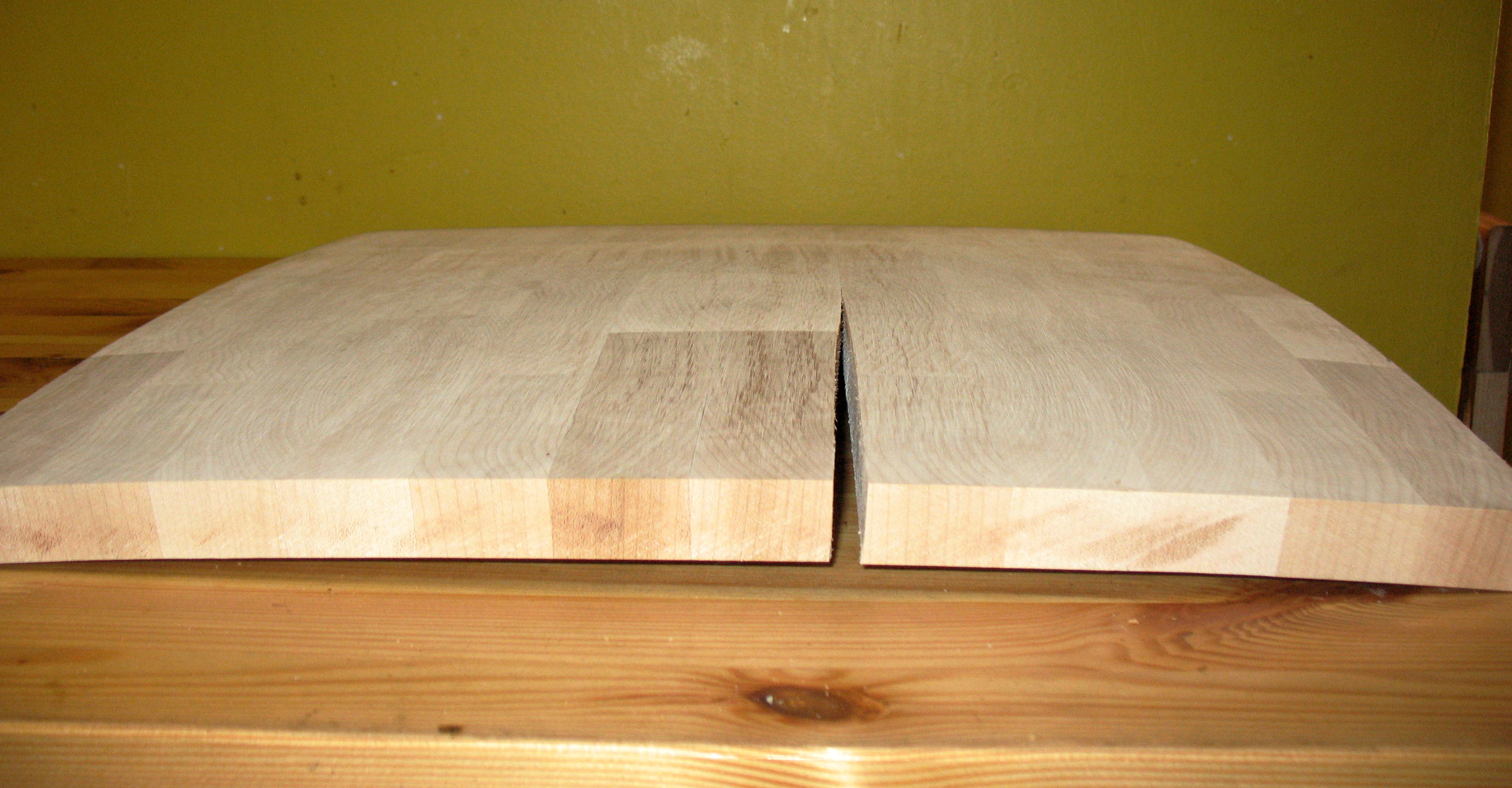
Wood that has moved

Fortunately, there are resources like today’s link of the week that can help. Chief Woodworking’s blog has some interesting information on why wood moves when humidity changes, how different cuts of wood (quartersawn vs. flatsawn) react to these changes and a calculator to determine how much a particular board will move when the humidity changes.

Now, I will be able to stack the deck in my favor. I hope.


part of the Wood Talk Online community