Category Archives: Shop Talk

From D’Oh to Woah…

If I had read James Krenov’s work the Impractical Cabinetmaker when I started woodworking, there’s a very good chance I would be writing about golf right now.

How do I come to this revelation more than a decade into my woodworking hobby?  Easy.  I don’t throw things away when I make mistakes.  In fact, mistakes should be considered opportunities to stretch your skills.

When I first read Krenov’s master work, the one thing that really stuck with me was his passion for perfection.  Krenov lavishes time on the board selections, the stock preparation, the jonery and the finishing, and he encourages other woodworkers to rise to the highest level of craftsmanship.  There’s nothing wrong with that – we should all be working to make our work shine.

Krenov, however, made clear his dislike for mistakes in the workpiece.  He hates them.  He’d rather see you as a woodworker get rid of a piece of wood than continue, trying to repair or undo what you had done.

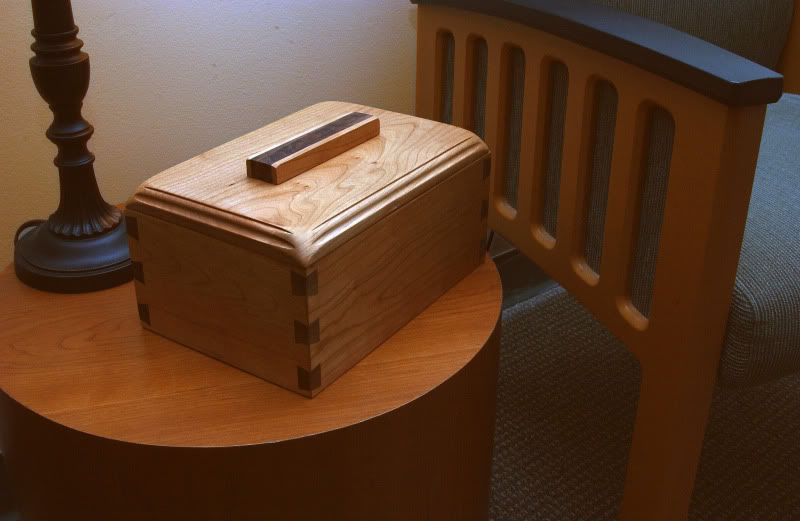
I disagree, because if I didn’t, my scrap bucket would be overflowing with some pretty nice pieces of wood.  Case in point – this is the box I was building a few weekends ago – the one I put the stopwatch on.  It’s a nice little box, and the couple who will receive it will be pretty darned happy to have it on display in their home.

While I could have just documented the extra 40 minutes of work (or six hours of work plus drying time) to put the final touches and finish on the box, there was a much more valuable lesson to be learned when I built the top.

In order to dress up the edges of the top, I decided to route an ogee profile.  A simple yet elegant way to make the top look nicer.  The only problem is that I was routing it with a hand held router, and when I got to one corner, the router wobbled, leaving a gouge in the profile.  Ouch.

According to Krenov, I was looking at a piece of chiminea chow, suitable for use when keeping warm on a cool night.  And, for a few days, that’s all I thought I had.

That was, until I had an idea.

Since I was only working on a piece of junk, I thought I would take a chance, break out the rasp and try to round the corners over.  Just to make them look a little nicer.

At first, I wasn’t sure what I was doing, but after a while, I fell into a rhythm, slowly grinding away the edge profiles.  Then, I turned to a sanding block with 100 grit, then 150 grit sandpaper.  Before long,  I was left with an interesting looking box top with a pretty cool looking design feature.  The lines of the ogee on the edges die into the curved corners, giving a unique and quite handsome look to the box top.

And, to think, I probably would have just chucked the piece and started over again…

In my opinion, it looks so nice that I may try making that profile a signature feature for some of my other upcoming projects.

Funny – all that from what other learned woodworkers would call trash.

On the clock

Spring is here – which means that lots of couples will be saying ‘I do’ as they tie the knot.  Here in Florida, we are no exception to the rule.  Two friends of mine recently sent out their invitations, and – as I am wont to do – I offered to build them a project as their wedding gift.

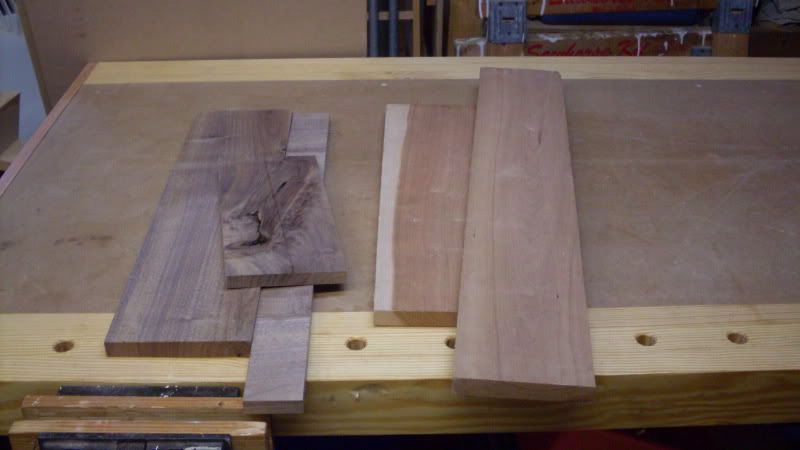
The raw pile of wood for the boxLast weekend, I had a day where I was going to be free to do some intensive woodworking.  To offer a glimpse into my shop habits and the speed of my work, I decided to start a stopwatch in order to time how long it is taking me to build this box. This way, I could measure the amount of elapsed time for each step in the process.

Was I trying to break a record?  Nah… But, this exercise did offer me an interesting glimpse into how long it takes to build and what steps I was doing at each point in the process.

The project is a small cherry box with mitered corners reinforced with dovetail splines.  It will have a lift-off lid and a solid cherry bottom.  Kind of basic, but still a nice piece which will prove to be an interesting project.

Now, I did choose my boards before I started, and I did edge-glue a wide piece of walnut for the splines.  And, the wood I was working with was already surfaced and dimensioned, so that milling step wasn’t necessary, saving time.

Before I started, I made sure that I had the basics:  Radio tuned to favorite station – check.  Refreshing beverage – check.  Eye and hearing protection at the ready – check.  Measuring devices at hand – check.

I started the stopwatch, and kept notes as I went along:

  • 0:00:00 – 0:03:50 – Rip Boards to width. My saw is tuned up, so the cuts came out very smooth with minimal additional work required.
  • 0:04:00 – 0:13:00 – Sweeten boards with a jointer and smoothing plane.
  • 0:13:00 – 0:28:00 – Cut sides to size, cut miter joints on edges of boards with the compound miter saw.
  • 0:17:45 – Ask kids where the shop vac is.  After three choruses of  ‘I don’t know’ my oldest son remembers that it was on the porch and brings it back.  Good boy.
  • 0:18:40 – Ask my oldest son if he knows where the  hose attachments are for the vacuum.  “Oh, I forgot them.”  Brings them to the shop.
  • 0:23:14 – Discover that it’s too warm in the shop I turn on the A/C unit.
  • 0:28:00 – 0:33:00 – Groove sides to receive the bottom.
  • 0:33:00 – 0:40:00 – Discover I had cut the grooves too wide and make a note that I have to make the tongue on the box bottom thicker.  Sweeten up the groove with chisel and router plane.
  • 0:40:00 – 0:56:00 – Carefully cut top and bottom of box.  Mill tongue on bottom.
  • 0:56:00 – 1:11:00 – Wife checks in.  Begins to ask in great detail about upcoming party plans for my youngest son’s First Communion.  Spend 10 minutes discussing the merits  of cubed cheese tray vs. sandwich ring.  Ultimately tell my wife to order whatever she thinks works best. She leaves shop in a huff.  “You don’t care about planning this event!”  Oy….
  • 1:11:00 – 1:25:00 – Regain composure, glue up mitered sides of box.  Clamp assembly.
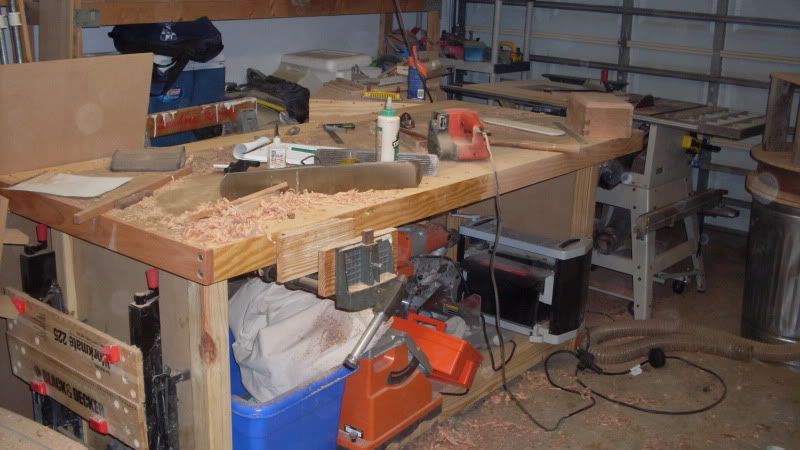
  • 1:25:00 – 1:33:00 – Spend time to clean up work area. Stare dumbfounded at bench wondering just how many tools are pulled out just to get this far…
  • 1:33:00 – 1:50:00 – Mill top elements.
  • 1:50:00 – 2:20:00 – Glue up top and inside ‘plug’ of walnut for lid.  Take immense care to ensure the plug is centered and doesn’t shift when the clamps are installed. Plug shifts anyway.  Minor oaths uttered.
  • 2:12:25 – Wife enters shop wearing bathing suit and informs me she’s bringing the kids to the beach.  “You sure you don’t want to come with us?” Uhhh, I’m  doing a little woodworking.. I’ll pass.  “OK, we’ll give you some time alone in the shop.”  Ahhh, what a woman!
  • 2:26:18 – Wife comes back out to garage to gather beach accouterments.  Asks why A/C unit is on and reminds me of the cost of the power bill.  I nod, distracted. She leaves for beach with boys in tow.
  • 2:20:00 – 2:35:00 – Cut and glue walnut pieces to build walnut ‘legs’ for the box.
  • 2:35:00 – 2:40:00 – Take a break.
  • 2:40:00 – 3:00:00 – Use Kehoe jig to cut dovetail slots in corners of the box.
  • 3:00:00 – 3:25:00 – Cut dovetail splines on table saw and glue splines into slots.  Wonder what I did wrong – this took what seems like just too little time.  Shrug shoulders and continue.
  • 3:25:00 – 3:30:00– Fit lid to box. Tune edge of walnut ‘plug’ with shoulder plane to ensure proper fit.
  • 3:30:00 – 3:45:00 – Edge profile lid with an ogee bit.
  • 3:45:00 – 3:55:00 – Start working on lid handle.
  • 3:55:00 – 4:20:00 – Realize that the shop is now a mess with sawdust and router cuttings all over the floor. Knowing that the no one else would clean this up, I break out the shop vac and start to clean.  Stare in dumb amazement at pile of tools necessary to get to this point.
  • 4:20:35 – Know when to say when. At this point, my feet were getting a little sore and I was getting tired.  I’ve discovered that it’s always a good idea to break for the day – or an extended rest – once I get to this point.  This way, I can prevent goof-ups and – even worse – accidents.
  • 4:26:48 – Crack open beer and relax on couch.

The mess at the end of the day...Sure, the box isn’t done yet.  However, with the wedding set for May 9, I still  have a little over a week to complete.  The remaining tasks include sanding down the dovetail splines to make them flush, working on the box handle, sanding and finishing.

I’ll pick up the count when I get back to the shop!

“Because that’s the way it’s done…”

I  have always had a fascination with writing.  Back in fourth grade, I won a short story contest for my class.  I started writing for the school newspaper in seventh grade.  And, while I was in high school, I routinely took extra credit writing assignments to help boost my grades. Some grades needed more help than others.

Writing provides me a powerful way to express myself and gives me the freedom to be as creative, analytic and persuasive as possible.

Unfortunately, English is beset with several complex rules pulled from Romance, Germanic and other language families. Writing is FUNdamental!I’ve discovered that many of the people who routinely point out when I run afoul of the rules of grammar – also known as the Grammar Police – can barely string together a coherent sentence on their own.  It’s kind of like someone having a mastery of every nuance of a driver’s manual, but routinely getting into traffic accidents and receiving tickets for moving violations.

The one rule that drives me up the wall is the one about NOT ending sentences with a preposition.  I’ve looked through books on the subject, but have yet to find a reason why this rule is enforced so rigorously.

Great writers will routinely ignore this rule – most famously was Sir Winston Churchill.  Once, a clerk returned a memo to Churchill after circling a sentence ending in a preposition.  Showing his disdain – and just how awkward this rule is to apply in writing – Churchill tersely penned a reply and returned it to the clerk – “This is the sort of pedantic nonsense up with which I shall not put.”

What’s the reason why so many Grammar Police point out this ‘mistake’?  Because, somewhere in their education, they had an English teacher who made a big stink about it.  It’s not in a manual or a well-written paper on the matter, but pulled from their personal memories of sweating under the stern glare of their fifth grade grammar instructor.  They will hem and haw for a while, and then say, “Because, that’s the way it’s done…”

In woodworking, many woodworkers fall into the same trap.  As skills are learned from a beloved shop teacher,  a woodworking school or a video produced by a famous woodworker, many of the individual preferences of the instructor are passed along as inviolable rules and regulations to another group of students. Norm Abram

One classic  example of this personal-preference-becoming-law scenario has to do with how Norm Abram instructed woodworkers for more than a decade on the New Yankee Workshop. For many woodworkers, NYW is a bellwether.  If Norm uses a certain tool to perform a certain task, many budding woodworkers will dutifully march down to their home improvement center or woodworking store and plunk down their hard-earned money.  If Norm cuts a joint one particular way, viewers have a tendency to abandon methods that work for them to use the described technique.  And, if Norm uses a particular species of wood for a project, a visit to the Q&A section of the NYW website will show that woodworkers frequently write in for ‘permission’ to use a different species in their iteration of the project.

The one example of how widespread his influence is shows in his method for gluing up panels.  Once Norm got his first biscuit jointer, every single long grain to long grain joint was reinforced with biscuits.  The only exception was if the boards were too thin to accept them. Panel Glue Ups in clamps

It’s well documented in  woodworking magazines and scads of books that the strongest glue joints are those that involve gluing long grain to long grain – what you see running the entire length of a panel glue up.  Tests have routinely shown that the wood will fail before a well-prepared glue joint, regardless of the type of glue being used.

Yet, even knowing these circumstances, woodworkers will dutifully retrieve their biscuit jointers with their clamps and glue before assembling panels.  I did it, and many other woodworkers did, and still do.  Yet, when I ask these folks why they use the biscuits in their joints, few could agree on the reasons why.  “It’s for reinforcement.” “They are for alignment purposes.” “They help the boards resist the effects of cupping and warping.”

The reasons were varied, but more often than not the main explanation was, “That’s how Norm does it.”

Please understand I’m not knocking Norm.  In recent years, he has shied away from using biscuits on his edge joints, and has taken the time to explain why. He’s a very skilled woodworker, an effective communicator and is the first woodworker to use TV to develop a massive following.  So, when every season of NYW rolls around on PBS, fans look to see what new tools, projects and techniques are being rolled out.

What I love most about woodworking is that there are many ways to get from a stack of dead tree flesh to an heirloom project.  While someone with the influence of a Norm Abram may use a table saw to cut a dado, you will also see Roy Underhill use a plow plane, Pat Warner grab his router or a woodworker from down the street use a totally different tool or technique. There is no one ‘right’ way to arrive at your goal.

What I encourage all of you to do is try several methods when you need to build a project.  Take the time to explore you options, evaluate what tools you already have on hand and determine the method that works best for you.  That’s where the real discovery of woodworking lies, and it’s easily within your grasp.

Tonight’s homework – I want a 500 word essay on sawdust and the best way to remove it from your carpet before your spouse goes ballistic.

Class dismissed.

It’s not personal. It’s strictly business.

The GodfatherDon Vito Corleone lay in a hospital bed clinging dearly to life after an attempt on his life by the the Turk, Sollozzo.  Vito’s son, Santino, paced angrily, demanding vengeance for this act. Family Consigliare Tom Hagen urged patience, asking Santino to get control of his anger.

Finally, after much heated debate, the Don’s youngest son Michael spoke up.  Someone who had been formerly shielded from the family ‘business’, Michael offers to take matters into his hands and ‘take care’ of Sollozzo.  When asked by Santino if this was in response to being slapped around by a crooked cop on Sollozzo’s payroll, Michael responded by saying, “It’s not personal, Sonny. It’s strictly business.”

Of course, I am referring to one of the most remembered scenes of was has been argued to be one of the greatest movies of all time, The Godfather.

Now, what does this have to do with woodworking – besides all of that gorgeous dark woodworking and paneling found in Don Vito’s office?

The Woodworkers Guide to Pricing Your WorkWell, plenty.  This scene flashed into my mind several times while I was reading Dan Ramsey’s book The Woodworker’s Guide to Pricing Your Work.  Dan’s book goes into great detail about how to figure your shop costs, how to track your expenses and how to increase your profits. By following the recommendations in  his book, you can learn how to turn your hobby into a paying business that can let you buy new tools, enjoy some extra night life or even quit your job.

The book is extremely clinical and unimpassioned.  This is a very good thing, because running a business needs to be looked at in the cold light of reason and analysis. By getting emotionally involved in the process, you might make bad decisions which can derail your success.

But, I don’t think Dan addressed one of the most important aspects of running a woodworking business – pulling yourself out of the work. Let me explain…

When I build woodworking projects, I typically build for one of  three ‘audiences’.  First, there’s me and my family.  Projects such as the draw leaf table, entertainment center or my kitchen’s pantry were built with a specific purpose in mind – to fill a particular need.  Our family needed a place to sit and eat dinner.  Bam. And, it was built. The only person who has to be made happy is my wife – and she’s pretty understanding.

The other purpose I build for are items to be given as a gift.  Small gift crosses, desktop boxes and cradles have all progressed out of my shop to the hands of grateful recipients.  These too are easy to make and give, because the recipient of such a gift of time and effort always appreciated.

But, the third and most challenging purpose are items built for sale.  Whether a commission for a customer or a piece built on spec and later sold, this is where things get a little dicey.  After all, you are building something in exchange for cash or some other commodity (Hey, Bob, you are plumber… how about I build you something in exchange for installing my sink…), and these folks can make things a bit more difficult.
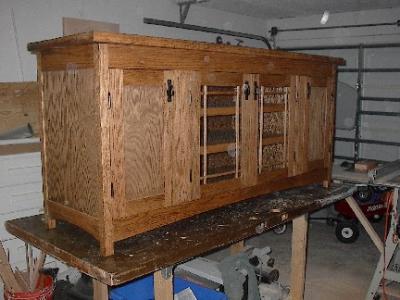
My first major sale - the entertainment credenzaSo far, I have lucked out.  The people who have bought my stuff have appreciated the value of hand-crafted work and have trusted me to do what I do best.

I have also heard about nightmare clients.  People who change their minds on wood stain color after the piece is already stained.  People who ask if the size or the complexity of the piece can be changed after materials are purchased and work has started.  And, people who will carefully examine every detail of the final piece looking for what they consider major flaws in order to haggle down the agreed price.

That might make you uncomfortable.  After all, haven’t you poured your time and creativity into the project?  Didn’t you agonize over grain matching and panel colors?  Isn’t it your baby?  HOW DARE THOSE PEOPLE!

Deep breath.  Have a cannoli. Serenity now….

Hey, to each or her own.  And, if this is how folks like this want to conduct business… well, that says something about them.

However, as a woodworker selling your products, you have to remember the line delivered by Michael Corleone in the Don’s office… it’s only business.  Nothing personal.  Even though you’d like to roll your eyes and call your client an idiot, you have to fight the urge and realize that you are conducting a business transaction.

Some of the things I know professional woodworkers do to help prevent issues with their clients is to first spell out the agreement in some form of a contract.  No, you don’t have to hire an attorney, but even a letter noting the date construction will commence, approximately how long the project will take, which key milestones you will have contact with the client, the payment schedule (half down on agreement, the other half on delivery) and the final price of the piece.

Another way to prevent issues with your client is to show scale drawings or computer renderings so the client will understand what the finished piece will look like.  This is a great time to get feedback before construction starts and materials are purchased.

Showing sample boards with finish examples will certainly go a long way toward showing the client what the finished product will be, as well as demonstrating your finishing skills.

Finally, and most importantly, it’s important to stick to your deadlines, communicate with your clients and deliver the best product you can. By taking these simple steps, you can make the entire experience a pleasant one for everyone.

While slight mistakes are almost inevitable in large projects, your pride in craftsmanship will always come through.  Someone who is coming to you and not headed to a large box mega-retailer is especially sensitive and appreciative of quality personalized craftsmanship.  Besides, aren’t those ‘mistakes’ really design features?

And remember, once they get hooked on your work, you’ll then be able to make them an offer they can’t refuse – to build more stuff!

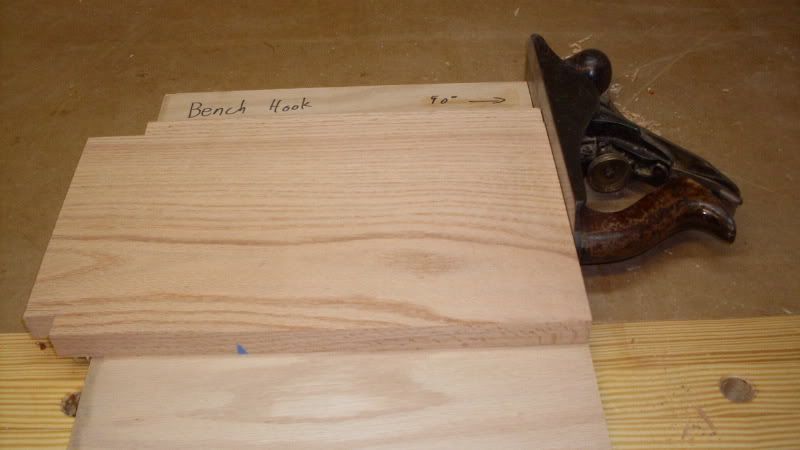
Great jigs: the bench hook

I love jigs – they make your tool collection work faster, more efficiently and with a much greater versatility.

And, there are very few jigs as useful – and as easy to use – as the bench hook.

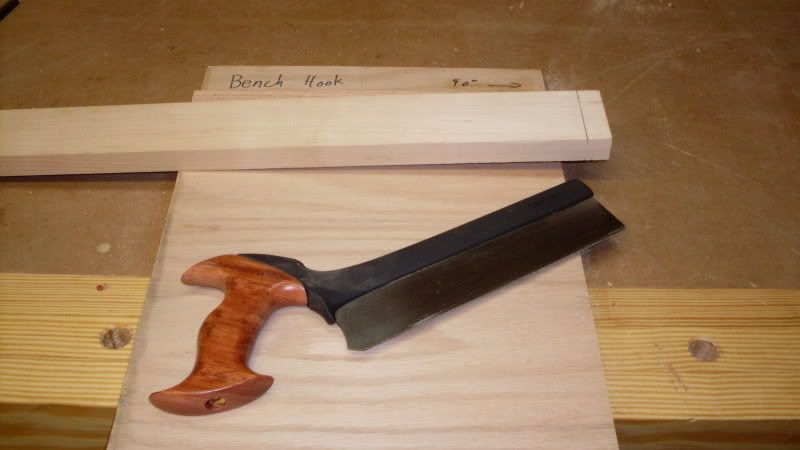
Yes, it’s a very classic, old-fashioned style jig, and it works primarily with hand tools – saws and hand planes.  It makes many different shop tasks much easier and more effective.  And, it’s insanely easy to build.

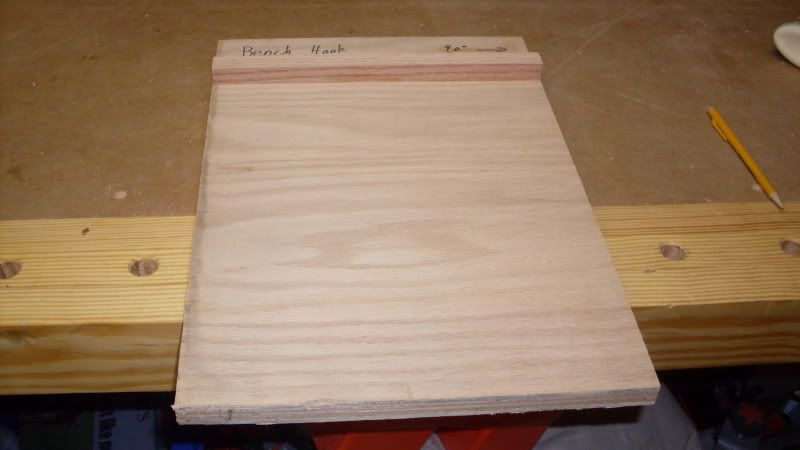
I built mine out of a piece of 3/4″ plywood – a piece about 12″ by 20″.  It was a leftover piece of very high quality red oak veneer plywood from a previous project, trimmed perfectly square. There are also two sticks cut from larger pieces of a red oak board – 3/4″ square.

First of all, you want to glue and brad a piece of the board perpendicular to a square edge of the plywood.  It’s OK to let this piece run long.  Flip the board over and drive three or four screws into the piece from below to add more support for the piece.  Once it’s secured, take the piece of plywood and the attached stick to your table saw and trim the stick flush with the edge of the plywood.  For righties, make sure to trim flush on the right side, lefties need to make sure it’s flush on the left.

The next step is to glue and brad another piece of wood on the bottom of the plywood on the opposite edge.  This piece should be a little shorter than the width of the plywood, but still installed perpendicular to the edge of the plywood.  This piece becomes the stop which will rest on the edge of the bench.

That’s it.  No. Really. You can stop there.

Now, how do you use the bench hook?  Well, it’s a piece of cake.  First, if you are going to cut small pieces of wood or do some hand cut joinery – such as hand cutting a tenon, you can simply brace the piece against the fence and cut away.  This is a far easier way to cut than by securing the piece in a vise, cutting, releasing the vise, repositioning the work, tightening down the vise and doing it all over again.

Another neat use for the bench hook is to use it as a shooting board.  If you want to sweeten up a joint, use a shoulder plane to trim a tenon’s width or ensure a board it cut squarely, you can brace the piece against the stop and plane.  Pushing the plane to trim the work again pushes the work into the stop, making it secure without having to fix it into a vise.

Road Trip Woodworking: Austin, Texas

Hurricane FlagsIt may seem tough to believe, but I actually have two consuming passions in my life.  (Well, three if you count my wife – I don’t think she’d ever forgive me for NOT counting her on the list!)

National Hurricane Center Director Bill Read at the National Hurricane ConferenceWoodworking is of course one of my favorite things.  The other is the weather – especially hurricanes.  That’s why my office sent me to the National Hurricane Conference taking place this week at the Austin Convention Center.
All day during the conference, I’ve been learning about hurricanes – how they form, how they are tracked and how people can get ready for them.  I’ve also been doing some teaching about how to communicate the risk to their residents about the threat posed by these storms.

That’s been a great way to spend the day.  However, at night, I’ve been staying at a good friend’s home just outside of the city.  And, he’s a woodworker.

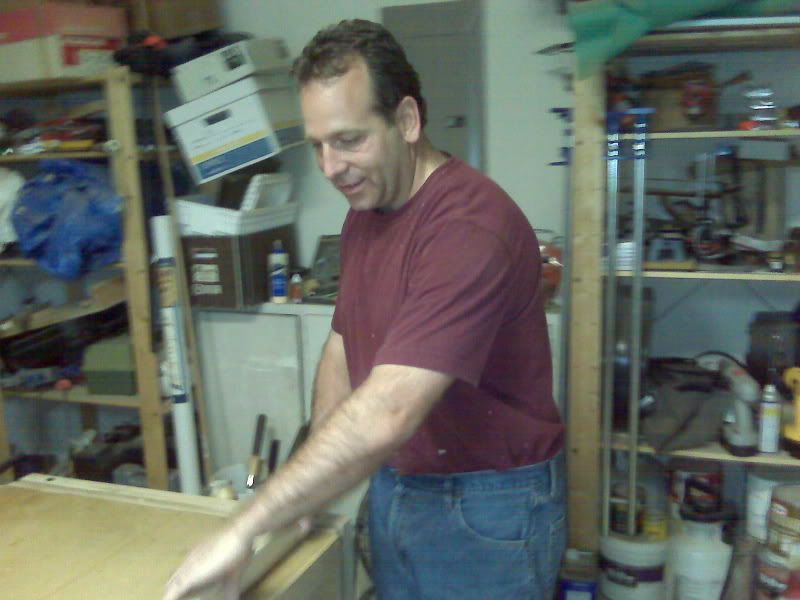
Craig Andrews in his shopI met Craig Andrews while at a woodworking school up in Indiana.  We have kept in touch, and he is hosting me at his house.  Besides the great Tex-Mex food, we’ve been doing a little work in his shop.
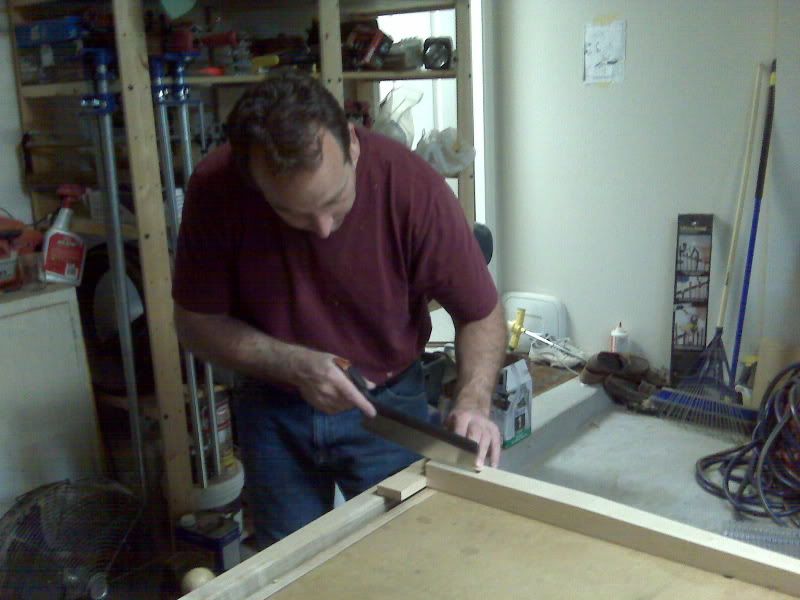
Craig, as with many other woodworkers, works out of his garage.  He has many of the standard tools you would expect to find in a typical shop – a Delta contractor’s table saw, a band saw, drill press and other power tools.  He is also an avid hand tool collector and has become highly skilled in their use.  His shelves have more than their fair share of Veritas and Lie-Nielsen planes tuned to perfection.

Craig cutting a groove for a haunched tenonBefore the trip, Craig promised me that he would show me a technique he picked up  on how to hand cut a haunched tenon.  Armed with a Veritas dovetail saw, a few chisels and some hand planes, we made a sample tenon to fit into a pre-milled mortise. Since all I had was the camera on my cell phone, I couldn’t get good shots.  However, I will write that technique up once I get back to my shop.

I also built him a bench hook for his planing and sawing chores.  Since he does so much hand tool work, it was something that’s going to make his efforts easier and more effective.

We worked at his bench until late in the night and had a great time making sawdust and swapping tall woodworking tales.

The best part about the entire trip is that I got to learn a lot more about weather and woodworking all at the same time.  And, a two-for-one is always a good thing.

Lemme Draw you a picture

A Shaker Style Chest of DrawersTalk to most beginning woodworkers about what gives them the most anxiety, and you might be surprised to hear that it’s not buying tools, planning projects or even tackling necessary joints such as the Mortise and Tenon…
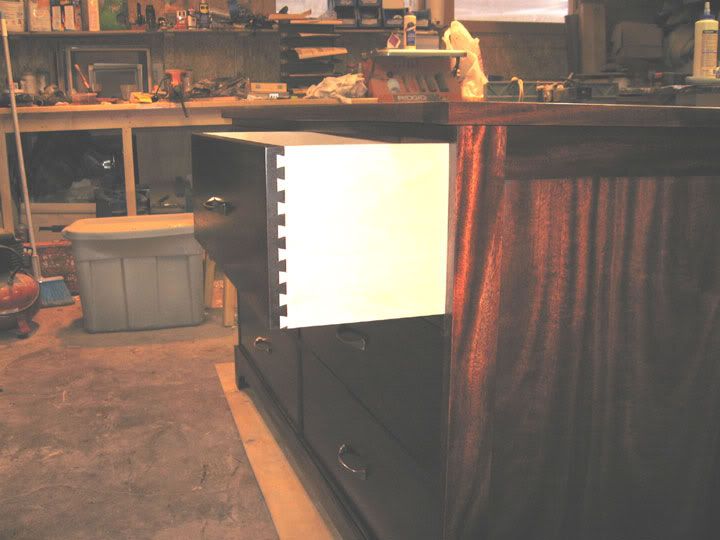
It’s building drawers.

As amazing as it may sound, drawers have this ability to freeze a woodworker in his or her tracks.  However, when you consider that a drawer is just a box inside a box, building drawers can actually be one of the easier parts of building a cabinet.

There are some things you do have to consider when building a drawer.  First of all, it should be truly square to fit inside the case and operate smoothly, so proper assembly is a key.

A beautifully dovetailed drawerSecondly, drawers are also exposed to tremendous pulling forces on the front corners.  Consider that a drawer may be opened tens of thousands of times in its lifetime, and, if it’s like the drawers in the dressers in my kids’ rooms, those drawers may be jammed full of clothes and have to be forced open.

Finally, drawers aren’t just functional pieces.  Many times, they add to the overall look of the piece, so making them tough and beautiful is important.

Drawer Lock JointAs far as materials go for drawer construction, few things are as useful as 1/2″ cabinet grade plywood.  This stuff is easy to work with, very stable and strong. You can also either edge band or install a piece of solid wood on the top edges to hid the plies in the plywood if you wish.

Materials such as melamine coated particleboard are also stable and easy to clean, but I have seen my share of particleboard sided drawers fall apart if abused and exposed to water… something that can happen in bathrooms and kitchens.

Solid wood drawers are stunning and allow the widest variety of drawer joinery methods, and are excellent choices for furniture projects.  Frequently, a ‘secondary wood’ such as poplar, pine, alder or red oak will be used to make the drawer sides, saving the prized cherry, maple, walnut or other exotic wood for the visible outside of the case.

doweled drawer sidesThe joinery methods which connect the back of the drawer to the sides are very easy – these joints don’t normally take much abuse.  So, setting the drawer back into a dado with some glue and bradding it into place should do the trick.  Pocket screws can also work.  Dovetailing or fancier joints can be done for drawer backs, but it would be considered overkill unless the drawer opens both sides of the case (a push through drawer) or it’s done for aesthetic reasons.

Drawer front joinery is where the challenges lie, and there are many different methods for joining them.  While not all joints will work in every situation, each can play a role in drawer construction.

  • Reinforced butt/rabbet  joints – Simply butting the sides to the front by gluing and bradding or screwing the sides to the front can work for light-duty drawers and utility models out in a work shop.  While they may work for a while, over time it’s unlikely that the drawer will hold together well.  With that being said, I have used pocket screws to join the sides of some pantry drawers from solid red oak in a project I built six years ago, and they are still holding together well even with tough use.
  • Wooden-fastener aided joints – Dowels and biscuits can  be very useful in constructing drawer front joints because they are set into place through the two boards with modern glues, which tends to anchor them in place and allows the forces to focus on a larger surface than can be provided with a brad.  In fact, cabinet makers will frequently use contrasting wood through dowels or the Miller Dowel system to give a stylish appearance and plenty of strength.
  • Locking dado/groove joints – By cutting a series of dadoes or rabbets into the front and sides of the drawer, you can create an interlocking joint with a table saw or with a router equipped with a straight or drawer lock type bit.  These joints can be mass produced, making cutting a bank of drawers a piece of cake.  Of course, you want to be as accurate in your setups as possible, but, once the heights are set, it’s off to the races.  Sliding dovetails also fall into this category.  They are really slick joints, but they can be kind of finicky to use in drawer joinery.
  • Interlocking joints – Through dovetails, half blind dovetails, and box or finger joints have set the standard for drawer front joinery for centuries.  While finger and box joints can be outstanding for this kind of application – especially with today’s modern adhesives, the dovetail joint’s mechanical interlock ensures that little short of a stick of dynamite will cause the joints to fail.  These joints are often seen as the true sign of quality, but they may be overkill for smaller drawers and against other capable joints.

An applied drawer frontBy the way, if you don’t have a dovetail jig capable of cutting half-blind dovetails, or you don’t want to learn how to master cutting these joints, all isn’t lost.  By cutting through dovetails with a jig or by hand – or cutting dovetail splines as with a Kehoe jig – and attaching a ‘false’ or ‘added’ drawer front, you gain the appearance of a half-blind dovetail joint and you can stretch your supply of good project wood by resawing thicker boards down to a thinner size.  I prefer this method, because it also allows me to get the drawer face absolutely centered in the project opening.

Drawer bottoms can be made out of plywood, some other sheet good or solid wood.  You can simply route grooves into the insides of the four box sides with a router, dado blade or with multiple passes on a regular table saw blade.  Just be careful about having the dado on the drawer front hidden when the drawer is assembled…  you can plan to have it fall where a socket will fall if using dovetails or box joints, or by having the drawer sides extend to the front of the drawer box for other kinds of drawers.

I prefer 1/2″ plywood for drawer bottoms, and I will rabbet it to fit into a slightly undersized dado (3/8″ seems to work well) to get a tight no-slop fit.  This is unless the drawer is going to be small and not carrying a lot of weight.  Then, I’ll choose 1/4″ plywood.

Solid wood drawer bottoms are a very classic touch, but you have to remember to allow for seasonal wood expansion and contraction – so don’t glue the bottom into the box.  A squirt of glue in the middle of the drawer front dado and a screw to secure the bottom to the back of the drawer should be sufficient.  You can build these drawer bottoms like a raised panel door if  you want to give the drawer bottom a little more mass and not have to create an extra wide dado in the sides.


Drawer Construction schematic
One easy way to install drawer bottoms is to cut the dado only into the front and two sides of the drawer box.  Make your drawer back the same height as the top of the drawer sides to the top of the dado.  This way, you can slip the drawer bottom into place past the drawer back and secure it to the bottom of the drawer back.  By building this way, you can replace the drawer bottom easily should something happen to it, instead of having to pull the entire drawer apart if you captured all four sides of the bottom.

Armed with a little bit of knowledge and some confidence, if you haven’t yet tried building drawers for your projects, now’s a good time to give it a shot.