It costs money to woodwork. Buying new tools, bits, blades, sandpaper, wood, hardware… well, it all adds up.
This week’s quick poll deals with how you handle the finances of woodworking. Do you use the general family funds? Have you set up a separate account for woodworking? Do you keep a mason jar full of cash buried in the back yard?
For professional woodworkers, it’s the way they keep food on the table and a roof over their heads. For amateurs, it’s a sign that they have arrived as respected crafts person.
Yes, selling your work is a big step to take. Whether you are building pieces on spec to be sold at a craft show or you are building on a commission or contract for a particular customer, there’s nothing quite like the thrill of the exchange of money for a completed woodworking project.
Now, given the current economic climate, it may have been a while since you have sold a piece, but we’re looking to see if you have ever sold one of your creations.
This week, we want to know if you have ever sold a piece of your work and what the experience was like for you.
However, everyone has a breaking point – some point at which they could be convinced to give up something – even something as beloved as the craft of woodworking.
Imagine if you will, a multi-gazillionaire were to come to your town to make you an offer to give up the craft. Cold turkey. A truck and a group of workmen would be dispatched to clear your shop of all of your tools and prized timbers, and, once completed, you would get a briefcase full of cash to use as you wish.
With one caveat. A big one.
The terms of this agreement would be severe – absolutely no woodworking at all. If you were to even read a woodworking magazine, participate in an online woodworking forum, even touch a piece of wood that you intended to cut, shape or drill – you would have to surrender the money and everything you bought with it.
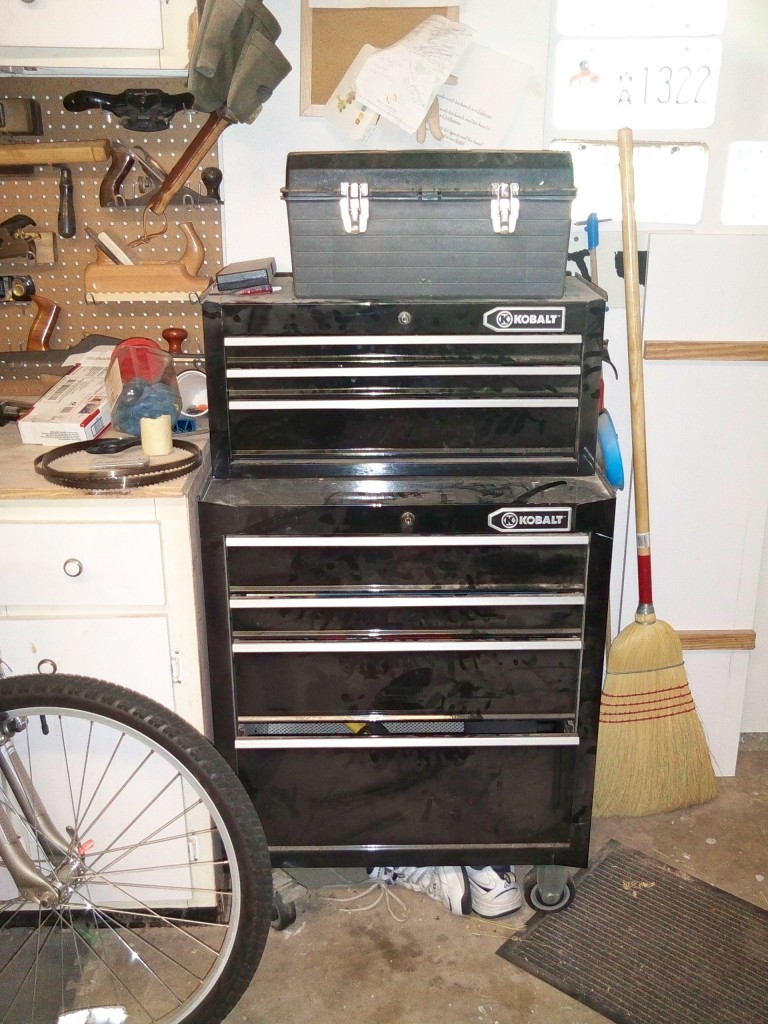
I can remember is clearly. The day I bought my rolling tool chest to store my woodworking tools, this one guy came over to me in the store. He told me, “there is no way I would ever put woodworking tools into something like that. I would spend more time looking for the darned things instead of using them. I keep them out on shelves so I know what I have.”
Free advice from a stranger in a home improvement store is often worth the price you pay for it. But, this guy’s rant did come back to me recently as I was putting my tools away in my tool chest. For me, I would much rather have my tools stored away out of sight. The reason? When I am done with a certain part of a project (say, using a caliper to measure the thickness of wood as it comes off the planer), I want to put that tool away and not see it. Too much visual clutter if things are out and messy. Puts me off my game.
So, this week’s poll – how do you like to store your tools? Do you keep them where you can see them easily, or do you store them in enclosed storage to keep them out of the line of sight? Does it even matter?
BTW – today is post number 990! I’ll keep the countdown clock running as we close in on post 1,000.
Getting started in woodworking is a tricky business. One typical route people enter woodworking is through home improvement… and many prospective woodworkers come to the table with your basic tools – a circular saw, a drill, screwdrivers – you know, those homeowner essentials.
From there, wisely adding to the tool collection is the best way to get your feet under you.
In many cases, budding woodworkers will turn to a more experienced woodworker for that advice, and the most commonly asked questions is, “What should I buy first?”
So, this week, what would you tell that new woodworker? What should be the first tool they set their shops up around?
Power tools are awesome. They make so many tasks in the shop faster and easier. From ripping boards to boring holes, there’s one to suit your needs.
However, they can cost quite a bit. There are off brands and cheaper models, but for high-end power tools, prepare to pry open your wallet to pay…
That is, of course, unless you buy a factory reconditioned tool. These reconditioned tools are typically ones that are sold to a customer but returned because of some defect. They are returned to the factory, rebuilt to specs and sold again. You might be able to score a decent tool for a discount price.
However, there are some woodworkers who have had bad experiences with reconditioned tool.
This week, let us know if you have every bought a reconditioned tool and how it worked for you.
OK, maybe they aren’t the most accurate of measuring devices. And, in many cases, getting an absolute relative measurement for a part you need to cut is far superior.
But, you can’t deny that a tape measure is a handy tool to have in a shop!
Just like potato chips, though, it seems like you can never have just one. This week, let us know just how many of these handy measuring devices you have in your shop.